
A hill town in the Quiet Corner, once Windham Village and Canada Parish, where one tree-lined street runs the length of Hampton Hill past a meetinghouse of 1754 and a house the women raised during the Revolution.
Hampton on the map
Click the map to look closer.
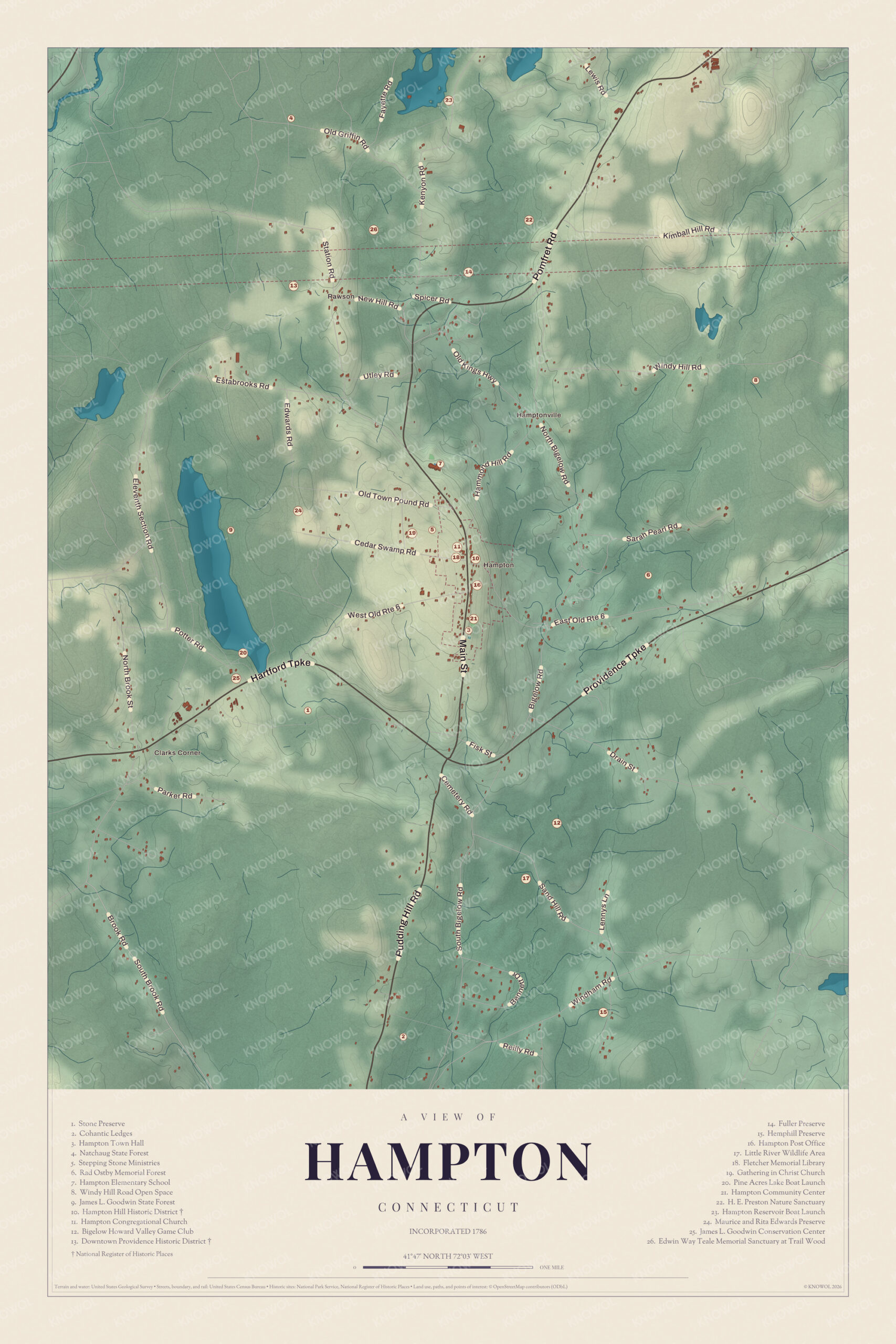
Hampton today
By KNOWOL
Shaded hills from Clarks Corner and the village on Hampton Hill down to the Little River valley, with Hampton Reservoir, Pine Acres Lake and a guide of 26 numbered landmarks with the National Register sites marked.5
The story of Hampton
The house the women raised
During the Revolution, with Hampton's men away in the Continental Army, a carpenter framed a house for a young soldier and his bride. Then there weren't enough able-bodied men left in town to raise it. A 1920 county history tells what happened next. Sally Bowers, the bride-to-be, asked the women of the town for help, and with their united strength the frame went up. A 1906 magazine found the house still standing in plain view of Hampton Hill, with twelve low rooms, cross-beamed ceilings, dark halls, a huge fireplace at its center and a big maple spreading over it. Sarah Hammond Mosely, who lived to a great age, used to tell the story of that day, and people in Hampton still remembered hearing it from her.167
Lying Ben, the blacksmith and the doctor's car
Hampton's old books are full of characters. Benjamin Fuller, a farmer who died in 1840, was a hunter and a joker, and no one in town could tell a better story, so his neighbors called him Lying Ben. A blacksmith named Fuller hung out his own horseshoe on credit, outlasted rivals who boasted they'd soon nail him, and was the leading smith in town for thirty-five years. He liked to tell how he once shod 173 oxen in a single winter. Old Doctor Hughes charged 12 and a half or 25 cents a visit. By 1902 Doctor Avery charged $2, and he drove the first doctor's automobile in Hampton, a buckboard of a car whose engine sounded like a runaway mowing machine, to the delight of small boys and the terror of horses.839
Windham Village on its fair hilltop
Before it was Hampton it was the second society of Windham, called Canada Parish after its first settler, David Canada or Kennedy, and also Windham Village. Settlers began arriving about 1708, and the church was gathered on June 5, 1723. By 1730 there was a road to Pomfret, a full military company, a tavern kept by Nathaniel Hovey and a first store kept by Benjamin Bidlack. Jeremiah Clark carried the parish's produce to Newport or Providence on horseback. An 1889 history said the village on its fair hilltop was hardly less a power than Windham Green. In 1786 it became the town of Hampton, and at the first town meeting Lieutenant Jacob Preston was elected Leather Sealer. The meetinghouse raised in 1754 still stands on the hill.10211121
Through the years
25 moments from 1708 to today.
- 1708About this year the first settlers come into what will be Hampton.2
- 1717The northern settlers of Windham get their own religious society, known as Canada Parish or Windham Village.13
- 1723The church is gathered on June 5 with 17 members.2
- 1730A full military company is formed, with Nathaniel Kingsbury as captain.11
- 1754A new meetinghouse replaces the first one. It's the church that still stands.2
- 1766The painter John Brewster Jr. is born in Hampton.5
- 1776Sally Bowers and other young women raise a house while the men are away at war.1
- 1786Hampton is incorporated as a town.1
- 1786At the first town meeting, Lieutenant Jacob Preston is elected Leather Sealer.12
- 1803Theodore Dwight Weld, later an abolitionist author, is born in Hampton.1
- 1827The Hampton Library begins. It gives up after about three years and sells its books.14
- 1842Chauncey F. Cleveland of Hampton begins two years as governor of Connecticut.15
- 1843The Burnham Baptist Church builds its meetinghouse in Howard Valley.16
- 1849Jonathan Clark puts up a liberty pole at Clark's Corner, marked with distances to other towns.1
- 1856The library's books are bought back and a new library association is formed.14
- 1862Hampton fills its quota of nine soldiers with volunteers and avoids a draft.17
- 1872The New York and New England Railroad arrives and summer visitors follow.5
- 1877A Roman Catholic church goes up on the crown of Hampton Hill.14
- 1885Little River Grange, No. 36, is organized at George M. Holt's house.14
- 1887Governor Cleveland dies in Hampton on June 6.18
- 1902Doctor Avery brings the first automobile owned by a Hampton physician.9
- 1913James L. Goodwin begins building up the forest that now bears his name.5
- 1959Edwin Way Teale and his wife, Nellie, move to their farm, Trail Wood.5
- 1982The Hampton Hill Historic District is listed on the National Register.19
- 2007The Hemlock Glen mill sites are listed on the National Register.20
Places to see
The numbers match the landmark guide printed on the 2026 map.
- 3Hampton Town HallHampton Hill. In a 1920s former firehouse.
- 4Natchaug State ForestNorth of the village. Big forest joined to Trail Wood.Visit their website
- 9James L. Goodwin State ForestWest of the village. About 2,000 acres with Pine Acres Lake.Visit their website
- 10Hampton Hill Historic DistrictRoute 97. A mile of the old village.
- 11Hampton Congregational ChurchHampton Hill. Parts of it date from 1754.
- 17Little River Wildlife AreaSouth of the village. Along the Little River.
- 18Fletcher Memorial Library257 Main Street. The town library since 1924.Visit their website
- 25James L. Goodwin Conservation CenterPine Acres Lake. Wildlife garden and small nature museum.Visit their website
- 26Edwin Way Teale Memorial Sanctuary at Trail WoodNorth of the village. The naturalist's farm, 168 acres.Visit their website
On the National Register
All 2 places in Hampton on the National Register of Historic Places that still stand today, oldest first, and why each one matters.4
-
Hampton Hill Historic District
About a mile of Route 97 laid out as a tree-lined boulevard, with 62 historic buildings, fifteen houses from the 1700s and a tavern of about 1727. Because industry and the railroad passed it by, it survives as a well-preserved 19th century country village.19
-
Hemlock Glen Industrial Archeological District
A row of mill sites on a tributary of the Shetucket River, with a sawmill and gristmill here by 1745 and later shops for pins and silver spoons and a tannery. The gristmill ran until about 1925, and its dam and pond and the dams and foundations of the other mills survive.20
In their words
“One of the beautiful towns of this beautiful rural county is the town of Hampton.”
History of Windham County, Connecticut, 188921
“Windham Village, on its fair hill top, was hardly less a power than Windham Green in the southwest corner.”
History of Windham County, Connecticut, 1889, on the parish before it became Hampton11
“We love each hill and fertile glade, The fairest land that God has made”
Mrs. C. H. N. Thomas, in A modern history of Windham County, 192022
Nearby towns
Sources
- Hampton, Connecticut, Wikipedia
- Connecticut Historical Collections, John Warner Barber (1836), on Hampton, Internet Archive
- Commemorative biographical record of Tolland and Windham counties, Connecticut (1903), on a Hampton blacksmith, Internet Archive
- National Register of Historic Places listings in Windham County, Connecticut, Wikipedia
- Map of Hampton, Connecticut in 2026, KNOWOL (USGS elevation, Census Bureau roads)
- A modern history of Windham County, Connecticut (1920), on the house the women raised, Internet Archive
- The Connecticut magazine (1906), on the house the women built, Internet Archive
- Commemorative biographical record of Tolland and Windham counties, Connecticut (1903), on Benjamin Fuller, Internet Archive
- A modern history of Windham County, Connecticut (1920), on Hampton's doctors, Internet Archive
- A memorial volume of the bi-centennial celebration of the town of Windham, Connecticut (1893), Internet Archive
- History of Windham County, Connecticut (1889), on Windham Village, Internet Archive
- History of Captain Roswell Preston of Hampton, Connecticut (1899), on the first town meeting, Internet Archive
- The historical, statistical and industrial review of the state of Connecticut (1884), on Windham's parishes, Internet Archive
- History of Windham County, Connecticut (1889), on Hampton's churches, library and grange, Internet Archive
- History of Windham County, Connecticut (1889), on Governor Chauncey F. Cleveland, Internet Archive
- A modern history of Windham County, Connecticut (1920), on the Baptists of Howard Valley, Internet Archive
- Genealogical and Family History of the State of Connecticut (1911), on George A. Hammond, Internet Archive
- The governors of Connecticut (1905), on Chauncey F. Cleveland, Internet Archive
- Hampton Hill Historic District, Wikipedia
- Hemlock Glen Industrial Archeological District, Wikipedia
- History of Windham County, Connecticut (1889), on the town of Hampton, Internet Archive
- A modern history of Windham County, Connecticut (1920), poem by Mrs. C. H. N. Thomas, Internet Archive