
A town of three mill villages on the Shetucket, made in 1861 around the Spragues' great cotton mill at Baltic, with the old parish of Hanover to the northeast and Versailles, once Eagleville, downriver.
Sprague on the map
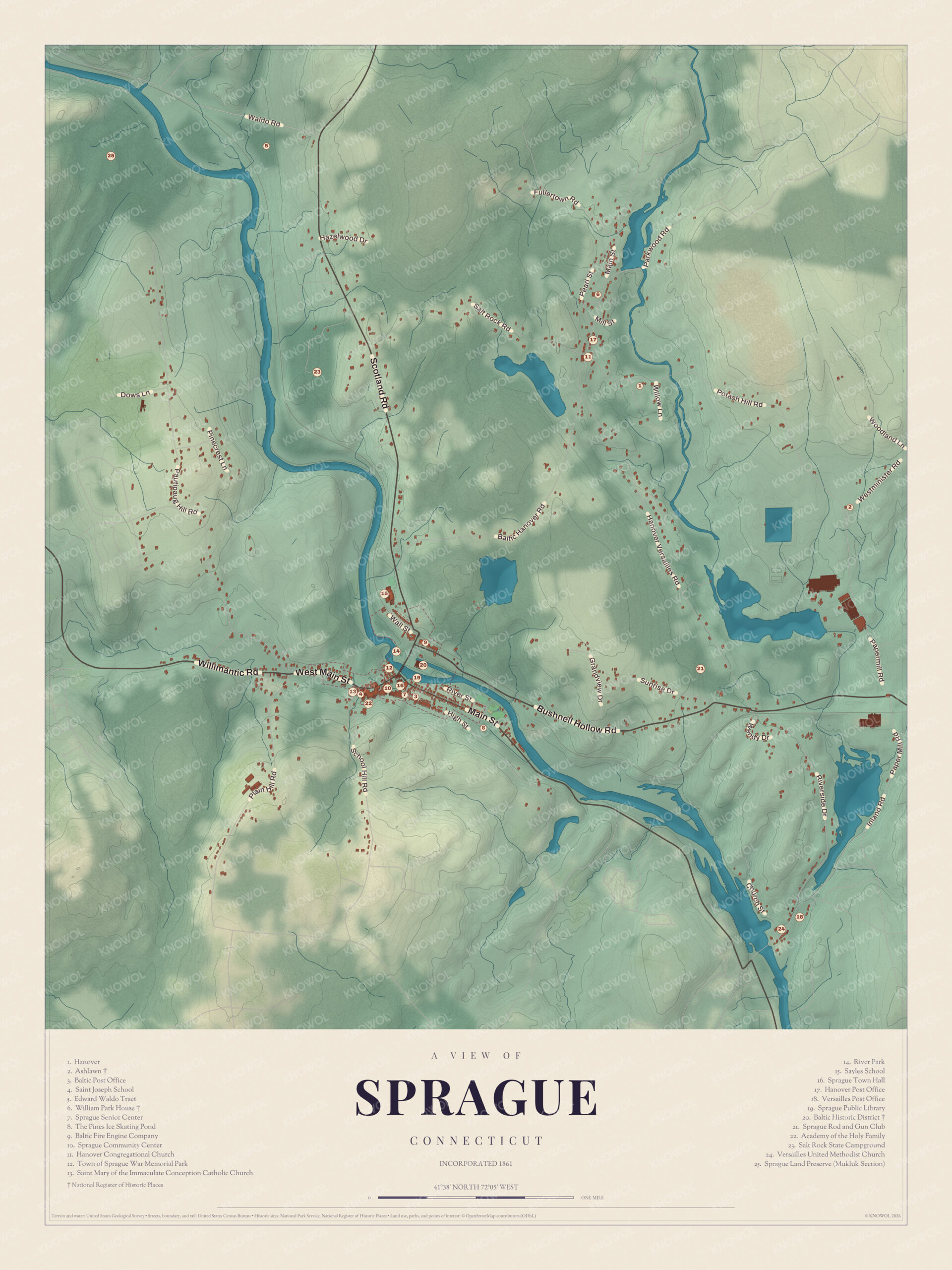
Click the map to look closer.
Sprague today
By KNOWOL
Shaded hills from Hanover in the north down to the Shetucket at Baltic and Versailles, every street by name, and a guide of 25 numbered landmarks with the National Register sites marked.4
The story of Sprague
Twenty-seven deeds at Lord's Bridge
Before Baltic, the crossing here was called Lord's Bridge, and the Lord family had farmed beside it for more than a century. The hamlet was a grist mill, a saw mill, a farmhouse with a tavern sign and two or three small houses. Governor William Sprague of Rhode Island wanted the water power, so he hired Samuel Ladd of Franklin to buy the land from all twenty-seven owners at a set price, and Ladd came back with every deed. Work began in July 1856. Rock was blasted, hills were moved and new channels dug for the river. Sprague died that October, but his family kept building. Within five years more than a hundred buildings stood around a mill 954 feet long, turned by six water wheels more than thirty feet across.562
An eagle on the belfry
Sprague was always a town of villages. Hanover is the oldest. Its people won their own parish in 1761 over warnings that it would ruin the churches around it, gathered a church of fourteen members in 1766, and kept one minister, Rev. Andrew Lee, for sixty-two years. The Allen family made woolen goods at Hanover from 1813 and rebuilt their mill after fires in 1834 and 1862. Down the river at Lovett's bridge, a brick mill made seamless cotton bagging. Its village took the name Eagleville, the story goes, because an eagle landed on the mill's belfry just before it was finished, and the workmen called it a good omen. Another Eagleville already existed, so there was talk of Buckingham. In 1872 it became Versailles instead.78910114
Baltic starts over
Debt hurt the Spragues after 1873, and a fire later ended their business at Baltic. Frederick Sayles of Pawtucket bought the site, and in 1900 the Baltic Mills Company was organized, with Harold Lawton, an Englishman who'd gone to work in a cotton mill at eight, as its manager. By 1905 it employed about 800 people, and by 1922 about 1,500, in a village of some 3,500. The weavers formed their own union in 1902 and met Wednesday evenings in St. Jean de Baptiste hall. Raymond J. Jodoin, born in Quebec, put his savings into Baltic real estate while his friends predicted he'd lose it. He built the Roderick Block, a hotel called the Sprague House and a theatre, and the first sidewalk in the village was laid in front of his house in 1898.41213141516
Through the years
24 moments from 1761 to today.
- 1761Hanover wins its own parish, made from parts of Canterbury, Scotland Parish and Newent.7
- 1766The Hanover church gathers with fourteen members on May 13.8
- 1768Rev. Andrew Lee is ordained at Hanover and serves sixty-two years.8
- 1813Ebenezer Allen begins making cotton and woolen goods at Hanover with his father.9
- 1852John Batchelder buys the mill at Lovett's bridge and soon builds a brick mill for seamless cotton bagging.10
- 1854The railroad reaches Lord's Bridge on the Shetucket.4
- 1856Governor William Sprague buys 300 acres at Lord's Bridge in July and dies that October.5
- 1861Sprague is incorporated from parts of Lisbon and Franklin.1
- 1861The first town meeting, on June 10, is celebrated as the town's birthday.17
- 1862The Allen woolen mill at Hanover burns for the second time and is rebuilt.9
- 1864More than 1,800 looms are running at Baltic, and 1,400 people work for the company.2
- 1870The Baltic mill employs 804 men, 396 women and 210 children.4
- 1872Eagleville's post office takes the name Versailles on May 13.4
- 1880Sprague counts 3,207 people.18
- 1898The first sidewalk in Baltic is laid in front of Raymond J. Jodoin's new house.15
- 1899Angus Park founds the Angus Park Woolen Company at Hanover.19
- 1900The Baltic Mills Company is organized and its new plant goes up.12
- 1902Baltic's weavers organize the Baltic Weavers Protective Association on April 7.14
- 1913The William Park House is built in Hanover.19
- 1922Baltic has some 3,500 people, and the Baltic Mills employ about 1,500.13
- 1967The mill at Baltic closes.1
- 1987Nearly all of Baltic is listed on the National Register as the Baltic Historic District.20
- 1999Fire destroys the remains of the Baltic mill.20
- 2001The state buys Salt Rock, a mile of wooded riverfront, for a campground.4
Places to see
The numbers match the landmark guide printed on the 2026 map.
- 1HanoverNortheast of Baltic. The oldest settlement in Sprague.
- 2Ashlawn1 Potash Hill Road. Georgian farmhouse of the Perkins family.
- 6William Park House330 Main Street, Hanover. Foursquare house built in 1913.
- 11Hanover Congregational ChurchHanover. Church organized in 1766.
- 13Saint Mary of the Immaculate Conception Catholic ChurchBaltic, west side. Catholic parish church of Baltic.
- 16Sprague Town HallBaltic. Built in the 1950s.
- 20Baltic Historic DistrictBaltic. 210 historic buildings on 122 acres.
- 22Academy of the Holy FamilyBaltic, west side. Catholic girls' school, still open.Visit their website
- 23Salt Rock State CampgroundAlong the Shetucket. A mile of wooded riverfront.Visit their website
- 24Versailles United Methodist ChurchVersailles. Italianate and Gothic church of 1876.
On the National Register
All 3 places in Sprague on the National Register of Historic Places that still stand today, oldest first, and why each one matters.3
-
Ashlawn
Also called the Joshua Perkins House, this Georgian farmhouse is named for the ash trees that once stood in front of it. Its register nomination calls it one of the finest of its type in the area and ties it to the Perkins family, especially important in settling Hanover.21
-
Baltic Historic District
Nearly the whole mill village of Baltic, 122 acres with 210 contributing buildings, grew up around the cotton mill begun on the Shetucket in 1856. The mill itself is gone, but the village it built still stands.20
-
William Park House
Built by master builder Peck McWilliams for William Park of the Angus Park Woolen Company, it's a high quality American Foursquare with Prairie School touches, a form not often found in Connecticut.19
In their words
“Sprague is pre-eminently a collection of mill villages.”
History of New London County, Connecticut, 188222
“amid mountainous heaps of cotton-bags the rural scene disappeared, and Baltic village leaped into existence.”
History of Norwich, Connecticut, 1866, on the building of Baltic5
“the whole spreading like wings each side of the river, and linking together two distinct towns.”
History of Norwich, Connecticut, 1866, on Baltic village5
Nearby towns
Sources
- Sprague, Connecticut, Wikipedia
- History of Norwich, Connecticut, from its possession by the Indians, to the year 1866 (1866), on the great mill, Internet Archive
- National Register of Historic Places listings in New London County, Connecticut, Wikipedia
- Map of Sprague, Connecticut in 2026, KNOWOL (USGS elevation, Census Bureau roads)
- History of Norwich, Connecticut, from its possession by the Indians, to the year 1866 (1866), on the building of Baltic, Internet Archive
- Genealogical and biographical record of New London County, Connecticut (1905), on Samuel J. P. Ladd, Internet Archive
- History of Windham County, Connecticut (1874), on Hanover parish, Internet Archive
- History of Norwich, Connecticut, from its possession by the Indians, to the year 1866 (1866), on Hanover Society, Internet Archive
- History of New London County, Connecticut (1882), on the Allens of Hanover, Internet Archive
- History of Norwich, Connecticut, from its possession by the Indians, to the year 1866 (1866), on Lovett's bridge, Internet Archive
- History of Norwich, Connecticut, from its possession by the Indians, to the year 1866 (1866), on the name Eagleville, Internet Archive
- Genealogical and biographical record of New London County, Connecticut (1905), on Harold Lawton and the Baltic Mills Company, Internet Archive
- A modern history of New London County, Connecticut (1922), on the mill villages of Sprague, Internet Archive
- Annual report of the Bureau of Labor Statistics of the State of Connecticut, on the Baltic Weavers Protective Association, Internet Archive
- Genealogical and biographical record of New London County, Connecticut (1905), on Raymond J. Jodoin, Internet Archive
- A modern history of New London County, Connecticut (1922), on Jodoin's hotel and theatre, Internet Archive
- History of Norwich, Connecticut, from its possession by the Indians, to the year 1866 (1866), on Sprague's first town meeting, Internet Archive
- The historical, statistical and industrial review of the state of Connecticut (1884), on Sprague, Internet Archive
- William Park House, Wikipedia
- Baltic, Connecticut (Baltic Historic District), Wikipedia
- Ashlawn, Wikipedia
- History of New London County, Connecticut (1882), on the town of Sprague, Internet Archive