
A corner town of ten villages where Connecticut meets Massachusetts and Rhode Island, with a white-spired green on Thompson Hill and the great brick cotton mill of North Grosvenordale on the French River.
Thompson on the map
Click the map to look closer.
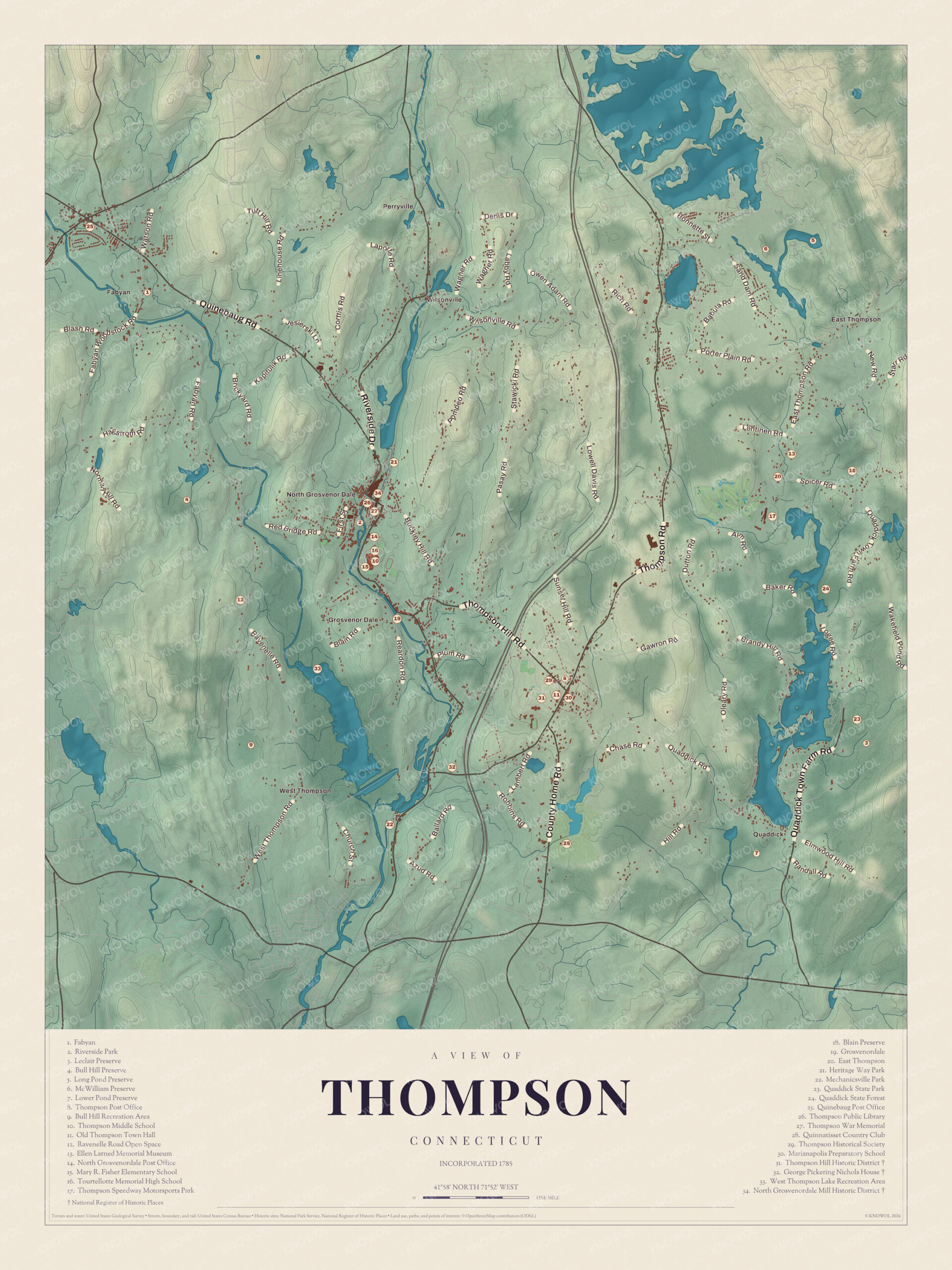
Thompson today
By KNOWOL
Shaded hills from Fort Hill down to the valleys of the French and Quinebaug Rivers, every road by name, North Grosvenordale, Grosvenordale, Fabyan, East Thompson, West Thompson and Quaddick, and a guide of 34 numbered landmarks with the National Register sites marked.5
The story of Thompson
Weddings on Thompson Hill
Thompson sits where Connecticut meets Rhode Island and Massachusetts, and in the early 1800s that corner was good for romance. Those two states made couples wait through a long published notice before a wedding, but Connecticut needed only one notice read at church. So it became the fashion for engaged pairs to drive to Thompson Hill on a Sunday and marry there. Ministers did it at first, until the crowds of Sabbath weddings alarmed them, and the job passed to Captain Vernon Stiles, landlord of the tavern and a justice of the peace. Hardly a Sunday went by without a wedding party and a cake made ready for it. People called Thompson a local Gretna Green, and in 1920 the inn still carried his name.67
A sloop built at Quaddick
After the Revolution the busiest corner of Thompson wasn't the hill but the South Neighborhood, where the firm of Larned and Mason ran a store, a nail factory and potash works, taking in produce from the whole countryside. Shipping goods in other men's vessels cost too much, so the partners decided to build their own. Men cut and hewed timber in the Thompson forests, the Quaddick sawmill was hired for the season, and Captain Jonathan Nichols, an ingenious mechanic, ran the work. Within a few months a tight little sloop stood far from any sea, and spectators flocked to Quaddick to see it. It was taken to Providence in sections, put back together and launched as the Harmony, and it carried goods between Providence and the West Indies.8
From the Swamp to Grosvenordale
Thompson's first factory went up in 1812, a wooden mill three stories high on the French River, in a swampy hollow below Stephen Crosby's mills. Rival mill owners in other parts of town called the new village The Swamp and Swamp Factory, and the names stuck for years. During the War of 1812 teamsters hauled cotton from distant markets, and one load from Philadelphia was said to have cost the company $1,100. After the Civil War William Grosvenor of Providence bought the mills, and in 1872 his builders raised the big brick mill at North Grosvenordale, its two towers cut with the words Grosvenordale Co. Erected A. D. 1872. The first cotton ran through it on April 2, 1873, and the mill made fine cotton cloth until 1954.9101112
Through the years
24 moments from 1674 to today.
- 1674John Eliot visits the praying towns, among them the Nipmuck village of Quinnatisset on today's Thompson Hill.13
- 1718Edward Morris builds the first permanent bridge over the Quinebaug, at what is now New Boston.14
- 1730The people on the hill ask the colonial assembly for a parish of their own.5
- 1735The Thompson Center Green is laid out and the first meeting house goes up on the hill.2
- 1785Thompson becomes a town, and its first town meeting is held on June 21.15
- 1789President Washington stops for breakfast at Jacobs' tavern, the halfway house between Boston and Hartford.16
- 1796The New England Conference of Methodists meets at Captain Jonathan Nichols' house, with Bishop Asbury preaching.17
- 1797Two turnpikes cross on Thompson Hill, today's Routes 193 and 200, and the village grows up around them.2
- 1805Dr. Daniel Knight becomes postmaster, so nobody has to drive seven miles to Pomfret for letters.18
- 1812Thompson's first factory goes up on the French River, in a hollow soon nicknamed The Swamp.9
- 1832The Thompson Fire Engine Company is organized, with a hand-cranked engine.7
- 1833The Thompson Bank opens in a little brick building beside the church.7
- 1850Thompson is the most populous town in Windham County.3
- 1850The railroads pass Thompson Hill by, and business moves down to the mill villages.2
- 1856The Congregational church with its tall white spire is built across from the common.7
- 1872William Grosvenor builds the big brick mill and renames the village North Grosvenordale.12
- 1873On April 2 the first cotton runs through the new North Grosvenordale mill.11
- 1891The Great East Thompson Train Wreck, the only American wreck to involve four trains, happens here.1
- 1902The town library starts on Thompson Hill with 1,370 books.1
- 1917The Baptist church on Thompson Hill burns on a Saturday in January.7
- 1926The Marians found Marianapolis Preparatory School.1
- 1940John Hoenig's oval track, built on his farmland, runs its first races.5
- 1954The North Grosvenordale mills stop making cloth.12
- 1965The Army Corps of Engineers dams the Quinebaug and makes West Thompson Lake.5
Places to see
The numbers match the landmark guide printed on the 2026 map.
- 1FabyanNorthwest. Once the mill village New Boston.
- 11Old Thompson Town HallThompson Hill. The town's original meeting hall.
- 13Ellen Larned Memorial MuseumThompson Hill. Named for the county's historian.Visit their website
- 17Thompson Speedway Motorsports ParkThompson. Highest-banked track in New England.
- 23Quaddick State ParkQuaddick. Beach on the old town farm.Visit their website
- 30Marianapolis Preparatory SchoolThompson Hill. On Norman B. Ream's old estate.Visit their website
- 31Thompson Hill Historic DistrictThompson Hill. The old village center and green.
- 32George Pickering Nichols HouseRoute 193. Greek Revival farmhouse of about 1846.
- 33West Thompson Lake Recreation AreaWest Thompson. Flood-control lake made in 1965.
- 34North Grosvenordale Mill Historic DistrictNorth Grosvenordale. The brick mill of 1872.
On the National Register
All 4 places in Thompson on the National Register of Historic Places that still stand today, oldest first, and why each one matters.4
-
Thompson Hill Historic District
The old village center of Thompson, 550 acres around the green laid out in 1735, with more than 100 historic buildings. It takes in the Congregational church, the Old Town Hall, the Ellen Larned Museum and the Ream estate, now Marianapolis, whose grounds were designed by the Olmsted Brothers.2
-
George Pickering Nichols House
A well-preserved rural Greek Revival farmhouse built by George Pickering Nichols, from a family of early settlers. The Nichols family lived here for nearly a century, at the center of a 260-acre farm.19
-
North Grosvenordale Mill Historic District
William Grosvenor's brick cotton mill of 1872 and the worker housing around it, about 70 acres with more than 100 buildings. Neighborhoods took names like Little Canada and Swede Village, and the mill ran until 1954.12
-
Isaac and Sarah Upham House
Thompson's newest National Register listing, added in August 2025.20
In their words
“The prettiest village we saw was a little place in Connecticut, that you probably never heard of, called Thompson.”
Travelers back from a New England motor trip, in A modern history of Windham County, 19207
“More stage passengers dined there every day than at any other house in New England.”
Captain Vernon Stiles on his Thompson Hill tavern, in History of Windham County, 18806
“Haste hither and share The peace and pure air Of this dear, poky, rosy, old Thompson.”
Ellen D. Larned, Windham County's historian, in a poem quoted in A modern history of Windham County, 192021
Nearby towns
Sources
- Thompson, Connecticut, Wikipedia
- Thompson Hill Historic District, Wikipedia
- History of Windham County, Connecticut, volume 2 (1880), on Thompson in 1850, Internet Archive
- National Register of Historic Places listings in Windham County, Connecticut, Wikipedia
- Map of Thompson, Connecticut in 2026, KNOWOL (USGS elevation, Census Bureau roads)
- History of Windham County, Connecticut, volume 2 (1880), on Captain Vernon Stiles' tavern, Internet Archive
- A modern history of Windham County, Connecticut (1920), on Thompson Hill, Internet Archive
- History of Windham County, Connecticut, volume 2 (1880), on the sloop Harmony, Internet Archive
- History of Windham County, Connecticut (1889), on Thompson's first factory, Internet Archive
- History of Windham County, Connecticut, volume 2 (1880), on Thompson's manufacturing companies, Internet Archive
- A modern history of Windham County, Connecticut (1920), on building the North Grosvenordale mill, Internet Archive
- North Grosvenordale, Connecticut, Wikipedia
- The historical, statistical and industrial review of the state of Connecticut (1884), on the praying towns, Internet Archive
- A modern history of Windham County, Connecticut (1920), on the settlement of Thompson, Internet Archive
- History of Windham County, Connecticut, volume 2 (1880), on Thompson's first town meeting, Internet Archive
- History of Windham County, Connecticut, volume 2 (1880), on Washington's visit, Internet Archive
- History of Windham County, Connecticut, volume 2 (1880), on the Methodist conference of 1796, Internet Archive
- History of Windham County, Connecticut, volume 2 (1880), on Thompson Hill village, Internet Archive
- George Pickering Nichols House, Wikipedia
- Weekly list of actions taken on properties, 8/8/2025 through 8/15/2025, National Park Service
- A modern history of Windham County, Connecticut (1920), on Ellen Larned's poem, Internet Archive