
A high hill town on the Massachusetts line, named for "Hartford land" and split by a deep river valley into East and West Hartland, whose old center in Hartland Hollow now lies under the Barkhamsted Reservoir.
Hartland on the map
Click the map to look closer.
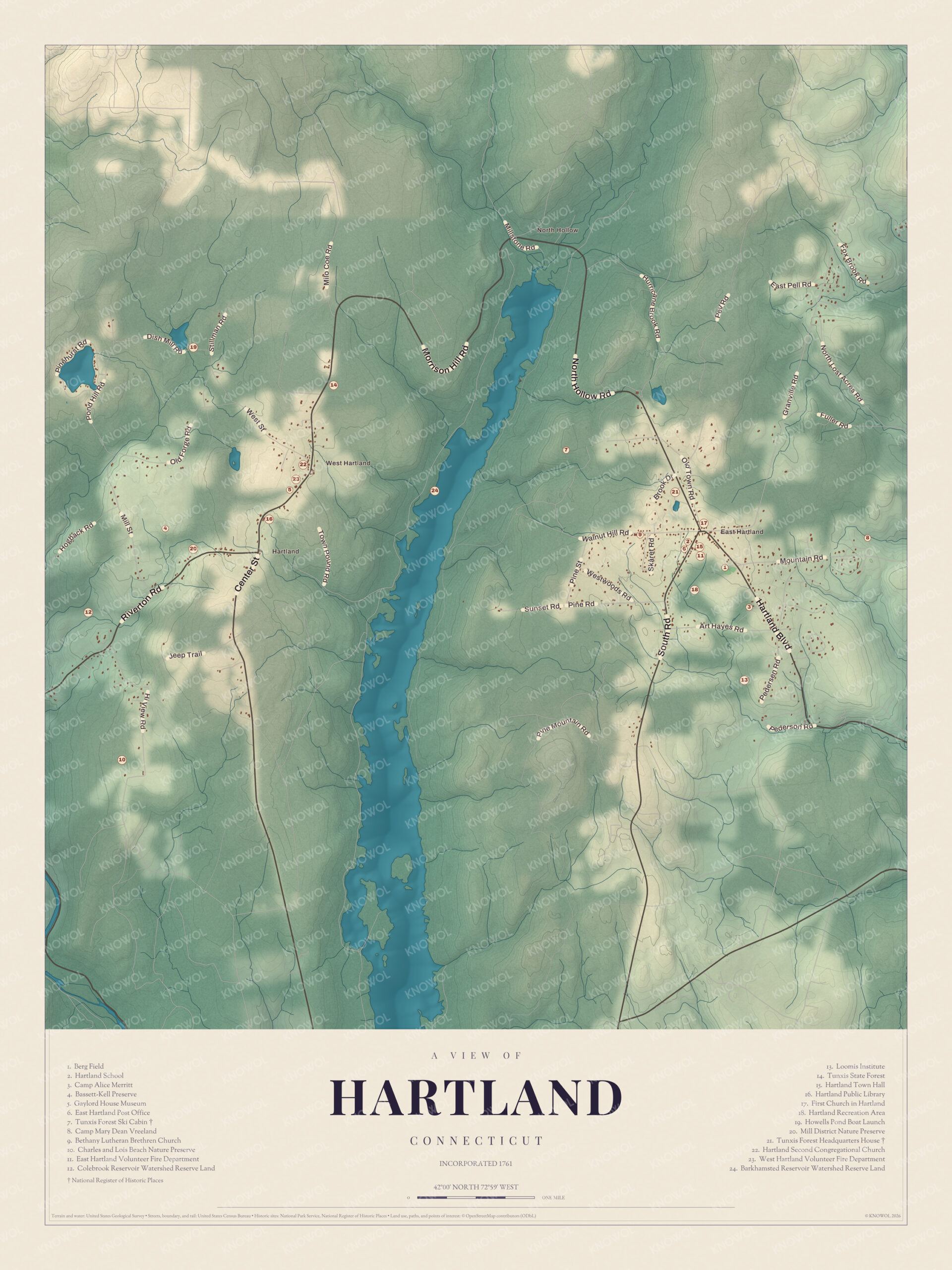
Hartland today
By KNOWOL
Shaded hills from East Mountain and West Mountain down to North Hollow and the long valley of the reservoir between them, roads from River Road to East Pell Road, East Hartland, West Hartland and North Hollow, and a guide of 24 numbered landmarks with the National Register sites marked.4
The story of Hartland
Hartland Hollow
Hartland Hollow is where the town began. In 1753 John Kendall, a Granby man trying to get away from his creditors, built a hut on the west bank of the river out of slabs that had floated down from Granville. He stayed about a year. Up the same valley in North Hollow, Uriel Holmes later built the first saw and grist mill, and Thomas Fuller ran a fulling mill. An 1837 guidebook said the valley had bold, rough and picturesque scenery. Because the Hollow sat near the middle of town, Hartland built its town hall there and held its first meeting in it in October 1860, and in 1879 the Hollow got its own post office. In 1940 the Saville Dam was finished, and the Hollow went under the Barkhamsted Reservoir.567891
One town on two mountains
From the start, the river and its deep valley split Hartland in two. During the Revolution, Eleazar Ensign asked the General Assembly to divide the town into two church societies, because a rapid river down the middle made it hard for everyone to meet for worship. The west side had already raised a big, solid meeting-house in 1775, and it got a steeple and a bell in 1837. East Hartland's first minister, Sterling Graves, had been ordained in 1768 in the open air, on a knoll south of the church. From 1782 the town held its meetings first on one side and then the other, until a town hall went up in the Hollow in 1860. Today the reservoir still divides East Hartland from West Hartland.109581
Up and up and up
Hartland sits high, and people noticed. An 1837 book called it cold and frosty, with poor soil for grain but good grazing. Farmers made butter and cheese, beef and pork, and farmers to the east sent their young cattle and sheep up here to pasture for the spring and summer. In 1895 a magazine writer on Hartland Green passed along a Bristol man's report of his visit: he went up and up and up until he bumped his head. Plenty of Hartland families moved on. Twenty families from East Hartland settled in Vernon and Hartford, Ohio, and Joshua R. Giddings, whose grandfather farmed in Hartland, became a famous antislavery congressman from Ohio. In 1890 the town counted 565 people.71112131415
Through the years
21 moments from 1733 to today.
- 1733The tract called the Northeast Part is named Hartland, from "Hartford land," and its proprietors first meet in Hartford.16
- 1753John Kendall builds a hut of river slabs in Hartland Hollow, the first home in town. He stays about a year.5
- 1754Thomas Giddings and Mary Coult become the first settlers to stay.1
- 1756Joshua Giddings, brother of the first settler, arrives from Lyme.13
- 1761Hartland becomes a town, with thirty-seven families and 212 people.2
- 1768Rev. Sterling Graves, the first minister, is ordained in the open air on a knoll south of the East Hartland church.5
- 1775The west side raises a large meeting-house of its own.9
- 1776Hartland sends its first representatives to the General Assembly.8
- 1777Stephen Bushnell builds a grist mill and a saw mill on Mill Brook.6
- 1778Consider Tiffany, a storekeeper loyal to the Crown, is confined to his Hartland farm for fifteen months.17
- 1782Town meetings begin to alternate between East and West Hartland.8
- 1796Hartland leaves Litchfield County for Hartford County, where its farmers sell their produce.18
- 1824Ezekiel Alderman of Granby starts making wagons in East Hartland.6
- 1827West Hartland gets the town's second post office.9
- 1837The West Hartland meeting-house gets a steeple and a bell given by Stephen Goodyear.9
- 1860The first town meeting is held in the new town hall at the Hollow.8
- 1879Daily mail starts from New Hartford, and Hartland Centre, the Hollow, gets a post office.9
- 1890The census counts 565 people, and farming is the town's main work.15
- 1936A Civilian Conservation Corps crew builds the Tunxis Forest Headquarters House.19
- 1937The CCC builds the Tunxis Forest Ski Cabin at the end of Balance Rock Road.20
- 1940The Saville Dam is finished and Hartland Hollow goes under the Barkhamsted Reservoir.1
Places to see
The numbers match the landmark guide printed on the 2026 map.
- 2Hartland SchoolEast Hartland. The town's school, pre-K through eighth.
- 5Gaylord House MuseumWest Hartland. Local history museum.Visit their website
- 7Tunxis Forest Ski CabinBalance Rock Road. CCC ski lodge of 1937.
- 14Tunxis State ForestAround the reservoir. Trails for hiking, biking and skiing.
- 15Hartland Town HallEast Hartland. Seat of town government.
- 17First Church in HartlandEast Hartland. The east parish, gathered in 1768.
- 19Howells Pond Boat LaunchNorth of town. Boat access to Howells Pond.
- 21Tunxis Forest Headquarters HouseNorth Hollow Road. CCC camp office of 1936.
- 22Hartland Second Congregational ChurchWest Hartland. The west parish church.
- 24Barkhamsted Reservoir Watershed Reserve LandThe central valley. Over the flooded Hartland Hollow.
On the National Register
All 2 places in Hartland on the National Register of Historic Places that still stand today, oldest first, and why each one matters.3
-
Tunxis Forest Headquarters House
A Civilian Conservation Corps crew built it as the main office of their camp, with fieldstone end walls and fireplaces built into them. The local forester lived here until 1948, and it is one of the few surviving houses the CCC built in Connecticut.19
-
Tunxis Forest Ski Cabin
A log cabin with a massive fieldstone chimney, built by CCC crews from nearby Camp Robinson as the base lodge of their ski area. It is believed to be one of the oldest surviving pieces of downhill skiing history in the state.20
In their words
“I went up and up and up until I bumped my head and then turned around and came back, and I had on a low cap, at that.”
A visitor from Chippen's Hill in Bristol, quoted in The Connecticut quarterly, 189511
“The churches of Hartland are on the hills and as the people from below climb upward of a Sabbath, they must get into a devout frame of mind ; they certainly get above most earthly things.”
The Connecticut quarterly, 189511
“The deep ravine or valley through which this stream passes is called Hartland hollow, and is characterized by bold, rough, and picturesque scenery.”
Connecticut historical collections, 18377
Nearby towns
Sources
- Hartland, Connecticut, Wikipedia
- The public records of the colony of Connecticut (1850), on Hartland becoming a town, Internet Archive
- National Register of Historic Places listings in Hartford County, Connecticut, Wikipedia
- Map of Hartland, Connecticut in 2026, KNOWOL (USGS elevation, Census Bureau roads)
- Connecticut historical collections (1837), on the first settlers of Hartland, Internet Archive
- The memorial history of Hartford County, Connecticut, 1633-1884 (1886), on Hartland's mills and shops, Internet Archive
- Connecticut historical collections (1837), on Hartland's hills, farms and the Hollow, Internet Archive
- The memorial history of Hartford County, Connecticut, 1633-1884 (1886), on town meetings and the town hall, Internet Archive
- The Memorial History of Hartford County Connecticut 1633-1884 (1886), on churches and post offices, Internet Archive
- The public records of the State of Connecticut (1894), on dividing Hartland into two societies, Internet Archive
- The Connecticut quarterly (1895), Trio and Tripod, Internet Archive
- Encyclopedia of Connecticut biography (1917), on the Banning family and East Hartland's move to Ohio, Internet Archive
- The memorial history of Hartford County, Connecticut, 1633-1884 (1886), on the Giddings family, Internet Archive
- A history of Cleveland and its environs (1918), on the Giddings family, Internet Archive
- Register and manual of the state of Connecticut (1896), Internet Archive
- The memorial history of Hartford County, Connecticut, 1633-1884 (1886), on the naming of Hartland, Internet Archive
- Genealogical and family history of the state of Connecticut (1911), on Consider Tiffany, Internet Archive
- The public records of the State of Connecticut (1894), on Hartland joining Hartford County, Internet Archive
- Tunxis Forest Headquarters House, Wikipedia
- Tunxis Forest Ski Cabin, Wikipedia