
Brookline began as Muddy River, a farming corner of Boston, became its own town in 1705 and voted again and again to stay that way, growing from the Punch Bowl crossroads into the garden suburb where Olmsted kept his office and John F. Kennedy was born.
Brookline on the map
Click the map to look closer.
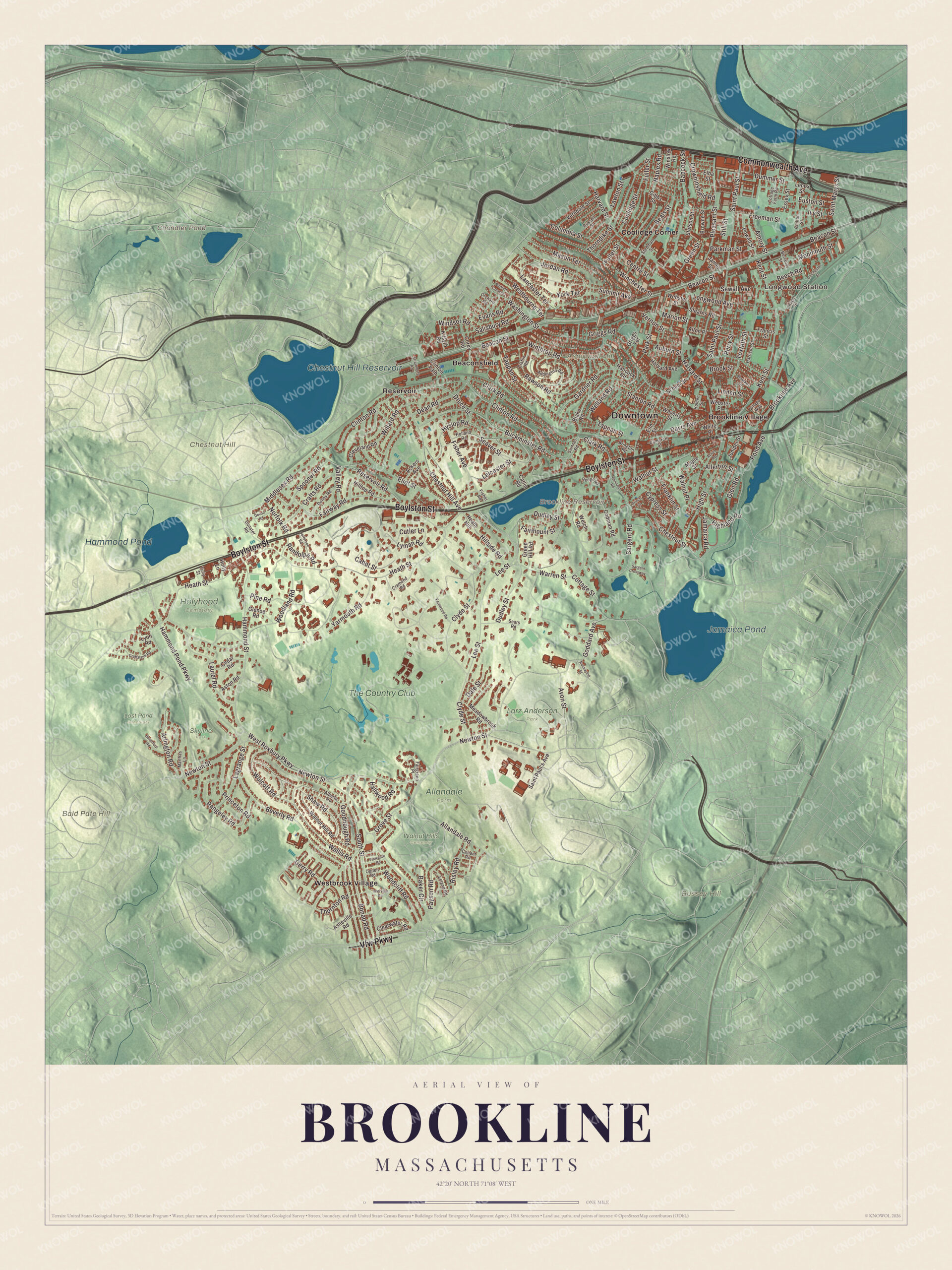
Brookline today
By KNOWOL
Brookline drawn with the shaded relief of an old atlas, printing Beacon, Boylston and Washington streets, Commonwealth Avenue, Saint Marys Street and the VFW Parkway, with Brookline Village, Westbrook Village, Aspinwall Hill, the Brookline Reservoir and Jamaica Pond.5
The story of Brookline
The Punch Bowl and the Mill Dam
By 1740 a tavern stood at the crossroads where Brookline Village is now, and it gave the place its name. Its sign, hung from a high red post, showed a punch bowl and ladle under a lemon tree, and the rest of New England knew the hamlet as Punch Bowl Village. British officers were among its guests before the Revolution. In 1816 a Mr. Spurr ran a coach to Boston from the tavern twice a day, but Brookline people, even women, walked rather than pay twenty-five cents each way, and it quit within a year. Then on July 2, 1821, the Mill Dam opened across the Back Bay with a cavalcade of citizens. Its road cost six and a quarter cents in tolls, and it became Beacon Street. The old tavern came down about 1833.6782910
The alarm on the old road
Brookline's militia gathered at the meetinghouse on April 19, 1775, and marched to Cambridge under Isaac Gardner, a justice of the peace and a Harvard graduate. He was killed in a skirmish about a mile beyond the college, and the town's 1906 history says the fact that such a man was in rebellion made a profound impression in England. While the British held Boston, a rider galloped up the old road shouting that the British were at the church green. He meant Roxbury's green, but upper Brookline ran. At the Hyslop house a table held up by carved spread eagles was carried into the woods and buried, and the family's little adopted daughter held on to a new pair of red bellows the whole time. On May 20, 1776, Brookline declared for independence.111213
The town that stayed a town
Muddy River started as a corner of Boston, where Boston people cut timber and pastured their cattle. In 1686 its farmers asked for a school of their own, and in 1705 they petitioned to be only a separate village, or peculiar. They got a town, Brookline, with maybe fifty families. Money was tight: in 1714 the new meetinghouse was such a burden for what the town called such a poor little town that it asked to skip sending a representative to the General Court. By 1846, a speaker said, citing the state's Board of Education, Brookline raised more money per head for its schools than any other town in the state. When Boston came asking, Brookline said no, 707 to 299 in 1873 and 541 to 271 in 1880, and it's still a town today.14151617321
Through the years
25 moments from 1638 to today.
- 1638Settlers begin the hamlet of Muddy River, an outlying part of Boston.1
- 1657Philip Curtis is paid twenty shillings for killing a wolf, the only wild animal trouble on record.18
- 1686The Muddy River farmers ask Boston for a school of their own.14
- 1705Muddy River, which had asked only to be a separate village, is made the town of Brookline.115
- 1714Building its first meetinghouse costs so much that the town asks to skip sending a representative to the General Court.17
- 1740By about this year the Punch Bowl Tavern stands at the village crossroads.6
- 1762Edward Devotion's estate passes to the town to build or keep a school.19
- 1775Isaac Gardner, leading the Brookline militia, is killed on April 19 beyond Harvard College.11
- 1776On May 20 Brookline declares for independence, six weeks before the Declaration.13
- 1788The town lets Dr. William Aspinwall build a smallpox inoculation hospital on his farm.20
- 1810The Boston and Worcester Turnpike, now Route 9, is laid out through the village.1
- 1816A coach to Boston starts from the Punch Bowl, but folks would rather walk than pay the fare.8
- 1821The Mill Dam opens across the Back Bay on July 2, the road that became Beacon Street.910
- 1833The Punch Bowl Tavern is pulled down.6
- 1841Lyceum Hall goes up on Washington Street, where Ralph Waldo Emerson would speak.21
- 1848The Brookline Reservoir is built as the end of the Cochituate Aqueduct.22
- 1848The railroad branch to Brookline opens in April with free trains all day for two thousand riders.23
- 1873Town meeting turns down annexation to Boston, 707 to 299.2
- 1880A second annexation attempt fails, 541 to 271.2
- 1882The Country Club is formed, the first private club in the country made only for outdoor activities.5
- 1883Frederick Law Olmsted moves to 99 Warren Street and opens Fairsted.5
- 1887Beacon Street is widened, and early electric streetcar tests run on tracks down its middle.24
- 1897The public bath house on Tappan Street opens on New Year's Day with an 80-foot pool.25
- 1913Francis Ouimet, a 20-year-old former caddie, wins the U.S. Open at The Country Club.5
- 1917John F. Kennedy is born at 83 Beals Street.5
Places to see
Places worth a visit in Brookline today.
- Brookline VillageWashington Street. The historic center, once Punch Bowl Village.
- Coolidge CornerBeacon and Harvard streets. Named for the 1857 Coolidge store.
- John Fitzgerald Kennedy National Historic Site83 Beals Street. The house where JFK was born.Visit their website
- Frederick Law Olmsted National Historic Site99 Warren Street. Fairsted, Olmsted's home and design office.Visit their website
- Olmsted ParkMuddy River, eastern edge. Part of Olmsted's Emerald Necklace.Visit their website
- Brookline ReservoirBoylston Street. End of the Cochituate Aqueduct, 1848.
- Coolidge Corner TheatreCoolidge Corner. Art Deco movie house since 1933.Visit their website
- The Country ClubClyde Street. Where Francis Ouimet won the 1913 Open.
- Larz Anderson ParkGoddard Avenue. The old 64-acre Anderson estate.
- Larz Anderson Auto MuseumLarz Anderson Park. America's oldest collection of motorcars.Visit their website
On the National Register
21 of the 94 places in Brookline on the National Register of Historic Places that still stand today, oldest first, and why each one matters. See the full list of National Register places in Brookline.4
-
Brookline Town Green Historic District
The colonial heart of the town on Walnut Street, where the first meetinghouse and burying ground were laid out after 1705. Brookline's first town hall, a stone building of 1825, still stands here as the First Parish Church's parish hall.26
-
Edward Devotion House
Built about 1745 by Solomon Hill on old Devotion family land, it is the best preserved of the town's few 18th-century buildings. Edward Devotion left money for a school; the town bought the house in 1891 and built a schoolhouse beside it, and the Brookline Historical Society shows it as a house museum.27
-
John Goddard House
John Goddard rebuilt his grandfather Joseph's house here in 1767. Rebel munitions were stored on the farm before the Revolution, and during the Siege of Boston Goddard served as wagon-master general to the Continental Army at the fortification of Dorchester Heights.28
-
Eliphalet Spurr House
Built in 1798 by Eliphalet Spurr, one of the first to run a coach service from Brookline to Boston. It is the oldest building on Pill Hill and one of the town's few 18th-century Georgian houses.29
-
Frederick Law Olmsted House National Historic Site
Olmsted bought this 1810 farmhouse in 1883 and made it Fairsted, the world's first full-scale professional office for landscape design. His sons and successors carried on the work here for most of the next century.30
-
William Ingersoll Bowditch House
A Gothic and Greek Revival house of about 1844 in one of Brookline's earliest planned subdivisions. Its first owner, the abolitionist William Ingersoll Bowditch, sheltered freedom seekers here on the Underground Railroad and served on the Boston Vigilance Committee.31
-
Pill Hill Historic District
A neighborhood built from the mid-1800s for Boston professionals after the railroad reached Brookline in 1848. So many doctors had settled here by the 1880s that it got the name Pill Hill.32
-
Reservoir Park
National Historic Landmark
Brookline Reservoir was built in 1848 as the main end point of the Cochituate Aqueduct, which brought Lake Cochituate's water toward Boston. Its granite gatehouse, the best-preserved part of the aqueduct, became a National Historic Landmark in 2015.22
-
Beacon Street Historic District
Beacon Street was built in 1850 and 1851 as an extension of the road over the Mill Dam across the Back Bay. In the 1880s Henry Whitney set out to make it a broad boulevard lined with housing, with a streetcar line down the middle.33
-
Longwood Historic District
Laid out in the mid-1800s by David Sears and Amos Adams Lawrence as a fashionable neighborhood, with Longwood Towers, Christ's Church Longwood and the Church of Our Saviour.34
-
Saint Paul's Church, Chapel, and Parish House
Richard Upjohn designed the Gothic Revival church, built in 1851 and 1852 on land given by Augustus Aspinwall, and it is the oldest religious building in town. Gutted by fire in 1976, it was rebuilt in 1979 and 1980.35
-
Holyhood Cemetery
Laid out in 1857 as Brookline's first rural-style cemetery, with a Gothic Revival puddingstone chapel by Patrick Keely. Joseph P. and Rose Fitzgerald Kennedy are buried here.36
-
Saint Mary of the Assumption Church, Rectory, School and Convent
It was the first Roman Catholic Church in Brookline, and the first in the nation to bear the name. Most of its buildings were built between 1880 and 1906, and are reflective of the growth of the area's Irish immigrant community during that time.37
-
The Dutch House
This four-story brick building was originally built as an exhibition hall at the 1893 World's Fair in Chicago, where it served as the Dutch Cocoa House. It is a close copy of the Franeker City Hall in Franeker, Netherlands.38
-
Larz Anderson Park Historic District
The 64-acre estate Larz and Isabel Anderson bought in 1899, left to the town by Isabel Anderson in 1948. The mansion came down in 1955, but the great Carriage House, now the Larz Anderson Auto Museum, and the Temple of Love by the water garden remain.39
-
John Fitzgerald Kennedy National Historic Site
National Historic Landmark
John F. Kennedy was born in the upstairs bedroom here in 1917, and the family lived here until 1920. Rose Kennedy later restored it to its 1917 look, and the National Park Service runs it today.40
-
Saint Aidan's Church and Rectory
A Tudor Revival church of 1911 by Maginnis and Walsh, where John F. and Robert F. Kennedy were baptized. The church closed in 1999 and was converted to housing.41
-
George R. Minot House
National Historic Landmark
The home of Dr. George R. Minot, who shared the 1934 Nobel Prize in Physiology or Medicine for discovering a cure for pernicious anemia. The plain brick Colonial Revival house was probably built in the 1920s.42
-
Olmsted Park System
Frederick Law Olmsted's Emerald Necklace, a 1,100-acre chain of parks and parkways in Boston and Brookline. Brookline cares for the west banks of Olmsted Park and the Riverway along the Muddy River.43
-
Cottage Farm Historic District
The Cottage Farm Historic District is a residential area in the northeastern corner of Brookline, Massachusetts, United States, known for its association with industrialist Amos Adams Lawrence (1814 to 1886). Laid out in the 1850s and centered around the junction of Essex and Ivy Streets, it features high-quality housing on large lots, built between the 1850s and 1910s.44
-
Brookline Village Commercial District
The commercial spine of Brookline Village along Washington Street, the town's historic center and first business district, which grew up where the old road crossed the Muddy River.45
In their words
“Brookline at last stands before us, with at least thirty-two freeholders, with all the privileges, and in all the dignity, of a Town.”
Robert C. Winthrop, at the dedication of the Town Hall, 187346
“No spot on the globe stands so high in my geographical estimation, as does Brookline.”
A Boston schoolmaster who went to school in Brookline, at Dr. John Pierce's jubilee, 184747
“It is said to be the richest town in the United States, the best governed and the most beautiful.”
A history of Brookline, Massachusetts, 190648
Nearby towns
Sources
- Brookline, Massachusetts, Wikipedia
- A history of Brookline, Massachusetts (1906), chronology of events, Internet Archive
- Brookline Jubilee (1847), on school spending, Internet Archive
- National Register of Historic Places list, Wikipedia
- Map of Brookline, Massachusetts in 2026, KNOWOL
- A history of Brookline, Massachusetts, from the first settlement of Muddy River until the present time (1906), on the Punch Bowl Tavern, Internet Archive
- The Bay State Monthly, November 1884, on the Punch Bowl Tavern, Internet Archive
- A Guide to the Local History of Brookline, Mass. (1897), on Mr. Spurr's coach, Internet Archive
- Bowen's picture of Boston (1833), on the Mill Dam, Internet Archive
- A history of Brookline, Massachusetts (1906), on the Mill Dam, Internet Archive
- A history of Brookline, Massachusetts (1906), on Isaac Gardner, Internet Archive
- History of Norfolk County, Massachusetts (1884), on the Hyslop house, Internet Archive
- A Guide to the Local History of Brookline, Mass. (1897), on Brookline in the Revolution, Internet Archive
- A Guide to the Local History of Brookline, Mass. (1897), on Muddy River and Boston, Internet Archive
- Proceedings at the dedication of the Town Hall, Brookline (1873), on the 1705 petition, Internet Archive
- A history of Brookline, Massachusetts (1906), on Muddy River in 1705, Internet Archive
- A history of Brookline, Massachusetts (1906), on the first meetinghouse, Internet Archive
- A history of Brookline, Massachusetts (1906), on the early settlers, Internet Archive
- A history of Brookline, Massachusetts (1906), on Edward Devotion, Internet Archive
- A history of Brookline, Massachusetts (1906), on Dr. William Aspinwall, Internet Archive
- A history of Brookline, Massachusetts (1906), on the Lyceum, Internet Archive
- Reservoir Park, Wikipedia
- A history of Brookline, Massachusetts (1906), chronology, on the railroad, Internet Archive
- A history of Brookline, Massachusetts (1906), on the street railways, Internet Archive
- A history of Brookline, Massachusetts (1906), on the Brookline Bath House, Internet Archive
- Brookline Town Green Historic District, Wikipedia
- Edward Devotion House, Wikipedia
- John Goddard House, Wikipedia
- Eliphalet Spurr House, Wikipedia
- Frederick Law Olmsted House National Historic Site, Wikipedia
- William Ingersoll Bowditch House, Wikipedia
- Pill Hill Historic District, Wikipedia
- Beacon Street Historic District, Wikipedia
- Longwood Historic District, Wikipedia
- Saint Paul's Church, Chapel, and Parish House, Wikipedia
- Holyhood Cemetery, Wikipedia
- Saint Mary of the Assumption Church, Rectory, School and Convent, Wikipedia
- The Dutch House, Wikipedia
- Larz Anderson Park Historic District, Wikipedia
- John Fitzgerald Kennedy National Historic Site, Wikipedia
- Saint Aidan's Church and Rectory, Wikipedia
- George R. Minot House, Wikipedia
- Olmsted Park System, Wikipedia
- Cottage Farm Historic District, Wikipedia
- Brookline Village Commercial District, Wikipedia
- Proceedings at the dedication of the Town Hall, Brookline, February 22, 1873 (1873), Internet Archive
- Brookline Jubilee: a discourse delivered in Brookline, 15 March 1847 (1847), Internet Archive
- A history of Brookline, Massachusetts (1906), Internet Archive