
A hill town on the Westfield River where William Cullen Bryant grew up, with a tannery and paper mill village at West Cummington, a Swift River village once called Babylon, and a first meetinghouse that stood high on Cummington Hill.
Cummington, Massachusetts on the map
Click the map to look closer.
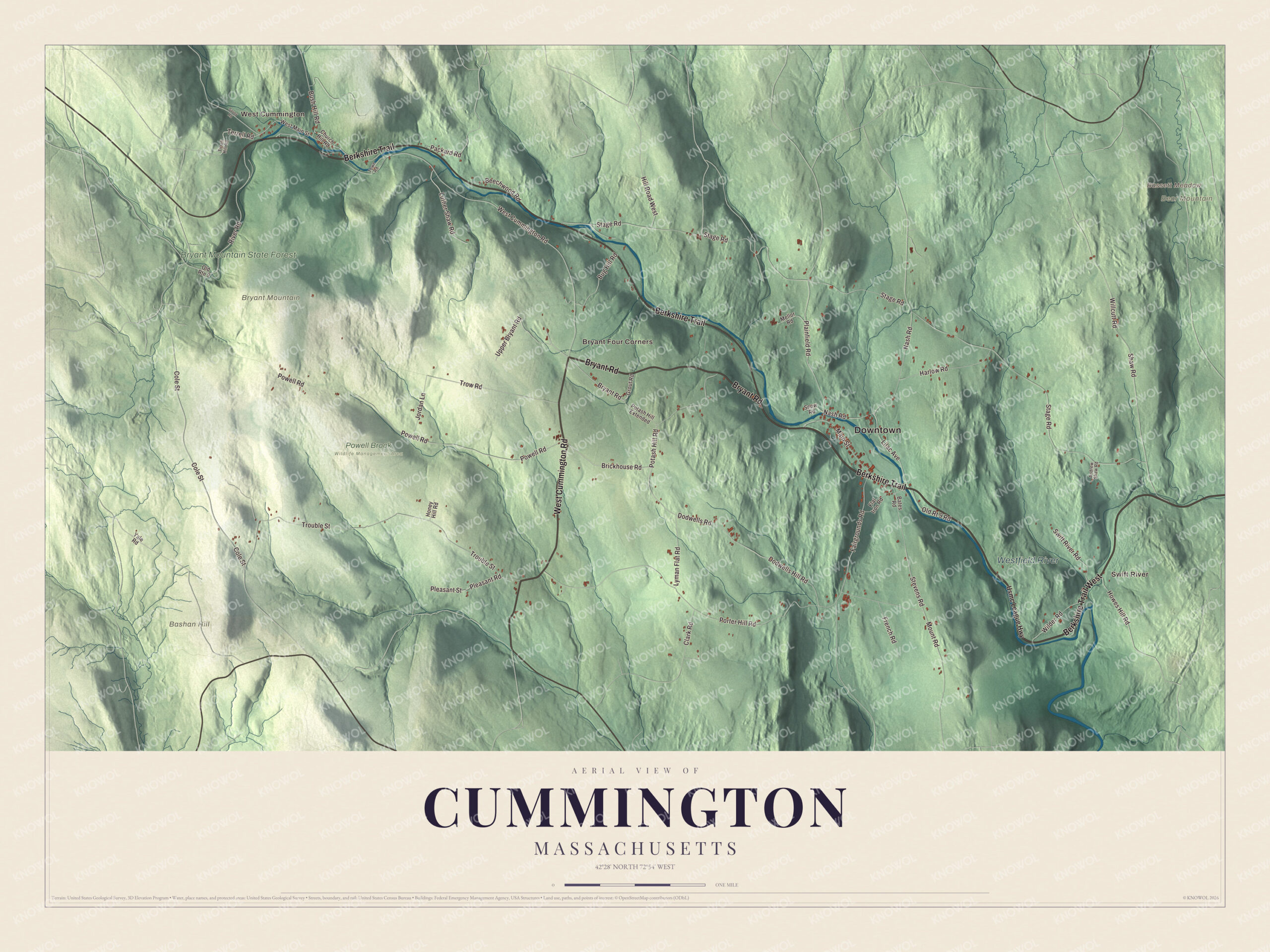
Cummington today
By KNOWOL
Shaded hills from Bashan Hill, Bear Mountain and Bryant Mountain down to the Westfield River, with the Berkshire Trail, West Cummington Road, Bryant Road and Bush Hill Road, Bryant Mountain State Forest and Bassett Meadow.5
The history of Cummington, Massachusetts
Leather and paper at West Cummington
West Cummington sits at the foot of Deer Hill on the banks of the Westfield. Jonah Beals was tanning hides there by about 1790, and in 1805 William Hubbard built the tannery that really founded the village. It employed more men than any business there, before or since. Elisha Mitchell opened a store in 1823 and became the first postmaster. In the summer of 1856 Nelson Shaw and Company put up paper mills just above the village, and by 1879 they were turning out a quarter of a million pounds a year, fine bond and writing paper in plain and fancy tints. All of it went by wagon fourteen miles to Adams to be finished.3
From Mount Zion down to Babylon
Cummington was planned before it was settled. The proprietors of plantation No. 5 laid out roads, voted money for mills and set aside land for a minister and the schools. They put the first meetinghouse high on Cummington Hill, a Mount Zion that families from the north side reached by going down to the Westfield and climbing again. The hamlet up there had its own mill, church, school and shops. But business moved down to the river, Cummington village grew, and new churches formed in the village and at West Cummington. In time the old meetinghouse on the hill was taken down, and its timbers went into a factory at Swift River Village, the place people once called Babylon.6789
The poet's walk to Plainfield
William Cullen Bryant moved into his grandfather Ebenezer Snell's house at age four and lived there until he was 22. As a young lawyer he walked the seven miles from Cummington to Plainfield, and on one of those walks a single bird on the horizon gave him "To a Waterfowl," which Matthew Arnold called the best short poem in the English language. He wrote "Inscription for the Entrance to a Wood" in the forest in front of his father's house. Years later, back for the summers, he often worshiped at the West Cummington church, and he gave the town its public library. He bought back the homestead in 1865, and his granddaughter gave it to The Trustees of Reservations in 1929.51011212
Cummington, Massachusetts through the years
23 moments from 1750 to today.
- 1750Four Stockbridge owners deed land east of Pittsfield to the Westfield River, taking in part of what is now Cummington.13
- 1762The General Court sells the township, then including Plainfield, to Col. John Cumings of Concord.14
- 1771The proprietors hold their first meeting in Cummington itself, in June.15
- 1779Cummington is incorporated as a town.1
- 1779Rev. James Briggs is ordained in July as the town's first pastor.11
- 1781A meetinghouse is finally built on the south side after a long fight over where it should stand.11
- 1785The north part of town is set off as the district of Plainfield.16
- 1787The state forgives the 377 pounds of taxes charged to the town back when it was plantation No. 5.7
- 1794William Cullen Bryant is born in Cummington.5
- 1805William Hubbard builds the tannery that founds West Cummington.3
- 1815On a walk to Plainfield, Bryant sees a single bird on the horizon and writes "To a Waterfowl."5
- 1821A Baptist society forms with fourteen members; in ten years it has 108.11
- 1823Elisha Mitchell opens a store at West Cummington and soon becomes its first postmaster.3
- 1824Cummingtonite is discovered in town and named for it.5
- 1834A tornado throws a wagon over the cliff above Swift River Village, and a small boy dies.17
- 1839The West Cummington church goes up, where Bryant would often worship.11
- 1856Nelson Shaw and Company build paper mills just above West Cummington.3
- 1865Bryant buys back his family's homestead and begins remaking it.12
- 1869Swift River village, once called Babylon, gets its own post office.9
- 1874A state gazetteer counts three post offices, the Union House hotel and a public library given by Bryant.2
- 1879The West Cummington paper mills turn out a quarter of a million pounds of paper.3
- 1929Bryant's granddaughter gives the homestead to The Trustees of Reservations.12
- 1945The documentary The Cummington Story shows the town welcoming European refugees.1
Places to see in Cummington, Massachusetts
Places worth a visit in Cummington today.
- William Cullen Bryant Homestead205 Bryant Road. The poet's boyhood and summer home.Visit their website
- Bryant Free LibraryBerkshire Trail. The town library, named for Bryant.Visit their website
- Kingman Tavern Historical MuseumMain Street, Cummington village. Town museum in an old tavern.Visit their website
- Greenwood Music CampThe Cummington hills. Summer music camp since 1933.Visit their website
- West CummingtonNorthwest, on the Westfield. Old tannery and paper mill village.
- Swift RiverSoutheast part of town. The village once called Babylon.
- Westfield RiverThrough the middle of town. The East Branch, followed by Route 9.
- Bryant Mountain State ForestNear West Cummington. State forest in the western hills.
- Bashan HillOn the Worthington line. High ground on the southern edge.
Cummington on the National Register of Historic Places
All 1 places in Cummington on the National Register of Historic Places that still stand today, oldest first, and why each one matters.4
-
William Cullen Bryant Homestead
National Historic Landmark
Bryant's grandfather Ebenezer Snell built the house in 1783, and the poet lived here from age four until he was 22. Bryant bought it back in 1865, raised it over a new first floor and spent his summers here; his granddaughter gave the 155-acre estate to The Trustees of Reservations in 1929.12
Cummington in their words
“Away back in the dim past, this hamlet had its mill, its church and school, its small shops and a really contented thrifty people, though few in number.”
Western Massachusetts, a history, 1926, on Cummington Hill9
“Cummington has been noted for the prominent men reared there.”
History of Mount Holyoke seminary, 188718
“That seven-mile exercise produced what Matthew Arnold regarded as the best "short poem in the English language."”
Brockton and its centennial, 1921, on Bryant's walk from Cummington to Plainfield10
Towns near Cummington, Massachusetts
Sources for the history of Cummington
- Cummington, Massachusetts, Wikipedia
- A gazetteer of the state of Massachusetts (1874), Internet Archive
- Western Massachusetts; a history, 1636-1925 (1926), on West Cummington, Internet Archive
- National Register of Historic Places listings in Hampshire County, Massachusetts, Wikipedia
- Map of Cummington, Massachusetts in 2026, KNOWOL
- History of the Connecticut Valley in Massachusetts (1879), on the settlement of Cummington, Internet Archive
- Resolves of the General Court of the Commonwealth of Massachusetts (1787 session), on Cummington's taxes, Internet Archive
- History of the Connecticut Valley in Massachusetts (1879), on the church on Cummington Hill, Internet Archive
- Western Massachusetts; a history, 1636-1925 (1926), on Swift River and Cummington Hill, Internet Archive
- Brockton and its centennial (1921), on Bryant's poems, Internet Archive
- Western Massachusetts; a history, 1636-1925 (1926), on Cummington's churches, Internet Archive
- William Cullen Bryant Homestead, Wikipedia
- A history of the town of Middlefield, Massachusetts (1924), Internet Archive
- Topographical description and historical sketch of Plainfield, in Hampshire County, Massachusetts (1834), Internet Archive
- Historical collections relating to every town in Massachusetts (1841), Internet Archive
- History of western Massachusetts (1855), on Plainfield, Internet Archive
- History of the town of Goshen, Hampshire County, Massachusetts (1881), on the tornado of 1834, Internet Archive
- History of Mount Holyoke seminary, South Hadley, Mass. (1887), on Rev. Roswell Hawks, Internet Archive