
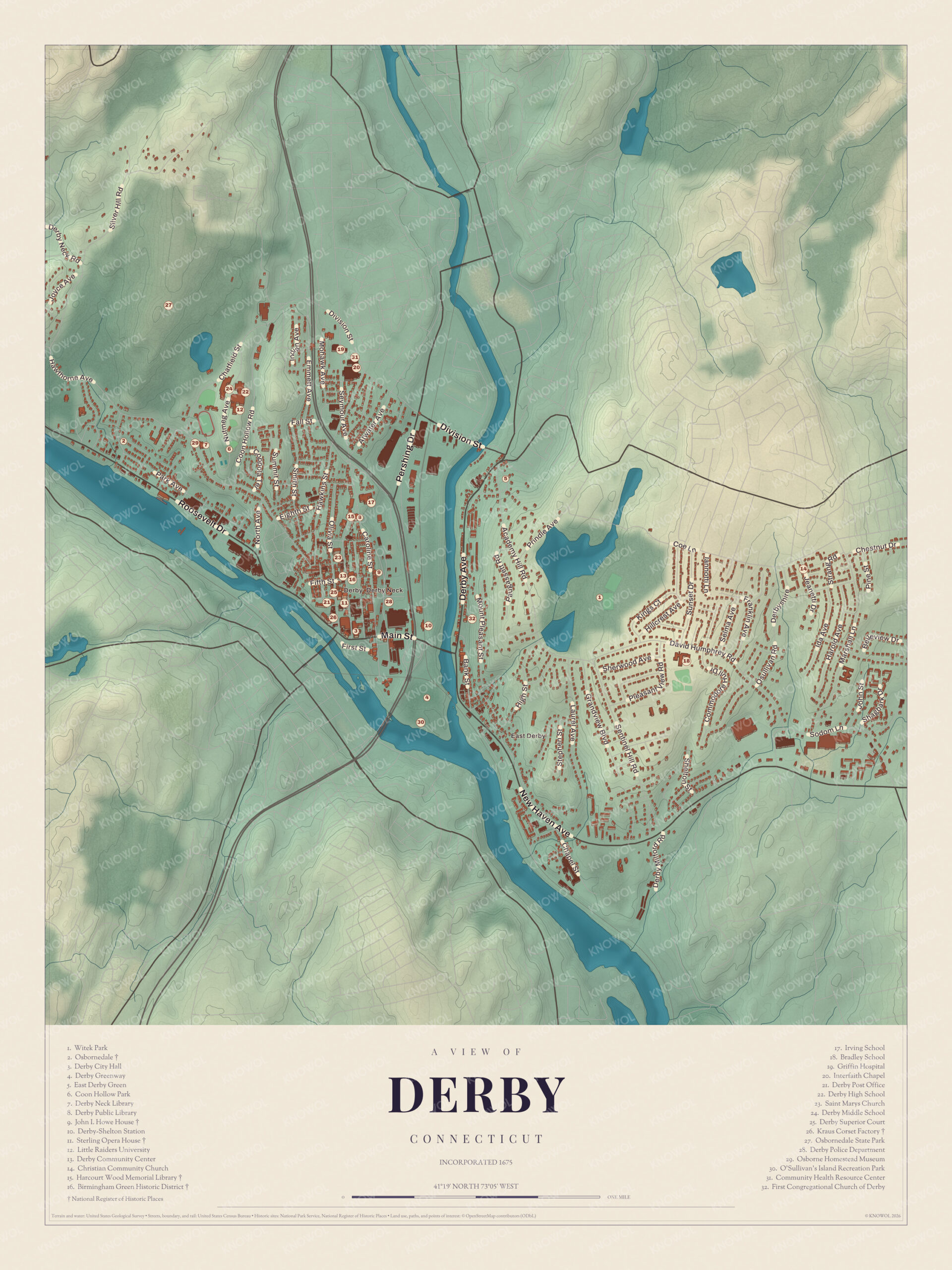
Connecticut's smallest city, where the Housatonic and Naugatuck rivers meet, began as the Paugasset trading post, shipped West Indies cargoes from Derby Narrows, and in 1836 grew the factory village of Birmingham around a public green.
Derby on the map
Click the map to look closer.
Derby today
By KNOWOL
Shaded hills from downtown up to Derby Neck and over to East Derby, every street from Main Street to Sentinel Hill Road, and a guide of 32 numbered landmarks with the National Register sites marked.4
The story of Derby
When Derby Narrows was a seaport
Before the factories, Derby made its living on the water. In the years before 1800, Leman Stone and other merchants traded from here with New York, Boston and the West Indies, and farm wagons from Waterbury and Woodbury sometimes lined up half a mile at Derby Narrows, waiting to unload. In 1807 the Derby Fishing Company was organized at Hull's tavern to fish the Newfoundland Banks, and one chest of its coin took eight men to carry into the Derby bank. In 1824 the Hallock brothers, shipbuilders and temperance men, bought land at Derby Landing and broke up the peach brandy distillery that came with it. A boy named Isaac Hull learned to sail at the Narrows, and in 1813 the town called him an ornament to the place of his birth.567891011
The Point that became Birmingham
In 1836 the land where the Naugatuck meets the Housatonic was a quiet spot called the Point. That April the selectmen laid out a sixty foot street there for Sheldon Smith and Anson G. Phelps of New York, and for a while the place went by Smithville. Smith rebuilt the Naugatuck dam and dug a reservoir for fourteen feet of fall, and people said he'd lose more money than the work cost. Edward Shelton and Nathan Sanford built a tack factory that spring, Smith gave the Methodists a church lot and the stone to build on it, and in 1838 Phelps drew John I. Howe's pin company to Derby, where it made pins until 1908. The public square in their plans is Birmingham Green.1213141516
Streetcars, concerts and a library
On May 1, 1888, the Derby Street Railway ran its first electric car, part of the first electric trolley system in New England, and a county history adds that it was the first line to use air brakes. By about 1900 it ran three and a half miles between Ansonia, Derby and Housatonic Park, with twenty-five cars and sixty employees. The company opened a park on the Housatonic with free summer concerts for its riders and a ball field beside it. H. Holton Wood, who made his fortune running the line, gave the land and the money for Derby's library. It opened in 1902 and carries the name of his son Harcourt, who died at twelve.217118
Through the years
25 moments from 1642 to today.
- 1642John Wakeman of New Haven sets up a trading post called Paugasset.1
- 1654Edward Riggs and Edward Wooster settle at Paugasuck, Wooster beside the river.19
- 1661By tradition, the hunted judges Whalley and Goffe hide in the Riggs house.19
- 1673Rev. John Bowers comes to Paugassett as the first minister.20
- 1675Paugasset is admitted as the township of Derby, named for Derby in England.1
- 1678The Church of Christ in Derby, today's First Congregational, is organized.21
- 1737An Episcopal parish is established in Derby.22
- 1775Isaac Hull, later captain of the frigate Constitution, is born in Derby on March 9.10
- 1786An academy goes up on Academy Hill, its bell shared by two churches.23
- 1790About this year merchant Leman Stone begins trading from Derby Narrows.5
- 1807The Derby Fishing Company is organized at Hull's tavern on January 15.7
- 1813A town meeting calls Isaac Hull an ornament to the place of his birth.11
- 1824The Hallock brothers move their shipyard to Derby Landing.9
- 1836Streets are laid out at the Point, briefly called Smithville, soon Birmingham.12
- 1838John I. Howe's pin company moves to Derby.15
- 1845Howe builds his granite house on Caroline Street.24
- 1879Sidney Downs builds the corset factory leased to Leopold Kraus.25
- 1888The Derby Street Railway runs its first electric car on May 1.2
- 1889The Sterling Opera House opens on April 2, the same year Ansonia becomes its own town.26
- 1894The City of Derby is incorporated.27
- 1902The Harcourt Wood Memorial Library is built.18
- 1904A slab marks Ye Ancient Common of the Founders of Derby.28
- 1908The Howe pin company is sold to Plume and Atwood of Waterbury.15
- 1956Frances Osborne Kellogg leaves her 350 acre estate to the state.29
- 1968The Sterling Opera House becomes Connecticut's first National Register listing.26
Places to see
The numbers match the landmark guide printed on the 2026 map.
- 5East Derby GreenEast Derby. The green of East Derby.
- 9John I. Howe House213 Caroline Street. The pin maker's granite house.
- 11Sterling Opera HouseElizabeth Street. Opera house and city hall of 1889.
- 15Harcourt Wood Memorial LibraryElizabeth and Caroline Streets. Granite and brick library of 1902.Visit their website
- 16Birmingham Green Historic DistrictDowntown. The 1830s public square and its churches.
- 26Kraus Corset FactoryRoosevelt Drive at Third Street. Last big corset factory, now apartments.
- 27Osbornedale State ParkWest of downtown. 417 acres on the Housatonic.Visit their website
- 29Osborne Homestead MuseumOsbornedale. The Osborne family house, open for tours.Visit their website
- 30O'Sullivan's Island Recreation ParkSouth of downtown. Recreation park on the river.
- 32First Congregational Church of DerbyDerby. Church first gathered in 1678.
On the National Register
All 6 places in Derby on the National Register of Historic Places that still stand today, oldest first, and why each one matters.3
-
Birmingham Green Historic District
The public square planned in the 1830s by Anson Phelps and Sheldon Smith for their new industrial village, which drew Derby's civic life over from Derby Landing. Three churches moved to the green in 1837, 1843 and 1845, and the district holds ten buildings and four monuments around the 1.8 acre green.16
-
Osbornedale
A Greek Revival farmhouse of 1840 that Waldo Kellogg enlarged into its Colonial Revival form between 1919 and 1925. It was the home of businesswoman Frances Osborne Kellogg, who left the estate to the state, and it's now the Osborne Homestead Museum.29
-
John I. Howe House
A granite Greek Revival house built for John Ireland Howe, whose machines made straight pins that had always been made by hand. The Derby Historical Society owns it and hopes to open it as a museum of the valley's industry.24
-
Kraus Corset Factory
Built by Sidney Downs and leased to Leopold Kraus, whose firm employed about a quarter of Derby's corset makers. It's the only major building left from Derby's corset years, later made pins and hairpins for Sterling Pin, and is now apartments.25
-
Sterling Opera House
Opened April 2, 1889 as an opera house over the city hall and police station, designed by H. Edwards Ficken and named for piano maker Charles A. Sterling. Harry Houdini played its stage, and it was the first building in Connecticut listed on the National Register.26
-
Harcourt Wood Memorial Library
A Colonial Revival library of Ansonia granite and brick, given by streetcar owner H. Holton Wood and named for his son Harcourt, who died at twelve. It still keeps most of its original woodwork and many original furnishings.18
In their words
“Has, in our opinion, deserved well of his country, and is an ornament to the place of his nativity.”
Derby town meeting on Isaac Hull, April 12, 1813, printed in The history of the old town of Derby, 188011
“For twenty years they labored hard, enduring the isolation and hardships of the forest for ten years almost alone, fighting the wild beasts, cultivating the wilderness”
The historian of Derby on the first planters Edward Wooster and Francis French, in The Connecticut magazine30
“From the plain farmer life to the conveniences, comforts, polish and grandeur of city life.”
The history of the old town of Derby, 1880, on the founding of Birmingham in 183612
Nearby towns
Sources
- Derby, Connecticut, Wikipedia
- Commemorative biographical record of New Haven County, Connecticut (1902), on the Derby Street Railway, Internet Archive
- National Register of Historic Places listings in New Haven County, Connecticut, Wikipedia
- Map of Derby, Connecticut in 2026, KNOWOL (USGS elevation, Census Bureau roads)
- The History of the Old Town of Derby, Connecticut 1642-1880 (1880), on Leman Stone, Internet Archive
- The history of the old town of Derby, Connecticut, 1642-1880 (1880), on the wagons at Derby Narrows, Internet Archive
- Papers of the New Haven Colony Historical Society (1882), volume 4, on the Derby Fishing Company, Internet Archive
- Papers of the New Haven Colony Historical Society (1882), on the Derby Fishing Company, Internet Archive
- The history of the old town of Derby, Connecticut, 1642-1880 (1880), on the Hallock shipyard, Internet Archive
- The history of the old town of Derby, Connecticut, 1642-1880 (1880), on Commodore Isaac Hull, Internet Archive
- The history of the old town of Derby, Connecticut, 1642-1880 (1880), on the town's 1813 resolution, Internet Archive
- The history of the old town of Derby, Connecticut, 1642-1880 (1880), on the Point and Smithville, Internet Archive
- The history of the old town of Derby, Connecticut, 1642-1880 (1880), on Sheldon Smith's dam, Internet Archive
- History of New Haven County, Connecticut (1892), on the Methodists of Birmingham, Internet Archive
- The Brass Industry in Connecticut (1909), on the Howe Manufacturing Company, Internet Archive
- Birmingham Green Historic District, Wikipedia
- Commemorative biographical record of New Haven County, Connecticut (1902), on the street railway's cars and staff, Internet Archive
- Harcourt Wood Memorial Library, Wikipedia
- Commemorative Biographical Record of Fairfield County, Connecticut (1899), on Edward Riggs, Internet Archive
- Chapter sketches, Connecticut Daughters of the American Revolution; patron saints (1901), on Rev. John Bowers, Internet Archive
- Souvenir History of Derby and Shelton, Connecticut (1896), on Derby's churches, Internet Archive
- Sketches of Church Life in Colonial Connecticut (1902), on the Episcopal Church in Derby, Internet Archive
- History of New Haven County, Connecticut (1892), on the Derby academy, Internet Archive
- John I. Howe House, Wikipedia
- Kraus Corset Factory, Wikipedia
- Sterling Opera House, Wikipedia
- Souvenir History of Derby and Shelton, Connecticut (1896), on the City of Derby, Internet Archive
- The Connecticut magazine, volume 12, on the Ancient Common, Internet Archive
- Osborne Homestead Museum, Wikipedia
- The Connecticut magazine, volume 12, on Edward Wooster and Francis French, Internet Archive