
A hilltop parish called New Stratford that became a town in 1823, where French officers danced on the green in 1781, Stepney built wagons and shirts beside the railroad, and the Stevenson Dam made Lake Zoar.
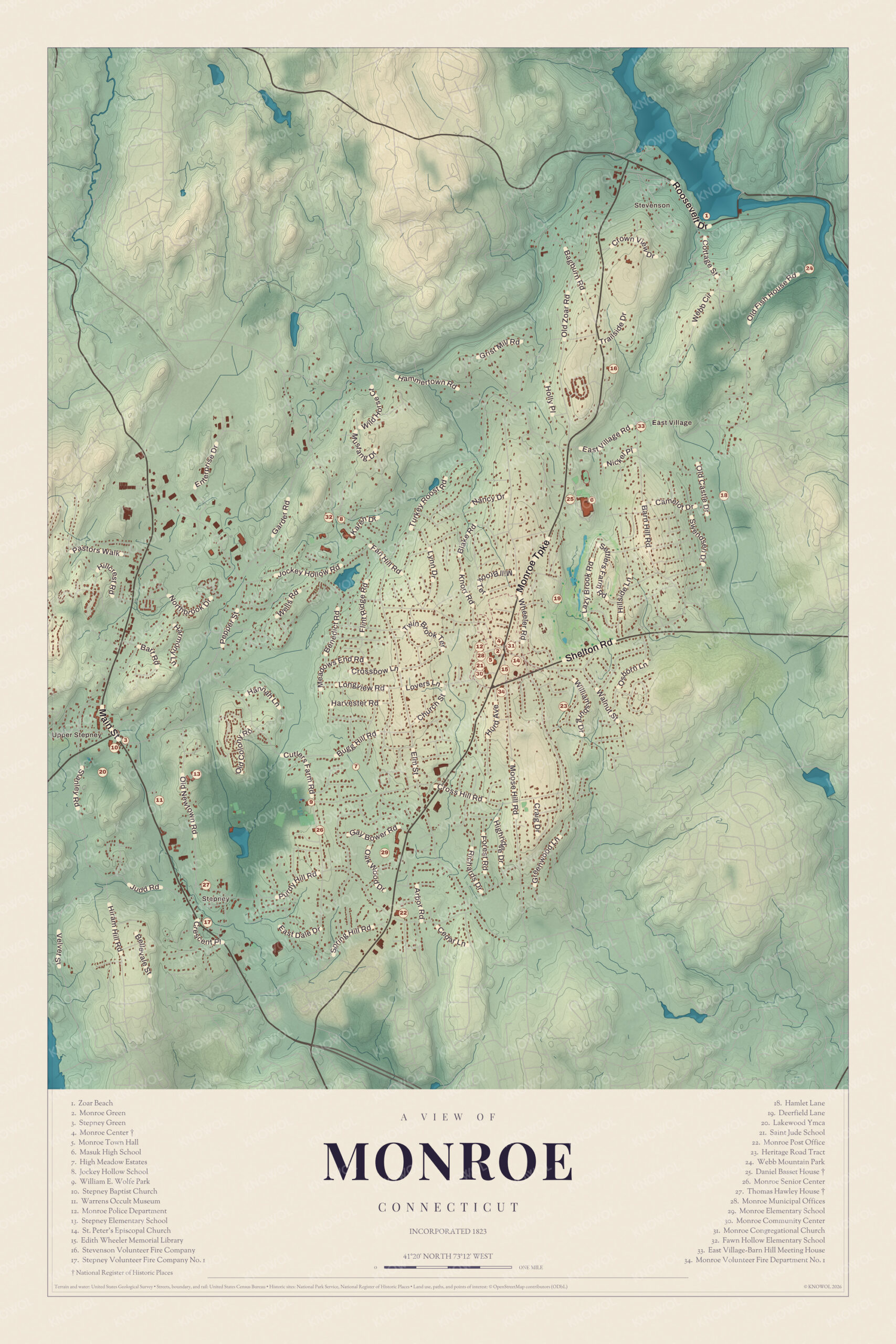
Monroe on the map
Click the map to look closer.
Monroe today
By KNOWOL
Shaded hills from Stepney in the west to Stevenson and Lake Zoar in the north, every street from Monroe Turnpike to Pepper Street, and a guide of 34 numbered landmarks with the National Register sites marked.5
The story of Monroe
A ball for the French officers
On June 30, 1781, Lauzun's Legion, a French cavalry unit marching beside Rochambeau's army toward Yorktown, camped near the village at Monroe Center. That evening a ball was held for its officers in Daniel Basset's house, built in 1775 on today's Monroe Turnpike, and a dance was held on the green for the soldiers. Monroe didn't forget that summer. In 1864 a pastor told the congregation that Mr. Deforest, who kept the first store and a public house on the west side of the green, had entertained the French officers and named his own son De Lazon after one of them. The Basset house still stands in front of Masuk High School, and a big room upstairs likely served as the ballroom.267
The leathern-apron judge
When Monroe's Congregational church turned one hundred in 1864, the Rev. T. T. Waterman told the town about its founders as tradition remembered them. Capt. Joseph Moore, who lived at the northeast corner of the green, gave the land for the meetinghouse and for the green itself, then saw the building through. It was raised in June 1769 but took about seventeen years to finish, because so many young men were away fighting the Revolution. Deacon John Judson of Elm Street sat as a justice in his leather apron instead of silk and a wig, so people called him the Leathern-apron judge. And when one young woman was warned she'd meet a headless man on a dark road, she said a man with his head on would scare her more.8910
Wagons, shirts and a camp meeting at Stepney
Stepney grew up along the Bridgeport and Newtown Turnpike, which opened in 1801, and its green was bought for public use in 1817 for $140. When the Housatonic Railroad came through in 1840, Barnum Curtiss bought a half share in Captain Leavenworth's mill, and he later ran the depot store. The Penfield brothers built wagons here before the Civil War, James Watson McNeil made hats, and in 1855 the tailor Willis Turney switched to shirts, putting in sewing machines and hiring fourteen or fifteen hands. The green drew crowds too. In 1843 Sojourner Truth calmed a frantic Millerite camp meeting there, and in 1861 P. T. Barnum and Elias Howe Jr. came up from Bridgeport and broke up a Copperhead peace rally.1112131415
Through the years
25 moments from 1662 to today.
- 1662Stratford's selectmen secure deeds from the Golden Hill Paugussett for the land that's now Trumbull, Shelton and Monroe.1
- 1671Stratford buys the rest of the northern land in the White Hills Purchase.1
- 1730The Thomas Hawley House, a saltbox farmhouse, is built on today's Purdy Hill Road.16
- 1755By tradition, Samuel Lewis moves his family from Stratford to the forest-covered hill that becomes Monroe Center.8
- 1761About seventy families, three to seven miles from the nearest meetinghouse, ask to form their own parish.17
- 1762The General Assembly makes them a separate society named New Stratford.18
- 1769The first meetinghouse is raised on land given by Capt. Joseph Moore, who also gave the green.9
- 1770About this year Mr. Deforest opens the first store at the center, on the west side of the green.7
- 1775The Daniel Basset House is built on what's now Monroe Turnpike.2
- 1781Lauzun's Legion camps near the village on June 30, and a ball is held for its officers at the Basset house.2
- 1802A London-made piano is given to Sylvia Curtiss, by tradition the first piano in town.19
- 1807The Zoar Bridge Company is incorporated to bridge the Housatonic.20
- 1807On September 18 Bishop Jarvis consecrates St. Peter's Church and confirms thirty-six people.21
- 1811John Wilcoxson gives the land for the Methodist meeting house at East Village.22
- 1817The militia's mustering ground at Upper Stepney is bought for public use for $140. It's the Stepney Green.11
- 1823Monroe holds its first town meeting on June 16 and votes to let pigs roam the common with rings in their noses.23
- 1824Schoolboys from Josiah Holbrook's school in Derby hike to Lane's mine in Monroe to collect minerals.24
- 1839Stepney's Methodist church is dedicated, after a fire burned the first load of building materials.25
- 1840Barnum Curtiss buys a half share in Captain Leavenworth's mill at Stepney, the year the Housatonic Railroad opens.12
- 1843Sojourner Truth attends a Millerite camp meeting on the Stepney Green.11
- 1847The present Congregational church is raised in July and dedicated in December.9
- 1855Willis Turney turns his Stepney tailor shop into a shirt factory with sewing machines.15
- 1861P. T. Barnum and Elias Howe Jr. break up a Copperhead peace rally on the Stepney Green.11
- 1888The railroad reaches Zoar Bridge, and the place is renamed Stevenson for the railroad's president.26
- 1919The Stevenson Dam is finished, and the Housatonic backs up into Lake Zoar.3
Places to see
The numbers match the landmark guide printed on the 2026 map.
- 1Zoar BeachLake Zoar. Monroe's boat ramp on the lake.
- 3Stepney GreenPepper Street, Upper Stepney. Militia ground bought for the public in 1817.
- 4Monroe CenterRoutes 110 and 111. Historic district of about 60 buildings.
- 9William E. Wolfe ParkSouth of town. Where the Pequonnock River begins.
- 14St. Peter's Episcopal ChurchMonroe Green. Federal style church at the south end.Visit their website
- 24Webb Mountain ParkStevenson. 135 acres of trails and campsites.
- 25Daniel Basset HouseMonroe Turnpike. Scene of the 1781 French ball.
- 27Thomas Hawley HousePurdy Hill Road. Saltbox farmhouse from Stepney's first years.
- 31Monroe Congregational ChurchMonroe Green. Raised and dedicated in 1847.
- 33East Village-Barn Hill Meeting HouseEast Village. Methodist meeting house on land given in 1811.
On the National Register
All 4 places in Monroe on the National Register of Historic Places that still stand today, oldest first, and why each one matters.4
-
Thomas Hawley House
A post-and-beam saltbox farmhouse and a rare survivor from the earliest years of Stepney's settlement. Thomas Hawley was one of the 48 men who asked for the New Stratford parish in 1761, and his descendants lived here for another century.16
-
Monroe Center Historic District
About 120 acres and some 60 significant buildings around the Monroe Center green, with history going back to 1762. On June 30, 1781, a dance was held on the green for about 600 French soldiers camped nearby on the march to Yorktown.6
-
Daniel Basset House
On the night of June 30, 1781, this house held a ball for the officers of Lauzun's Legion, the last entertainment for the French troops before they neared British-held New York. A large chamber on the second floor likely served as the ballroom.2
-
Stevenson Dam Hydroelectric Plant
The first high dam on the Housatonic, built by about 800 men working day and night, it created Lake Zoar. Route 34 crosses on a bridge built into the dam, and the powerhouse stands on the Monroe side.3
In their words
“The hills about us, as Bagburn and Barn and Moore, attracted early notice, and were favorite spots”
Rev. T. T. Waterman, centennial address at Monroe, 1864, in History of Fairfield County, 18818
“Capt. Moore, being a white-oak and persevering kind of man, held it on its course”
Rev. T. T. Waterman in 1864, on the building of Monroe's first meetinghouse, History of Fairfield County, 18819
“The little vine then planted in this wilderness still lives and flourishes.”
Rev. T. T. Waterman, on the Monroe church at one hundred, History of Fairfield County, 18818
Nearby towns
Sources
- Monroe, Connecticut, Wikipedia
- Daniel Basset House, Wikipedia
- Stevenson Dam Hydroelectric Plant, Wikipedia
- National Register of Historic Places listings in Fairfield County, Connecticut, Wikipedia
- Map of Monroe, Connecticut in 2026, KNOWOL (USGS elevation, Census Bureau roads)
- Monroe Center Historic District, Wikipedia
- History of Fairfield County, Connecticut (1881), on the Deforest store and the French officers, Internet Archive
- History of Fairfield County, Connecticut (1881), Rev. T. T. Waterman's 1864 address on Monroe, Internet Archive
- History of Fairfield County, Connecticut (1881), on Capt. Joseph Moore and the meetinghouse, Internet Archive
- History of Fairfield County, Connecticut (1881), on the Leathern-apron judge, Internet Archive
- Stepney Green (1817 to present), Monroe Historical Society
- Commemorative Biographical Record of Fairfield County, Connecticut (1899), on Barnum Curtiss, Internet Archive
- Commemorative Biographical Record of Fairfield County, Connecticut (1899), on the Penfield wagon makers, Internet Archive
- Commemorative Biographical Record of Fairfield County, Connecticut (1899), on hat making at Stepney, Internet Archive
- Commemorative Biographical Record of Fairfield County, Connecticut (1899), on Willis Turney, Internet Archive
- Thomas Hawley House, Wikipedia
- A history of the old town of Stratford and the city of Bridgeport, Connecticut (1886), on the 1761 petition, Internet Archive
- A history of the old town of Stratford and the city of Bridgeport, Connecticut (1886), on the Society of New Stratford, Internet Archive
- History of Fairfield County, Connecticut (1881), on the first piano in Monroe, Internet Archive
- A history of the old town of Stratford and the city of Bridgeport, Connecticut (1886), on the Zoar Bridge Company, Internet Archive
- History of Fairfield County, Connecticut (1881), on St. Peter's Church, Internet Archive
- East Village Meeting House, Monroe Historical Society
- History of Fairfield County, Connecticut (1881), on Monroe's first town meeting, Internet Archive
- The history of the old town of Derby, Connecticut, 1642-1880 (1880), on Lane's mine, Internet Archive
- History of Fairfield County, Connecticut (1881), on the Methodist church at Stepney, Internet Archive
- Stevenson 1 Railroad Station, Monroe Historical Society