
A seaport city on a deep harbor at the mouth of the Thames, burned by Arnold in 1781 and rebuilt in granite and Greek Revival on the money of a great whaling fleet.
Then and now
The same town 150 years apart. Click either map to look closer.
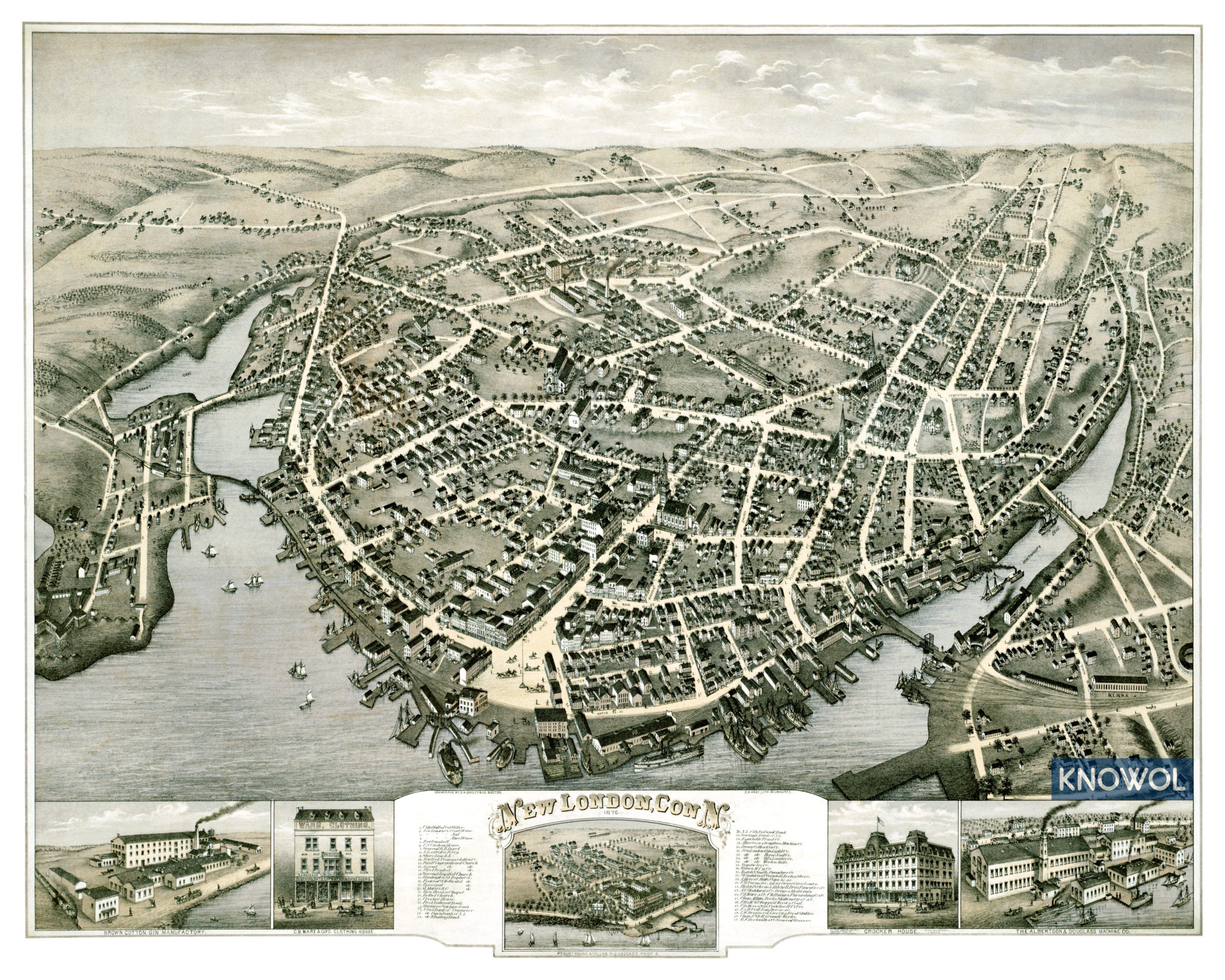
The bird's-eye view
By O.H. Bailey
New London drawn as if from the sky in 1876, with Fort Trumbull, the New London and Groton ferry, the Shore Line Railroad, the Crocker House, the National Whaling Bank, Brown Cotton Gin Company, Albertson and Douglass Machine Company and City Hall.4
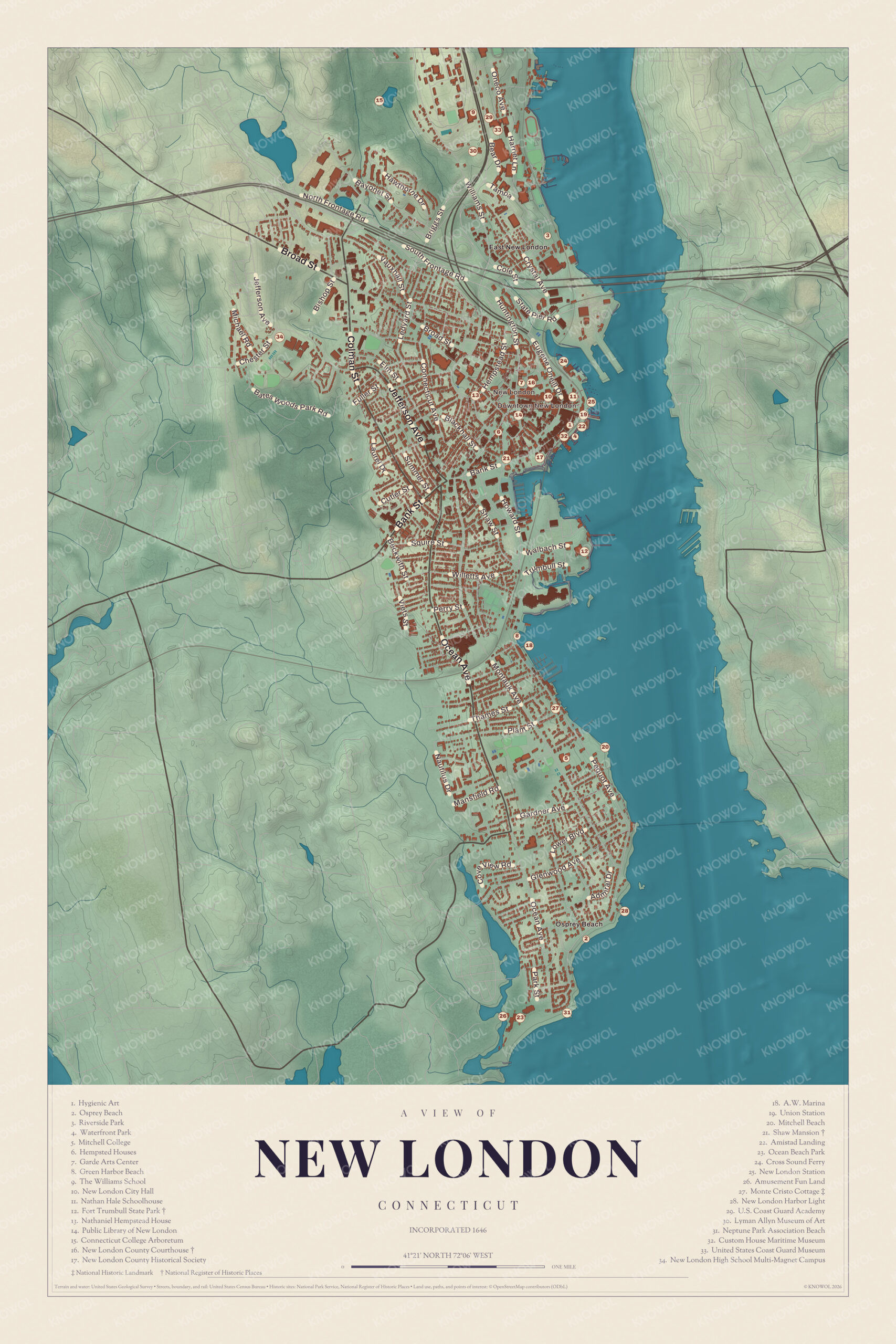
New London today
By KNOWOL
Shaded land from the Connecticut College Arboretum down to Ocean Beach, every street, downtown along the Thames waterfront, and a guide of 34 numbered landmarks with the National Historic Landmark and National Register sites marked.5
The story of New London
Saved by a cask of vinegar
On September 6, 1781, Benedict Arnold landed troops on both sides of the harbor, took Fort Trumbull and set New London on fire. Nathaniel Shaw's granite house on Blinman Street had been the state's naval office, and its wooden annex burned to the ground. When the flames caught the roof of the stone house, a neighbor climbed to the garret, found a cask of vinegar, knocked in the head and poured it down the roof until the fire was out. The house and the houses below it were saved. Twelve years later the state tried to make up the losses with land on Lake Erie, called the fire lands, though the town's historian wrote that very few of the real sufferers ever benefited from it.6789
Nine hundred whalemen
The War of 1812 and the embargo before it wiped out New London's old trade with the West Indies. In 1819 T. W. Williams and Daniel Deshon tried whaling instead. Williams's brig Mary came home the next June after ten months and twenty days at sea, with 744 barrels of whale oil and 78 of sperm. By 1834 more than thirty ships and 900 men and boys were in the whale and seal fishery, with about a million dollars at work. Whaling money built much of the city, including the four temple-front houses on Huntington Street still called Whale Oil Row, put up between 1835 and 1845 for owners who largely made their money in whaling.1011212
A harbor that stayed open
In 1680 the colony bragged that a 500-ton ship could sail right up to New London and come close enough to toss a biscuit ashore. In 1760 a lottery paid for a lighthouse at the harbor mouth, the first on the Connecticut coast, and the stone tower that replaced it in 1801 still stands, 90 feet tall. In January 1776 the first naval expedition ordered by Congress was fitted out here. On December 4, 1812, Commodore Decatur sailed in with the captured British frigate Macedonian. And in the deep cold of January 1835, when ice shut New York harbor, New London's stayed open. Its own historian called it the key of Long Island Sound.13141516171819
Through the years
25 moments from 1646 to today.
- 1646John Winthrop Jr. founds the English settlement at Nameaug.1
- 1650A grist mill is set up on Briggs Brook, said to be by Winthrop himself.20
- 1658On March 24 the town is officially named New London.1
- 1661The New London Tryall, the first merchant vessel built here, is launched.13
- 1678About this year the Joshua Hempsted House is built.21
- 1756Colonel George Washington stays in town on his way to and from Boston.22
- 1756Nathaniel Shaw Sr. builds his granite house on Blinman Street.9
- 1758The New London Summary, the town's first newspaper, comes out on August 8.23
- 1760A lottery pays for the first lighthouse on the Connecticut coast, at the harbor mouth.14
- 1768Town meeting fines anyone who lets barberry bushes grow on their land.24
- 1776Commodore Hopkins's fleet, the first naval expedition ordered by Congress, is fitted out here.16
- 1781On September 6 Benedict Arnold's troops take Fort Trumbull and burn much of the town.1
- 1784New London becomes one of Connecticut's first five cities.1
- 1786The city sets up its first regular fire company.25
- 1793The state grants fire lands on Lake Erie to people burned out in 1781.7
- 1801The present stone tower of New London Harbor Light is built.15
- 1812Commodore Decatur sails in on December 4 with the captured frigate Macedonian.17
- 1819T. W. Williams and Daniel Deshon start the whaling business anew.10
- 1833The granite Customhouse by Robert Mills is built on Bank Street.26
- 1835In January the harbor stays open while ice closes New York's.18
- 1876O.H. Bailey publishes his bird's-eye view of New London.4
- 1884The actor James O'Neill buys land on Pequot Avenue, the future Monte Cristo Cottage.27
- 1887H. H. Richardson's Union Station opens downtown.28
- 1932The Coast Guard Academy moves to its present site in the north of the city.1
- 1940The city opens Ocean Beach Park.5
Places to see
The numbers match the landmark guide printed on the 2026 map.
- 6Hempsted HousesHempstead Street. House of about 1678, a museum.Visit their website
- 11Nathan Hale SchoolhouseDowntown. Where Hale taught before the war.
- 12Fort Trumbull State ParkFort Neck. Granite fort built 1839 to 1852.Visit their website
- 14Public Library of New LondonState and Huntington Streets. Richardsonian Romanesque library of 1889 to 1892.Visit their website
- 16New London County CourthouseTop of State Street. Built in 1784.
- 19Union StationDowntown. H. H. Richardson's last and largest station.
- 21Shaw MansionBlinman Street. Connecticut's naval office in the Revolution.Visit their website
- 27Monte Cristo CottagePequot Avenue. Eugene O'Neill's boyhood summer home.Visit their website
- 28New London Harbor LightPequot Avenue. Connecticut's oldest and tallest lighthouse.Visit their website
- 32Custom House Maritime MuseumBank Street. Robert Mills's granite customhouse of 1833.Visit their website
On the National Register
21 of the 40 places in New London on the National Register of Historic Places that still stand today, oldest first, and why each one matters. See the full list of National Register places in New London.3
-
Winthrop Mill
Also called the Old Town Mill, it was established on Briggs Brook in 1650, supposedly by John Winthrop Jr. and William Comstock. Arnold's men set it afire in 1781, but its elevated flume, wheel pit and tail race may be close to the originals.20
-
Joshua Hempstead House
One of Connecticut's oldest buildings, with diamond-pane windows and exposed framing. It stayed in the Hempstead family until 1937 and is now a museum run by Connecticut Landmarks.21
-
Shaw Mansion
The granite house of the merchant Nathaniel Shaw Sr. served as Connecticut's naval office in the Revolution. It survived the 1781 burning and has been the New London County Historical Society's museum since 1907.9
-
Nathaniel Hempstead House
A stone house with a gambrel roof, unlike anything else in the city, long called the Old Huguenot House. Acadian exiles may have been among its builders.29
-
New London County Courthouse
A gambrel-roofed courthouse at the head of State Street, attributed to Isaac Fitch and called the oldest courthouse in Connecticut by a plaque on the building. It has also been a yellow fever hospital and a Union Army recruiting center.30
-
New London Harbor Lighthouse
The 90-foot stone tower replaced the light of 1760. It's the oldest and tallest lighthouse in Connecticut and on Long Island Sound.15
-
Deshon-Allyn House
A stone Federal house built for Captain Daniel Deshon, master of a whaling ship, and later owned by the whaling captain Lyman Allyn. It stands on the campus of the Lyman Allyn Art Museum.31
-
New London Customhouse
Robert Mills designed it in granite from Waterford's Millstone Quarry, and its door is made of wood once used in the USS Constitution. The schooner Amistad was held at a wharf behind it in 1839 and 1840; it is now the Custom House Maritime Museum.26
-
Whale Oil Row
Four matching Greek temple-front houses with Ionic porticos, built for owners who made their money in whaling. The row may be unique in the United States.12
-
Fort Trumbull
The first fort here, finished in 1777 and named for Governor Jonathan Trumbull, fell to Arnold's troops in 1781. The massive granite fort that stands now was built from 1839 to 1852 and is a state park.8
-
Antone DeSant Houses
Built for Antone DeSant, a whaler born in Cape Verde in 1816, they were his home and place of business. One building's curved side follows the course of Truman's Brook, which is now paved over.32
-
Coit Street Historic District
Coit Street, probably laid out in the late 1640s along the shore of Bream Cove, is one of the city's oldest. The cove was later filled, and most of the 33 houses are Greek Revival.33
-
Downtown New London Historic District
More than 220 buildings along the waterfront on Bank, State and Green Streets, rebuilt after the 1781 burning. The district stands, though the 1853 First Church inside it collapsed in 2024.34
-
Monte Cristo Cottage
National Historic Landmark
The summer home of the actor James O'Neill and his son, the playwright Eugene O'Neill, and the setting of Ah, Wilderness! and Long Day's Journey into Night. A National Historic Landmark, it is now a museum.27
-
Huntington Street Baptist Church
Universalists who split from the Baptists built this Greek Revival church on a granite ledge, meaning to have the highest steeple in the city. A Baptist congregation later bought it.35
-
St. James Episcopal Church
Richard Upjohn designed this Gothic Revival church for a parish founded in 1725, whose first church burned in 1781. Bishop Samuel Seabury, the first bishop of the Episcopal Church in the United States, is buried here.36
-
Central Vermont Railroad Pier
A granite-lined pier 1,100 feet long where freighters unloaded straight onto trains, believed to be the only 19th-century pier left in Connecticut. It is now part of an offshore wind port.37
-
New London Railroad Station
Union Station was the last and largest station designed by H. H. Richardson. Saved from urban renewal after its listing, it was the first station restored for Amtrak's use.28
-
New London Public Library
The gift of the whaling merchant Henry P. Haven, designed by Shepley, Rutan and Coolidge from H. H. Richardson's preliminary designs.38
-
Williams Memorial Institute
Harriet Peck Williams founded the school in memory of her son, and for decades it was the girls' high school for the city. The Richardsonian Romanesque building is now a state courthouse.39
-
Lighthouse Inn
William Ralph Emerson designed this Mission style summer home for the steel man Charles S. Guthrie. It opened as an inn in 1927 and drew Hollywood stars in the 1940s.40
In their words
“New London harbor is the key of Long Island Sound and the only naval station of importance between Newport and New York.”
Frances M. Caulkins, History of New London, 185219
“A ship of five hundred tunns may go up to the Town, and come so near shoar that they may toss a biskitt on shoar.”
The colony of Connecticut asking for a free port, 1680, quoted in A history of Connecticut, 191413
“No city in this country has the advantages of New London, in this particular, where the materials for erecting houses can be found in their streets.”
John Warner Barber, Connecticut historical collections, 1836, on the city's granite41
Nearby towns
Sources
- New London, Connecticut, Wikipedia
- Connecticut historical collections (1836), John Warner Barber, on New London's whale fishery, Internet Archive
- National Register of Historic Places listings in New London County, Connecticut, Wikipedia
- Bird's-eye view of New London, Connecticut from 1876, restored by KNOWOL
- Map of New London, Connecticut in 2026, KNOWOL (USGS elevation, Census Bureau roads)
- History of New London, Connecticut (1852), Frances M. Caulkins, on the Shaw house in 1781, Internet Archive
- History of New London, Connecticut (1852), Frances M. Caulkins, on the fire lands, Internet Archive
- Fort Trumbull, Wikipedia
- Shaw Mansion (New London, Connecticut), Wikipedia
- History of New London, Connecticut (1852), Frances M. Caulkins, on whaling after 1819, Internet Archive
- History of New London, Connecticut (1852), Frances M. Caulkins, on the brig Mary, Internet Archive
- Whale Oil Row, Wikipedia
- A history of Connecticut (1914), on New London's early shipping, Internet Archive
- History of New London, Connecticut (1852), Frances M. Caulkins, on the lighthouse lottery, Internet Archive
- New London Harbor Light, Wikipedia
- A catalogue of the names of the early Puritan settlers of the colony of Connecticut (1852), on Commodore Hopkins's fleet, Internet Archive
- History of New London, Connecticut (1852), Frances M. Caulkins, on Decatur and the Macedonian, Internet Archive
- Connecticut historical collections (1836), John Warner Barber, on the winter of 1835, Internet Archive
- History of New London, Connecticut (1852), Frances M. Caulkins, on the harbor, Internet Archive
- Winthrop Mill, Wikipedia
- Joshua Hempsted House, Wikipedia
- History of New London, Connecticut (1852), Frances M. Caulkins, on Washington's visit of 1756, Internet Archive
- History of New London, Connecticut (1852), Frances M. Caulkins, on the New London Summary, Internet Archive
- History of New London, Connecticut (1852), Frances M. Caulkins, on the barberry edict, Internet Archive
- History of New London, Connecticut (1852), Frances M. Caulkins, on the first fire company, Internet Archive
- New London Customhouse, Wikipedia
- Monte Cristo Cottage, Wikipedia
- New London Union Station, Wikipedia
- Nathaniel Hempstead House, Wikipedia
- New London County Courthouse, Wikipedia
- Deshon-Allyn House, Wikipedia
- The Preservationist, November and December 2025, New London Landmarks, on the DeSant Houses
- Coit Street Historic District, Wikipedia
- Downtown New London Historic District, Wikipedia
- Huntington Street Baptist Church, Wikipedia
- St. James Episcopal Church (New London, Connecticut), Wikipedia
- Central Vermont Railroad Pier, Wikipedia
- New London Public Library, Wikipedia
- The Williams School (Williams Memorial Institute), Wikipedia
- Lighthouse Inn (New London, Connecticut), Wikipedia
- Connecticut historical collections (1836), John Warner Barber, on New London's granite, Internet Archive