
A mill town built around the falls of the Quinebaug, where the first cotton factory in eastern Connecticut began spinning in 1807 and three quarreling mill villages fought six years to become one town, named for General Israel Putnam.
Putnam on the map
Click the map to look closer.
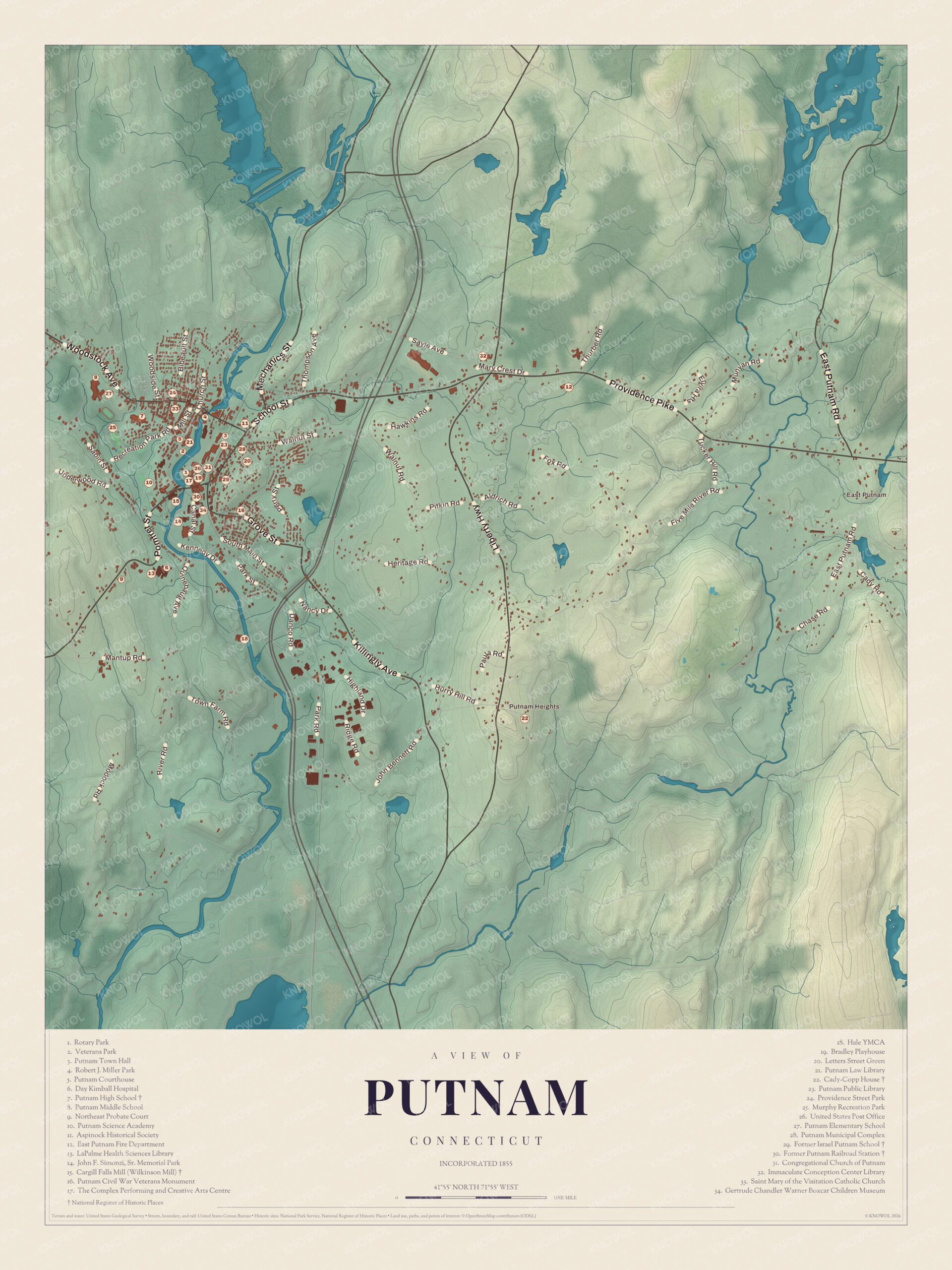
Putnam today
By KNOWOL
Shaded land from the Quinebaug valley downtown up to Putnam Heights and out to the Five Mile River at East Putnam, every street by name, and a guide of 34 numbered landmarks with the National Register sites marked.5
The story of Putnam
Six years to become a town
By the 1840s the mill villages around the falls belonged to three different towns, and nobody could run them as one place. In May 1849 the villagers asked the legislature for a new town to be called Quinebaug, and the old towns got the petition thrown out. They tried again in 1851 and lost again. The proposed town was shaped like a funnel, and the 1889 county history says a drawing of it shown to lawmakers drew so much ridicule it helped sink the early tries. In 1854 the movement took Putnam as its name. Sidney Deane, elected Thompson's representative on a promise not to raise the question, raised it anyway. When the town won in 1855, bells rang and cannon boomed, and Edmond Wilkinson, who led the fight, paid five-sixths of the legal bills.6789
The little girls in men's boots
Putnam's first cotton mill belonged to the Pomfret Manufacturing Company, formed in 1806 by Rhode Island investors, and Smith Wilkinson, the youngest of the Wilkinson brothers, ran it. He picked the Fourth of July to raise its frame, and people came from all the nearby towns to help. On April 1, 1807, the four-story wooden mill started spinning, the first cotton factory in eastern Connecticut. Its first hands were neighborhood children paid about seven shillings a week, and when snow blocked the roads one morning the little girls put on men's boots and waded through the drifts to get to work. In one year of the War of 1812 the mill paid a $36,000 dividend. Wilkinson once counted a haycock for every day of the year, and a village cow went house to house so every family had fresh milk.2103
Cargill's mills at the falls
Long before there was a town, the High Falls of the Quinebaug drew people. For twenty years Peter Aspinwall begged the colony for a bridge here, and in 1723 Captain John Sabin and his sons simply built one. In 1730 David Howe, a clothier from Mendon, set up a grist mill, malt house and dye house on the point between the Quinebaug and Mill River. Benjamin Cargill bought the whole place in 1760. His mills ground so well that farmers in neighboring towns drove right past their own mills to reach his. One loft held a Baptist meeting room, and in 1786 the third meeting of Connecticut's first medical society was held there. Selling up in 1793, Cargill promised buyers the spot was and must be a place of great trade.1112
Through the years
25 moments from 1691 to today.
- 1691Woodstock sends Peter Aspinwall to cut a road across the Quinebaug toward Providence.13
- 1693Richard Evans of Rehoboth is living here, the first known settler within today's Putnam.13
- 1708Killingly is organized, and the old name Aspinock falls out of use.13
- 1723Captain John Sabin and his sons build the first bridge over the Quinebaug below the High Falls.11
- 1760Benjamin Cargill buys the mills at the falls and makes them known across the region.12
- 1786The third meeting of Connecticut's first medical society is held at Cargill's mills.12
- 1806Rhode Island investors form the Pomfret Manufacturing Company to spin cotton at the falls.3
- 1807On April 1 the first cotton factory in eastern Connecticut starts running.2
- 1812Smith Wilkinson builds a brick schoolhouse for the growing factory village.10
- 1840The Norwich and Worcester Railroad arrives and downtown starts to grow around the depot.14
- 1849A first petition for a new town, to be called Quinebaug, is turned down.7
- 1855Putnam is incorporated and named for General Israel Putnam; its first town meeting is held July 3 in Quinebaug Hall.9
- 1870Putnam turns out by the thousands to welcome President Grant.15
- 1874The new high school on Church Street, today's Town Hall, is dedicated.16
- 1877The great fire of October sweeps through the heart of the village.17
- 1878G. A. Hammond and C. C. Knowlton start making silk thread in Putnam.18
- 1880An Antique Art Loan Exhibition of nearly 3,000 items marks the town's 25th birthday.19
- 1886Water from the outlet of Woodstock Lake starts flowing to the village.20
- 1890Gertrude Chandler Warner, author of The Boxcar Children, is born in Putnam.21
- 1894Day Kimball Hospital opens.5
- 1901The Bradley Theatre, today's Bradley Playhouse, is finished on January 29.1
- 1907The New Haven Railroad builds the new railroad station on Main Street.14
- 1955On August 19 the flood from two hurricanes tears through Putnam.1
- 1971The last passenger train stops at Putnam on April 30.14
- 2004The Gertrude Chandler Warner Boxcar Children Museum opens on July 3.5
Places to see
The numbers match the landmark guide printed on the 2026 map.
- 3Putnam Town HallChurch Street. Built in 1874 as the high school.
- 6Day Kimball HospitalThe West End. Opened in 1894 in a son's memory.
- 11Aspinock Historical SocietyNorth of downtown. Keeps the old name Aspinock alive.Visit their website
- 15Cargill Falls MillPomfret Street. Mill complex on the 1806 falls site.
- 16Putnam Civil War Veterans MonumentSoutheast of downtown. Honors the town's Civil War soldiers.
- 19Bradley PlayhouseDowntown. The Bradley Theatre of 1901.Visit their website
- 22Cady-Copp HousePutnam Heights. Colonial house with no plumbing or electricity.
- 29Former Israel Putnam SchoolSchool and Oak Streets. The town's first modern school, 1902.
- 30Former Putnam Railroad StationMain Street. Mediterranean-style depot of 1907.
- 34Gertrude Chandler Warner Boxcar Children MuseumDowntown. Inside a 1920s railroad boxcar.Visit their website
On the National Register
All 5 places in Putnam on the National Register of Historic Places that still stand today, oldest first, and why each one matters.4
-
Cady-Copp House
Joseph Cady built this gambrel-roofed house for his daughter Damaris, who was marrying Perley Howe, the second minister at Putnam Heights. Its inside is almost unchanged, with no plumbing or electricity, and it went to the local historical society in 1992.22
-
Cargill Falls Mill (Wilkinson Mill)
Founded in 1806 by the Pomfret Manufacturing Company, it's one of the state's oldest mill complexes, with twenty connected buildings on about 7.5 acres. The first wooden mill was copied from Slater's mill in Pawtucket, and its foundation still carries a later building.3
-
Putnam High School (Putnam Town Hall)
The town voted in 1873 to build a high school, and its first class graduated in 1876. It's one of the oldest surviving high school buildings in the state, a Ruskinian Gothic building with two towers, and it now holds town offices.16
-
Israel Putnam School
Putnam's first modern school building and its first with an auditorium, designed with an imposing front to show seriousness of purpose. It has been turned into homes.23
-
Putnam Railroad Station
Built by the New York, New Haven and Hartford Railroad, with a terra cotta tile roof and colored brick that give it a Mediterranean look. Passenger trains stopped here until April 30, 1971.14
In their words
“Putnam went bravely onward, preeminently the modern town of northeastern Connecticut, booming with life, hope and energy”
History of Windham County, Connecticut, 1889, on the new town after 185524
“Few battles have been fought in which there was more harmony among the assailants. There were no traitors in the camp.”
History of Windham County, Connecticut, 1889, on the fight to make Putnam a town7
“the town of Putnam owes its prosperity, owes its reputation, and owes the spirit of its people to that name”
Edgar M. Warner of Putnam, speaking to the Sons of the American Revolution, 189625
Nearby towns
Sources
- Putnam, Connecticut, Wikipedia
- History of Windham County, Connecticut (1889), on the first cotton factory, Internet Archive
- Cargill Falls Mill, Wikipedia
- National Register of Historic Places listings in Windham County, Connecticut, Wikipedia
- Map of Putnam, Connecticut in 2026, KNOWOL (USGS elevation, Census Bureau roads)
- History of Windham County, Connecticut (1889), on the shape of the new town, Internet Archive
- History of Windham County, Connecticut (1889), on the petitions for a new town, Internet Archive
- History of Windham County, Connecticut (1889), on Sidney Deane, Internet Archive
- History of Windham County, Connecticut (1889), on the new town's victory and first meeting, Internet Archive
- History of Windham County, Connecticut (1889), on life in Pomfret Factory village, Internet Archive
- History of Windham County, Connecticut (1889), on Sabin's bridge, Internet Archive
- History of Windham County, Connecticut (1889), on Cargill's mills, Internet Archive
- History of Windham County, Connecticut (1889), on Putnam's first settlers, Internet Archive
- Putnam station, Wikipedia
- History of Windham County, Connecticut (1889), on President Grant's reception, Internet Archive
- Putnam Town Hall, Wikipedia
- History of Windham County, Connecticut (1889), on the great fire, Internet Archive
- History of Windham County, Connecticut (1889), on the silk mills, Internet Archive
- History of Windham County, Connecticut (1889), on the Antique Art Loan Exhibition, Internet Archive
- History of Windham County, Connecticut (1889), on the water works, Internet Archive
- Gertrude Chandler Warner, Wikipedia
- Cady-Copp House, Wikipedia
- Israel Putnam School, Wikipedia
- History of Windham County, Connecticut (1889), on Putnam's early years as a town, Internet Archive
- Year-book of the Connecticut Society of the Sons of the American Revolution (1896), Internet Archive