
A small farm town on Merrick's Brook, named by its first settler for his native Scotland, where Samuel Huntington was born and six generations of Waldos kept one house for more than 250 years.
Scotland on the map
Click the map to look closer.
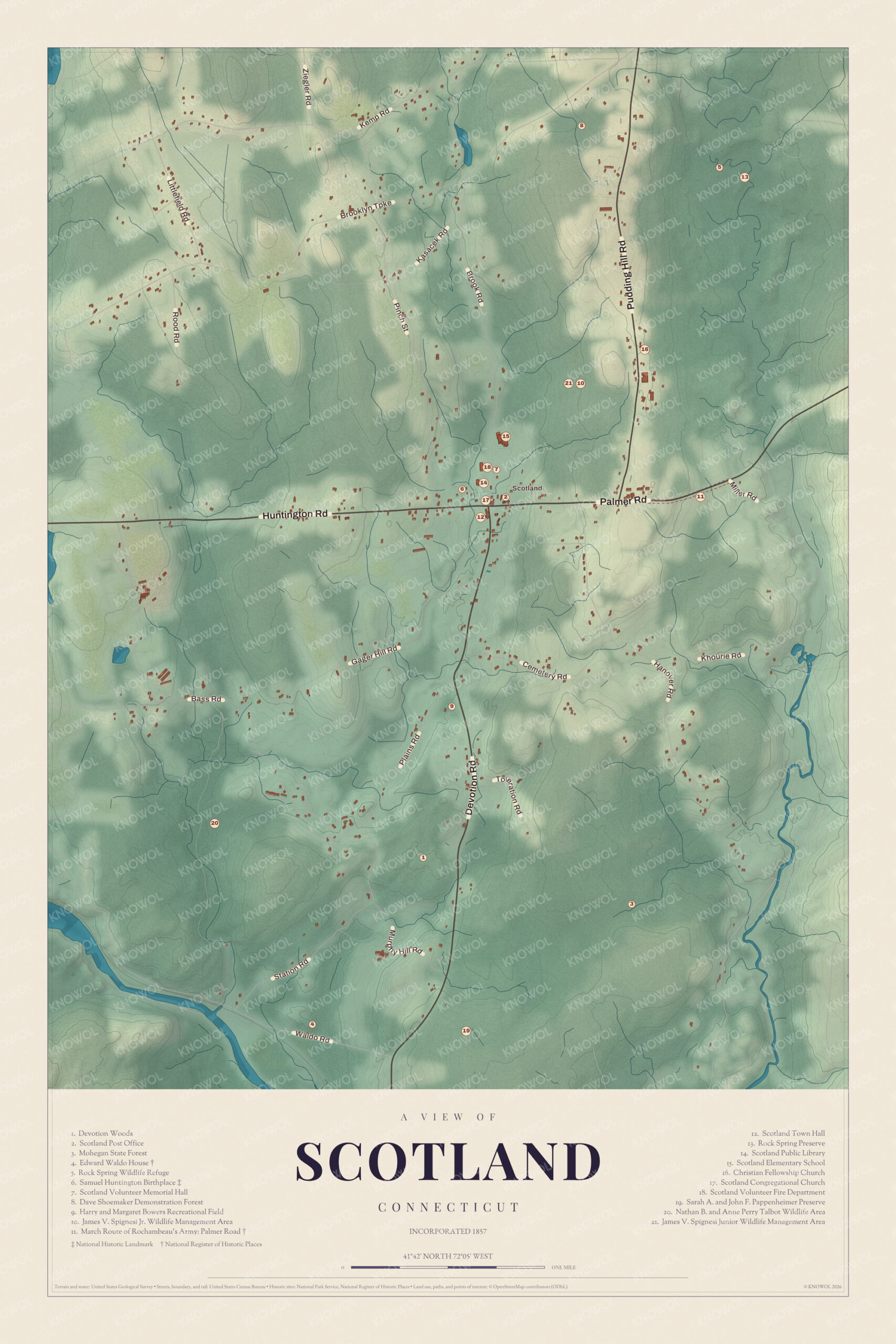
Scotland today
By KNOWOL
Shaded hills from Parish Hill in the north down to the woods along the Sprague line, every road from Huntington Road to Gager Hill Road, and a guide of 21 numbered landmarks with the National Historic Landmark and the National Register sites marked.6
The story of Scotland
Twenty families on Merrick's Brook
Isaac Magoon came to Windham in 1698 and went looking east, into country nobody had settled yet. In 1700 he built a small house on the east side of Merrick's Brook and named the place Scotland, after his native country. Within two or three years about twenty families had joined him, drawn by good soil and enough water to turn their mills. A sawmill went up on the brook, and in 1706 a gristmill was allowed on Wolf Pit Brook. For Sunday meeting they still went seven or eight miles over a rough trail to Windham Green. In 1732 Scotland became a parish of about eighty families, and on October 22, 1735, it gathered its own church with eighty-nine members.237
The cooper's apprentice and his brothers
Samuel Huntington was born in Scotland on July 3, 1731, in the saltbox house that still stands on Route 14. His father was a farmer and clothier, and young Samuel was apprenticed to a cooper. He picked up Latin and studied law in borrowed books, and before he was thirty he was a promising lawyer in Norwich, married to a Scotland playmate, Martha Devotion, the minister's daughter. He went on to sign the Declaration of Independence, preside over the Continental Congress and serve as governor. His brothers made their mark too. Enoch and Joseph became ministers, and Jonathan, a doctor and preacher with a gift for music, is remembered as the composer of the old round "Scotland's Burning."68910
The youngest daughter
Scotland finally broke away from Windham in 1857, and held its first town meeting on the Fourth of July, with a celebration in the church that afternoon. By 1892, when Edwin Baker Gager stood up at Windham's 200th birthday to speak for the youngest of Old Windham's daughters, the town had fewer than five hundred people, down from about a thousand in 1860. Its sons and daughters had gone to Providence, Norwich and Hartford, and a whole colony of them lived in Nebraska. The ones who stayed kept busy. They voted the town dry in 1884, started Shetucket Grange in 1887, voted money for a free library in 1894 and brought all five district schools together at the center in 1895.41112
Through the years
24 moments from 1698 to today.
- 1698Isaac Magoon comes to the new settlement of Windham and heads east to find a home.2
- 1700Magoon builds on the east side of Merrick's Brook and names the place Scotland, after his native country.2
- 1706Leave is given to build a gristmill on Wolf Pit Brook; a sawmill already stands on Merrick's Brook.3
- 1715About this year Edward Waldo builds the first house in what's now Scotland.13
- 1731Samuel Huntington is born on July 3 in the house on today's Route 14.6
- 1732Scotland becomes a parish of Windham, with about eighty families.3
- 1735The Scotland church is gathered on October 22 with eighty-nine members, Ebenezer Devotion its pastor.7
- 1746More than twenty members leave to form the Separate church known as Brunswick Church.14
- 1772The parish votes to build a new meeting house and pays Elisha Lillie 450 pounds to build it.15
- 1778Governor Trumbull calls on Ebenezer Devotion of Scotland Parish for one hundred barrels of musket powder.16
- 1781Rochambeau's French army marches over the road east of the village, and comes back the same way in 1782.17
- 1790A social library is formed for the east part of Windham.18
- 1813The Brunswick Church votes itself out of existence; its meeting house stands until about 1850.14
- 1842The present Congregational meeting house goes up on the site of the second one.4
- 1857Scotland is incorporated as a town, and holds its first town meeting on July 4.4
- 1884The town votes no license, and is still a dry town in 1920.12
- 1887Shetucket Grange is organized with twenty-four charter members.12
- 1892Edwin Baker Gager speaks for Scotland, the youngest of Old Windham's daughters, at Windham's 200th birthday.11
- 1894The town votes money every year for a free public library.12
- 1895The five district schools are joined into one school at the center.12
- 1907A golden jubilee on July 4 marks fifty years as a town.19
- 1971The Samuel Huntington Birthplace is named a National Historic Landmark.10
- 1975Ruth Fanshaw Waldo gives the Waldo House, with everything in it, to the Scotland Historical Society.13
- 2005The D'Elia Antique Tool Museum opens in the library building.1
Places to see
The numbers match the landmark guide printed on the 2026 map.
- 3Mohegan State ForestThe southern woods. Began with a gift in 1960.
- 4Edward Waldo HouseWaldo Road. The first house in Scotland.
- 5Rock Spring Wildlife RefugeThe northeast. Shares its spot with Rock Spring Preserve.
- 6Samuel Huntington BirthplaceHuntington Road. The signer's saltbox boyhood home.Visit their website
- 8Dave Shoemaker Demonstration ForestThe northeast. Woods just west of Rock Spring.
- 10James V. Spignesi Jr. Wildlife Management AreaNortheast of the village. State wildlife land.
- 11March Route of Rochambeau's Army: Palmer RoadRoute 14, east of the village. The French army's road of 1781.
- 12Scotland Town HallThe village center. Beside the Huntington Homestead.
- 14Scotland Public LibraryThe village center. Home of the D'Elia Antique Tool Museum.Visit their website
- 17Scotland Congregational ChurchThe village center. The parish church gathered in 1735.
On the National Register
All 3 places in Scotland on the National Register of Historic Places that still stand today, oldest first, and why each one matters.5
-
Edward Waldo House
Edward Waldo, a farmer and deacon of the Congregational church, built it on land he bought in 1702, and it was the first house built in what's now Scotland. Six generations of Waldos lived here before Ruth Fanshaw Waldo gave it, with its contents, to the Scotland Historical Society in 1975, and it is now a museum.13
-
Samuel Huntington Birthplace
National Historic Landmark
The birthplace and boyhood home of Samuel Huntington, signer of the Declaration of Independence, president of the Continental Congress and governor of Connecticut. It is a classic saltbox around a big central chimney, with its woodwork and plaster almost all original, and the Governor Samuel Huntington Trust opens it as a museum.10
-
March Route of Rochambeau's Army: Palmer Road
About 2,000 feet of road that French troops under Rochambeau marched in 1781, and again on their way back in 1782. Their chroniclers called it narrow, steep and stony, and it still climbs between fieldstone walls and open farmland much as they described.17
In their words
“The youngest daughter is always the favorite.”
Edwin Baker Gager, speaking for Scotland at Windham's 200th birthday, 189211
“She is very fair to look upon, she has an indomitable spirit and is greatly beloved of her own.”
Edwin Baker Gager, on his native town of Scotland, 189211
“I heard Tom Bingham was sick and I was terrible 'fraid I would not get a cradle, so I come over to see about it.”
A Lebanon farmer, as Dr. A. D. Ayer remembered him, A modern history of Windham County, 192020
Nearby towns
Sources
- Scotland, Connecticut, Wikipedia
- A modern history of Windham County, Connecticut (1920), on Isaac Magoon and the first settlers, Internet Archive
- A modern history of Windham County, Connecticut (1920), on Scotland's early mills and the parish, Internet Archive
- A modern history of Windham County, Connecticut (1920), on the 1842 meeting house and the new town of 1857, Internet Archive
- National Register of Historic Places listings in Windham County, Connecticut, Wikipedia
- Map of Scotland, Connecticut in 2026, KNOWOL (USGS elevation, Census Bureau roads)
- A modern history of Windham County, Connecticut (1920), on the gathering of the Scotland church, Internet Archive
- History of Windham County, Connecticut (1874), on the Huntington brothers, Internet Archive
- The Connecticut magazine (1899), on Samuel Huntington and Martha Devotion, Internet Archive
- Samuel Huntington Birthplace, Wikipedia
- A memorial volume of the bi-centennial celebration of the town of Windham, Connecticut (1893), Edwin Baker Gager's response for Scotland, Internet Archive
- A modern history of Windham County, Connecticut (1920), on no license, the Grange, the library and the schools, Internet Archive
- Edward Waldo House, Wikipedia
- Contributions to the ecclesiastical history of Connecticut (1861), on the Brunswick Church, Internet Archive
- A modern history of Windham County, Connecticut (1920), on the Brunswick Meeting House and the 1772 meeting house, Internet Archive
- History of Windham County, Connecticut (1889), on the Revolution, Internet Archive
- March Route of Rochambeau's Army: Palmer Road, Wikipedia
- A modern history of Windham County, Connecticut (1920), on Scotland Parish after the Revolution, Internet Archive
- A modern history of Windham County, Connecticut (1920), on the 1907 golden jubilee, Internet Archive
- A modern history of Windham County, Connecticut (1920), Doctor Ayer's recollections of Scotland, Internet Archive