
A farm town on the Massachusetts line, once East Enfield and a Massachusetts town until 1749, where Charles Backus trained ministers, Levi Pease ran his first stages, and the mill village of Somersville grew up on the Scantic River.
Somers on the map
Click the map to look closer.
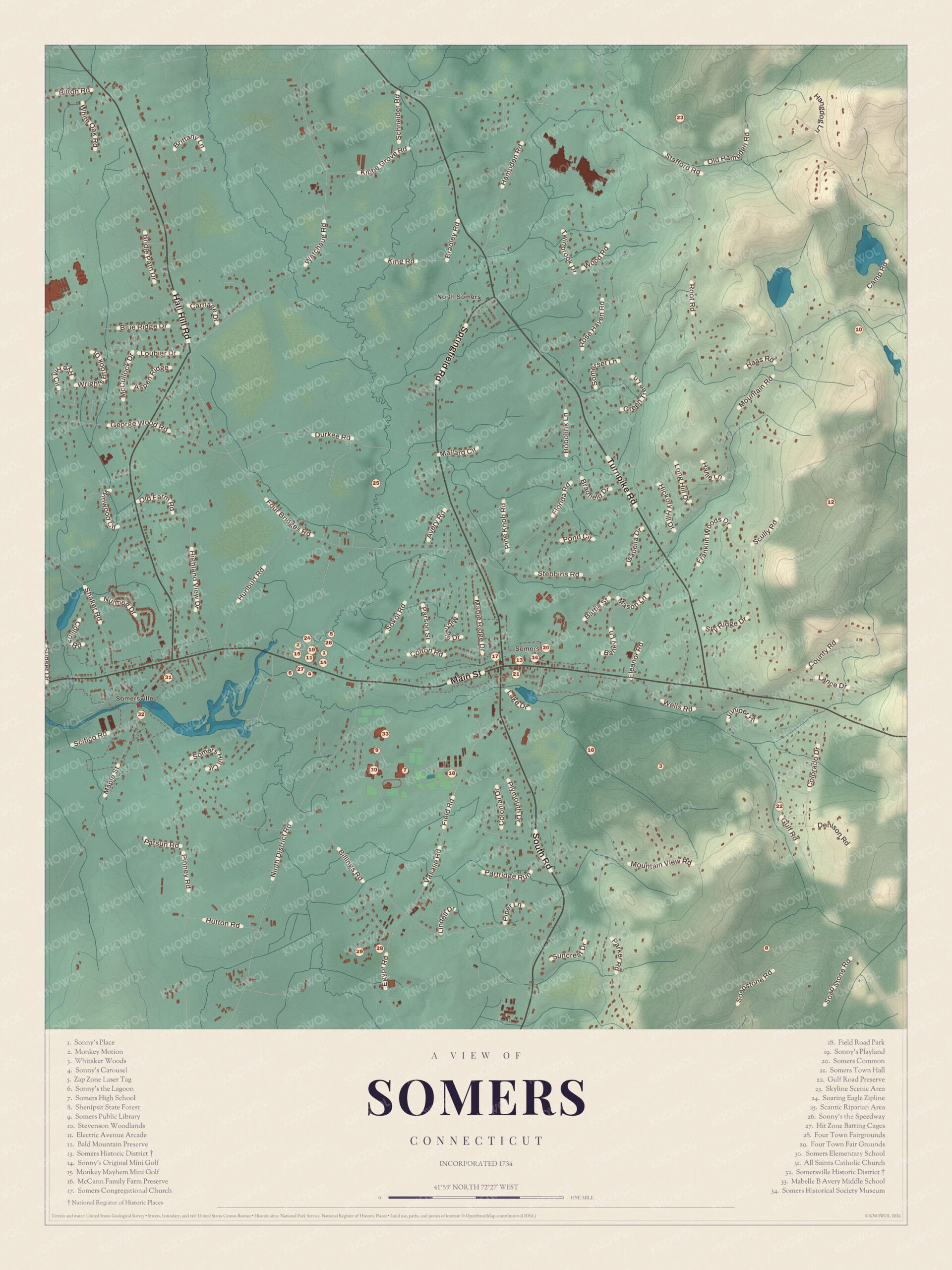
Somers today
By KNOWOL
Shaded hills from Bald Mountain in the east down to the Scantic River at Somersville, every street from Main Street to Watchaug Road, and a guide of 34 numbered landmarks with the National Register sites marked.4
The story of Somers
Sitting on the sills
Somers began as the far eastern end of Enfield, inside the old bounds of Springfield. Benjamin Jones came first, living on his land in summer and going back to Enfield for the winters. In 1713 Edward Kibbe, James Pease, Timothy Root and Robert Montgomery brought their families and stayed, and Root's house on the mountain served for worship until there was a meetinghouse. The church was gathered on March 15, 1727, with the Rev. Samuel Allis as pastor. Four years later the meetinghouse went up, and an 1883 history says the whole town could sit at once on its sills. Massachusetts made Somers a town in 1734, named, it's said, at Governor Belcher's request for Lord Somers. It came under Connecticut in 1749.5671
Two ministers
In 1770 part of the Somers church ordained Samuel Ely by laying on their own hands, after the ministers they asked refused to do it. The town split, and Ely's side laid claim to the meetinghouse and the parsonage lands until the General Assembly ruled against them. A council of ministers sent Ely away. He turned up in western Massachusetts, stirring up the debt protests that came before Shays' Rebellion, and a crowd broke him out of the Springfield jail. With Ely gone, Somers came back together and called Charles Backus, ordained in 1774. He stayed until he died in 1803 and trained about 60 young ministers. His college classmate Dwight said of him, "I have not known a wiser man."8910111213214
Bonnets and satinet
Somers was a farm town, but its kitchens and streams stayed busy too. About 1830 Ebenezer Clark began making straw bonnets, said to be the first shop of its kind in Connecticut, and women and girls in Somers and the towns around braided the straw and sewed the bonnets. Another firm made palm-leaf Shaker bonnets. The palm leaf went out to families all over Tolland County to be woven into sheets, then came back to Somers to be cut and sewn, and the bonnets were worn across New England and shipped south in large lots. A small satinet shop was running by 1825. At Somersville on the Scantic, cloth making began in 1835, and in 1879 the Keeney family bought the woolen mills.151617
Through the years
24 moments from 1688 to today.
- 1688The sachem Totatuck gives up all rights to the Enfield grant, which takes in Somers, except hunting and fishing.18
- 1689Benjamin Jones, the first settler, builds a summer house here and spends his winters in Enfield.1
- 1713Edward Kibbe, James Pease, Timothy Root and Robert Montgomery bring their families and settle for good.5
- 1726About this year Massachusetts makes the settlement its own church society, named East Enfield.5
- 1727The church is gathered on March 15, with the Rev. Samuel Allis as pastor.6
- 1731A meetinghouse goes up where the whole town can sit at once on the sills.6
- 1734Massachusetts makes East Enfield a town and names it Somers, after Lord Somers.5
- 1749Somers comes under Connecticut, along with Enfield, Suffield and Woodstock.19
- 1770Part of the church ordains Samuel Ely as minister by laying on their own hands.8
- 1771The General Assembly sides against Ely's breakaway group in its claim to the meetinghouse.9
- 1774Charles Backus is ordained pastor at Somers.13
- 1779Dr. Asa Hamilton rides into town with his wife and son on one horse and starts a practice.20
- 1783Levi Pease runs his stage line from Hartford through to Boston.21
- 1803Charles Backus dies on December 30, after training about 60 ministers.2
- 1825A small shop is making satinet cloth in Somers.15
- 1830About this year Ebenezer Clark begins making straw bonnets, said to be the first such shop in Connecticut.15
- 1835Spencer and Chaffee begin making cloth at the Somersville mill on the Scantic.16
- 1857The state school journal holds up the Somers schools as an example to every town.22
- 1879Rockwell Keeney and his sons buy the woolen mills at Somersville.17
- 1881About this year Lucinda Pomeroy, at eighty, gathers 200 signatures and the town votes out the sale of liquor.23
- 1883The Keeneys incorporate the Somersville Manufacturing Company.17
- 1950The present Somers Town Hall is built.24
- 1982The Somers Historic District is listed on the National Register.24
- 1995The Somersville Historic District is listed on the National Register.16
Places to see
The numbers match the landmark guide printed on the 2026 map.
- 8Shenipsit State ForestSouth. Forest shared with Ellington and Stafford.Visit their website
- 12Bald Mountain PreserveEast side. Town-owned summit, 1,121 feet.
- 13Somers Historic DistrictSomers Center. Federal and Greek Revival houses, 100 acres.
- 17Somers Congregational ChurchSomers Center. The town's mother church.
- 20Somers CommonEast of the center. Open green near Main Street.
- 21Somers Town HallSomers Center. Built in 1950.
- 28Four Town FairgroundsSouth of the schools. Home of the Four Town Fair.
- 31All Saints Catholic ChurchSomersville. Church near the mill village.
- 32Somersville Historic DistrictSomersville. Mill village on the Scantic River.
- 34Somers Historical Society MuseumEast of the center. The town's history collection.
On the National Register
All 2 places in Somers on the National Register of Historic Places that still stand today, oldest first, and why each one matters.3
-
Somers Historic District
The town's civic and social center from the start, with the early churches, the town hall and the library. Its 100 acres along Main Street hold mostly early 1800s houses in the plain Federal and Greek Revival styles.24
-
Somersville Historic District
The mill village that grew around a sawmill and gristmill on the Scantic River and turned to textiles in 1835. The Somersville Manufacturing Company built much of its worker housing from about 1885. The brick mill itself has since burned, but its canal remains and the village houses still stand.16
In their words
“I have not known a wiser man.”
Timothy Dwight on the Rev. Charles Backus of Somers, in History of New London County, 188225
“If every town in the state will follow the noble example of Somers we shall soon witness improvements and progress far exceeding our most sanguine expectations.”
The Connecticut Common School Journal, February 185722
“The village of Somers was asleep when I arrived there in the early afternoon, not having roused itself as yet from the morning sermon.”
The harvest of a quiet eye, 192726
Nearby towns
Sources
- Somers, Connecticut, Wikipedia
- Somers School of the Prophets, ConnecticutHistory.org
- National Register of Historic Places listings in Tolland County, Connecticut, Wikipedia
- Map of Somers, Connecticut in 2026, KNOWOL (USGS elevation, Census Bureau roads)
- A complete history of Connecticut, civil and ecclesiastical (Trumbull; 1898 edition), Internet Archive
- The historical, statistical and industrial review of the state of Connecticut (1883), on the settlement of Somers, Internet Archive
- Men of progress; biographical sketches and portraits of leaders in business and professional life in and of the state of Connecticut (1898), on Timothy Root, Internet Archive
- Extracts from the itineraries and other miscellanies of Ezra Stiles (1916), on Samuel Ely's ordination, Internet Archive
- The public records of the colony of Connecticut [1636-1776] (1850), on the Ely separation, Internet Archive
- The public records of the colony of Connecticut [1636-1776] (1850), on the town reunited, Internet Archive
- A history of Hatfield, Massachusetts (1910), on Samuel Ely, Internet Archive
- History of the Connecticut Valley in Massachusetts (1879), on Samuel Ely, Internet Archive
- The Connecticut Evangelical Magazine, February 1804, obituary of the Rev. Charles Backus, Internet Archive
- The Celebration of the one hundred and fiftieth anniversary of the Congregational Church and Society in Franklin, Connecticut (1869), on Charles Backus, Internet Archive
- The historical, statistical and industrial review of the state of Connecticut (1884), on bonnets and satinet, Internet Archive
- Somersville Historic District, Wikipedia
- Genealogical and Family History of the State of Connecticut (1911), on the Keeneys and the Somersville mill, Internet Archive
- The historical, statistical and industrial review of the state of Connecticut (1884), on the Enfield grant, Internet Archive
- Somers, ConnecticutHistory.org
- Proceedings of the Connecticut Medical Society (1892), on Dr. Asa Hamilton, Internet Archive
- Levi Pease, Stage Route and Transportation Innovator, ConnecticutHistory.org
- The Connecticut Common School Journal and Annals of Education, February 1857, Internet Archive
- Commemorative biographical record of Tolland and Windham counties, Connecticut (1903), on Lucinda Pomeroy, Internet Archive
- Somers Historic District, Wikipedia
- History of New London County, Connecticut (1882), on Charles Backus, Internet Archive
- The harvest of a quiet eye: a book of digressions (1927), Internet Archive