
The old northern farms of Stratford on the Pequonnock River, first the parish of Unity and then North Stratford, where Nichols Farms made saddle-trees and coaches for half the world and the scientist Benjamin Silliman was born in 1779.
Trumbull on the map
Click the map to look closer.
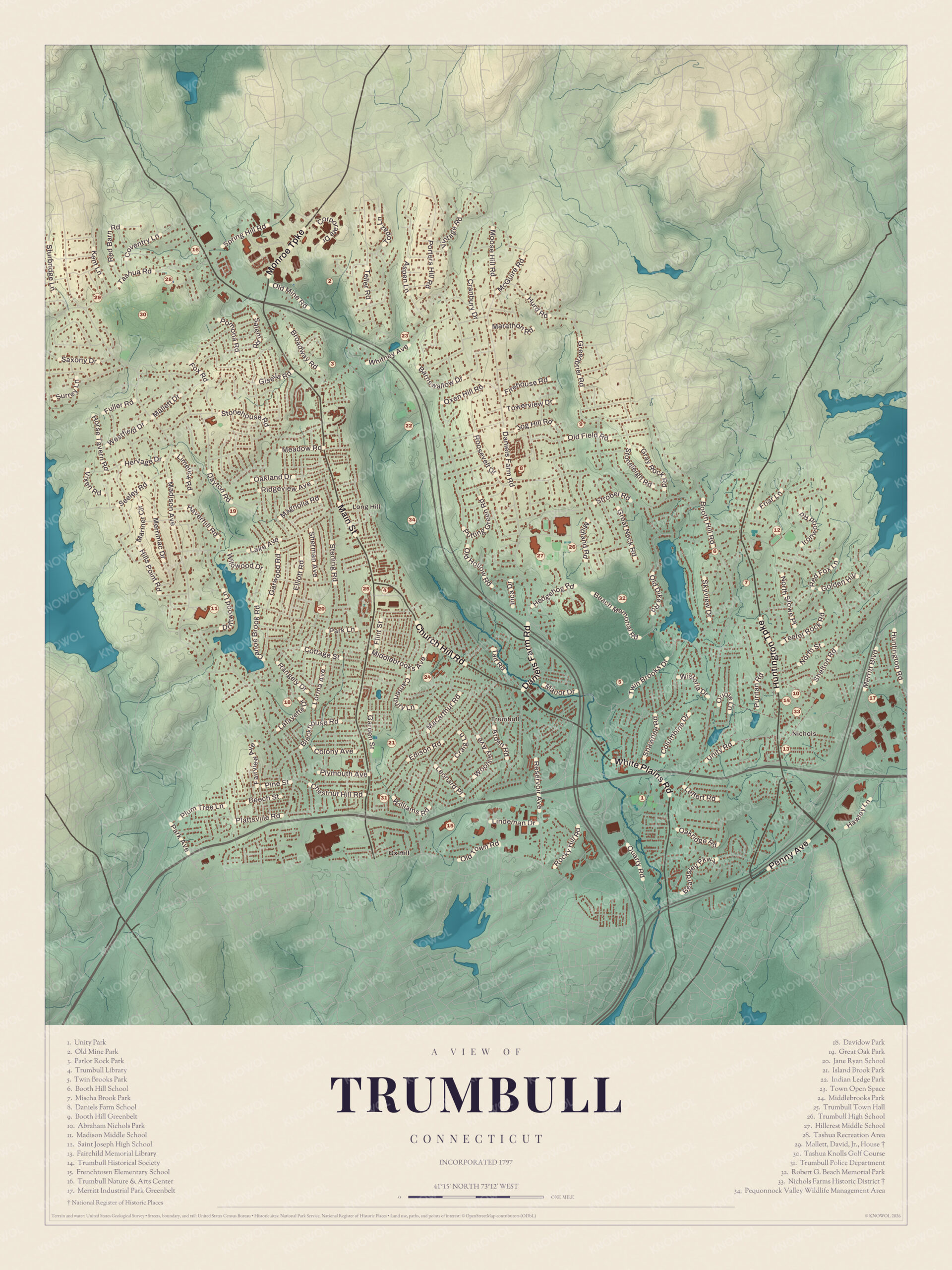
Trumbull today
By KNOWOL
Shaded hills from Rock Raymond in the northwest down through the Pequonnock River valley, every street, Nichols and Long Hill, and a guide of 34 numbered landmarks with the National Register sites marked.4
The story of Trumbull
Born while Fairfield burned
In July 1779 a British fleet landed troops at Fairfield, and Mary Silliman watched them come ashore from the top of her house. Her husband, General Gold Selleck Silliman, was already a prisoner of the British. She gathered her family and rode seven or eight miles inland to North Stratford, now Trumbull, where Eliakim Beach took them in. That night she could see the light of Fairfield burning. In August her son Benjamin was born there. An 1881 history called him the most eminent of American teachers of natural science. Around 1818 a Trumbull man, Ephraim Lane, brought him rocks from the hills where he was born, and Silliman found tungsten and topaz in them. That spot is Old Mine Park today.567
Devil-trees and Mexican coaches
Nichols Farms was a farm village, but in the 1800s it made things people wanted all over the world. About 1815 Eben Fairchild took an old saddle apart and copied its wooden frame, called a saddle-tree. He made a dozen and took them to New York by stage while his neighbors jeered at his devil-trees, and he found a ready market. In 1844 Franklin P. Ambler bought the business, and with his sons he built big factories and brought in steam power. In the Civil War the firm employed about six hundred men on government contracts, and later it filled large orders for the French government. Down the road, the Nichols brothers built coaches for Texas and the South, and for years they shipped carriages to Australia.8921011
Pulpit Rock and the parish of Unity
For almost a century Trumbull was just the northern farms of Stratford, and families went down to Stratford for Sunday meeting. In 1730 they gathered a church of their own, with thirty-eight members, in the parish called Unity. Their first meetinghouse, at the foot of White Plains Street, was so plain that an 1881 history said it would pass for a barn. Tradition says that for a few Sundays before there was any meetinghouse, the minister preached from a cliff down that street, and it's still called Pulpit Rock. The parish split in 1744, when its minister, Rev. Richardson Miner, who was a busy doctor too, joined the Episcopal Church, and Unity became part of North Stratford. In 1797 it all became the town of Trumbull.1213141
Through the years
25 moments from 1639 to today.
- 1639English settlers found Stratford, and the land that becomes Trumbull is its northern woods and farms.1
- 1658By this year the Judsons and Joseph Curtiss are farming Mischa Hill, the first English farms in Trumbull.15
- 1696Nichols Avenue is entered in the land records, one of the oldest documented highways in Connecticut.1
- 1700About this year Abraham Nichols builds a big gambrel-roofed homestead on a rise at Nichols Farms.4
- 1725Farmers in northern Stratford ask for a village of their own, and the colony names it Unity.1
- 1730The church of Unity is gathered on November 18 with thirty-eight members.12
- 1744Unity joins Long Hill to form the parish of North Stratford.1
- 1760Families at Tashua build a church and finish it in about six weeks.16
- 1760About this year David Mallett Jr. builds his center-chimney farmhouse on Tashua Road.17
- 1778North Stratford sends money, cheese and gammon to its fifteen soldiers at Valley Forge.18
- 1779Benjamin Silliman is born in North Stratford after his mother flees the British landing at Fairfield.5
- 1797In October the General Assembly makes North Stratford the town of Trumbull.1
- 1797Trumbull holds its first town meeting at the meetinghouse on November 20.19
- 1815News of peace with Britain brings a celebration at Trumbull church, and a pole is raised.20
- 1815About this year Reuben and Eben Fairchild begin making saddle-trees at Nichols Farms.8
- 1818About this year Ephraim Lane takes rocks from the old mine site to Professor Silliman, who finds tungsten and topaz.7
- 1822A post office opens at Long Hill, with Stephen Beardsley as postmaster.21
- 1827Scottish papermaker Andrew Tait arrives to oversee the building of the Fairchild paper mill.22
- 1844F. P. Ambler buys the saddle-tree business and runs it with his sons.8
- 1846Grace Church at Long Hill becomes a parish of its own, apart from Christ Church, Tashua.23
- 1898The tungsten deposit at the old mine is worked again, until 1901.24
- 1928Igor Sikorsky makes his home in Nichols, where he lives until 1951.4
- 1937The town turns the old mine into Old Mine Park.7
- 1987The Nichols Farms Historic District is listed on the National Register.15
- 1997A time capsule is laid at the Bicentennial fountain, to be opened on October 12, 2097.1
Places to see
The numbers match the landmark guide printed on the 2026 map.
- 2Old Mine ParkNorthwest, near Monroe. Old tungsten mine, now a town park.
- 5Twin Brooks ParkAlong the Pequonnock. Six ponds beside the river.
- 10Abraham Nichols ParkNichols. Beside the historical society.
- 13Fairchild Memorial LibraryNichols. The village library in Nichols.
- 14Trumbull Historical SocietyNichols. On the old Nichols family farm.Visit their website
- 22Indian Ledge ParkPequonnock valley. Parkland northwest of Trumbull Center.
- 25Trumbull Town HallTrumbull Center. Near the Bicentennial fountain.
- 28Tashua Recreation AreaTashua. Town recreation grounds up in Tashua.
- 29David Mallett, Jr., HouseTashua Road. Mallett farmhouse of about 1760.
- 33Nichols Farms Historic DistrictNichols. 81 historic buildings around the green.
On the National Register
All 4 places in Trumbull on the National Register of Historic Places that still stand today, oldest first, and why each one matters.3
-
Nichols Farms Historic District
The houses around the Nichols green, 81 historic buildings on 104 acres, cover every period of Connecticut house building from the early 1700s on. Mischa Hill, at the center of Nichols Farms, was the first land in Trumbull farmed by English settlers.15
-
David Mallett Jr. House
A well-preserved center-chimney farmhouse that stayed with the Mallett family for about 150 years. A small building joined to its west side is believed to have been a Sabbath Day House, where churchgoers from far away warmed up between Sunday services.17
-
Christ Episcopal Church and Tashua Burial Ground
The burial ground dates to 1766, and the Carpenter Gothic church is the third on the site. Inside, the parish still keeps the Bible and Book of Common Prayer it received from England in 1762.25
-
Old Mine Park Archeological Site
Rocks from here led Professor Benjamin Silliman to report tungsten, topaz and fluorite around 1818. The site was mined from 1828 to 1920 and again from 1942 to 1946, and the town made it a 72-acre park in 1937.7
In their words
“The green fields, smiling meadows, waving woods, and good people of Old Trumbull have experienced a genuine sensation”
History of Fairfield County, 1881, on a golden wedding at Tait's Mills in 187226
“Old inhabitants still refer to this celebration with patriotic pride.”
History of Fairfield County, 1881, on Trumbull's 1815 peace celebration20
“in spite of the jeers of his neighbors, who called them "devil-trees," he went with them by stage to New York, where he found a ready market.”
History of Fairfield County, 1881, on Eben Fairchild's first saddle-trees9
Nearby towns
Sources
- Trumbull, Connecticut, Wikipedia
- History of Fairfield County, Connecticut (1881), on F. P. Ambler & Sons, Internet Archive
- National Register of Historic Places listings in Fairfield County, Connecticut, Wikipedia
- Map of Trumbull, Connecticut in 2026, KNOWOL (USGS elevation, Census Bureau roads)
- History of Fairfield County, Connecticut (1881), on the birthplace of Benjamin Silliman, Internet Archive
- Benjamin Silliman, Wikipedia
- Old Mine Park Archeological Site, Wikipedia
- A history of the old town of Stratford and the city of Bridgeport, Connecticut (1886), on the saddle-tree business, Internet Archive
- History of Fairfield County, Connecticut (1881), on the saddle-tree business at Nichols Farms, Internet Archive
- A history of the city of Bridgeport, Connecticut (1887), on the Nichols coach works, Internet Archive
- A history of the city of Bridgeport, Connecticut (1887), on Nichols, Peck and Company, Internet Archive
- History of Fairfield County, Connecticut (1881), on the church at Unity, Internet Archive
- History of Fairfield County, Connecticut (1881), on Pulpit Rock and the first meetinghouse, Internet Archive
- A history of the old town of Stratford and the city of Bridgeport, Connecticut (1886), on Rev. Richardson Miner, Internet Archive
- Nichols Farms Historic District, Wikipedia
- History of Fairfield County, Connecticut (1881), on the first church at Tashua, Internet Archive
- David Mallett, Jr., House, National Register nomination, National Park Service
- A history of the old town of Stratford and the city of Bridgeport, Connecticut (1886), on North Stratford's gifts to Valley Forge, Internet Archive
- History of Fairfield County, Connecticut (1881), on the first town meeting, Internet Archive
- History of Fairfield County, Connecticut (1881), on the peace celebration of 1815, Internet Archive
- A history of the old town of Stratford and the city of Bridgeport, Connecticut (1886), on the Trumbull post offices, Internet Archive
- History of Fairfield County, Connecticut (1881), on Andrew Tait and the Fairchild paper mill, Internet Archive
- History of Fairfield County, Connecticut (1881), on Grace Church, Long Hill, Internet Archive
- Bulletin of the Connecticut Geological and Natural History Survey (1904), on tungsten mining at Trumbull, Internet Archive
- Christ Church and Tashua Burial Ground, Wikipedia
- History of Fairfield County, Connecticut (1881), on the Tait golden wedding, Internet Archive