
A mill town on the west bank of the Connecticut River, once called Pine Meadow, that took its name from the canal locks of 1829 and made paper, school globes and tinsel thread long before Bradley Field rose on its tobacco farms.
Then and now
The same town 149 years apart. Click either map to look closer.
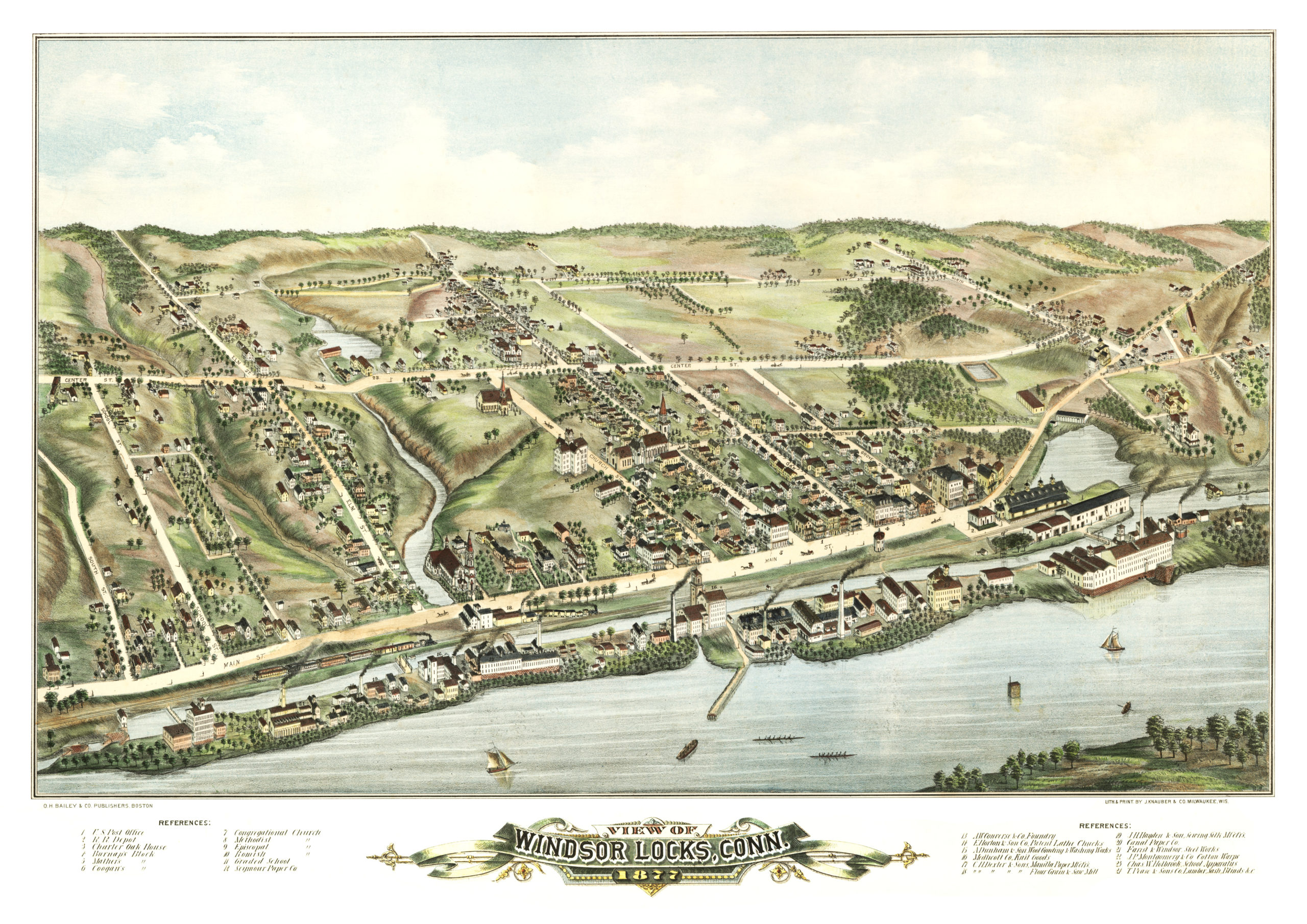
Windsor Locks in 1877
By J. Knauber & Co., printed by O.H. Bailey & Co.
Windsor Locks and the country around it in 1877, with landmarks such as the Charter Oak House, Burnap's Block, Mather's Block, Coogan's Block and the Seymour Paper Company.4
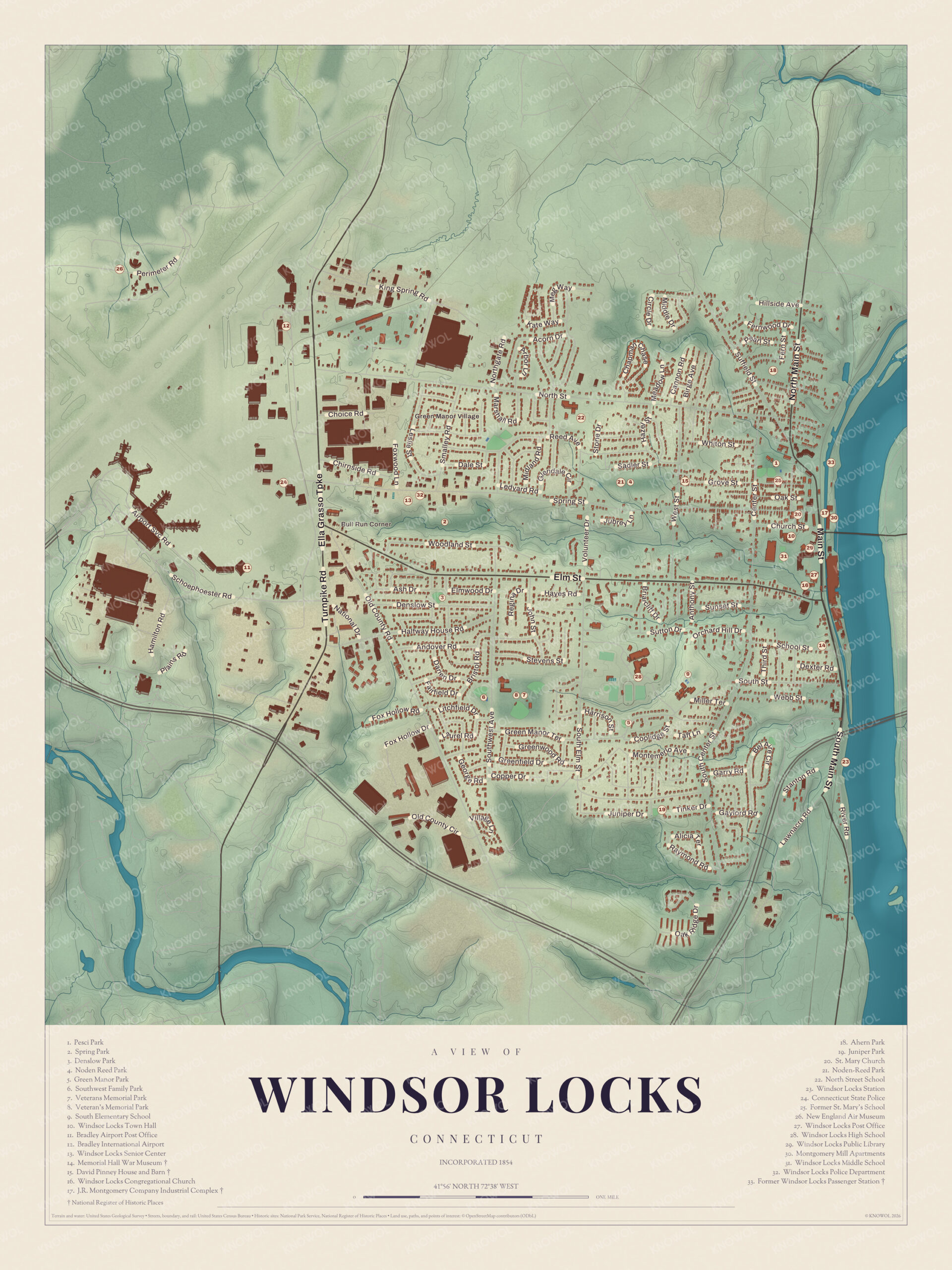
Windsor Locks today
By KNOWOL
Shaded land from downtown and the canal out to Green Manor Village and Bradley International Airport, every street, and a guide of 33 numbered landmarks with the National Register sites marked.5
The story of Windsor Locks
Twelve years alone at Pine Meadow
Henry Denslow built the first house in Pine Meadow in 1662 or 1663, on a hill just south of where the canal's town lock would later be, and his nearest neighbor lived two miles away. When King Philip's War broke out in 1676 the family moved to Windsor for safety, but Henry went back alone to tend his crops and was killed. After the war his widow came home with her seventeen-year-old son and seven daughters, and they lived there by themselves for twelve years. Nathaniel Gaylord settled nearby in 1678. Even by the summer of 1776 there were only nine families here, and the heads of eight of them were away serving in the Revolution. Two hundred years after Henry's death, a boulder at his home site was inscribed with his story.678
Paper, globes and lathe chucks
The canal brought water power, and Windsor Locks put it to work. In 1835 Charles H. Dexter started making paper in the basement of his family's grist mill, using old manila rope for pulp, and in 1847 he built a mill across the canal that grew into the Dexter plant. It burned in 1875 and was rebuilt. By 1859 the young town had six paper mills, two thread mills and a wire mill. Dwight Holbrook's factory made school globes and tellurians, and in 1864 its work went to an exhibition in Copenhagen. Eli Horton's lathe chuck was made here too. J. R. Montgomery began in 1871 with eight spinning frames, and in World War I his tinsel threads were wanted for telephone and switchboard cords.9101112131415
The locks that named a town
Before 1829, boats heading up the Connecticut River had to get past Enfield Falls with the help of local fallsmen, who poled them up the rapids, one man for each ton of cargo. The Connecticut River Company was chartered in 1824 to build a canal and to buy mill sites along it, and the canal opened on November 11, 1829, dropping 32 feet through its locks. When a post office opened at Pine Meadow in 1833, the place took the name Windsor Locks, joining the old town's name to the new locks. Railroads soon took the river trade, and every canal on the upper river was given up for traffic except this one. Its water ran the mills instead, and in 1854 Windsor Locks became a town of its own.2168171
Through the years
25 moments from 1662 to today.
- 1662Henry Denslow builds the first house in Pine Meadow, two miles from his nearest neighbor.6
- 1676Henry Denslow is killed during King Philip's War. After the war his widow and eight children come home and live there alone for twelve years.6
- 1678Nathaniel Gaylord moves up from Windsor and settles at Pine Meadow.6
- 1769Seth Dexter and Jabez Haskell arrive from Rochester, Massachusetts.7
- 1776Pine Meadow has nine families, and the heads of eight of them are serving in the Revolution.7
- 1824The Connecticut River Company is chartered to build a canal, with the right to buy mill sites too.16
- 1829The Enfield Falls Canal opens on November 11, carrying boats around the falls through its locks.2
- 1833A post office opens, and Pine Meadow takes the name Windsor Locks.8
- 1835Charles H. Dexter starts making paper from manila rope in the basement of the family grist mill.9
- 1839The railroad comes through Windsor Locks.18
- 1842Charles Dickens travels on the canal.2
- 1854Windsor Locks is incorporated as a town, separate from Windsor.1
- 1858Part of Windsor Locks goes to the new town of East Granby.19
- 1858Dwight Holbrook brings his school globe and apparatus business to Windsor Locks.11
- 1859The town has about 1,500 people, six paper mills, two thread mills and a wire mill.10
- 1864School apparatus made in Windsor Locks is sent to an exhibition in Copenhagen.12
- 1865James Coogan, an Irish-born paper maker who ran a Windsor Locks paper mill, sits in the legislature, said to be the first Catholic there.20
- 1871J. R. Montgomery starts a small mill with eight spinning frames.14
- 1875The Dexter paper mills burn and are rebuilt.9
- 1877J. Knauber & Co. and O.H. Bailey & Co. publish their map of Windsor Locks.4
- 1890Memorial Hall is built of Monson granite for the town's Civil War soldiers.21
- 1941The new air base is named Bradley Field for Lt. Eugene M. Bradley, killed in a training flight there.22
- 1951The Kaman Corporation flies the world's first turbine-powered helicopter at Bradley.5
- 1965Windsor Locks Little League wins the Little League World Series.23
- 1974Ella Grasso, born in Windsor Locks to a mill worker's family, is elected governor of Connecticut.24
Places to see
The numbers match the landmark guide printed on the 2026 map.
- 12Bradley International AirportWest of town. Connecticut's busiest airport, once Bradley Field.
- 14Memorial Hall War MuseumSouth Main and Elm Streets. Granite memorial to Civil War soldiers.
- 15David Pinney House and BarnWest Street. Rare brick barn of 1826.
- 16Windsor Locks Congregational ChurchDowntown. Longtime keeper of Memorial Hall.
- 17J.R. Montgomery Company Industrial ComplexBetween the canal and the river. Once the country's largest tinsel maker.
- 20St. Mary ChurchDowntown. The town's Catholic parish church.
- 21Noden-Reed ParkWest Street. The old Pinney farm, now parkland.
- 26New England Air MuseumBeside the airport. Three hangars of historic aircraft.Visit their website
- 30Montgomery Mill ApartmentsCanal Bank Road. The old mill, homes since 2020.
- 33Former Windsor Locks Passenger StationDowntown. The railroad depot of 1875.
On the National Register
All 5 places in Windsor Locks on the National Register of Historic Places that still stand today, oldest first, and why each one matters.3
-
David Pinney House and Barn
David Pinney, a farmer, built the brick barn in 1826, an unusual and costly choice for a farm building, and one of the only such barns known in the state. He added the Greek Revival house in the 1840s. The Reed family gave the farm to the town in 1974, and the house and barn are now a museum run by the historical society.25
-
Enfield Falls Canal
The canal carried boats around the Enfield Falls from 1829, five and a quarter miles long with a drop of 32 feet through its locks, and it gave Windsor Locks its name. Its builders planned from the start to sell mill sites and water rights along the last mile of its banks, and those mills built the town.2
-
Windsor Locks Passenger Station
The railroad built this station in the town center in 1875. It closed in 1971, and when the railroad tried to tear it down, a local group got it listed on the National Register, and a new platform is going up beside it.18
-
Memorial Hall
A granite Romanesque hall with a round tower, given by Charles Chaffee, a mill owner from Monson, Massachusetts, as a memorial to the town's Civil War soldiers and dedicated in 1891. By the terms of the gift it is still a meeting place for veterans' groups, and the Congregational church has looked after it.21
-
J. R. Montgomery Company Industrial Complex
The mill on the island between the canal and the river was once the country's largest maker of tinsel and wove cotton warps and yarns, with about 500 workers around 1920. Its three connected main buildings, from about 1893, 1904 and 1920, survived years of fires and neglect and reopened as apartments in 2020.26
In their words
“combining the good old name of Windsor with the canal improvements which were completed in 1829.”
History of ancient Windsor, Connecticut, 1859, on how Pine Meadow became Windsor Locks8
“Their patriotism was such, that with the exception of the Coye family, the heads of the other eight were serving in the Revolution in 1776”
Historic towns of the Connecticut River Valley, 1906, on the nine families of 17767
“his life, taken in all its bearings, was by far the most influential that Windsor Locks has known.”
The memorial history of Hartford County, 1886, on the paper maker Charles H. Dexter27
Nearby towns
Sources
- Windsor Locks, Connecticut, Wikipedia
- Enfield Falls Canal, Wikipedia
- National Register of Historic Places listings in Hartford County, Connecticut, Wikipedia
- Old map of Windsor Locks, Connecticut from 1877, restored by KNOWOL
- Map of Windsor Locks, Connecticut in 2026, KNOWOL (USGS elevation, Census Bureau roads)
- Historic towns of the Connecticut River Valley (1906), on Henry Denslow, Internet Archive
- Historic towns of the Connecticut River Valley (1906), on the early families of Pine Meadow, Internet Archive
- History of ancient Windsor, Connecticut (1859), on Pine Meadow and the name Windsor Locks, Internet Archive
- History of Hartford County, Connecticut, 1633-1928 (1928), on C. H. Dexter and Sons, Internet Archive
- History of ancient Windsor, Connecticut (1859), on Windsor Locks in 1859, Internet Archive
- Encyclopedia of Connecticut biography (1923), on Dwight Holbrook, Internet Archive
- The Connecticut Common School Journal and Annals of Education (April 1864), Internet Archive
- Representative men of Connecticut, 1861-1894 (1894), on the Horton lathe chuck, Internet Archive
- Encyclopedia of Connecticut biography (1917), on John Robert Montgomery, Internet Archive
- History of Connecticut in monographic form (1925), on the J. R. Montgomery Company, Internet Archive
- History of Connecticut in monographic form (1925), on the Windsor Locks water power, Internet Archive
- The Connecticut River and the valley of the Connecticut (1906), Internet Archive
- Windsor Locks station, Wikipedia
- The memorial history of Hartford County, Connecticut, 1633-1884 (1886), on East Granby, Internet Archive
- Encyclopedia of Connecticut biography (1917), on James Coogan, Internet Archive
- Memorial Hall, Windsor Locks, National Register nomination, National Park Service
- Bradley International Airport, Wikipedia
- 1965 Little League World Series, Wikipedia
- Ella Grasso, Wikipedia
- Noden-Reed Museum (David Pinney House and Barn), Wikipedia
- J. R. Montgomery Company Industrial Complex, Wikipedia
- The memorial history of Hartford County, Connecticut, 1633-1884 (1886), on Charles H. Dexter, Internet Archive