
A big hill town in the Quiet Corner that began as New Roxbury, a Massachusetts colony, voted itself into Connecticut in 1749, made shoes in Stoggy Hollow and pottery at Quasset, and filled Roseland Park with presidents every Fourth of July.
Woodstock on the map
Click the map to look closer.
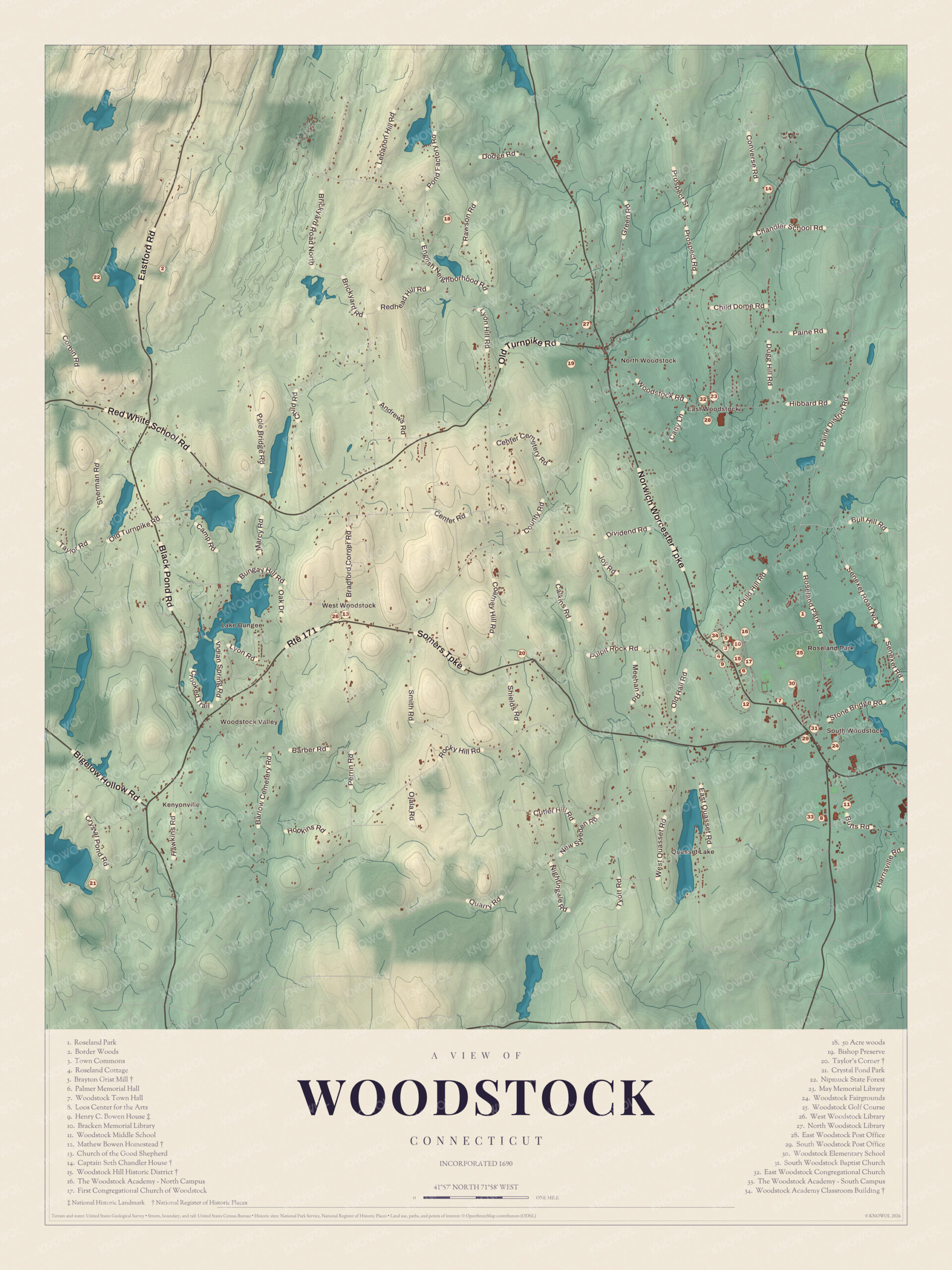
Woodstock today
By KNOWOL
Shaded hills from Lake Bungee to Quasset Lake, every road printed by name, Woodstock Hill and each of the villages, and a guide of 34 numbered landmarks with the National Historic Landmark and the National Register sites marked.3
The story of Woodstock
The Massachusetts town that changed sides
Woodstock began as New Roxbury. On April 5, 1686, the first planters from Roxbury broke ground and planted corn, and that August the settlers drew their home lots on Plaine Hill. Samuel Sewall named the town Woodstock in 1690, for its nearness to Oxford and for the sake of Queen Elizabeth. For about sixty years it answered to Massachusetts. Then on July 28, 1749, a Connecticut justice opened a town meeting in the first meetinghouse, and the town chose its officers under Connecticut law, over a written protest from a few neighbors. Boston called it very extraordinary proceedings. At the town's two hundredth birthday in 1886, the speaker called Woodstock a miniature republic, and reminded the crowd that its delegates had refused to vote for the Constitution in 1788.45678
Stoggy Hollow and the pottery cart
Woodstock was a farming town, but it made things too. From 1793 Thomas Bugbee's pottery at Quasset turned local clay into jars, jugs, mugs, inkstands and milk pans, as many as five thousand pieces a summer, carried far and wide in his pottery cart. Brides counted Woodstock ware in their outfits. In Woodstock Valley, Peletiah and Zenas Wight were making the first sale shoes in Connecticut by 1828. Nearly every house for miles around fitted up a room as a shoe shop, and the Wights made so many of the shoes called stoggies that the valley got the nickname Stoggy Hollow. By 1837 about 900 people in town worked at shoemaking. Up at Village Corners, now North Woodstock, L. M. Deane & Co. built wagons and carriages from about 1835.9101112
Mr. Bowen's Fourth of July
Woodstock Hill always loved a big gathering. A Fremont rally in 1856 was followed by a great Lincoln mass meeting on the Common in 1864 and a Grant meeting in 1868. On the Fourth of July in 1870, Henry C. Bowen, the Woodstock boy who'd made his fortune in New York, brought President Grant himself to town as his guest. Bowen then turned the grove beside the lake into Roseland Park and gave it to the town for the nation's hundredth birthday. At its formal opening on July 4, 1877, Oliver Wendell Holmes, whose father was born in Woodstock, read a poem. Presidents Hayes, Harrison and McKinley came in later years, and crowds of up to 10,000 heard speeches, watched fireworks and drank pink lemonade.131431
Through the years
25 moments from 1674 to today.
- 1674John Eliot and Daniel Gookin visit the praying town at Wabbaquasset and stay in the sagamore's sixty-foot wigwam.15
- 1682Massachusetts buys the tract that includes Woodstock.1
- 1686On April 5 the first planters from Roxbury break ground and plant corn at New Roxbury.4
- 1686In August the settlers draw their home lots on Plaine Hill, the Westward Hill and the Eastward Vale, now South Woodstock.4
- 1689Lieutenant Edward Morris dies; his gravestone on Woodstock Hill is called the oldest in the county.16
- 1690Samuel Sewall gives New Roxbury the name Woodstock.5
- 1693Jabez Corbin is granted land on Woodstock Hill for the town's first shop.17
- 1749On July 28 the town holds its first meeting under Connecticut law and leaves Massachusetts.6
- 1776George Washington and Israel Putnam write the Woodstock church asking it to spare its pastor, Abiel Leonard, as an army chaplain.18
- 1788Woodstock's delegates refuse to vote to ratify the United States Constitution.8
- 1793Thomas Bugbee starts his pottery at Quasset.9
- 1793The theft-detecting society is organized, with six pursuers on good horses.19
- 1801Woodstock Academy is founded on land on the common.3
- 1821The First Congregational Church builds its meetinghouse on Woodstock Hill.3
- 1828The Wight brothers of Woodstock Valley are making the first sale shoes in Connecticut.10
- 1835About this year L. M. Deane & Co. begins building wagons and carriages at Village Corners.12
- 1846Henry C. Bowen builds Roseland Cottage on Woodstock Hill.20
- 1859The Woodstock Agricultural Society holds its first fair at South Woodstock.3
- 1864A great Lincoln mass meeting is held on Woodstock Common.13
- 1870President Ulysses S. Grant spends the Fourth of July in Woodstock as Bowen's guest.13
- 1873Woodstock Academy's Italianate classroom building goes up.21
- 1877Roseland Park is formally opened on the Fourth, and Oliver Wendell Holmes reads a poem.13
- 1886The town celebrates its two hundredth birthday at Roseland Park.8
- 1916Minnie Palmer Dean finishes Palmer Memorial Hall on the hill.3
- 1999The Woodstock Hill Historic District is listed on the National Register.22
Places to see
The numbers match the landmark guide printed on the 2026 map.
- 1Roseland ParkRoseland Park Road. Bowen's park, given to the town.
- 3Town CommonsWoodstock Hill. The old heart of town.
- 4Roseland CottageWoodstock Hill. Bowen's pink Gothic summer house of 1846.Visit their website
- 6Palmer Memorial HallWoodstock Hill. Home of the Woodstock Historical Society.Visit their website
- 12Mathew Bowen HomesteadPlaine Hill Road. Federal farmhouse of 1816, now an inn.
- 14Captain Seth Chandler HouseEast Woodstock. House of about 1760 with stenciled plaster.
- 17First Congregational Church of WoodstockWoodstock Hill. The meetinghouse of 1821.
- 22Nipmuck State ForestNorthwest corner. Connecticut's second oldest state forest.Visit their website
- 24Woodstock FairgroundsSouth Woodstock. The fair's home since 1870.
- 34Woodstock Academy Classroom BuildingWoodstock Hill. The Academy's oldest building, 1873.Visit their website
On the National Register
All 7 places in Woodstock on the National Register of Historic Places that still stand today, oldest first, and why each one matters.2
-
Woodstock Hill Historic District
The old village center on the ridge the first settlers chose in 1686, around the green they set aside for the church and burying ground. It takes in the 1821 Congregational church, the Woodstock Academy buildings and Roseland Cottage.22
-
Capt. Seth Chandler House
Captain Seth Chandler bought the land in 1760 and enlarged the house about 1780 for his eleven children. Its chimney sits well back from the roof ridge, unusual for the period, and the walls keep their stenciled plaster.23
-
New Roxbury Ironworks Site
An archaeological site of a colonial iron furnace set up about 1760 near Black Pond to work the bog iron found by local settlers. Grist and saw mills later used the site.24
-
Taylor's Corner
A well-kept central chimney farmhouse at the bend of Route 171 and Pulpit Rock Road, which reached its present form around 1790. It takes its name from Clinton Taylor, an owner in the early 1900s.25
-
Mathew Bowen Homestead
A Federal farmstead built by William Bowen, with two barns and a carriage house. Henry C. Bowen enlarged it in the 1880s, and it stayed in the Bowen family until 1982. It's now the Inn at Woodstock.26
-
Henry C. Bowen House (Roseland Cottage)
National Historic Landmark
Henry C. Bowen's Gothic Revival summer house, with its boxwood parterre garden, carriage barn and the nation's oldest surviving indoor bowling alley. Four presidents came here for Bowen's Fourth of July celebrations. It's a National Historic Landmark, run as a museum by Historic New England.20
-
Woodstock Academy Classroom Building
Henry C. Bowen started the fund drive for this Italianate school building overlooking the Woodstock Green, designed by Alexander G. Cutler of Norwich. It's the oldest building on the Academy campus and the only known school building in the state to keep significant Italianate features.21
In their words
“Woodstock has been like a miniature republic, and has always believed in the supremacy of local law.”
Clarence Winthrop Bowen, at the town's bicentennial in Roseland Park, 18868
“The congregation of Woodstock will cheerfully give up to the public a gentleman so very useful.”
George Washington and Israel Putnam, asking for Rev. Abiel Leonard as chaplain, 177618
“Woodstock with its rich soil and vigorous population is preeminently a farming town”
History of Windham County, Connecticut, 187427
Nearby towns
Sources
- Woodstock, Connecticut, Wikipedia
- National Register of Historic Places listings in Windham County, Connecticut, Wikipedia
- Map of Woodstock, Connecticut in 2026, KNOWOL (USGS elevation, Census Bureau roads)
- History of Windham County, Connecticut (1889), on the New Roxbury planters, Internet Archive
- History of Windham County, Connecticut (1889), on the naming of Woodstock, Internet Archive
- History of Windham County, Connecticut (1889), on the town meeting of 1749, Internet Archive
- Collections of the Connecticut Historical Society (1860), the Massachusetts protest of 1749, Internet Archive
- Woodstock, an historical sketch (1886), read at the bicentennial in Roseland Park, Internet Archive
- History of Windham County, Connecticut (1889), on the Quasset pottery, Internet Archive
- History of Windham County, Connecticut (1889), on shoemaking in Woodstock Valley, Internet Archive
- Connecticut historical collections (1837), on Woodstock, Internet Archive
- History of Windham County, Connecticut (1889), on L. M. Deane's carriages, Internet Archive
- History of Windham County, Connecticut (1889), on Woodstock's public celebrations, Internet Archive
- Woodstock, an historical sketch (1886), on Woodstock's famous sons, Internet Archive
- History of Windham County, Connecticut (1889), on Eliot's visit to Wabbaquasset, Internet Archive
- Woodstock, an historical sketch (1886), on the first settlers, Internet Archive
- History of Windham County, Connecticut (1889), on the Corbin shop, Internet Archive
- Historic gleanings in Windham County, Connecticut (1899), on Rev. Abiel Leonard, Internet Archive
- History of Windham County, Connecticut (1889), on the theft-detecting society, Internet Archive
- Roseland Cottage, Wikipedia
- Woodstock Academy Classroom Building, Wikipedia
- Woodstock Hill Historic District, Wikipedia
- Capt. Seth Chandler House, Wikipedia
- New Roxbury Ironworks Site, Wikipedia
- Taylor's Corner, Wikipedia
- Mathew Bowen Homestead, Wikipedia
- History of Windham County, Connecticut (1874), Internet Archive