
The Hardware City, a farming parish in the Great Swamp that had no river worth the name and still grew into the home of Stanley, Corbin and Landers, Frary and Clark, with an Olmsted park on Walnut Hill and the oldest public university in Connecticut.
Then and now
The same town 151 years apart. Click either map to look closer.
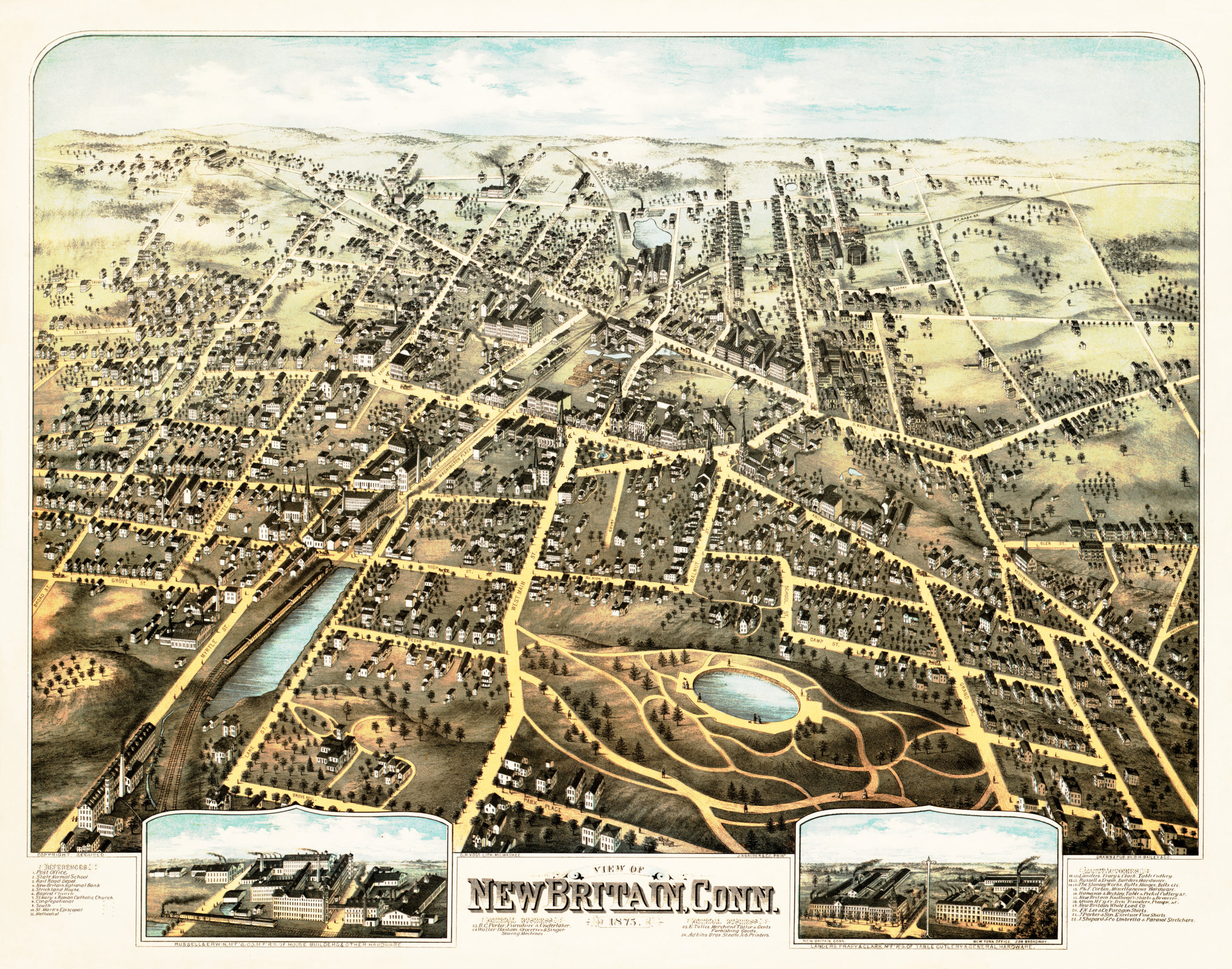
The 1875 map
By O.H. Bailey & Co.
New Britain and the surrounding area in 1875, printed by J. Knauber and Co., with landmarks such as the New Britain National Bank, the railroad depot, the Strickland House, the Stanley Works and Adkins Brothers Printers.5
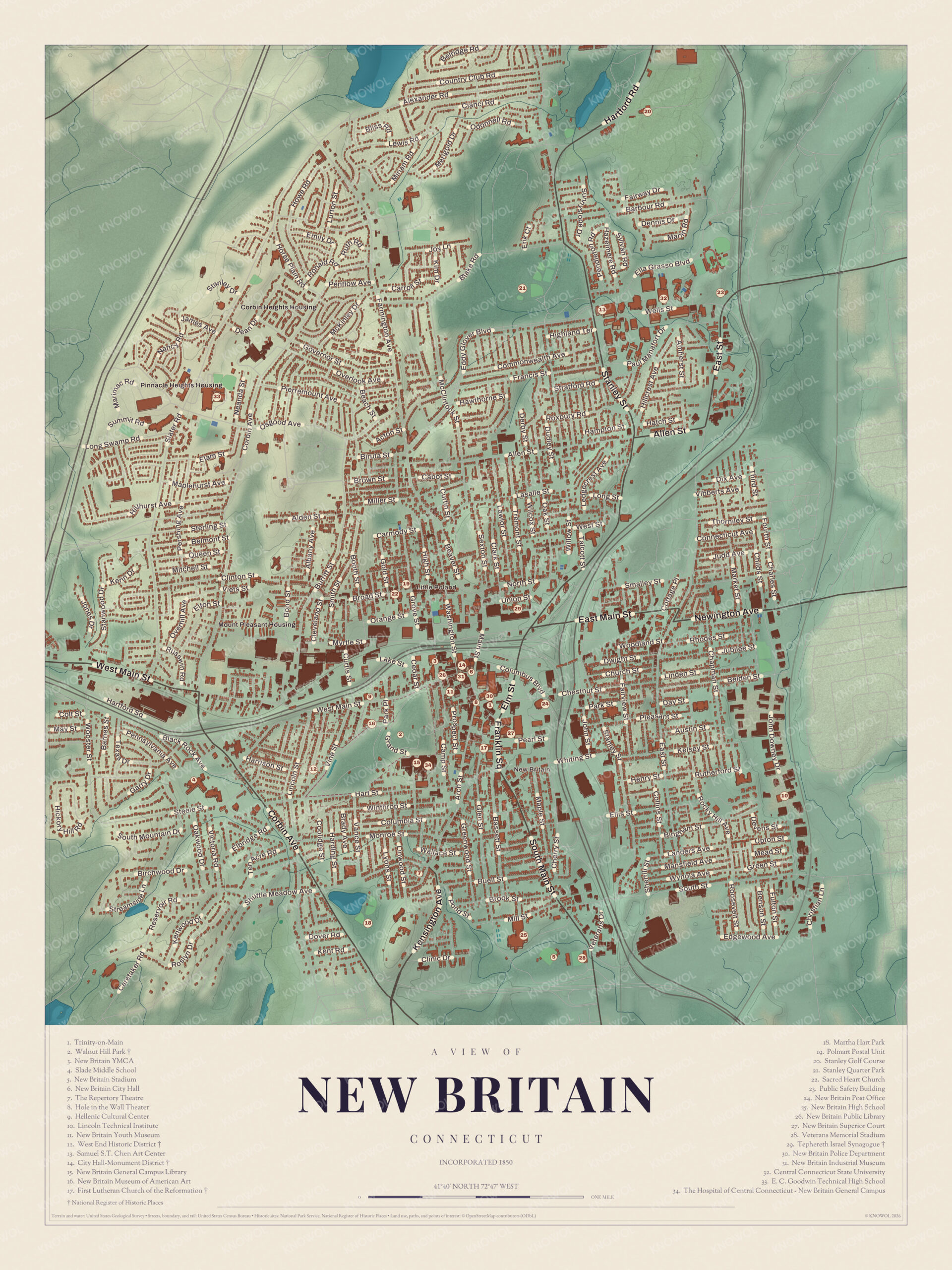
New Britain today
By KNOWOL
The gentle, rolling hills from Walnut Hill to the north end, every street, Little Poland and the city's housing neighborhoods by name, and a guide of 34 numbered landmarks with the National Register sites marked.6
The story of New Britain
The town hall that became a school
When New Britain became its own town in 1850, it had just put up a town hall on Main Street, across from the South Church. It didn't stay a town hall for long. A subscription led by Seth J. North bought the building and gave it to the state for a Normal School to train teachers, with the promise of a free public high school beside it. The Normal School opened on May 15, 1850, and the first regular town meeting was held there that July. Its basement held the first hot-air furnace ever used in New Britain, and when the new borough's lines were surveyed, a Normal School pupil did the surveying. The high school opened in 1851. The Normal School grew into Central Connecticut State University.789101
Bolts behind an old mare
New Britain had no navigable water within ten miles and no stream strong enough to turn a mill wheel all day. Asked what natural advantages the place had, one proud resident is said to have answered, "The Grace of God, and men like Major North!" The blacksmith shops came first. North and Stanley built the first brick factory in town beside a pond on Piper's Brook, and Philip Corbin's first shop ran on a horse treadmill in the cellar. In 1843 Frederick T. Stanley opened a little bolt shop. He made the bolts by hand, drove his old mare out to the farms to sell them, and screwed them onto the barn doors himself. His cousin's rule company later bought all the standing hickory within fifty miles for tool handles.111213141
The view from Walnut Hill
In the 1850s Walnut Hill was a cow pasture. Frederick T. Stanley's plan for the water works brought water from Shuttle Meadow to a reservoir on the hill, and at the celebration a fountain on Central Park threw water a hundred feet into the air. Frederick Law Olmsted laid out the park around the reservoir, and its main road was built from 1870 to 1872. In 1876 the Putnam Phalanx planted an oak there and set an old cannon beneath it. That cannon had a habit of vanishing after political victories, and one day it was gone for good. A 1925 history said everyone in New Britain shared one feeling, pride in Walnut Hill Park, and that on a clear day you could catch the glint of the Capitol dome at Hartford.10151617
Through the years
25 moments from 1687 to today.
- 1687New Britain is settled, in the Great Swamp section of Farmington.1
- 1754The New Britain Society is formed, named in honor of Great Britain by Colonel Isaac Lee. About sixty houses stand inside it.18
- 1758A church is gathered in the parish on April 19, with John Smalley ordained as its pastor.19
- 1785The parish leaves Farmington and becomes part of the new town of Berlin.20
- 1816A Sunday school opens in the spring, two years before Hartford's.21
- 1831A group of young women led by Nancy Smith start the Shepherdess, the town's earliest publication.22
- 1843Frederick Trent Stanley opens his bolt shop, the start of the Stanley Works.1
- 1850New Britain becomes a town, and its brand new town hall opens as the State Normal School on May 15.7
- 1851A free public high school opens alongside the Normal School.10
- 1857The water works planned by Frederick T. Stanley are built.23
- 1857Henry Stanley founds the Stanley Rule and Level Company.1
- 1859About 4,000 people watch New Britain play Bristol for the state ball championship. New Britain loses, 190 to 162.24
- 1861The first regular war meeting in Hartford County is held in New Britain, the Sunday after Fort Sumter.25
- 1865A branch railroad opens from New Britain to the main line at Berlin.26
- 1869O. A. North of New Britain invents the wire coat hanger.1
- 1871The borough approves its city charter in April by a majority of one vote.2
- 1871The Burritt School, named for Elihu Burritt, is dedicated on January 2.27
- 1875O.H. Bailey and Co. publish a map of New Britain.5
- 1885The Russwin Hotel goes up on Central Park. It's City Hall today.28
- 1895Dribbling a basketball is developed at the New Britain YMCA.1
- 1900Ernest Flagg's Civil War monument is set up in Central Park.28
- 1903The New Britain Museum of American Art is founded, the first museum in the country dedicated to American art.6
- 1928The World War I memorial is put up in Walnut Hill Park, on a spot Olmsted chose for a tower.15
- 1969Cardinal Karol Wojtyla, later Pope John Paul II, says Mass at Sacred Heart Church.1
- 2008The city council names the Broad Street neighborhood Little Poland.1
Places to see
The numbers match the landmark guide printed on the 2026 map.
- 1Trinity-on-MainMain Street. Methodist church of 1891, now a stage.Visit their website
- 2Walnut Hill ParkWest of downtown. Olmsted's park on the old reservoir hill.
- 3New Britain YMCADowntown. Where the basketball dribble began, 1895.
- 6New Britain City HallWest Main Street. The former Russwin Hotel of 1885.
- 14City Hall-Monument DistrictCentral Park. Flagg's Civil War monument of 1900.
- 16New Britain Museum of American ArtBeside Walnut Hill Park. First museum of American art, 1903.Visit their website
- 17First Lutheran Church of the ReformationFranklin Square. Granite church built 1903 to 1907.Visit their website
- 22Sacred Heart ChurchLittle Poland. Where Cardinal Wojtyla said Mass in 1969.Visit their website
- 29Tephereth Israel SynagogueWinter Street. Red brick temple of 1925.Visit their website
- 32Central Connecticut State UniversityNorth end. Founded in 1849 as the Normal School.Visit their website
On the National Register
All 19 places in New Britain on the National Register of Historic Places that still stand today, oldest first, and why each one matters.4
-
Walnut Hill District
The neighborhood between downtown and Walnut Hill Park, with 145 historic buildings, mostly wood-frame houses, the Italianate style most common among them. It takes in the state armory and the 1881 state normal school buildings on Hillside Place.29
-
City Hall-Monument District
City Hall's central building is the former Russwin Hotel of 1885, a terra cotta palazzo and the only building known to be designed by Joseph Morrill Wells alone. Beside it stand the former post office of 1871 and the New Britain National Bank building of 1860 to 1861, and in the park is Ernest Flagg's Civil War monument of 1900.28
-
South Congregational Church
A brownstone Gothic Revival church by the Boston architect George F. Meacham, with a tower 170 feet tall. The congregation was formed in 1842, when 119 members left the First Church, and it merged with the First Baptist Church in 1974.30
-
Walnut Hill Park
An early work of Frederick Law Olmsted, laid out around an 1858 fire reservoir that was later filled in. Its main road was built from 1870 to 1872, and the city's Art Deco World War I memorial went up in 1928 where Olmsted had planned a tower.15
-
West End Historic District
One of the city's premier neighborhoods, wrapped around the west side of Walnut Hill Park. Henry Russell sold off its lots between 1884 and 1908, and many of its houses were built for executives of the Stanley Works.31
-
Sloper-Wesoly House
A brick Queen Anne house by George Dutton Rand, built for Dr. Andrew J. Sloper, who promoted bringing European workers to the city's factories. Dr. Andrew Wesoly and his wife Cecilia, leaders of the Polish community, later bought it, and it's now a Polish cultural center.32
-
Trinity Methodist Episcopal Church
A Richardsonian Romanesque church of granite and slate by Amos P. Cutting, for a Methodist congregation organized in 1816. When the congregation planned to tear it down in 2000, preservationists saved it, and it's now the Trinity-on-Main arts center.33
-
Erwin Home for Worthy and Indigent Women
Paid for by a bequest from Cornelius Erwin, who died in 1885, and run by the South Church as a home for women of limited means. Its Queen Anne main building with a Gothic turret opened in 1892, when the rent was two dollars a month.34
-
New Britain Public High School Campus
Its oldest building, a Renaissance Revival school of 1896, was one of the first public high schools in Connecticut. The campus grew with trade and vocational buildings and served as the high school until the 1970s, when it became housing.35
-
First Lutheran Church of the Reformation
A granite Late Gothic Revival church with twin towers and a rose window, built by a congregation of German and Swedish immigrants founded in the 1880s. William Caldwell designed it.36
-
St. Mary's Parochial School
The city's first brick school building, put up by St. Mary's parish, founded in 1850 for Irish immigrants. It was the city's only Catholic school until 1938 and now holds housing for older residents.37
-
Francis H. Holmes House
Walter P. Crabtree designed this brick house for Francis Holmes, who owned a brickyard just south in Berlin, as a showcase for his bricks.38
-
Landers, Frary and Clark Ellis Street Plant Historic District
A 22-acre factory complex on both sides of Ellis Street, with 25 historic buildings and structures. Landers, Frary and Clark made household electrical appliances here, and military equipment used in both world wars.39
-
Washington School
A Gothic Revival school by Delbert K. Perry, laid out for the platoon system, in which students moved between rooms for each subject. Its fancy exterior drew so much criticism that the city limited ornament on later schools. It's now apartments.40
-
Burritt Hotel
Built for local business owners who wanted a first-class hotel in town, it was New Britain's most luxurious hotel and a center of its social life for many years. It's now the Burritt House apartments.41
-
Tephereth Israel Synagogue
A red brick temple blending Romanesque and Colonial Revival styles, built by an Orthodox congregation founded in 1925. It's one of fifteen Connecticut synagogues listed together in 1995 and 1996.42
-
Commercial Trust Company Building
Known as the Anvil Building for the blacksmith's anvils carved into its facade, the bank's symbol. The bank built it in the boom of the 1920s and closed its doors in December 1930.43
-
Masonic Temple
A Beaux-Arts Masonic hall by Walter P. Crabtree, sold in 1940 to Temple B'Nai Israel, the city's first Jewish congregation, and used as a synagogue until 2007. It's a church today.44
-
Downtown New Britain
The commercial and civic heart of the city, from City Hall and Central Park south to Franklin Square, with stores, apartment blocks and the churches built for a wide mix of immigrant congregations in the 1800s and early 1900s.45
In their words
“The Grace of God, and men like Major North!”
A New Britain man's answer to a visitor who asked what natural advantages the town had, from The story of New Britain, 192511
“Of all cities I have known or heard of, New Britain seems to me the most accurate representative of the genius of New England.”
A speaker at the First Church of Christ's 150th anniversary, 190846
“the little village of New Britain is the world of my childhood, the birthplace of my first hopes and aspirations”
Elihu Burritt, welcomed home from the Paris Peace Congress, in The Connecticut magazine, 190647
Nearby towns
Sources
- New Britain, Connecticut, Wikipedia
- The story of New Britain, Connecticut (1925), on the city charter, Internet Archive
- The story of New Britain, Connecticut (1925), on the Civil War, Internet Archive
- National Register of Historic Places listings in Hartford County, Connecticut, Wikipedia
- Old map of New Britain, Connecticut from 1875, restored by KNOWOL
- Map of New Britain, Connecticut in 2026, KNOWOL (USGS elevation, Census Bureau roads)
- The story of New Britain, Connecticut (1925), on the Town Hall and Normal School, Internet Archive
- The story of New Britain, Connecticut (1925), on the first hot-air furnace, Internet Archive
- The story of New Britain, Connecticut (1925), on the borough of 1850, Internet Archive
- The story of New Britain, Connecticut (1925), on the water works and the free high school, Internet Archive
- The story of New Britain, Connecticut (1925), on Major North, Internet Archive
- The story of New Britain, Connecticut (1925), on the first factories, Internet Archive
- History of Connecticut in monographic form (1925), on Frederick T. Stanley's bolt shop, Internet Archive
- History of Connecticut in monographic form (1925), on the Stanley Rule and Level Company, Internet Archive
- Walnut Hill Park, Wikipedia
- The story of New Britain, Connecticut (1925), on the Putnam Oak and its cannon, Internet Archive
- The story of New Britain, Connecticut (1925), on the view from Walnut Hill, Internet Archive
- The Connecticut magazine (1900), on the naming of New Britain, Internet Archive
- 1758-1908: one hundred and fiftieth anniversary, First Church of Christ, New Britain (1908), on the gathering of the church, Internet Archive
- The Connecticut quarterly (1895), on New Britain's early history, Internet Archive
- Memorial. Genealogy, and ecclesiastical history of First Church, New Britain (1867), on the Sabbath school, Internet Archive
- History of Connecticut in monographic form, volume two (1925), on New Britain's newspapers, Internet Archive
- Genealogical and family history of the state of Connecticut (1911), on Frederick T. Stanley, Internet Archive
- Bristol, Connecticut: in the olden time New Cambridge (1907), on the ball game of 1859, Internet Archive
- The memorial history of Hartford County, Connecticut, 1633-1884 (1886), on the first war meeting, Internet Archive
- The story of New Britain, Connecticut (1925), on the 1860s, Internet Archive
- The Connecticut School Journal, February 1871, on the Burritt School, Internet Archive
- City Hall-Monument District, Wikipedia
- Walnut Hill District, Wikipedia
- South Congregational Church (New Britain, Connecticut), Wikipedia
- West End Historic District (New Britain, Connecticut), Wikipedia
- Sloper-Wesoly House, Wikipedia
- Trinity Methodist Episcopal Church (New Britain, Connecticut), Wikipedia
- Erwin Home for Worthy and Indigent Women, Wikipedia
- New Britain Public High School Campus, Wikipedia
- First Lutheran Church of the Reformation, Wikipedia
- St. Mary's Parochial School, Wikipedia
- Francis H. Holmes House, Wikipedia
- Connecticut State Historic Preservation Review Board, minutes of December 3, 2021, on the Landers, Frary and Clark Ellis Street Plant Historic District
- Washington School (New Britain, Connecticut), Wikipedia
- Burritt Hotel, Wikipedia
- Tephereth Israel Synagogue, Wikipedia
- Commercial Trust Company Building, Wikipedia
- Temple B'Nai Israel (New Britain, Connecticut), Wikipedia
- Downtown New Britain, Wikipedia
- 1758-1908: one hundred and fiftieth anniversary, First Church of Christ, New Britain (1908), anniversary address, Internet Archive
- The Connecticut magazine (1906), recollections of Elihu Burritt, Internet Archive