
The old Ripton parish of Stratford, a town called Huntington from 1789, where a dam across the Housatonic in 1870 raised a factory village named for Edward N. Shelton that grew into the city.
Shelton on the map
Click the map to look closer.
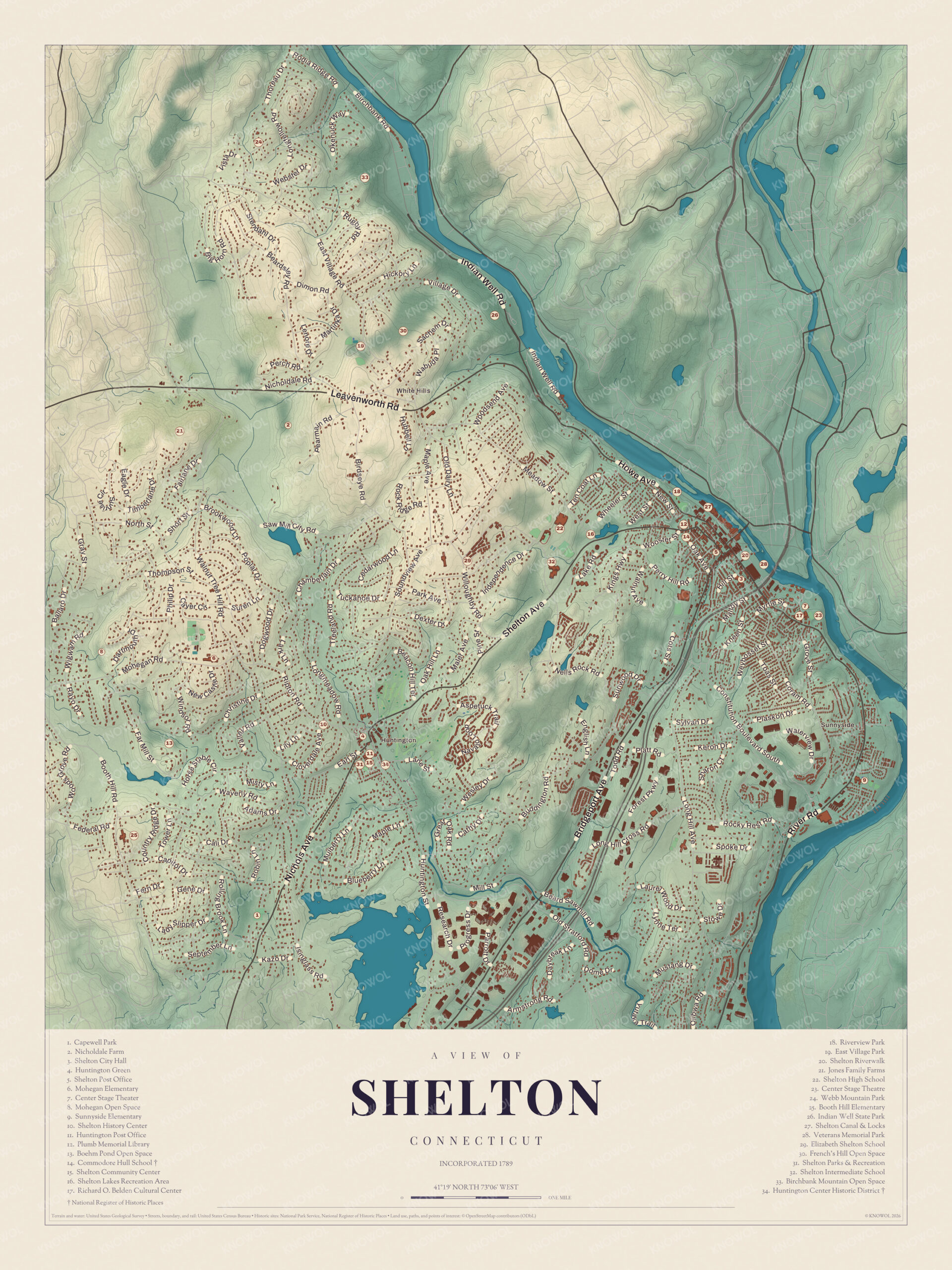
Shelton today
By KNOWOL
Shaded hills from Webb Mountain and Birchbank Mountain down to Pine Rock Park and the Housatonic, every street, downtown on the river and Huntington Center to the west, and a guide of 34 numbered landmarks with the National Register sites marked.4
The story of Shelton
The boy who wasn't born yet
When the books opened for stock in a dam across the Housatonic, a doubter told Dr. A. Beardsley that the boy wasn't born who would live to see the river dammed. Up-river towns fought the charter with cries of shad, so William E. Downes went to Maine, brought back a dam builder, and showed the legislature a model fish weir. Edward N. Shelton's company finished the dam in 1870, and on October 10 a procession more than a mile long marched out to celebrate. Across from Birmingham, on farmland, Nelson H. Downs built the first factory in 1871. By 1880 the new village named for Shelton had 175 houses and twelve factories, and its historian wrote that it had put on the garb of a miniature city.56278910
Ripton, Daniel Shelton's parish
Long before the factory village, the Sheltons were farmers in Ripton. In 1717 the families in the northern parts of Stratford, some six and some ten miles from the meetinghouse, asked to be a parish of their own, and Daniel Shelton's name was first on the petition. The parish was named Ripton, said to be after Ripon in Yorkshire, where he came from. Its first minister, Rev. Jedediah Mills, served about fifty years and took young David Brainerd into his home after Yale expelled him. The Episcopal church at Ripton burned in June 1811, a fire said to have started when a young man shot at a dove sitting on the church. The St. Paul's built after it, finished in 1812, still stands in Huntington Center.1112131415
The Indian Well
About a mile above the dam, on the Shelton side, a stream pours through an opening in the rocks into a deep pool. An 1886 history called it the only visible reminder of the Pootatuck people who lived along this part of the river, and it noted two stone pestles dug up in 1879 in the lower part of Shelton as the finest seen in this part of the country. Books of the 1880s said the stream fell twenty-five feet, that tradition held the pool had no bottom at a hundred feet, and that thousands of visitors came every summer. In 1928 the state bought about 150 acres here for Indian Well State Park.161718
Through the years
25 moments from 1639 to today.
- 1639English settlers arrive, and the land here is part of Stratford.1
- 1662Stratford's selectmen hold deeds from the Golden Hill Paugussett for the land that's now Shelton, Trumbull and Monroe.1
- 1717Farmers in the northern parts of Stratford, some living ten miles from the meetinghouse, ask to become a parish of their own.11
- 1717The new parish is named Ripton, said to be after Ripon in England, where Daniel Shelton came from.12
- 1724The Ripton church is gathered with 92 members, and Rev. Jedediah Mills is ordained the same day.13
- 1740About this year St. Paul's Episcopal church is built at Ripton.14
- 1743Rev. Mills takes David Brainerd into his family after Yale expels him, and teaches him theology.13
- 1789Ripton and New Stratford are set off from Stratford as the town of Huntington, named for Samuel Huntington.1
- 1791Agur Judson becomes the first person buried in the Lower White Hills burying ground, on land he promised for it.19
- 1811St. Paul's church at Ripton burns in June.14
- 1812The new St. Paul's church is finished before Easter.20
- 1816In the cold summer of 1816 the sloop Champion is launched near where Shelton's end of the bridge would be.21
- 1823The parish of New Stratford is set off as the town of Monroe.17
- 1870The dam is finished, and on October 10 a procession more than a mile long turns out to celebrate.2
- 1871Nelson H. Downs builds the first factory in the new village of Shelton.7
- 1876Edwin Wooster, who helped build the dam, drowns when his wood boat goes over it on a dark April night.9
- 1877The Derby Silver Company builds its large factory on Bridge Street.9
- 1878Fire destroys the Wilkinson paper mills, and they are rebuilt in four months and eighteen days.9
- 1882The borough of Shelton is incorporated.8
- 1893The Shelton Savings Bank opens as the first bank in the town of Huntington.22
- 1895The Plumb Memorial Library is built on Wooster Street.23
- 1907The Commodore Hull School is built of terra cotta, brick and reinforced concrete.24
- 1919The city of Shelton, incorporated in 1915, and the town of Huntington are joined as one city.1
- 1928The state buys about 150 acres around the Indian Well for a state park.18
- 2007A Shelton tree becomes the Rockefeller Center Christmas tree, and another follows in 2013.1
Places to see
The numbers match the landmark guide printed on the 2026 map.
- 4Huntington GreenHuntington Center. The parish green laid out in 1717.
- 10Shelton History CenterNear Huntington Green. The city's history close to the green.Visit their website
- 12Plumb Memorial Library65 Wooster Street. Richardsonian Romanesque library of 1895.
- 14Commodore Hull School130 Oak Avenue. Fireproof school of 1907, now apartments.
- 20Shelton RiverwalkDowntown on the river. On the old Sponge Rubber plant site.
- 21Jones Family FarmsNorthwest Shelton. Farmland in the city's northwest.
- 26Indian Well State ParkLake Housatonic, north. The waterfall and pool, a park since 1928.Visit their website
- 27Shelton Canal & LocksDowntown on the river. The canal that carried the dam's power.
- 28Veterans Memorial ParkDowntown on the river. Beside City Hall and the Riverwalk.
- 34Huntington Center Historic DistrictChurch and Huntington Streets. Old Ripton's center, three quarters of a mile.
On the National Register
All 3 places in Shelton on the National Register of Historic Places that still stand today, oldest first, and why each one matters.3
-
Huntington Center Historic District
The original colonial center of the town first known as Huntington, about three quarters of a mile long around the green laid out in 1717. Its oldest house is estimated to date to 1710, and it includes the Rev. Jedediah Mills House of 1734 and St. Paul's Episcopal Church of 1812.15
-
Plumb Memorial Library
A Richardsonian Romanesque library by the Bridgeport architect Charles T. Beardsley Jr., named for the businessman David Wells Plumb, whose widow gave the land. A modern addition came in 1975.23
-
Commodore Hull School
Built while Shelton was still part of Huntington, it is believed to be the first school in the state made with the fireproof combination of terra cotta blocks and reinforced concrete. Named for Commodore Isaac Hull of USS Constitution, it was a school until 1978 and is now apartments.24
In their words
“Thus within the last decade Shelton has put on the garb of a miniature city.”
The history of the old town of Derby, 188010
“Why Doctor, the boy isn't born who will live long enough to see the Ousatonic dammed.”
A doubter, as Dr. A. Beardsley told it at the dam celebration of 1870, in The history of the old town of Derby, 18805
“Previous to that date the present borough was but a farming district, where fruit orchards nodded to the majestic waters of the river.”
Souvenir history of Derby and Shelton, 18968
Nearby towns
Sources
- Shelton, Connecticut, Wikipedia
- The history of the old town of Derby, Connecticut, 1642-1880 (1880), on the Ousatonic dam, Internet Archive
- National Register of Historic Places listings in Fairfield County, Connecticut, Wikipedia
- Map of Shelton, Connecticut in 2026, KNOWOL (USGS elevation, Census Bureau roads)
- The history of the old town of Derby, Connecticut, 1642-1880 (1880), Dr. Beardsley's speech at the dam, Internet Archive
- The history of the old town of Derby, Connecticut, 1642-1880 (1880), S. W. Kellogg's speech at the dam, Internet Archive
- History of New Haven County, Connecticut (1892), on the first factories at Shelton, Internet Archive
- Souvenir history of Derby and Shelton, Connecticut (1896), on the borough of Shelton, Internet Archive
- The history of the old town of Derby, Connecticut, 1642-1880 (1880), on the village of Shelton, Internet Archive
- The history of the old town of Derby, Connecticut, 1642-1880 (1880), on Shelton as a miniature city, Internet Archive
- A history of the old town of Stratford and the city of Bridgeport (1886), on the Ripton petition of 1717, Internet Archive
- A history of the old town of Stratford and the city of Bridgeport (1886), on the name Ripton, Internet Archive
- History of Fairfield County, Connecticut (1881), on the Huntington Congregational church, Internet Archive
- History of Fairfield County, Connecticut (1881), on St. Paul's Episcopal Church, Internet Archive
- Huntington Center Historic District, Wikipedia
- A history of the old town of Stratford and the city of Bridgeport (1886), on Pootatuck and the Indian Well, Internet Archive
- History of Fairfield County, Connecticut (1881), on the Indian Well and the town of Huntington, Internet Archive
- Indian Well State Park, Wikipedia
- A history of the old town of Stratford and the city of Bridgeport (1886), on the Lower White Hills burying place, Internet Archive
- Sketches of church life in colonial Connecticut (1902), on St. Paul's Parish, Ripton, Internet Archive
- The history of the old town of Derby, Connecticut, 1642-1880 (1880), on the sloop Champion, Internet Archive
- Souvenir history of Derby and Shelton, Connecticut (1896), on the Shelton Savings Bank, Internet Archive
- Plumb Memorial Library, Wikipedia
- Commodore Hull School, Wikipedia