
A hill town on the old road from Northampton to Albany, once Township No. 3, where tavern keepers, sheep farmers and small mills on the Little River and the Westfield gave way to summer boarders, maple sugar and five quiet villages.
Worthington, Massachusetts on the map
Click the map to look closer.
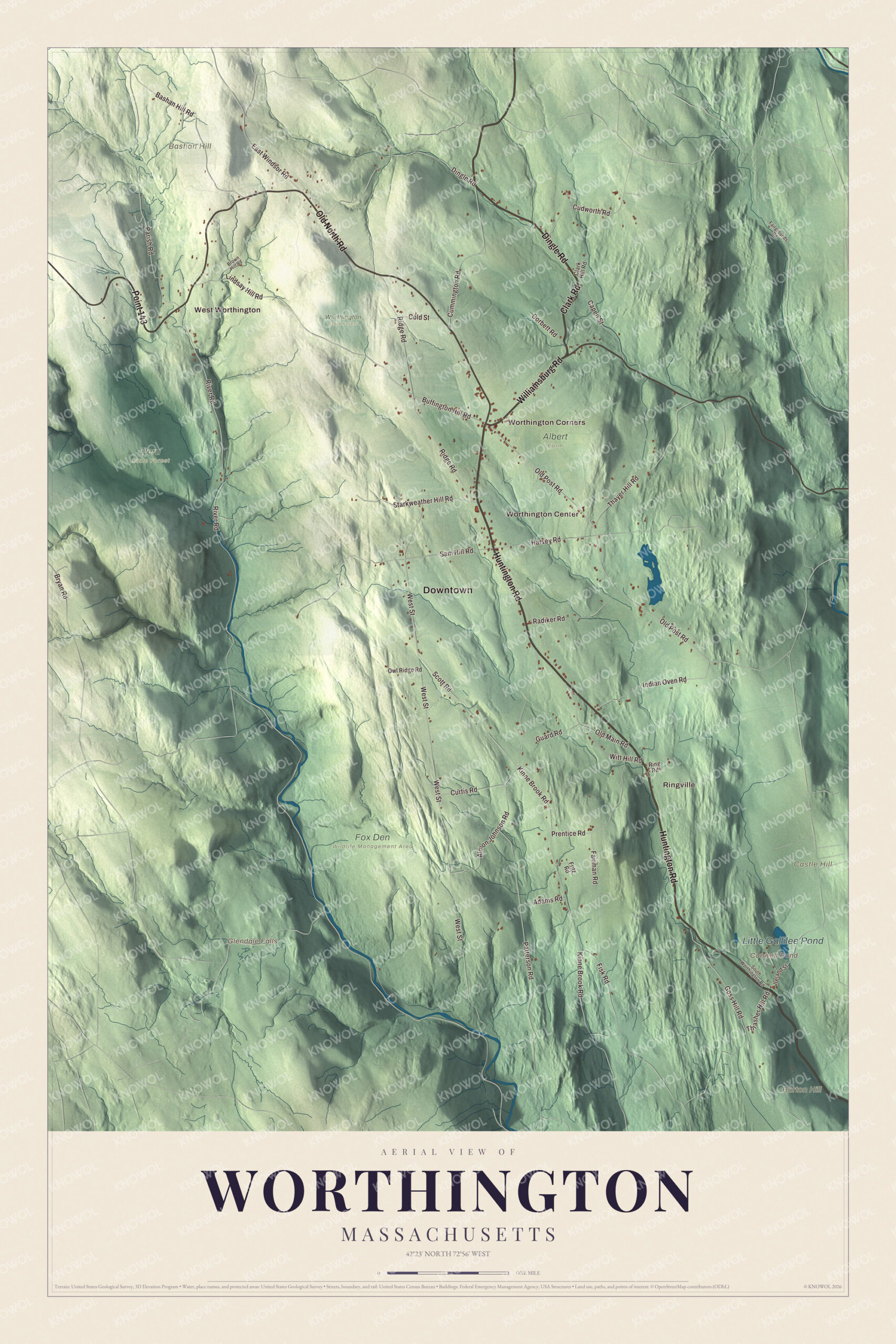
Worthington today
By KNOWOL
Shaded hills from Bashan Hill, Burton Hill and Castle Hill down to Conwell Pond and Little Gallilee Pond, with Huntington Road, Old North Road, Williamsburg Road and Old Post Road joining West Worthington, Worthington Corners, Worthington Center and Ringville.5
The history of Worthington, Massachusetts
Taverns on the old road
Worthington began along a road. The first clearings followed the old way from Northampton toward Berkshire County, and the men who kept taverns on it were among the first settlers. The town's first meeting was held in 1768 at Alexander Miller's inn, and in 1879 his old well and a single pear tree still marked the spot. Later, two tavern keepers on the same route, Capt. Dan Daniels and Isaiah Kingman, had each lost a leg. A traveler who met them both asked if it was the custom in Worthington to take off one leg. No, Daniels told him, but when they find a man peculiarly honest they mark him. In 1825 the town's most famous guest, General Lafayette, rode in from Peru with a mounted escort and spent the night.678
Sleds, cheese and picker sticks
Worthington was a farm town first. For years it was known for its sheep, and in the fine-wool craze farmers sat up more nights saving lambs than their own children, lambs that one man said no one should have tried to raise north of Florida. The wool business faded, dairying came back, and in the winter of 1874 to 1875 Horace Cole built a cheese factory at the Corners. Small mills filled the streams. At Ringville, where the Ring brothers had first built a gristmill, Cole and Hayden made children's sleds and wagons. At West Worthington Falls, O. B. Parish turned out picker sticks and loom fixtures, and a bedstead factory stood just upstream. The falls themselves dropped 75 feet into a rocky gorge.93
Under the maple at South Worthington
South Worthington grew up along the Little River, where a sawmill stood by 1794 and a gristmill followed. In 1828 a Methodist society formed there. Before it had a building, it met in houses, in barns and, in good weather, under a maple tree, where Horace Cole and six others joined the church. A small chapel went up about 1829, and later a Greek Revival church took its place. The old chapel still stands and later served as a store and a school. Russell Conwell was born in the village in 1843. He became a Baptist minister, gave his famous Acres of Diamonds lecture and founded Temple University, and his summers back in his boyhood home brought visitors to the valley.101112
Worthington, Massachusetts through the years
22 moments from 1762 to today.
- 1762Township No. 3 is sold at auction in Boston to Aaron Willard for 1,860 pounds.2
- 1764Settlers begin clearing farms along the old road from Northampton toward Berkshire County.1
- 1768Worthington is incorporated, named for Col. John Worthington of Springfield, one of the proprietors.6
- 1768The first town meeting gathers on August 1 at Alexander Miller's inn.6
- 1773The town's first schoolhouse is built.13
- 1781Worthington raises fifteen men for three years of service, and women plant, harvest and plow the farms.14
- 1791The town votes to move and finish its meetinghouse, paying most of the bill in cattle, grain, flax and meat.15
- 1825Col. William Rice and forty mounted men escort General Lafayette from Peru to spend the night in Worthington.8
- 1825After a long contest over its site, a new Congregational meetinghouse goes up at the Centre.15
- 1828Methodists in South Worthington form a society, meeting in good weather under a maple tree.10
- 1837The Mountain Seminary is incorporated at Worthington Corners.13
- 1843Russell Conwell, later the founder of Temple University, is born in South Worthington.12
- 1849West Worthington gets its post office, with Russell Bartlett as postmaster.3
- 1865The church parish is finally organized apart from the town, which had run its business at town meeting until then.15
- 1866The town buys land from Ethan Ring for the Ringville Cemetery.16
- 1875Horace Cole's new cheese factory at the Corners takes the milk of 150 cows or more.9
- 1879Cole and Hayden are making children's sleds and wagons at the old Ringville mill.9
- 1884A library is founded in Worthington, with William A. Rice among its leaders.17
- 1888The third Congregational church, with steeple, bells and new stained glass, is dedicated after the 1887 fire.1
- 1931The Lafayette Inn burns to the ground and is never rebuilt.1
- 1945The town's population reaches its low point of 363.1
- 1968Worthington celebrates its bicentennial with a parade, an antique fair and a beard-growing contest.1
Places to see in Worthington, Massachusetts
Places worth a visit in Worthington today.
- Worthington CornersOn the old stage road. Main village, early summer resort.
- Worthington CenterA mile south of the Corners. Town hall and the Congregational church.
- West WorthingtonNorthwest, on the Westfield. Mill village above the falls.
- RingvilleSoutheast, on the Little River. Named for the Ring family's mills.
- Bashan HillNorthwest corner of town. High ground above West Worthington.
- Burton HillJust south of South Worthington. Hill above the Little River valley.
- Castle HillEast of Ringville. Hill near the Chesterfield line.
- Conwell PondAbove South Worthington. Pond in the Little River valley.
- Little Gallilee PondSouth Worthington, Chesterfield line. Its dam reaches into Chesterfield.
- Glendale FallsJust over the Middlefield line. Long falls run, a Trustees reservation.Visit their website
Worthington on the National Register of Historic Places
All 4 places in Worthington on the National Register of Historic Places that still stand today, oldest first, and why each one matters.4
-
Center Cemetery
Many of Worthington's founders and early settlers lie here, under more than 600 stones set inside stone walls lined with sugar maples. One 1777 marker carries a carved face of a kind rarely found outside the Hampton, Connecticut area.18
-
North Cemetery
The town's largest cemetery, near Worthington Corners, with more than 700 markers, the oldest dated 1790. Its best-known grave is the Horace Cole family's zinc obelisk of 1877, and a storage vault held caskets in winter until the 1950s.19
-
South Worthington Historic District
A once-industrial village on the Little River, with the Theron Higgins Mill, the Greek Revival South Worthington Methodist Church of 1848, and the boyhood and summer home of Russell Conwell, founder of Temple University. The dam of Little Galilee Pond reaches into Chesterfield.11
-
Ringville Cemetery
Started in 1866 on land bought from Ethan Ring, in the village that was the industrial heart of Worthington in the 1800s. Its granite-topped front wall and the brick and granite Blair Vault stand out.16
Worthington in their words
“When they find a man peculiarly honest they mark him.”
History of the Connecticut Valley in Massachusetts, 1879, Capt. Dan Daniels answering a traveler who asked why two Worthington tavern keepers had each lost a leg7
“A cataract seventy-five feet in depth, the gorge below bordered by rocky precipices.”
History of the Connecticut Valley in Massachusetts, 1879, on West Worthington Falls3
“Several places of romantic beauty are within easy drive, and there is much to attract in all parts of the town.”
History of the Connecticut Valley in Massachusetts, 1879, on Worthington Corners3
Towns near Worthington, Massachusetts
Sources for the history of Worthington
- Worthington, Massachusetts, Wikipedia
- History of western Massachusetts (1855), Internet Archive
- History of the Connecticut Valley in Massachusetts (1879), on Worthington's villages, Internet Archive
- National Register of Historic Places listings in Hampshire County, Massachusetts, Wikipedia
- Map of Worthington, Massachusetts in 2026, KNOWOL (USGS elevation, Census Bureau roads)
- History of the Connecticut Valley in Massachusetts (1879), on Worthington's founding, Internet Archive
- History of the Connecticut Valley in Massachusetts (1879), on Worthington's taverns, Internet Archive
- Western Massachusetts: a history, 1636-1925 (1926), on Col. William Rice, Internet Archive
- History of the Connecticut Valley in Massachusetts (1879), on Worthington's mills and farms, Internet Archive
- History of the Connecticut Valley in Massachusetts (1879), on the South Worthington Methodists, Internet Archive
- South Worthington Historic District, Wikipedia
- Russell Conwell, Wikipedia
- Western Massachusetts; a history, 1636-1925 (1926), on Worthington's villages and schools, Internet Archive
- A history of the town of Middlefield, Massachusetts (1924), Internet Archive
- History of the Connecticut Valley in Massachusetts (1879), on Worthington's meetinghouses, Internet Archive
- Ringville Cemetery, Wikipedia
- Western Massachusetts; a history, 1636-1925 (1926), on William A. Rice, Internet Archive
- Center Cemetery (Worthington, Massachusetts), Wikipedia
- North Cemetery (Worthington, Massachusetts), Wikipedia