
A town almost ringed by the Charles River, where the old Great Plain became the center, gravel trains carried whole hills off to fill Boston's Back Bay, and English knitters built up Highlandville, now Needham Heights.
Needham, Massachusetts on the map
Click the map to look closer.
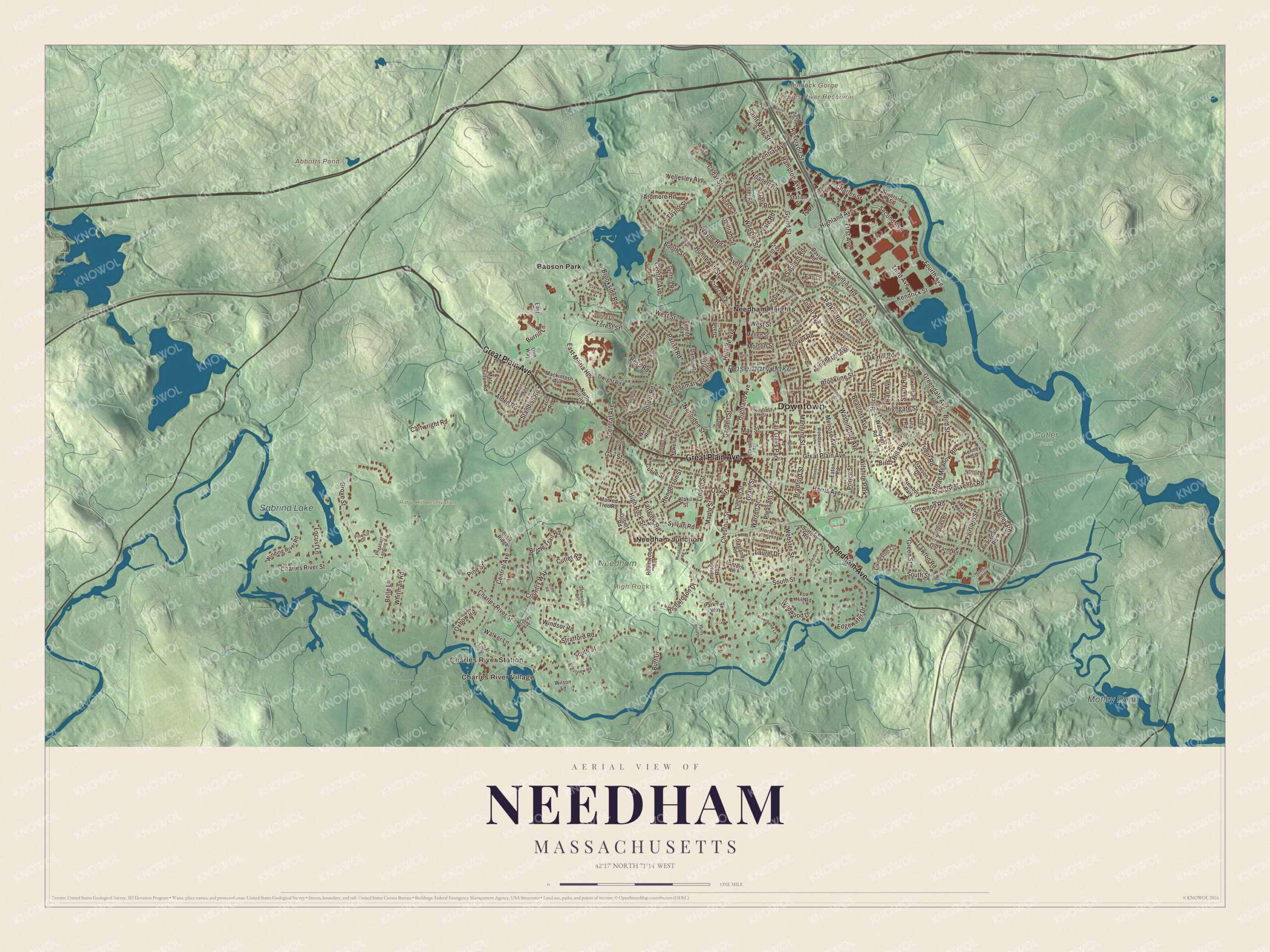
Needham today
By KNOWOL
Needham between its banks of the Charles River, from Great Plain Avenue and Central Avenue out along Dedham Avenue, Highland Avenue, Grove Street and Wellesley Avenue, with Rosemary Lake, Sabrina Lake, Ridge Hill Reservation and Birds Hill printed on it and the hills shaded from USGS elevation data.4
The history of Needham, Massachusetts
For liberty they died
The alarm reached East Needham about nine on the morning of April 19, 1775, brought by a rider bound for Dedham. The militia lined up in the driveway of their minister, the Rev. Samuel West, because the town's ammunition was kept in his house, the one on Central Avenue now called the Townsend House. They stopped at Watertown for food and still caught the British retreating through West Cambridge. Five Needham men were killed there, and all five left widows and large families. John Tolman, who lived on the farm now known as the Tolman-Gay House, was shot between the shoulders and lived, and the bullet was still kept in 1911. In 1851 the women of the town raised a granite monument in the old graveyard with their five names and the words "For Liberty they died."256
The hills that went to the Back Bay
The railroad reached Needham on June 1, 1853. It might have run past the old Centre on Central Avenue, but the story goes that one man wouldn't give up his land, so it crossed the Great Plain, where land was cheerfully offered. Business followed the trains, and by 1879 even the First Parish meetinghouse had left the old Centre. In 1859 Myron C. Munson began hauling gravel from East Needham to fill Boston's Back Bay. Locomotives pulled forty loaded cars, two hundred men worked the pits, and the trains ran all night. In ten years the hills were leveled, and hundreds of acres were left a desert, worth next to nothing for twenty-five years. When a new line opened in 1906, Needham was twenty-one minutes from South Station.78910
Gloves on the drying boards
By the late 1840s English knitters were settling in Needham, many from Nottinghamshire, Derbyshire and Leicestershire. They worked hand-frames in small shops, mostly in Highlandville, and gloves and stockings stretched on boards to dry were a common sight until after 1880. In 1864 Mark and John Lee built the start of a big knitting mill there, and in 1869 William Carter, born in Alfreton, Derbyshire, joined the firm. By 1911 the William Carter Company employed three to four hundred people in town, and Carter had named his own street Alfreton Road. The town historian remembered Highlandville as decidedly English when he was young. On May 28, 1907, its post office took a new name, Needham Heights, after Needham Highlands was ruled out because Newton Highlands was so close.111213
Needham, Massachusetts through the years
23 moments from 1680 to today.
- 1680Settlers buy a tract four miles by five from Chief Nehoiden.1
- 1711The north side of the Charles is set off from Dedham as the town of Needham.1
- 1720A house goes up on today's Central Avenue for the Rev. Jonathan Townsend.5
- 1774A mysterious fire destroys the meetinghouse.1
- 1775On April 19 five Needham men are killed at West Cambridge as the British retreat from Concord.2
- 1814Rufus Ellis builds a cotton factory on the Needham side of the Upper Falls.14
- 1851Women of the town raise a granite monument to the five men of 1775 in the old graveyard.2
- 1853The railroad opens to Needham on June 1, running over the Great Plain instead of the old Centre.7
- 1859Gravel trains begin carrying East Needham's hills away to fill Boston's Back Bay.9
- 1864Mark and John Lee build the first part of the knitting mill William Carter joins in 1869.12
- 1875William Emerson Baker entertains the Fifth Maryland Regiment at Ridge Hill Farms.15
- 1876Echo Bridge is finished over the Charles at the Upper Falls.16
- 1879The First Parish meetinghouse is moved away from the old Centre.8
- 1881West Needham becomes the town of Wellesley.1
- 1882Needham and Wellesley high schools play their first Thanksgiving football game.1
- 1888William Emerson Baker builds Hotel Wellesley, with room for more than 300 guests, on his Needham estate.1
- 1891Walker-Gordon Laboratories sets up in Charles River Village to make cleaner milk for babies.1
- 1902The cornerstone of Town Hall is laid on September 2.1
- 1906A new line through Needham Junction opens on November 4, twenty-one minutes from South Station.10
- 1907Highlandville's post office takes the name Needham Heights on May 28.13
- 1909William Carter puts four swans on Rosemary Pond.15
- 1911Needham marks its 200th birthday with three days of services, speeches and a parade from Needham Square.17
- 2005Needham raises the legal age to buy tobacco to 21; the town's Wikipedia page calls it a world first.1
Places to see in Needham, Massachusetts
Places worth a visit in Needham today.
- Needham SquareGreat Plain Avenue. The old Great Plain, now the center.
- Needham HeightsHighland Avenue. Highlandville until 1907, the knitting village.
- Charles River VillageSouth end, on the Dover line. Old paper-mill village on the river.
- Rosemary LakeNorth of the center. Carter's swans arrived in 1909.
- Sabrina LakeNear Locust Lane. Dug for Baker's Ridge Hill Farm.
- Ridge Hill ReservationCharles River Street. Town conservation land with trails.
- Birds HillEast of the center. Highest ground in town, 300 feet.
- Cutler ParkAlong the Charles toward Newton. Largest freshwater marsh on the middle Charles.Visit their website
Needham on the National Register of Historic Places
All 15 places in Needham on the National Register of Historic Places that still stand today, oldest first, and why each one matters.3
-
Robert Fuller House
Called the oldest house in Needham, it was built in 1707 by Robert Fuller, who moved it in 1750 a short way along what is now Burrill Lane to make room for a new house. The saltbox leanto was added after the move.18
-
Kingsbury-Whitaker House
At its core is a house of about 1720 built by Deacon Timothy Kingsbury, one of the leaders of the effort to make Needham a town in 1711. After 1839 the Whitakers made it a larger house, and their addition meant moving Nehoiden Street 150 feet to the west.19
-
Townsend House
Built in 1720 by the sea captain Gregory Sugars for his son-in-law, Rev. Jonathan Townsend. Rev. Samuel West gave it a Federal look in the 1780s, and under his ownership it was a muster site for the local militia before the battles of Lexington and Concord.5
-
James Smith House
James Smith, a recent immigrant from Ireland, built this house about 1727 to 1728, and it is one of the oldest in Needham. Its center doorway has a Greek Revival surround with sidelights.20
-
Tolman-Gay House
Nathaniel Tolman built this house in 1743. His son John fought at Lexington and Concord, the Siege of Boston and Saratoga, and the Gay family who came next kept it until 1923.6
-
Amos Fuller House
Amos Fuller, son of one of Needham's first settlers, built this house in 1754 on the site of his father's house and served as a selectman and in the legislature. Later it belonged to the lawyer Artemas Newell, whose family gave Newell Avenue its name.21
-
Joshua Lewis House
Joshua Lewis built this saltbox above the Charles River in 1776. The Swiss horticulturist Denys Zirngiebel bought it in 1874 and Longfellow is known to have visited, and Zirngiebel's grandson, the artist N.C. Wyeth, bought it in 1921 for a home and studio.22
-
McIntosh Corner Historic District
This crossroads of Great Plain Avenue and Central Avenue faded after the railroad was routed around it in 1853, and the town center moved about a mile east. Its oldest house, the Daniel Kingsbury House, dates from 1794.23
-
Israel Whitney House
Israel Whitney, a shoemaker active in town politics, built this house in 1830 on land he bought the year before. Its center doorway has sidelights, pilasters and a corniced entablature.24
-
Davis Mills House
Davis Mills, a butcher, tavernkeeper and active citizen from one of Needham's big landowning families, built this Greek Revival house in 1834 at Central Avenue and Nehoiden Street, then the town center.25
-
Needham Street Bridge
Built in 1875 when Needham Street was laid out to Newton, this three-arch stone bridge was designed and built by Hiram Blaisdell and William Wheeler. It is one of the finest surviving stone arch bridges around Boston, and it has never been widened.26
-
Sudbury Aqueduct Linear District
Built from 1875 to 1878 to carry Sudbury River water 16 miles toward Boston, the aqueduct runs through Natick, Wellesley and Needham and crosses the Charles on Echo Bridge into Newton. It was in use for almost 100 years.27
-
Echo Bridge
This granite bridge carries the Sudbury Aqueduct and a footpath across the Charles River at Hemlock Gorge. When it was built in 1876 to 1877 it was the second longest masonry arch in the country, and a platform under the arch is where visitors try the echo.28
-
Emery Grover Building
A tan brick building in the Italian Renaissance Revival style, designed by Whitman & Hood and built in 1898. It now holds the offices of the Needham Public Schools.29
-
Needham Town Hall Historic District
Town Hall, a Georgian Revival building by Winslow & Bigelow finished in 1903, faces the common the town bought in 1884 to make a new civic center on the Great Plain. Its upper hall held town meetings and all kinds of gatherings until 1952.30
Needham in their words
“Our town is a unit in a constellation of towns and cities and mighty states, and it is older than the Federal government itself.”
George K. Clarke, address at Needham's 200th anniversary, 191131
“It is one of the most beautiful of the many beautiful suburbs of Boston, and I do not blame any of you for wanting to live here.”
A. P. Langtry, Massachusetts Secretary of State, at the bicentennial banquet, 191132
“Newton is proud of Needham; we are bound to you by many ties”
Charles E. Hatfield, mayor of Newton, at the bicentennial banquet, 191133
Towns near Needham, Massachusetts
Sources for the history of Needham
- Needham, Massachusetts, Wikipedia
- History of Needham, Massachusetts, 1711-1911 (1912), on the Lexington alarm, Internet Archive
- National Register of Historic Places listings in Norfolk County, Massachusetts, Wikipedia
- Map of Needham, Massachusetts in 2026, KNOWOL
- Townsend House, Wikipedia
- Tolman-Gay House, Wikipedia
- History of Needham, Massachusetts, 1711-1911 (1912), on the Charles River Railroad, Internet Archive
- History of Needham, Massachusetts, 1711-1911 (1912), on the railroad and the old Centre, Internet Archive
- History of Needham, Massachusetts, 1711-1911 (1912), on filling the Back Bay with soil from Needham, Internet Archive
- History of Needham, Massachusetts, 1711-1911 (1912), on the railroad of 1906, Internet Archive
- History of Needham, Massachusetts, 1711-1911 (1912), on the English knitters, Internet Archive
- History of Needham, Massachusetts, 1711-1911 (1912), on the William Carter Company, Internet Archive
- History of Needham, Massachusetts, 1711-1911 (1912), on the industries of Needham Heights, Internet Archive
- History of Needham, Massachusetts, 1711-1911 (1912), on the mills at the Upper Falls, Internet Archive
- History of Needham, Massachusetts, 1711-1911 (1912), on the ponds and Ridge Hill Farms, Internet Archive
- History of Needham, Massachusetts, 1711-1911 (1912), on Echo Bridge, Internet Archive
- Needham's bicentennial celebration (1913), the program of September 17 to 19, 1911, Internet Archive
- Robert Fuller House, Wikipedia
- Kingsbury-Whitaker House, Wikipedia
- James Smith House, Wikipedia
- Amos Fuller House, Wikipedia
- Joshua Lewis House, Wikipedia
- McIntosh Corner Historic District, Wikipedia
- Israel Whitney House, Wikipedia
- Davis Mills House, Wikipedia
- Needham Street Bridge, Wikipedia
- Sudbury Aqueduct Linear District, Wikipedia
- Echo Bridge, Wikipedia
- Emery Grover Building, Wikipedia
- Needham Town Hall Historic District, Wikipedia
- Needham's bicentennial celebration (1913), address by George K. Clarke, Internet Archive
- Needham's bicentennial celebration (1913), remarks of A. P. Langtry, Internet Archive
- Needham's bicentennial celebration (1913), remarks of Mayor Charles E. Hatfield of Newton, Internet Archive