
Cape Cod's oldest town, settled from Saugus in 1637, where early Quakers met in a hidden hollow, the town meeting paid bounties on blackbirds and wolves, and the Boston and Sandwich Glass Company kept its furnaces burning from 1825 to 1888.
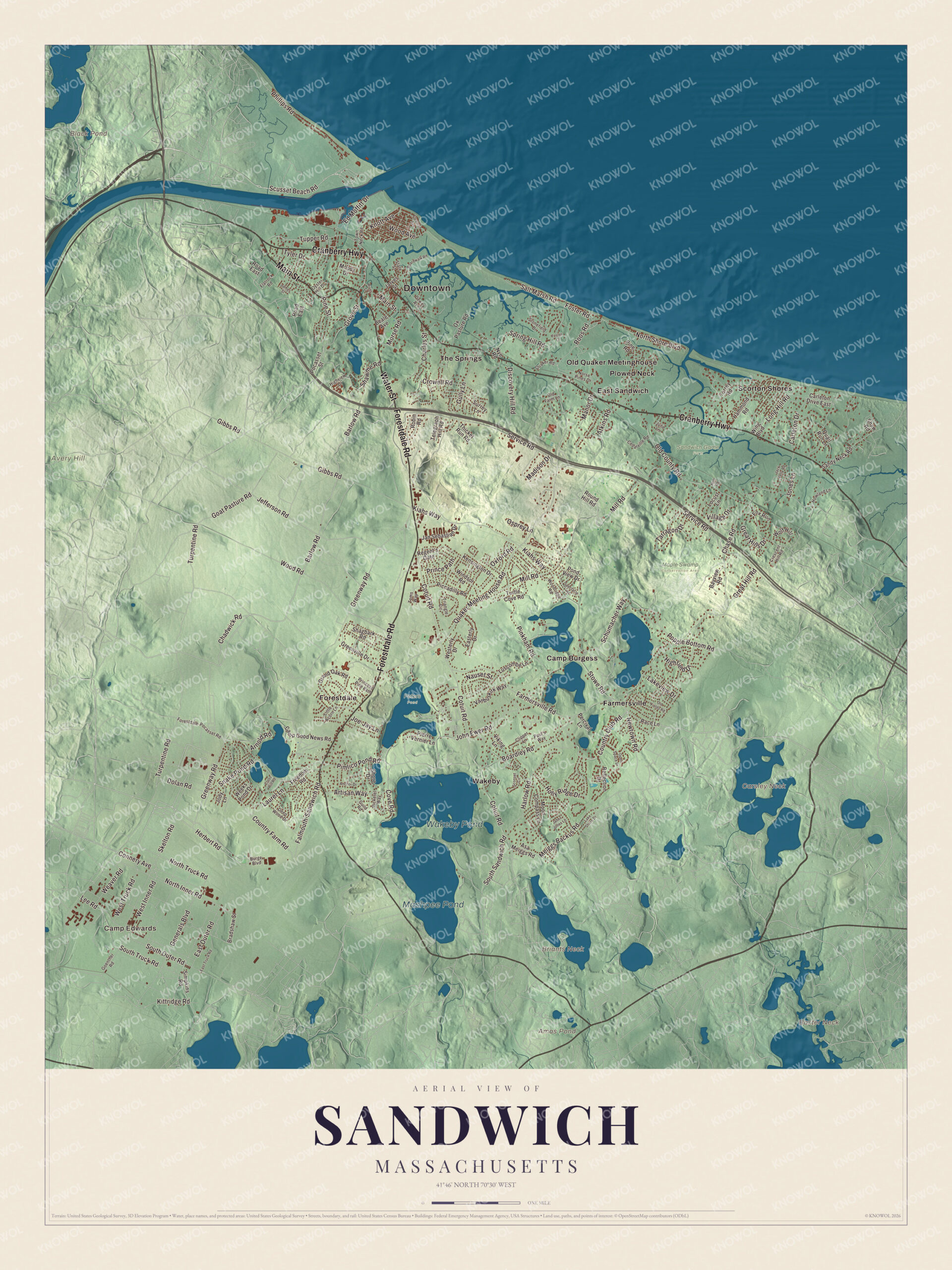
Sandwich, Massachusetts on the map
Click the map to look closer.
Sandwich today
By KNOWOL
Main Street, Water Street, Cranberry Highway, Forestdale Road, Barlow Road and Scusset Beach Road across town, with East Sandwich, Forestdale, Scorton Shores and the long reach of Mashpee and Wakeby ponds, drawn from USGS elevation data and Census Bureau roads.5
The history of Sandwich, Massachusetts
When Sandwich made glass
In the winter of 1824 and 1825 a man named Jabez Dame went quietly around Sandwich and bought a factory site for Deming Jarves. Glassmaking began in a small building there on July 4, 1825. The Boston and Sandwich Glass Company bought 2,300 acres of woodland, and its furnaces burned 3,000 cords of oak and pine a year, hauled by fifty pairs of oxen owned by the company and the farmers around. In the Civil War years it had 500 hands. Daniel Webster thanked Jarves in 1841 for a gift of glass with substance as well as beauty. The works closed on January 1, 1888, with 276 men still on the payroll, and ten of them put up a building and went on making glass on their own.236
Christopher's Hollow
In 1657 two Quaker preachers, Christopher Holder and John Copeland, reached Sandwich, and by the next year eighteen families here had joined the new Society of Friends. They met at William Allen's house on Spring Hill and in a deep glen in the woods about a mile southeast of the village, where a row of flat stones was believed to be their seats. Two centuries later people still called it Christopher's Hollow. The colony fined them hard: in three years their fines came to at least a thousand pounds, and William Allen alone paid eighty-seven. The Friends' own records call the Sandwich Monthly Meeting the first in America, and the town still hosts the oldest continuous Quaker meeting in the country.789101
What the town meeting ordered
Sandwich's old town records read like a list of chores and alarms. In 1672 every head of a family had to kill a dozen blackbirds to protect the wheat and corn. In 1702 the town gave its minister, Roland Cotton, every drift whale that washed ashore while he served. In 1754 it named forty-two men to set fire to the woods before April 16, an old way to clear brush and bring on grazing. When smallpox came in 1778, the town built a pest-house, fenced the roads and put out red flags. In 1790 it offered 25 pounds, then 30, for the wolf, catamount or tiger killing its sheep. And in 1814, with British cruisers threatening the Cape, the voters promised to defend the town to the last extremity.111213141516
Sandwich, Massachusetts through the years
25 moments from 1637 to today.
- 1637Settlers from Saugus begin Sandwich with Plymouth Colony's permission.1
- 1637Two men clearing land here without leave or families are charged with disorderly keeping house alone.17
- 1638John Alden and Miles Standish are sent to lay out the bounds of the Sandwich grant.18
- 1639Sandwich is incorporated as a town of Plymouth Colony.1
- 1655The colony court cites Sandwich for having no stocks and no whipping post.19
- 1657Quakers begin meeting at William Allen's house on Spring Hill and in Christopher's Hollow.8
- 1659John Ellis is licensed to keep an ordinary, a tavern, in Sandwich village.20
- 1672Every head of a family is ordered to kill a dozen blackbirds.11
- 1702The town gives Rev. Roland Cotton every drift whale that comes ashore during his ministry.12
- 1754Forty-two men are named to set fire to the woods before April 16.13
- 1774Men who cut down the Liberty Pole confess in print, pay five pounds and a new pole goes up.21
- 1778Smallpox breaks out; the town builds a pest-house and fences the roads.14
- 1790The town offers 25 pounds for the wolf, catamount or tiger killing sheep.15
- 1792Sandwich counts 2,024 people and 296 houses.22
- 1814Voters promise to defend the town to the last extremity if the British attack.16
- 1819The town votes to license no retailer of distilled liquors.20
- 1822Joseph Hoxie makes the county's first morocco, kid and cloth shoes at East Sandwich.23
- 1825Glassmaking begins in Sandwich on July 4.2
- 1859Deming Jarves starts a second glass works, the Cape Cod Glass Works.24
- 1875Gustavus Howland builds the first boardwalk across the marsh.1
- 1881Thomas Dexter's old grist mill stops grinding.25
- 1884The western part of town becomes the town of Bourne.1
- 1887About this year Greenville gets a post office and a new name, Forestdale.26
- 1888The Boston and Sandwich Glass Company closes on January 1.3
- 1914The Cape Cod Canal, begun in 1909, opens through town.1
Places to see in Sandwich, Massachusetts
Places worth a visit in Sandwich today.
- Hoxie HouseSandwich village. Rev. John Smith's saltbox, about 1675.Visit their website
- Dexter Grist MillSandwich village. The rebuilt mill by the town hall.Visit their website
- Sandwich Glass MuseumSandwich village. Pieces from the Boston and Sandwich works.Visit their website
- Heritage Museums and GardensGrove Street. Museums and public gardens.Visit their website
- Sandwich boardwalkOver the marsh to Town Beach. First built in 1875, 1,350 feet long.
- Old Quaker MeetinghouseEast of Spring Hill. Oldest continuous Quaker meeting in the country.
- ForestdaleSouth part of town. Called Greenville until about 1887.
- Wakeby PondSouth, on the Mashpee line. With Mashpee Pond, the Cape's largest.
- Scusset Beach State ReservationNorth of the canal. Half a mile of beach and a jetty.Visit their website
- Sagamore HillScusset Beach State Reservation. Once a Native American meeting ground.
Sandwich on the National Register of Historic Places
All 10 places in Sandwich on the National Register of Historic Places that still stand today, oldest first, and why each one matters.4
-
Wing Fort House
Stephen Wing, son of the Rev. John Wing, took up this homestead around his first marriage in 1646, and his descendants lived here until 1942, when the last of them sold it to the Wing Family of America. Tradition says it was a fort for the first settlers; it's now a museum.27
-
Benjamin Nye Homestead
Benjamin Nye built the earliest part in 1678, a date confirmed by a tree-ring study in 2012. Sold to the state in 1924 and threatened with demolition in 1962, it was bought and restored by the Nye Family Association, which runs it as a museum.28
-
Jarvesville Historic District
The glassworkers' neighborhood around the site of the Boston and Sandwich Glass Company factory, north and east of the town center. Most of its more than 200 contributing buildings are modest Cape and Greek Revival houses built between 1825 and 1860; the factory buildings themselves were torn down in the 20th century.29
-
John and Mary Waterman Jarves House
An Italianate house designed and built by Charles Kirk Kirby in 1857 for John Jarves, head of the Cape Cod Glass Works and son of Deming Jarves, who founded the Boston and Sandwich Glass Company.30
-
Forestdale School
A one-room district school built in 1878 for the farming village then called Greenville, now Forestdale. Of the 21 district schools the town built in the 1800s, it's the least altered survivor, and classes met here until 1927.31
-
Town Hall Square Historic District
The old center of Sandwich, around the town hall, Shawme Pond and the reconstructed Dexter Grist Mill, with First Period houses from the 1600s and the original burying ground, whose oldest grave dates to 1663. The district was enlarged in 2010.32
-
Town Boundary Marker
A rough granite stone on the Sandwich and Barnstable town line on Race Lane, carved with a B on the Barnstable side and an S on the Sandwich side. The line was first laid out by the Plymouth Colony council in 1639.33
-
Town Line Boundary Marker
One of the old stones on the Sandwich and Barnstable town line, marked like the Race Lane stone with a B on one side and an S on the other. It was probably set after the colonists bought this part of West Barnstable in 1644.34
-
Town Line Boundary Marker
One of the old stones on the Sandwich and Barnstable town line, marked like the Race Lane stone with a B on one side and an S on the other. No one knows when it was set; the colonists didn't buy this part of West Barnstable until 1644.34
-
Spring Hill Historic District
A rural stretch along Main Street and Spring Hill Road with the Wing Fort House, the site its write-up calls the first Quaker meeting in the New World, wide views, and cranberry bogs, some worked since the 1800s.35
Sandwich in their words
“Early in its history the village of Sandwich was the door of the Cape and the terminus of lines of travel.”
History of Barnstable County, Massachusetts, 189020
“By the location of the Sandwich glass works here was created a home market for the sale of the surplus produce of our farmers. Those were indeed the palmy days of Sandwich”
Charles E. Pope, speaking at the town's 250th anniversary, 18892
“I please myself with the hope that I may find leisure before autumn to visit Sandwich once more, a spot in which I have spent so much agreeable time in years past.”
Daniel Webster, thanking Deming Jarves for a gift of Sandwich glass, 18416
Towns near Sandwich, Massachusetts
Sources for the history of Sandwich
- Sandwich, Massachusetts, Wikipedia
- Two hundred and fiftieth anniversary celebration of Sandwich and Bourne (1890), Charles E. Pope on the glass works, Internet Archive
- History of Barnstable County, Massachusetts (1890), on the Boston and Sandwich Glass Company, Internet Archive
- National Register of Historic Places listings in Barnstable County, Massachusetts, Wikipedia
- Map of Sandwich, Massachusetts in 2026, KNOWOL (USGS elevation, Census Bureau roads)
- History of Plymouth, Norfolk and Barnstable counties, Massachusetts (1928), on Daniel Webster's letter, Internet Archive
- History of Barnstable County, Massachusetts (1890), on the Society of Friends in Sandwich, Internet Archive
- History of Barnstable County, Massachusetts (1890), on Christopher's Hollow, Internet Archive
- A trip around Cape Cod (1898), on the Quakers of Sandwich, Internet Archive
- The history of Cape Cod: the annals of Barnstable County (1860), on the Friends of Sandwich, Internet Archive
- History of Barnstable County, Massachusetts (1890), on the blackbird order, Internet Archive
- Cape Cod, the right arm of Massachusetts (1897), on Roland Cotton's drift whales, Internet Archive
- History of Barnstable County, Massachusetts (1890), on firing the woods, Internet Archive
- History of Barnstable County, Massachusetts (1890), on the smallpox of 1778, Internet Archive
- History of Barnstable County, Massachusetts (1890), on the wolf bounty, Internet Archive
- History of Barnstable County, Massachusetts (1890), on the vote of 1814, Internet Archive
- Cape Cod, the right arm of Massachusetts (1897), on the first settlement, Internet Archive
- Cape Cod, the right arm of Massachusetts (1897), on the bounds of Sandwich, Internet Archive
- History of Barnstable County, Massachusetts (1890), on early town government, Internet Archive
- History of Barnstable County, Massachusetts (1890), on the village and its taverns, Internet Archive
- Publications of the Colonial Society of Massachusetts (1922), on the Sandwich Liberty Pole, Internet Archive
- Collections of the Massachusetts Historical Society (1792), on Sandwich, Internet Archive
- History of Barnstable County, Massachusetts (1890), on Joseph Hoxie, Internet Archive
- History of Barnstable County, Massachusetts (1890), on the Cape Cod Glass Works, Internet Archive
- History of Barnstable County, Massachusetts (1890), on Dexter's mill, Internet Archive
- History of Barnstable County, Massachusetts (1890), on Forestdale, Internet Archive
- Wing Fort House, Wikipedia
- Benjamin Nye Homestead, Wikipedia
- Jarvesville Historic District, Wikipedia
- John and Mary Waterman Jarves House, Wikipedia
- Forestdale School, Wikipedia
- Town Hall Square Historic District, Wikipedia
- Town Boundary Marker, Wikipedia
- Town Line Boundary Marker, Wikipedia
- Spring Hill Historic District, Wikipedia