
A narrow Naugatuck River town between Rock Rimmon and High Rock, where one brick mill made hard rubber, then woolen shawls, then rubber boots and canvas sneakers sold around the country.
Beacon Falls on the map
Click the map to look closer.
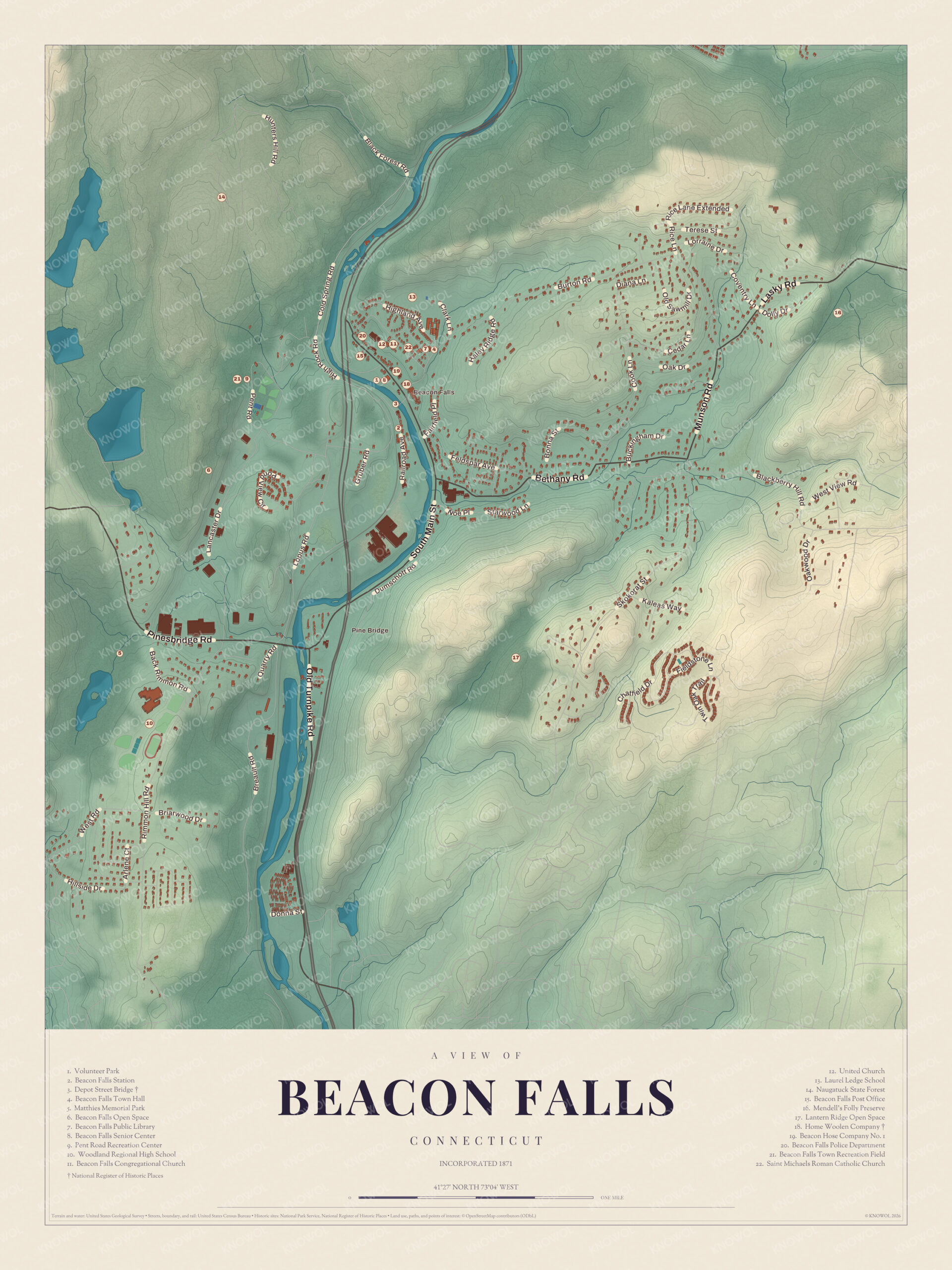
Beacon Falls today
By KNOWOL
Shaded hills on both sides of the Naugatuck valley, every street from North Main to Skokorat Street, Beacon Falls and Pine Bridge by name, and a guide of 22 numbered landmarks with the Home Woolen Company and Depot Street Bridge marked.5
The story of Beacon Falls
From shawls to rubber shoes
Before the big brick mill, the site held John V. Coe's tannery, and Coe made shoes there too. In 1853 the American Hard Rubber Company opened works fed by a raceway three quarters of a mile long, then left for Long Island in 1860, and for three years the village was nearly deserted. The Home Woolen Company bought the plant in 1863, and by 1870 its 330-foot mill turned out nearly 18,000 shawls a month. Woolens kept it going on and off for years, but in 1897 and 1898 the mill and many village houses stood closed with their windows boarded up. Then on March 15, 1899, the Beacon Falls Rubber Shoe Company made its first rubber shoe. By 1918 it employed fifteen hundred people and made twenty thousand pairs a day.67389
High Rock and Toby's Rocks
Coming up the valley from the south, Rock Rimmon rises 400 feet and seems to block the way. A mile above the station, High Rock stands at the north end of a cliff that an 1880 history calls Toby's Rocks, after Toby, the man who once had been enslaved by Colonel Ebenezer Johnson and was deeded land here. His tract was confirmed to him in 1713, and he lived on it until he died in 1734. In 1876 George W. Beach, superintendent of the Naugatuck Railroad, began making the level woods at the foot of High Rock into a pleasure ground called High Rock Grove, with boating above the dam, shady walks in High Rock Glen, and Lookout Point at the top.21011
The bridge fund at Pines Bridge
Pines Bridge, south of the village, is where many of the first families lived. When Benajah Johnson died in 1763 there was no burying ground nearby, so he was carried to Derby on a horse litter. In 1800 Alexander Johnson gave the land for the cemetery near the bridge. In 1827 Sheldon Clark, a benefactor of Yale College whose ancestor Hezekiah Clark was one of the first settlers on the Lopus Plains, left 100 pounds to build and keep up a bridge at Pines Bridge. The money had to stay invested and only the interest could be spent. It was still paying out decades later, and in 1888 the Clark fund built an iron bridge there.121314
Through the years
24 moments from 1678 to today.
- 1678Settlers from Derby begin moving into the area.1
- 1693Toby, a man who had once been enslaved, buys much of the land for 10 pounds and a barrel of cider.1
- 1713Toby's mountain tract in the northwest is legally confirmed to him. He lives there until his death in 1734.11
- 1763Benajah Johnson dies near Rock Rimmon and is carried to Derby on a horse litter, since there's no burial ground closer.12
- 1800Alexander Johnson gives the site for the town cemetery near Pines Bridge.13
- 1827Sheldon Clark leaves 100 pounds to build and keep up a bridge at Pines Bridge.13
- 1836About this year William De Forest secures the water privilege at the natural falls below Beacon Hill.7
- 1853The American Hard Rubber Company finishes its works, fed by a raceway three quarters of a mile long.7
- 1860The rubber company moves to College Point, Long Island, and the village sits nearly empty for three years.7
- 1863The Home Woolen Company buys the plant and about 30 houses.3
- 1867Agent John Wolfe lays out 90 house lots on the west side of the river.15
- 1868The Naugatuck Railroad opens a regular station, with Julius A. Hart as agent.15
- 1870The main mill is 330 feet long and turns out nearly 18,000 shawls a month.3
- 1871Beacon Falls is incorporated from parts of Bethany, Oxford, Seymour and Naugatuck.1
- 1876George W. Beach of the Naugatuck Railroad starts turning High Rock Grove into a pleasure resort.2
- 1880The reorganized Home Woolen Company restarts the mills with 300 hands.16
- 1884The Homer D. Bronson Company takes over the brass business on the old Coe tannery site.6
- 1888An iron bridge is built at Pines Bridge with money from the Clark fund.13
- 1899The first rubber shoe comes off the line at the Beacon Falls Rubber Shoe Company on March 15.8
- 1918The rubber shoe company employs fifteen hundred people and makes twenty thousand pairs a day.9
- 1920The company ships 5.5 million pairs of shoes.1
- 1935The steel Depot Street Bridge is built across the Naugatuck River.17
- 1955The Flood of 1955 does heavy damage along the Naugatuck River through the valley.1
- 1984The Home Woolen Company mill is listed on the National Register of Historic Places.18
Places to see
The numbers match the landmark guide printed on the 2026 map.
- 1Volunteer ParkNear the station. Close to the station.
- 2Beacon Falls StationDepot Street. Right by Depot Street Bridge.
- 3Depot Street BridgeNaugatuck River. Steel truss bridge of 1935.
- 4Beacon Falls Town HallThe village. In the north part of the village.
- 11Beacon Falls Congregational ChurchWolfe Avenue. Built on land the woolen mill gave.
- 14Naugatuck State ForestThe northwest hills. Wooded hills above the valley.Visit their website
- 16Mendell's Folly PreserveOpen space. Preserved woods and trails.
- 18Home Woolen CompanyNorth Main Street. The brick mill, now apartments.
- 19Beacon Hose Company No. 1The village. The town's fire company.
- 22Saint Michaels Roman Catholic ChurchNear Wolfe Avenue. A short walk from the Congregational church.
On the National Register
All 2 places in Beacon Falls on the National Register of Historic Places that still stand today, oldest first, and why each one matters.4
-
Home Woolen Company
The American Hard Rubber Company built the core of this brick mill in 1853, and the Home Woolen Company and then the Beacon Falls Rubber Shoe Company grew it to about 25 buildings with two five-story clock and stair towers. It's now apartments.18
-
Depot Street Bridge
Built with federal jobs relief money, it's one of a small number of Parker through truss bridges left in Connecticut. It replaced a wooden bridge at the same spot, and before that one a bridge downstream that the 1855 flood washed away.17
In their words
“The rugged Naugatuck valley is nowhere more picturesque and attractive than in the town of Beacon Falls.”
History of New Haven County, Connecticut, 18922
“On High Rock is Lookout Point, where is disclosed a view of sublime beauty.”
History of New Haven County, Connecticut, 18922
“From that day to the present moment, the manufacture of rubber footwear at Beacon Falls has been a continuous and growing reality.”
History of Waterbury and the Naugatuck Valley, 1918, on the first rubber shoe of March 15, 18998
Nearby towns
Sources
- Beacon Falls, Connecticut, Wikipedia
- History of New Haven County, Connecticut (1892), on Rock Rimmon and High Rock Grove, Internet Archive
- History of New Haven County, Connecticut (1892), on the Home Woolen Company, Internet Archive
- National Register of Historic Places listings in New Haven County, Connecticut, Wikipedia
- Map of Beacon Falls, Connecticut in 2026, KNOWOL (USGS elevation, Census Bureau roads)
- History of New Haven County, Connecticut (1892), on the Coe tannery, Internet Archive
- History of New Haven County, Connecticut (1892), on the water power and the rubber works, Internet Archive
- History of Waterbury and the Naugatuck Valley, Connecticut (1918), on the rubber industry at Beacon Falls, Internet Archive
- History of Waterbury and the Naugatuck Valley, Connecticut (1918), on Richard L. Fisher, Internet Archive
- The history of the old town of Derby, Connecticut, 1642-1880 (1880), on place names, Internet Archive
- History of New Haven County, Connecticut (1892), on Toby's land, Internet Archive
- History of New Haven County, Connecticut (1892), on the Johnson brothers, Internet Archive
- History of New Haven County, Connecticut (1892), on the Clark Pines Bridge Fund and the cemetery, Internet Archive
- History of New Haven County, Connecticut (1892), on the first settlers near Pines Bridge, Internet Archive
- History of New Haven County, Connecticut (1892), on the village and the station, Internet Archive
- History of New Haven County, Connecticut (1892), on the mills after 1879, Internet Archive
- Depot Street Bridge, Wikipedia
- Home Woolen Company, Wikipedia