
Connecticut's largest city, a harbor town named for its bridges over the Pequonnock, where P.T. Barnum built a new city across the river, Wheeler and Wilson made sewing machines for the world, and the shore became Seaside Park.
Then and now
The same town 151 years apart. Click either map to look closer.
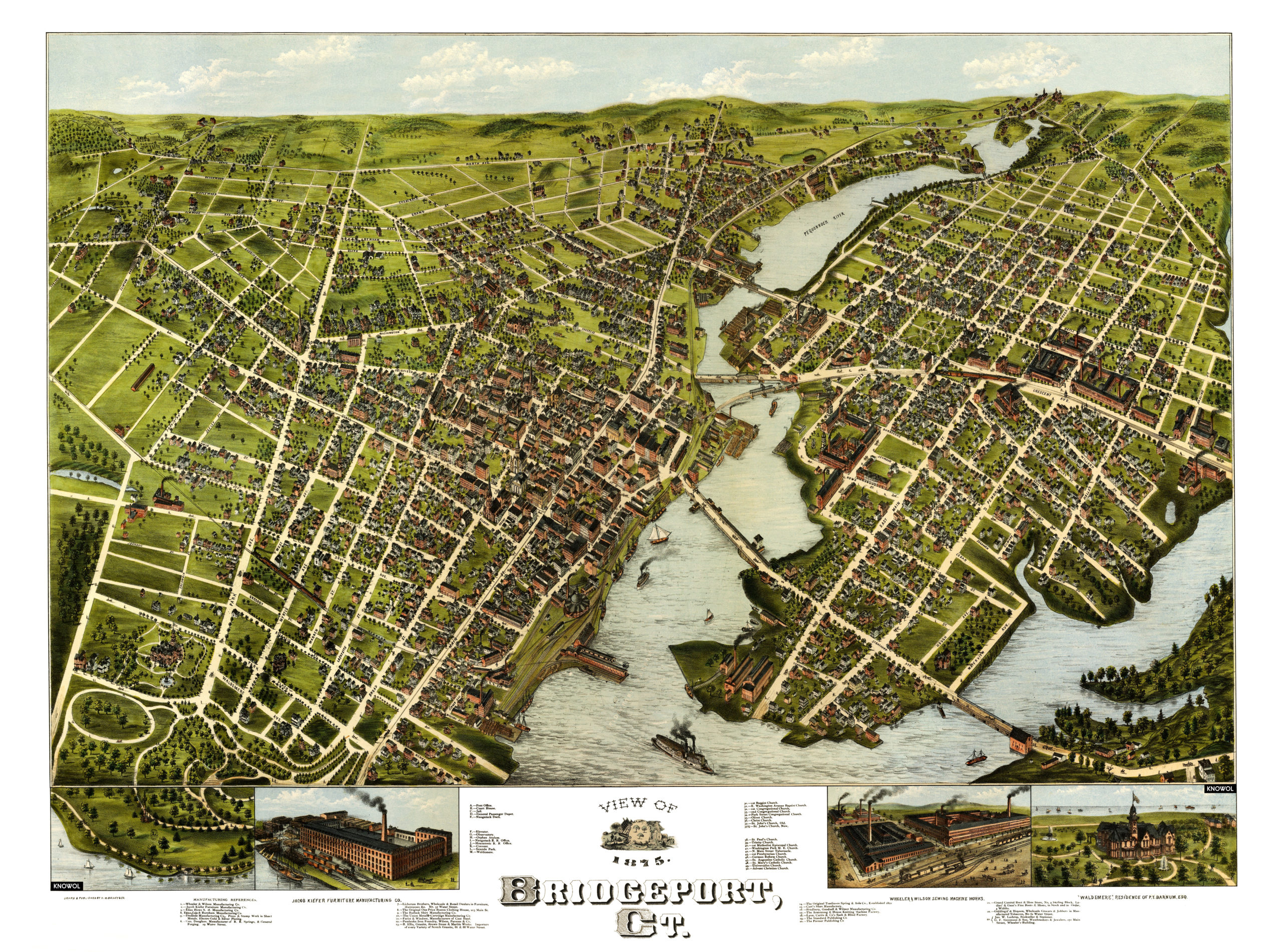
The bird's-eye view
By O.H. Bailey & Co.
Bridgeport drawn as if from the sky in 1875, when about 20,000 people lived here, with Seaside Park, P.T. Barnum's Waldemere mansion and the Standard Publishing Company.5
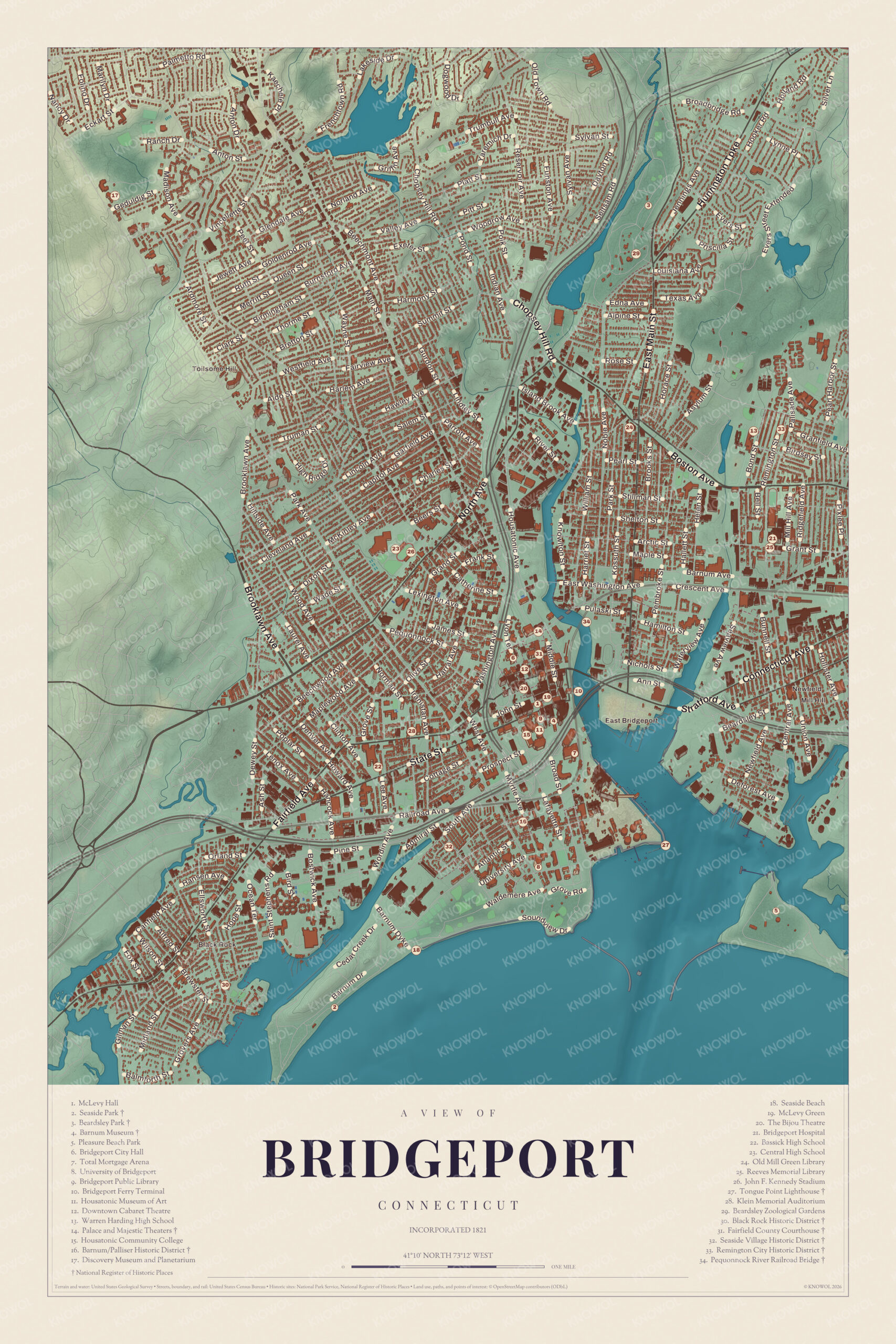
Bridgeport today
By KNOWOL
Shaded hills from downtown out to Schoonhoven Park, the harbor and the shore drawn to their true shape, Black Rock, East Bridgeport and Newfield by name, and a guide of 34 numbered landmarks with 11 National Register sites marked.6
The story of Bridgeport
The bridges that named a city
Bridgeport was named for its bridges, and an 1881 county history counted at least twenty-five or thirty of them over the Pequonnock, Pembroke Lake, Ash Creek and the brooks. The most famous was the Lottery Bridge, built in 1793 with money raised by selling lottery tickets. It ran from near the foot of Wall Street to Stratford Avenue, with a draw that parted in the middle and was raised by pulleys. It was poorly built. About 1804, during repairs, the whole bridge tipped over into the river and lay there as a ruin for years. A new bridge went up at the foot of Fairfield Avenue in 1807. Travelers paid a toll to cross it until 1868, when the city bought it for about $18,000 and made it free.37
Whale ships and warships
In 1833 the Bridgeport Whaling Company sent out four ships, the Atlantic, Hamilton, Harvest and Stieglitz. When word came that one was outside the harbor, crowds gathered at Stephen Hawley's lumber yard to cheer the crew ashore. The Atlantic's third voyage lasted 629 days and covered 46,640 miles; her crew saw 901 whales and took 34. The business never paid well and ended after a few years. The harbor had seen worse scares. Late in the War of 1812 two British men-of-war anchored off the town with their gun ports open. Church bells rang, the money in the bank was carried away to safety, and nobody slept. In the morning the ships were gone.8910
Barnum's city across the river
In 1851 P.T. Barnum and William H. Noble set out to build a new city on the east bank of the Pequonnock. They laid out tree-lined streets around a park, sold lots on the condition that a house, store or factory went up within a year, and built a covered drawbridge for $16,000. A clock company got land for a big factory there and failed, and Barnum's $400,000 in endorsements for the Jerome Clock Company nearly ruined him. Then Wheeler and Wilson bought the empty building in 1856 to make sewing machines. An 1886 history says the city's great prosperity dates from that day. Its first president had hoped for twenty-five machines a day. The works came to make six hundred.111213
Through the years
25 moments from 1644 to today.
- 1644The first documented English settlement inside today's city grows up around Black Rock Harbor and North Avenue.1
- 1695About this time the parish between Stratford and Fairfield takes the name Stratfield.1
- 1760sA village called Newfield grows up around the corner of State and Water Streets.1
- 1793The Lottery Bridge, paid for with lottery tickets, is built across the Pequonnock from the foot of Wall Street.37
- 1800Bridgeport becomes the first borough in Connecticut.2
- 1804About this year the Lottery Bridge tips over into the river during repairs and lies there as a ruin.7
- 1807A new bridge at the foot of Fairfield Avenue replaces the fallen one.3
- 1814Two British men-of-war anchor off the town; bells ring, the bank's money is hidden and nobody sleeps.10
- 1821Bridgeport becomes a town of its own, separate from Stratford.1
- 1833The Bridgeport Whaling Company is formed and sends out four ships.8
- 1834Rev. Mr. McDermott says the first Catholic Mass in Bridgeport, in a house on Middle Street.14
- 1836Bridgeport is chartered as a city.1
- 1837The whale ship Atlantic sails on a voyage of 629 days and 46,640 miles.9
- 1842Charles S. Stratton, not two feet tall, debuts at Barnum's Museum as General Tom Thumb.15
- 1848Barnum opens Iranistan with a housewarming for a thousand guests.16
- 1851Barnum and William H. Noble begin laying out East Bridgeport across the river.11
- 1856Wheeler and Wilson moves its sewing machine works into the empty clock factory in East Bridgeport.12
- 1862The Seventeenth Connecticut Volunteers camp on the shore that becomes Seaside Park.17
- 1864Barnum, Noble and Nathaniel Wheeler give the city land on the Sound for Seaside Park.1
- 1866The Wheeler and Wilson Band begins giving concerts in Seaside Park.18
- 1868The city buys the toll bridge for about $18,000 and makes it free.3
- 1871P.T. Barnum serves as mayor.6
- 1878James Beardsley gives more than 100 acres along the Pequonnock for Beardsley Park.1
- 1893The Barnum Institute building, today's Barnum Museum, is completed on Main Street.19
- 1915Remington Arms builds its huge plant on Boston Avenue.1
Places to see
The numbers match the landmark guide printed on the 2026 map.
- 2Seaside ParkThe South End shore. Olmsted's park on Long Island Sound.
- 3Beardsley ParkNorth of downtown. James Beardsley's gift of 1878.
- 4The Barnum MuseumMain Street, downtown. Barnum's museum of 1893, a National Historic Landmark.Visit their website
- 14Palace and Majestic TheatersMain Street, downtown. Twin theaters of 1922.
- 16Barnum/Palliser Historic DistrictSouth of downtown. Barnum's 1880s workers' houses.
- 27Tongue Point LighthouseBridgeport Harbor. The little Bug Light of 1891.
- 29Beardsley Zoological GardensBeardsley Park. The state's zoo, beside the park.Visit their website
- 30Black Rock Historic DistrictThe southwest. Where the first settlers came, 1644.
- 31Fairfield County CourthouseGolden Hill Street. Romanesque courthouse of 1888.
- 33Remington City Historic DistrictThe northeast. Housing for World War I workers.
On the National Register
20 of the 49 places in Bridgeport on the National Register of Historic Places that still stand today, oldest first, and why each one matters. See the full list of National Register places in Bridgeport.4
-
Black Rock Historic District
Black Rock was settled in 1644 and was the third largest port in Connecticut at the time of the Revolution. It was part of Fairfield until Bridgeport annexed it in 1870.20
-
Sterling Block-Bishop Arcade
One of the city's oldest commercial buildings, begun as part of the Sterling Hotel. William D. Bishop added its glass-roofed arcade in 1889, and it's called the first indoor shopping mall in the state.21
-
Mary and Eliza Freeman Houses
Two houses built in 1848 for the sisters Mary and Eliza Freeman in Little Liberia, a neighborhood of free Black families, and the last of its houses on their original foundations. They are the oldest remaining houses in Connecticut built by free Black residents, and stops on the Connecticut Freedom Trail.22
-
East Bridgeport Historic District
The planned neighborhood P.T. Barnum and William H. Noble laid out around Washington Park, whose growth brought industry to the east bank of the Pequonnock.23
-
Bridgeport City Hall (McLevy Hall)
Built to house both the city hall and the Fairfield County courthouse after Bridgeport offered to pay for them. It served as city hall into the 1930s and was renamed for Mayor Jasper McLevy in 1966.24
-
Seaside Park
A crescent of shore park about two and a half miles long, begun on land Barnum and others gave the city by 1864, with plans from Frederick Law Olmsted's firm.25
-
St. John's Episcopal Church
A Gothic Revival church of Greenwich granite designed by James Renwick Jr. for a congregation founded in the mid-1700s.26
-
Beardsley Park
More than 100 acres along the Pequonnock that farmer James W. Beardsley gave the city in 1878 to be kept forever as a public park. Frederick Law Olmsted delivered its plan in 1884.27
-
Barnum/Palliser Historic District
Houses P.T. Barnum developed for workers in the 1880s, most designed by the pattern-book architects Palliser, Palliser & Co.28
-
Bridgeport Downtown North Historic District
The northeastern quarter of downtown, with commercial and civic buildings from every stage of the city's growth after the Civil War.29
-
Seaside Institute
Built by the Warner Brothers Corset Company as a dining hall, library and meeting place for its women workers, who made up most of its 1,200 employees.30
-
Fairfield County Courthouse
A Richardsonian Romanesque courthouse by Warren R. Briggs. Bridgeport won it over Norwalk with a $150,000 offer backed by P.T. Barnum, and it still hears cases.31
-
Tongue Point Lighthouse
The little cast iron Bug Light, built at the end of the breakwater and moved here in 1919. Boaters protested when the Coast Guard planned to remove it in 1967.32
-
Barnum Museum
National Historic Landmark
Built with Barnum's money and land for the Bridgeport Scientific Society and the Fairfield County Historical Society. It holds a large collection on Barnum and the city and was made a National Historic Landmark.19
-
Stratfield Historic District
More than 100 acres of fine houses built mostly from 1880 to 1920, once the most fashionable part of the city and one of the largest such neighborhoods in the state.33
-
Nathaniel Wheeler Memorial Fountain
A bronze mermaid holding a lamp and a baby above a granite pool, with three watering troughs, given by the children of sewing machine maker Nathaniel Wheeler.34
-
Seaside Village Historic District
Brick rowhouses the federal government built in World War I for munitions workers, designed by R. Clipston Sturgis with Arthur Shurtleff.35
-
Remington City Historic District
Brick duplexes and rowhouses Remington Arms built to draw workers to its huge munitions plant nearby.36
-
Palace and Majestic Theaters
Sylvester Z. Poli's twin theaters and hotel, designed by Thomas W. Lamb. The Majestic opened in 1922 with Eddie Cantor, and both theaters closed in the 1970s.37
-
Hotel Beach
A thirteen-story Art Deco tower, also called the Hotel Barnum, one of the city's outstanding Art Deco buildings, built when Bridgeport was at its peak.38
In their words
“Bridgeport is not inappropriately named, as the whole number of bridges, great and small, crossing the Pequonnock River, Pembroke Lake, and the various streams known as Ash Creek, Horse Tavern Brook, Island Brook, and Rooster River, cannot be less than twenty-five or thirty in number.”
History of Fairfield County, Connecticut, 18813
“From this time dates the great prosperity and growth of Bridgeport. It not only brought new business to the toilers of the city, but also a lot of new inhabitants, men of vigorous mind and liberal enterprise, and a class of educated, skilled mechanics, unequaled anywhere in the country.”
A history of the old town of Stratford and the city of Bridgeport, 1886, on the coming of Wheeler and Wilson12
“laid out the entire property in regular streets and lined them with trees, reserving a beautiful grove of six or eight acres, which we inclosed and converted into a public park.”
P. T. Barnum on founding East Bridgeport, quoted in History of Fairfield County, 188111
Nearby towns
Sources
- Bridgeport, Connecticut, Wikipedia
- A history of the city of Bridgeport, Connecticut (1887), on the first borough, Internet Archive
- History of Fairfield County, Connecticut (1881), on Bridgeport's bridges, Internet Archive
- National Register of Historic Places listings in Bridgeport, Connecticut, Wikipedia
- Bird's-eye view of Bridgeport, Connecticut in 1875, restored by KNOWOL
- Map of Bridgeport, Connecticut in 2026, KNOWOL (USGS elevation, Census Bureau roads)
- History of Fairfield County, Connecticut (1881), on the Lottery Bridge, Internet Archive
- History of Fairfield County, Connecticut (1881), on the Bridgeport Whaling Company, Internet Archive
- A history of the old town of Stratford and the city of Bridgeport, Connecticut (1886), on the ship Atlantic, Internet Archive
- The historical, statistical and industrial review of the state of Connecticut (1884), on the War of 1812, Internet Archive
- History of Fairfield County, Connecticut (1881), quoting P. T. Barnum on East Bridgeport, Internet Archive
- A history of the old town of Stratford and the city of Bridgeport, Connecticut (1886), on East Bridgeport and Wheeler and Wilson, Internet Archive
- Encyclopedia of Connecticut biography (1917), on the Wheeler and Wilson company, Internet Archive
- History of Fairfield County, Connecticut (1881), on St. Augustine's Church, Internet Archive
- A history of the old town of Stratford and the city of Bridgeport, Connecticut (1886), on General Tom Thumb, Internet Archive
- Genealogical and family history of the state of Connecticut (1911), on Barnum and Iranistan, Internet Archive
- The Connecticut quarterly (1895), on the parks of Bridgeport, Internet Archive
- The Connecticut magazine (1905), on Seaside Park, Internet Archive
- Barnum Museum, Wikipedia
- Black Rock Historic District, Wikipedia
- Sterling Block-Bishop Arcade, Wikipedia
- Mary and Eliza Freeman Houses, Wikipedia
- East Bridgeport Historic District, Wikipedia
- McLevy Hall (Bridgeport City Hall), Wikipedia
- Seaside Park (Connecticut), Wikipedia
- St. John's Episcopal Church (Bridgeport, Connecticut), Wikipedia
- Connecticut's Beardsley Zoo (Beardsley Park), Wikipedia
- Barnum-Palliser Historic District, Wikipedia
- Bridgeport Downtown North Historic District, Wikipedia
- Seaside Institute, Wikipedia
- Fairfield County Courthouse (Bridgeport, Connecticut), Wikipedia
- Tongue Point Light, Wikipedia
- Stratfield Historic District, Wikipedia
- Nathaniel Wheeler Memorial Fountain, Wikipedia
- Seaside Village Historic District, Wikipedia
- Remington City Historic District, Wikipedia
- Palace and Majestic Theaters, Wikipedia
- Hotel Beach, Wikipedia