
A farm town on the Quinebaug that began as the manor of Mortlake, where Israel Putnam kept a tavern on the Green, the county courts sat for most of the 1800s, and the Brooklyn Fair still gathers the county every summer.
Brooklyn on the map
Click the map to look closer.
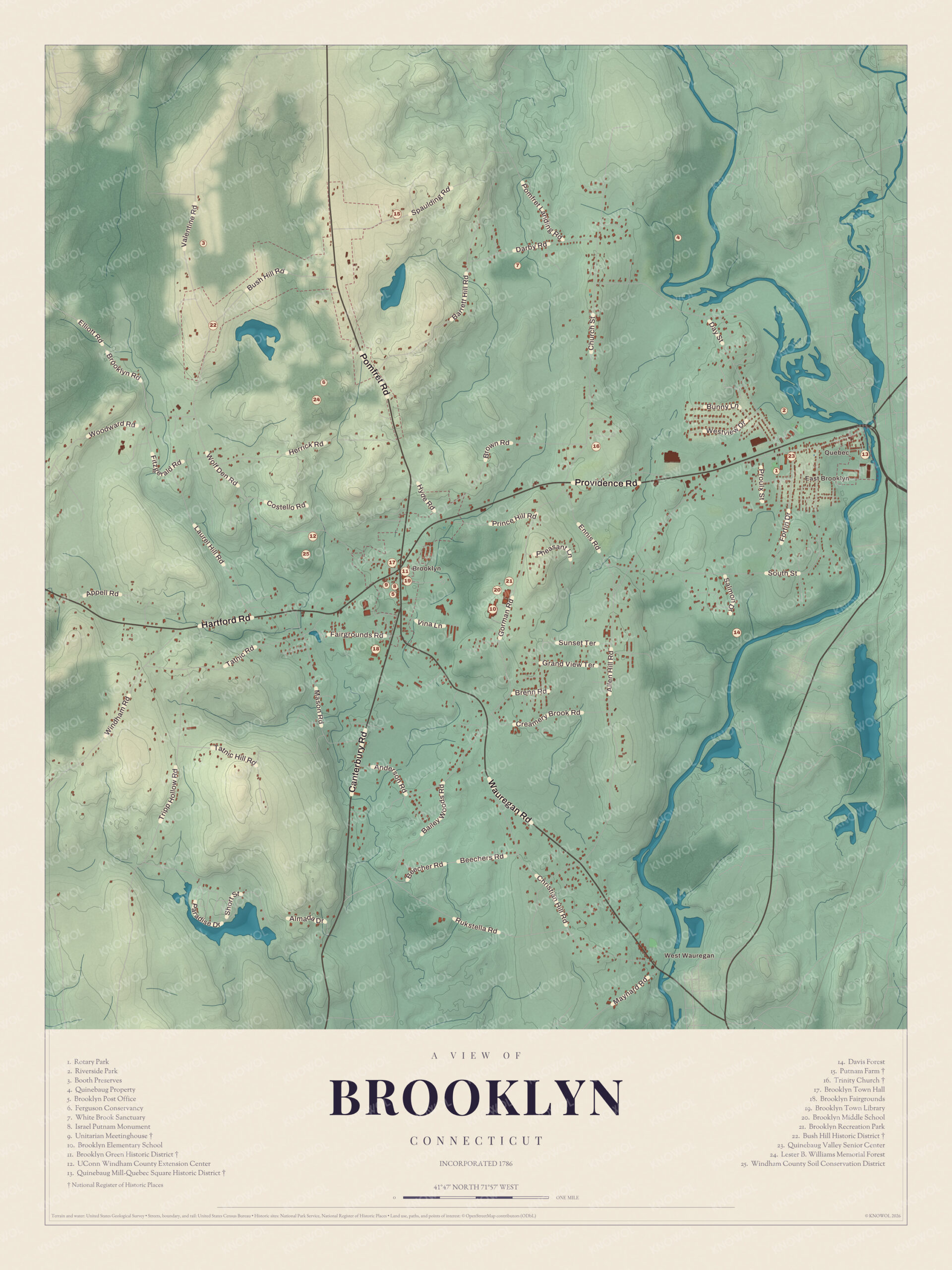
Brooklyn today
By KNOWOL
Shaded hills from the Green out to Quebec on the Quinebaug River, every street from Hartford Road to Stetson Road, the villages of Brooklyn, East Brooklyn, Quebec and West Wauregan, and a guide of 25 numbered landmarks with the National Register sites marked.4
The story of Brooklyn
When Brooklyn was Mortlake
Before there was a Brooklyn there was Mortlake, a manor owned by Sir John Blackwell, who meant to plant a colony there. Nothing came of it. Governor Jonathan Belcher of Massachusetts bought the land from Blackwell's son in 1713, and for nearly thirty years it sat mostly wild. When the settlers asked in 1728 to become a town, the upper house said no, because Belcher was too powerful to cross. The church society kept the name Mortlake until 1754, then became Brooklyn, and the town was made in 1786, with its first town meeting set for June 22. Barber's 1837 history adds two local names: Gray Mare hill, where an old mare and her colt were trapped in the ledges, and Lyon's Den, the cave where a deserter hid.526
The shire town
In 1819 the Assembly agreed to move the Windham County courts to Brooklyn, but only if the town put up the buildings at no cost to the county. It took $6,000, and Brooklyn pledged $2,500. The court house and jail were accepted on July 26, 1820, and a newspaper, a bank and a fire insurance company soon followed. The bank, opened in 1822, was the first in the county. In 1833 Prudence Crandall spent a night in that jail, in the cell of a condemned murderer, and the outrage won her friends. By 1874 the railroad towns were pulling business away, and a county history said Brooklyn was thirty minutes behind the times.789101
Putnam on the Green
Israel Putnam bought 500 acres here in 1739 and farmed cattle and sheep. In 1767 he moved to Brooklyn Green and opened a tavern, which became one of the best known gathering places in eastern Connecticut. When word of Lexington came in 1775, he left his plough in the furrow and rode for Boston without changing his clothes. He died in Brooklyn in 1790 and was buried in the South Cemetery, but so many people came to his tomb that his remains had to be moved. In 1888 the state put up his statue on horseback, and T. S. Marlor, a New York banker living in Brooklyn, paid for the site, grading and granite work himself.111213114
Through the years
24 moments from 1713 to today.
- 1713Governor Jonathan Belcher of Massachusetts buys the manor of Mortlake from the son of Sir John Blackwell.5
- 1731The first society meeting is held in what will become Brooklyn.2
- 1734The first meetinghouse is built, a few rods from the one that stands today.2
- 1739Israel Putnam buys 500 acres from Belcher and starts the farm on today's Spaulding Road.11
- 1754The parish stops being called Mortlake and takes the name Brooklyn.2
- 1767Putnam moves to Brooklyn Green and opens a tavern.12
- 1771Godfrey Malbone's Trinity Church is finished, ahead of the new Congregational meetinghouse.15
- 1775Word of Lexington reaches Brooklyn, and Putnam leaves his plough in the furrow and rides for Boston.13
- 1786Brooklyn becomes a town, and its first town meeting is set for June 22.6
- 1790Israel Putnam dies in Brooklyn.1
- 1817The county consociation removes the junior pastor, Rev. Luther Willson, for heresy, and the church divides.16
- 1820The new court house and jail are accepted, and Brooklyn becomes the Windham County seat.7
- 1822The first bank in Windham County opens in Brooklyn.8
- 1824Dr. Whitney's 68 years in Brooklyn's pulpit come to an end.2
- 1830Brooklyn Academy is incorporated.8
- 1833Prudence Crandall is tried here and spends a night in the Brooklyn jail.9
- 1851Amos D. Lockwood starts building the Quinebaug Mill on the river.17
- 1869T. S. Marlor, a New York banker, builds a country home in Brooklyn village.14
- 1871The Unitarian society ordains Rev. Celia Burleigh, the first woman Unitarian minister.18
- 1874A county history says Brooklyn is thirty minutes behind the times as business moves to the railroad.10
- 1884The Quinebaug Brick Company's yards in Brooklyn make about four million bricks a year.19
- 1888The statue of Putnam on horseback goes up, with his remains in its foundation.1
- 1917Brooklyn women form the Brooklyn War Relief Association and roll thousands of bandages.20
- 1938After the great New England hurricane, the old meetinghouse gets a new steeple.18
Places to see
The numbers match the landmark guide printed on the 2026 map.
- 2Riverside ParkQuinebaug River. Woods and river walking.
- 8Israel Putnam MonumentNear the Green. The general on horseback, 1888.
- 9Unitarian MeetinghouseBrooklyn Green. The old meeting house of 1771.
- 11Brooklyn Green Historic DistrictTown center. The Green and its old houses.
- 13Quinebaug Mill-Quebec Square Historic DistrictQuebec, on the river. Brick mill village by the Quinebaug.
- 15Putnam FarmSpaulding Road. Israel Putnam's farm of 1739.
- 16Trinity ChurchChurch Street. Godfrey Malbone's church of 1771.
- 18Brooklyn FairgroundsNear the center. Home of the Brooklyn Fair.
- 19Brooklyn Town LibraryBrooklyn Green. The town library on the Green.Visit their website
- 22Bush Hill Historic DistrictNorthwest. Old farmhouses along two ridges.
On the National Register
All 6 places in Brooklyn on the National Register of Historic Places that still stand today, oldest first, and why each one matters.3
-
Brooklyn Green Historic District
A 1.75-acre green crossed by two diagonal roads, with the old meeting house, town hall, library, two churches and houses from the mid-1700s around it. Little changed since the mid-1800s, it keeps the look of Brooklyn's busiest years, 1750 to 1850.21
-
Putnam Farm
The heart of Israel Putnam's 500 acres, bought in 1739. He built the oldest part of the house about 1750 for his growing family and farmed here until he moved to Brooklyn village in 1767.11
-
Trinity Church
Godfrey Malbone pushed it up in answer to plans for a new Congregational meetinghouse and finished it in April 1771. It's the oldest surviving Anglican church building in Connecticut, with its original box pews, pulpit and reading desk.15
-
Unitarian Meetinghouse
One of a few pre-Revolutionary church buildings left in the state, restored inside to its first form. Samuel J. May, a supporter of Prudence Crandall, preached here, and in 1871 the society ordained Celia Burleigh, the first woman Unitarian minister.18
-
Bush Hill Historic District
A farm landscape on two ridges with twenty center-chimney farmhouses, most from the late 1700s or early 1800s, and their old barns. The Williams and Putnam families settled most of it.22
-
Quinebaug Mill-Quebec Square Historic District
A well-kept textile mill village in Quebec. Amos D. Lockwood began the Quinebaug Mill in 1851; most of the mill later burned, but the weave shed and the brick rows of workers' housing survive.17
In their words
“this Brooklyn tavern became one of the most noted rendezvous in eastern Connecticut.”
The historical, statistical and industrial review of the state of Connecticut, 1884, on Israel Putnam's tavern12
“Brooklyn has need to be proud of her women for the part they played in the horrible tragedy of war.”
A modern history of Windham County, 1920, on the Brooklyn War Relief Association20
“Brooklyn is a typical farming town of New England, and was the home of General Israel Putnam and Godfrey Malbone.”
Men of mark in Connecticut, 190623
Nearby towns
Sources
- Brooklyn, Connecticut, Wikipedia
- Connecticut historical collections, John Warner Barber (1837), on Brooklyn, Internet Archive
- National Register of Historic Places listings in Windham County, Connecticut, Wikipedia
- Map of Brooklyn, Connecticut in 2026, KNOWOL (USGS elevation, Census Bureau roads)
- Collections of the Connecticut Historical Society (1860), on the manor of Mortlake, Internet Archive
- The public records of the State of Connecticut (1894), the act creating Brooklyn, Internet Archive
- History of Windham County, Connecticut (1889), on the county seat, Internet Archive
- The historical, statistical and industrial review of the state of Connecticut (1884), on the bank, academy and fair, Internet Archive
- History of Windham County, Connecticut (1889), on Prudence Crandall, Internet Archive
- History of Windham County, Connecticut, Ellen D. Larned (1874), on Brooklyn's decline, Internet Archive
- Putnam Farm, Wikipedia
- The historical, statistical and industrial review of the state of Connecticut (1884), on Putnam's tavern, Internet Archive
- The history of Connecticut, from the first settlement to the present time (1840), Internet Archive
- Commemorative biographical record of Tolland and Windham counties, Connecticut (1903), on T. S. Marlor, Internet Archive
- Trinity Church (Brooklyn, Connecticut), Wikipedia
- A review of ecclesiastical proceedings in the Congregational Church and Society in Brooklyn, (Conn.) (1818), Internet Archive
- Quinebaug Mill-Quebec Square Historic District, Wikipedia
- Unitarian Meetinghouse, Wikipedia
- The historical, statistical and industrial review of the state of Connecticut (1884), on the Quinebaug Brick Company, Internet Archive
- A modern history of Windham County, Connecticut (1920), on Brooklyn's old church vestry, Internet Archive
- Brooklyn Green Historic District, Wikipedia
- Bush Hill Historic District, Wikipedia
- Men of mark in Connecticut (1906), on Flavel S. Luther, Internet Archive