
A town of pine woods, cedar swamps and ponds, set off from Plympton in 1790, where bog ore from its swamps and ponds fed the Popes Point, Charlotte and Federal furnaces before the same swamps grew a fifth of America's cranberries.
Carver, Massachusetts on the map
Click the map to look closer.
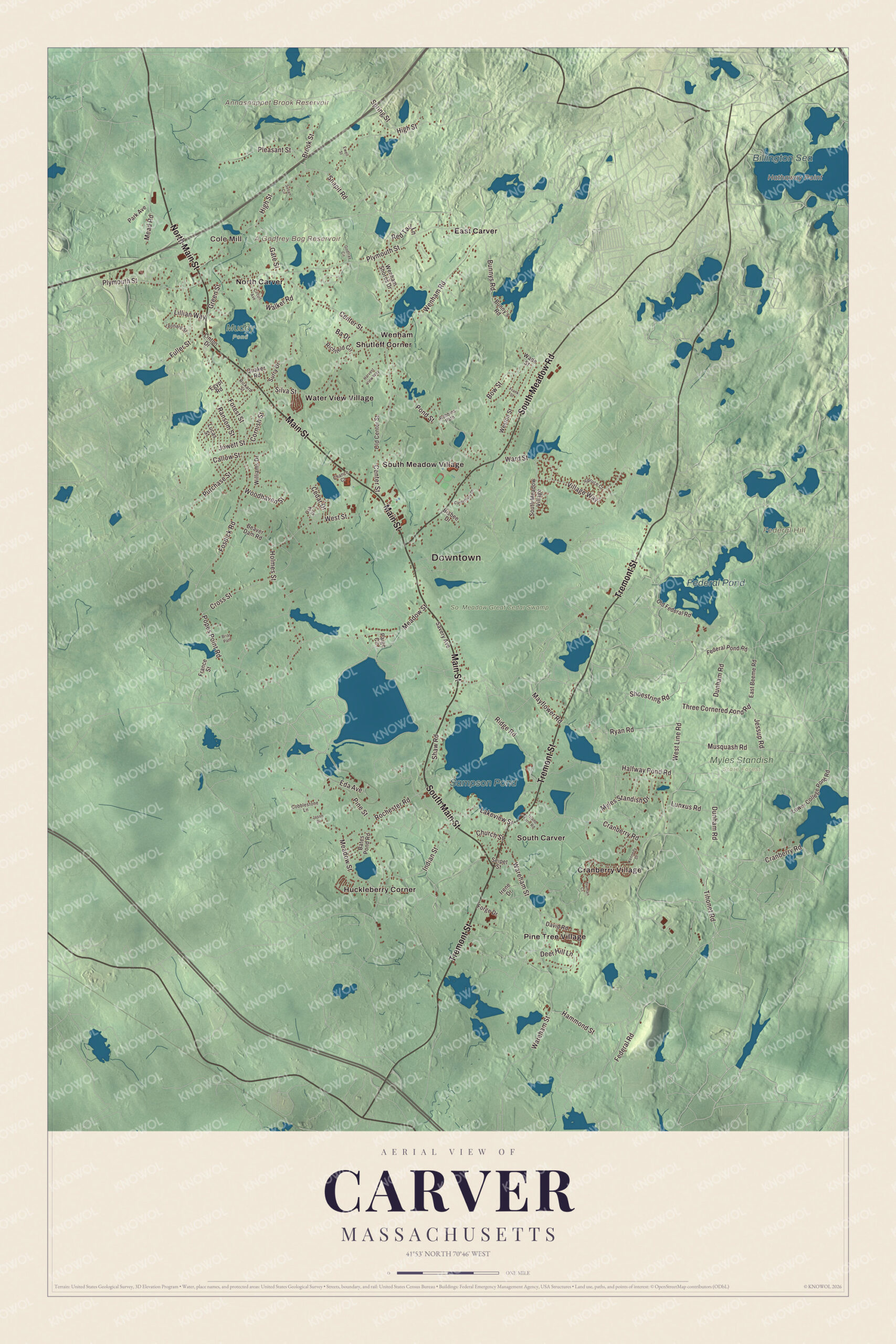
Carver today
By KNOWOL
Carver's cranberry country in one view, with Tremont Street, Main Street, North Main Street, South Main Street, South Meadow Road and Red Tail Lane, and Sampson Pond, Federal Pond, the Annasnappet Brook Reservoir, the A Godfrey Bog Reservoir and Federal Hill named on the map.6
The history of Carver, Massachusetts
Iron from the bogs
Carver's swamps and ponds were bedded with iron ore, its hills grew wood for charcoal, and its brooks could turn a wheel. In 1735 Jonathan Shaw deeded a dam on Watson's Cove brook for a furnace at Popes Point. Its water wheel stood thirty feet high and was a plaything for village children long after the last blast in 1836. Charlotte furnace went up by Sampson's pond in the 1760s, said to be named for Queen Charlotte, and the village around it was just The Furnace until after the Civil War. In 1815 the pond still gave 80 tons of ore a year. The furnace store took deposits and paid interest like a bank, iron ware passed as money, and ships carried it from Bangor to New Orleans. The Ellis Foundry, the last in town, closed in 1904.789103
Berries by the halves
In 1815 a writer found cranberries growing thick in the wet meadows of south Carver, sold as far away as Boston. Once the marsh owners took charge, pickers worked by the halves, keeping half of each day's berries as their pay, and barefoot boys lined the edge of the marsh, waiting for the signal to drop into the icy water. Benjamin D. Finney diked a marsh for flooding in 1856, and in the 1870s growers began training the vines. Thomas Huit McFarlin noticed a large variety, transplanted a few vines, and started the McFarlin variety. George P. Bowers began the East Head bogs in 1878, and the swamps around Wankinco became the largest single bog in the state. Up to 1900 Carver raised a fifth of America's crop, and later Edaville's little trains ran along the bog levees.9115126
The Carver Light-House
In 1772 the people of the South Meadows, tired of the long trip to the meeting house at Lakenham, began one of their own. The subscribers voted to buy two barrels of rum for the workmen and the crowd at the raising, and when the frame was up, Benjamin Ward shouldered his broad axe, climbed the ladder and walked the plate from corner to corner. Iron ware from the furnaces was taken as payment toward the building. In 1854 the old meeting house was rebuilt inside as Bay State hall and town house, with a dance hall upstairs, muskets in racks, and town meetings below. Civil War volunteers gathered there before they left for the front. It stood on high ground, its lit windows could be seen from every road, and people far and near called it the Carver Light-House.1310
Carver, Massachusetts through the years
25 moments from 1637 to today.
- 1637Lakenham, today's North Carver, gets its name in a grant of land to John Jenney.14
- 1698Sampson's pond is first mentioned in the records, and the Rochester road is laid out.15
- 1732The South Precinct of Plympton, the future Carver, holds its first meeting on December 18.16
- 1735Jonathan Shaw deeds land and a dam on Watson's Cove brook for an iron furnace at Popes Point.7
- 1760Bartlett Murdock begins building Charlotte furnace by Sampson's pond.8
- 1762About this year, by the 1874 state gazetteer's account, the Charlotte foundry casts the first iron tea-kettle made in this country.17
- 1772Families of the South Meadows start a subscription to build their own meeting house.13
- 1777Smallpox breaks out around today's North Carver, and the town votes to bar Dr. Jonah Whitcomb, who inoculated a family, from speaking in town until it passes.18
- 1790Plympton votes 97 to 76 to let its south precinct go, and Governor John Hancock signs Carver's charter in June.19
- 1793Federal furnace is built on the site of a saw mill on the Cranebrook.20
- 1812Against most of New England, Carver backs the war, and its furnaces cast shot and shell night and day.21
- 1815Sampson's Pond still yields 80 tons of iron ore a year.9
- 1819Asked whether Halifax should become the county seat, Carver votes 147 to 1 against.2
- 1836Popes Point furnace makes its last blast after about a century.7
- 1852William F. Jenkins and George P. Bowers start the Shoestring Factory on the Cranebrook.4
- 1854The South Meeting House of 1772 is rebuilt inside as Bay State hall and town house.13
- 1856Benjamin D. Finney builds a dike to flood a marsh, claimed as the first effort to grow cranberries by artificial means.5
- 1861In January William Savery agrees with five landowners to build Savery's Avenue, twin roads with trees between them.15
- 1861Capt. William S. McFarlin's Company K, Carver's minute men, is on Boston Common by ten in the morning on April 16.22
- 1878George P. Bowers begins building the East Head cranberry bogs.5
- 1900Up to this year Carver alone has raised one fifth of America's cranberry crop.5
- 1904The Ellis Foundry Company is dissolved, and with it the last foundry in Carver.3
- 1910The Soldiers Monument, raised by the Carver Ladies' Soldiers Memorial Association, is dedicated on Decoration Day.15
- 1949Edaville Railroad, a narrow-gauge railroad attraction, opens in Carver.1
- 1982King Richard's Faire is founded in Carver's pine woods.6
Places to see in Carver, Massachusetts
Places worth a visit in Carver today.
- North CarverNorth end of town. Called Lakenham until the Civil War.
- East CarverEast side of town. Called Wenham until after the Civil War.
- South CarverSouth end of town. Charlotte furnace's village, once The Furnace.
- Sampson PondSouth Carver. Its bog ore fed Charlotte furnace.
- Federal PondPlymouth line. Where the Crane Brook begins.
- So. Meadow Great Cedar SwampMiddle of town. About a thousand acres of cedar in 1913.
- Savery's AvenueOff Main Street. Twin roads with trees between.
- Myles Standish State ForestSoutheast corner. Pitch pine and scrub oak, 26 square miles.Visit their website
- EdavilleSouth Carver. A cranberry farm railroad turned attraction.
- King Richard's FaireCarver's pine woods. New England's largest Renaissance fair.
Carver in their words
“And why not? For standing on the highest eminence between bay and bay the light streaming from its windows could be seen from every approach”
Henry S. Griffith, History of the town of Carver, 1913, on the old South Meeting House, called the Carver Light-House13
“No snow so deep that the pines and cedars do not wave their green branches above it; no winter so bleak as to hide the beauties of the holly, the laurels and winterberries.”
Henry S. Griffith, History of the town of Carver, 191323
“Most of the people in this town are descendants of the first settlers at Plymouth, and know how to get a good living and thrive on a poor soil.”
A gazetteer of Massachusetts, 184924
Towns near Carver, Massachusetts
Sources for the history of Carver
- Carver, Massachusetts, Wikipedia
- History of Plymouth County, Massachusetts (1884), History of Carver, Internet Archive
- History of the town of Carver, Massachusetts: historical review, 1637 to 1910, by Henry S. Griffith (1913), on the Ellis Foundry and the last foundry crew, Internet Archive
- History of the town of Carver, Massachusetts: historical review, 1637 to 1910, by Henry S. Griffith (1913), on the Shoestring Factory, Internet Archive
- History of the town of Carver, Massachusetts: historical review, 1637 to 1910, by Henry S. Griffith (1913), on the cranberry industry, Internet Archive
- Map of Carver, Massachusetts in 2026, KNOWOL
- History of the town of Carver, Massachusetts: historical review, 1637 to 1910, by Henry S. Griffith (1913), on the Popes Point furnace, Internet Archive
- History of the town of Carver, Massachusetts: historical review, 1637 to 1910, by Henry S. Griffith (1913), on Charlotte furnace, Internet Archive
- Collections of the Massachusetts Historical Society, second series, vol. 4 (1816, reprinted 1846), Description of Carver, 1815, Internet Archive
- History of the town of Carver, Massachusetts: historical review, 1637 to 1910, by Henry S. Griffith (1913), on Benjamin Ellis and the furnace store, Internet Archive
- History of the town of Carver, Massachusetts: historical review, 1637 to 1910, by Henry S. Griffith (1913), on the early cranberry harvests, Internet Archive
- History of the town of Carver, Massachusetts: historical review, 1637 to 1910, by Henry S. Griffith (1913), on the McFarlin cranberry, Internet Archive
- History of the town of Carver, Massachusetts: historical review, 1637 to 1910, by Henry S. Griffith (1913), on the South Meeting House, Internet Archive
- History of the town of Carver, Massachusetts: historical review, 1637 to 1910, by Henry S. Griffith (1913), on the landmarks of Carver, Internet Archive
- History of the town of Carver, Massachusetts: historical review, 1637 to 1910, by Henry S. Griffith (1913), chronological events, Internet Archive
- History of the town of Carver, Massachusetts: historical review, 1637 to 1910, by Henry S. Griffith (1913), on the South Precinct of Plympton, Internet Archive
- Gazetteer of the state of Massachusetts (1874), Internet Archive
- History of the town of Carver, Massachusetts: historical review, 1637 to 1910, by Henry S. Griffith (1913), on the smallpox of 1777, Internet Archive
- History of the town of Carver, Massachusetts: historical review, 1637 to 1910, by Henry S. Griffith (1913), on the vote that made Carver a town, Internet Archive
- History of the town of Carver, Massachusetts: historical review, 1637 to 1910, by Henry S. Griffith (1913), on Federal furnace, Internet Archive
- History of the town of Carver, Massachusetts: historical review, 1637 to 1910, by Henry S. Griffith (1913), on the War of 1812, Internet Archive
- History and complete roster of the Massachusetts regiments, minute men of '61 (1910), on Company K of Carver, Internet Archive
- History of the town of Carver, Massachusetts: historical review, 1637 to 1910, by Henry S. Griffith (1913), on the town's natural conditions, Internet Archive
- A gazetteer of Massachusetts, by John Hayward (1849), Internet Archive