
The old shore half of Killingworth on Long Island Sound, where Yale's first classes met in Abraham Pierson's parsonage, shipwrights built vessels at the harbor and a native son gave the town the Morgan School.
Then and now
The same town 145 years apart. Click either map to look closer.
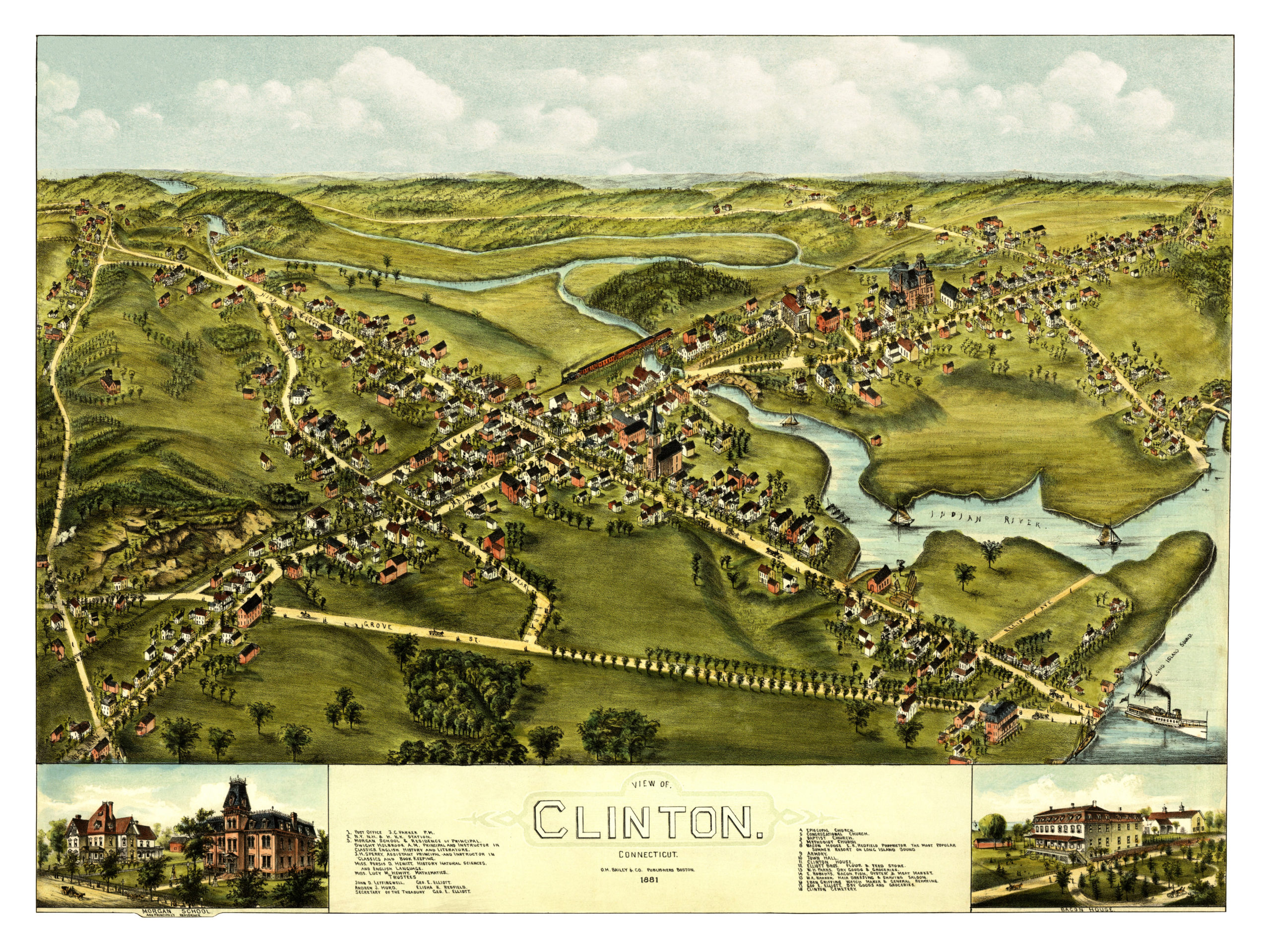
The bird's-eye view
By O.H. Bailey
Clinton drawn as if from the sky toward the end of the 1800s, with the Morgan School, the Bacon House, the Clinton House, the Town Hall and a fish, oyster and meat market.5
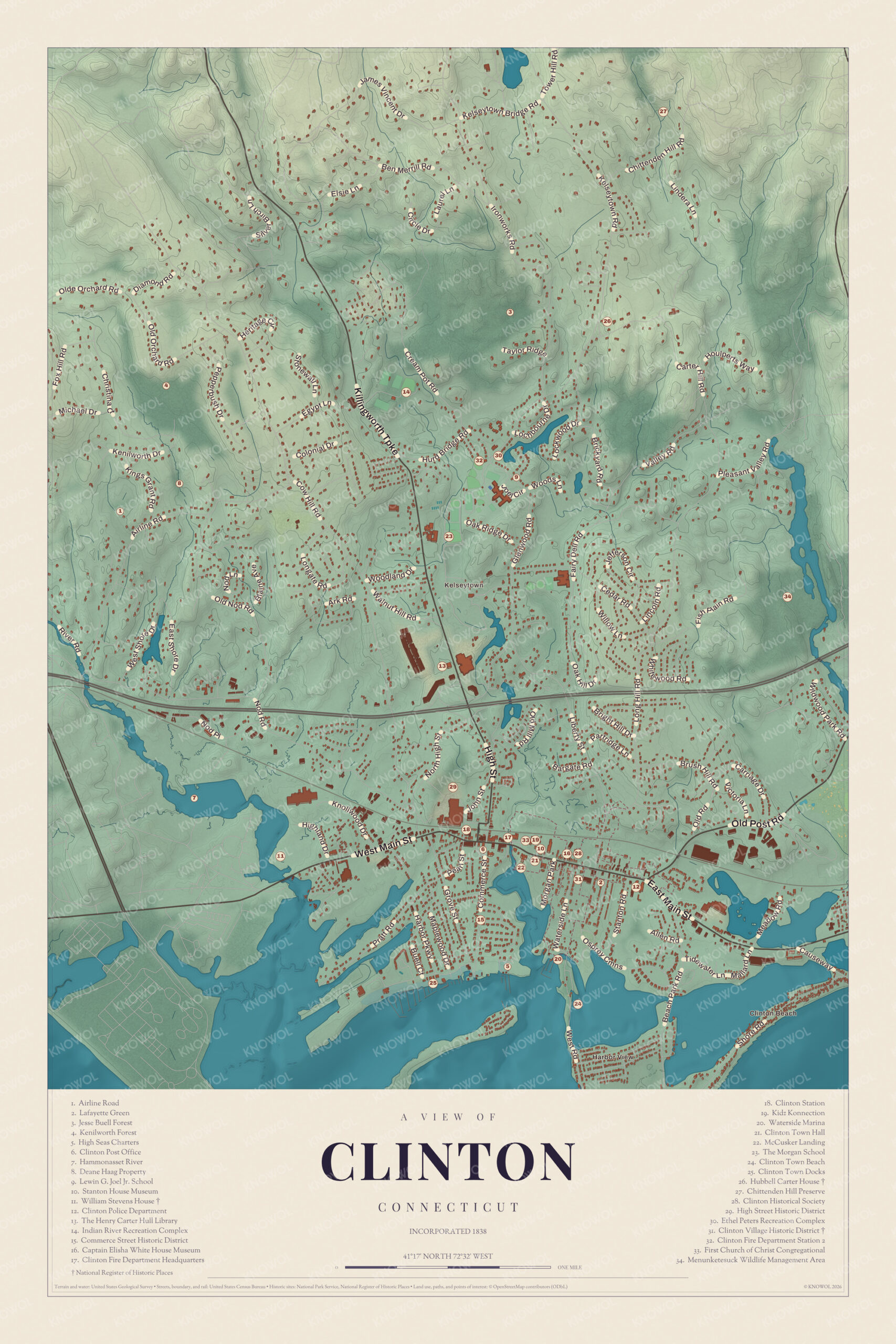
Clinton today
By KNOWOL
Shaded hills from the woods in the north down to the shore at Duck Island Roads, every street, Kelseytown, Clinton Beach and Harbor View, and a guide of 34 numbered landmarks with the National Register sites marked.6
The story of Clinton
The house on Pierson's lot
Clinton's tie to Yale starts with one house lot. Rev. Abraham Pierson became pastor here in 1694, and when the college was founded he was made its rector. He found it impossible to go to Saybrook to teach, so the young men came to him in Killingworth, and he gave the college books too. About 1775 Adam Stanton came from Westerly, Rhode Island, and built his house on the lot where Pierson's had stood. A family history says Pierson's old timbers went into it. Stanton's first business was making salt from the water of the Sound and sending it by ox train to Boston, at two dollars a bushel. His grandson John A. Stanton later filled the house with restored antiques, and in the summer of 1909 more than 350 visitors came to see them.78910
Iron from the sea sand
Two curious minds worked in old Killingworth. Jared Eliot, a grandson of John Eliot, the Apostle to the Indians, began preaching here in 1707 and stayed until he died in 1763. An 1877 memoir says he hardly missed a single Sabbath in forty years. He was also a physician, a botanist, an agriculturist and a metallurgist. He was elected to the Royal Society, and the London Society of Arts gave him a gold medal for making very good iron out of black sea sand. Dr. Benjamin Gale built a stone tavern in Clinton with a second stone house, two stories high, standing inside it, a house within a house. When Gale died he was buried north of his house, at right angles to the other graves, his feet to the south.111213
Charles Morgan's school
Charles Morgan was born in Clinton in 1795, the grandson of Theophilus Morgan, a merchant and ship owner here before the Revolution. He left home a poor boy and made his fortune running steamship lines on the Gulf of Mexico. The idea of doing something for his birthplace came from his old teacher, Leet Hurd, then 87, a ship carpenter who had built many vessels and stood guard at Clinton Harbor in 1814. Morgan spent $60,000 on a brick school trimmed with granite under a French roof, and gave $50,000 more to keep it running. When it was dedicated on December 7, 1871, a school journal called it the most beautiful school building in the state. The Morgan School still carries his name.31415166
Through the years
24 moments from 1663 to today.
- 1663In October, twelve planters begin the settlement at Hammonasset that becomes Killingworth.2
- 1667The General Court names the town Kenilworth, later spelled Killingworth.1
- 1669The settlers buy the land from Uncas and the Mohegans, who keep six acres off what's now Commerce Street.6
- 1670Margaret Griswold dies; her stone is the oldest in the Clinton burying ground.17
- 1694Rev. Abraham Pierson becomes pastor of the Killingworth church.7
- 1697The General Court allows a cart bridge over the Hammock River, later the Water Side Bridge.18
- 1701Pierson is made rector of the new Collegiate School, and its first classes meet at his parsonage.1
- 1707Pierson dies, and Jared Eliot begins preaching at Killingworth.711
- 1740Native people still live in large numbers around Killingworth until about this year.2
- 1750Capt. Elisha White's brick house, Old Brick, is built.1
- 1763Jared Eliot dies after more than half a century as pastor.11
- 1775Adam Stanton builds his house on Pierson's old lot and starts making salt from the Sound.9
- 1795Charles Morgan is born in Clinton.3
- 1813A turnpike is laid out through the center of town.19
- 1814Shipbuilder Leet Hurd is stationed at Clinton Harbor as a Coast Guard lieutenant.14
- 1837The First Church of Christ is built.6
- 1838The shore half of Killingworth is incorporated as the town of Clinton.1
- 1871The Morgan School is dedicated on December 7.3
- 1879Gen. William S. Pierson dies, having raised a granite shaft to Abraham Pierson on Meeting House Hill.20
- 1881O.H. Bailey publishes his bird's-eye view of Clinton.5
- 1890Clinton counts 1,384 people.21
- 1909More than 350 visitors come to see John A. Stanton's antique collection.10
- 1994The Clinton Village Historic District is listed on the National Register.22
- 2015The Bluefish Festival is held for the last time.1
Places to see
The numbers match the landmark guide printed on the 2026 map.
- 7Hammonasset RiverWest edge of town. Meets the Sound at Clinton.
- 10Stanton House MuseumEast Main Street. Where Pierson's home once stood.Visit their website
- 11William Stevens HouseCow Hill Road. One of Clinton's oldest buildings.
- 16Captain Elisha White House MuseumClinton village. Old Brick, built 1750.Visit their website
- 18Clinton StationWest of the Indian River. Shore Line East trains stop here.
- 21Clinton Town HallClinton village. Home of the historical society museum.
- 23The Morgan SchoolNear Kelseytown. Charles Morgan's gift to his hometown.
- 24Clinton Town BeachOn the Sound. The town beach on Long Island Sound.
- 31Clinton Village Historic DistrictEast Main Street. The old village, 154 historic places.
- 33First Church of Christ CongregationalClinton village. The church of 1837.Visit their website
On the National Register
All 5 places in Clinton on the National Register of Historic Places that still stand today, oldest first, and why each one matters.4
-
Clinton Village Historic District
The old town center of Killingworth and then Clinton, with 154 historic buildings, sites and objects along the Boston Post Road. Its oldest house, The Arsenal on Waterside Lane, is believed to date to 1675, and Liberty Green survives from the old common and militia training ground.22
-
William Stevens House
One of Clinton's oldest buildings, usually credited to William Stevens, who died in 1703. Its unusual floor plan suggests it began as a one-room house and grew, and nine generations of his descendants owned it until the 1970s.23
-
Hubbell Carter House
A Cape Cod style farmhouse listed for its architecture, with a period of significance from 1775 to 1830.24
-
High Street Historic District
A neighborhood near Clinton Station, on the side of the Indian River where the town's business moved in the late 1800s because the railroad station was there.6
-
Commerce Street Historic District
A stretch of Commerce Street a little south of the station area, and the newest of Clinton's National Register listings.6
In their words
“The town of Clinton, lovely in its quiet scenery, looks off on as dainty a bit of water view as can well be found.”
The Connecticut quarterly, 18952
“In the war of the Revolution, Clinton bravely did her part and sent a regiment of men to aid in the victory.”
The Connecticut quarterly, 189525
“Undoubtedly the most beautiful school building in the state.”
The Connecticut School Journal, 1872, on the new Morgan School15
Nearby towns
Sources
- Clinton, Connecticut, Wikipedia
- The Connecticut quarterly (1895), Clinton, once Killingworth, Internet Archive
- History of Middlesex County, Connecticut (1884), on the Morgan School, Internet Archive
- National Register of Historic Places listings in Middlesex County, Connecticut, Wikipedia
- Bird's-eye view of Clinton, Connecticut from 1881, restored by KNOWOL
- Map of Clinton, Connecticut in 2026, KNOWOL (USGS elevation, Census Bureau roads)
- Genealogical and family history of the state of Connecticut (1911), on Abraham Pierson, Internet Archive
- The Connecticut quarterly (1895), on Meeting House Hill and Abraham Pierson, Internet Archive
- A record, genealogical, biographical, statistical, of Thomas Stanton, of Connecticut, and his descendants (1891), Internet Archive
- Genealogical and family history of the state of Connecticut (1911), on John A. Stanton, Internet Archive
- Collections of the Connecticut Historical Society (1860), on Jared Eliot, Internet Archive
- Biographical sketches of the original members of the Middlesex County Medical Society (1877), Internet Archive
- Commemorative biographical record of Middlesex County, Connecticut (1903), on Jared Eliot's medal, Internet Archive
- History of Middlesex County, Connecticut (1884), on Leet Hurd, Internet Archive
- The Connecticut School Journal (January 1872), on the Morgan School, Internet Archive
- The Connecticut School Journal (January 1872), on Charles Morgan, Internet Archive
- Encyclopedia of Connecticut biography (1923), on Edward Griswold, Internet Archive
- History of Middlesex County, Connecticut (1884), on the Hammock River bridge, Internet Archive
- The Griswold family, England-America (1900), on William Stevens's lot, Internet Archive
- History of Middlesex County, Connecticut (1884), on the Pierson family, Internet Archive
- Genealogical notes on the families of Daniel Lane 2d and Mary Griswold Lane (1899), Internet Archive
- Clinton Village Historic District, Wikipedia
- William Stevens House (Clinton, Connecticut), Wikipedia
- Carter, Hubbell, House, National Park Service NPGallery
- The Connecticut quarterly (1895), on Waterside, Internet Archive