
The last piece of old Saybrook, renamed for its mill village in 1947, where a small stream called the Deep River powered the factories that cut ivory combs and the piano keys bought by most American piano makers.
Deep River on the map
Click the map to look closer.
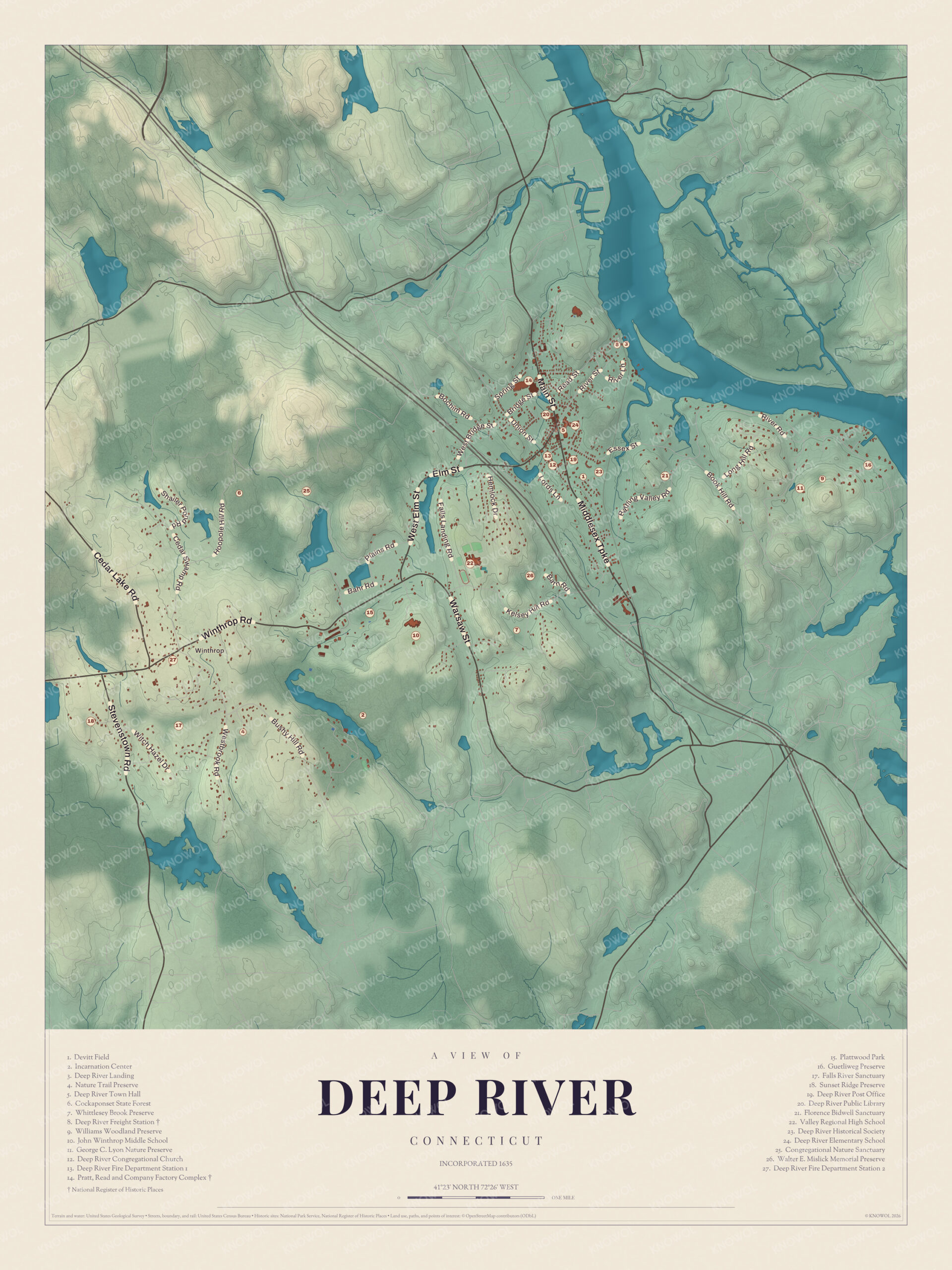
Deep River today
By KNOWOL
Shaded hills from Bushy Hill across to the Connecticut River, every street, Deep River and Winthrop printed by name, and a guide of 27 numbered landmarks with the National Register sites marked.5
The story of Deep River
Combs, keys and tusks from Zanzibar
Deep River's ivory trade started small. Phineas Pratt was making ivory combs by hand as early as 1809, and in 1816 Ezra Williams & Co. opened a little comb shop on North Main Street, with Thomas Howard of Providence supplying the ivory. By 1819 more than twenty men were turning out 50,000 combs a year. Before 1839 George Read & Co. began cutting piano keys, and in 1863 three firms joined as Pratt, Read & Co. In 1884 the tusks came mostly from Zanzibar and weighed about 170 pounds on average, and the factories of Deep River and Ivoryton took three-fourths of the best ivory shipped from there. Nothing went to waste. The dust became fertilizer, and the smallest scraps were burned to make ivory black.6273
The Sunday morning fire
Early on Sunday morning, July 31, 1881, the Pratt, Read factory on Main Street caught fire, and in a short time it was gone with everything in it. About all that was saved was the company safe with its records. The county history said the whole community felt the shock. The superintendent found many workers temporary jobs in the Ivoryton factories, but nobody knew if the company would rebuild. On August 6 the town voted, unanimously, to ease the company's taxes for five years if it rebuilt in Deep River. It did. On May 8, 1882, the first goods came out of the new brick factory, the building with the entry tower that still stands on Main Street, now homes.891011
Winthrop, out on the west end
Four miles west of the village is Winthrop, and in some ways it's older than Deep River itself. People there took up Baptist beliefs as early as 1729, and the 1884 county history tells how in February 1744 fourteen of them were arrested for holding a meeting on the Sabbath and marched on foot to jail in New London. Their church was believed to be the second oldest Baptist church in Connecticut. Bani Denison kept a country store in Winthrop by 1797, about thirty years before Deep River's first store. When the post office opened about 1837, the place was called Sayville, after Lord Say and Seal, but within a few years it became Winthrop. The Denison family made joiners' planes there from about 1832.121314151617
Through the years
24 moments from 1635 to today.
- 1635Settlers land at Saybrook Point and begin the old town of Saybrook, which once reached north to Haddam.18
- 1662The water privilege at the mouth of the Deep River is said to be part of a royal grant to Governor Winthrop.19
- 1723John, Nathaniel and Philip Kirtland own nearly the whole plain where Deep River village now stands.20
- 1729People around Winthrop take up Baptist beliefs and hear visiting Baptist preachers.12
- 1744Fourteen Winthrop Baptists are arrested for holding a Sabbath meeting and jailed in New London.12
- 1758Lieut. Andrew Southworth owns a saw mill on the Deep River, near where Pratt, Read later builds.19
- 1797Bani Denison keeps a country store in Winthrop, years before the village of Deep River has one.1415
- 1799R. Kirtland builds a house facing the Connecticut River and cuts "R. K., 1799" into his kitchen fireplace stone.21
- 1807The Middlesex Turnpike opens, and its route becomes Deep River's Main Street.22
- 1809Phineas Pratt is making ivory combs by hand in Deep River.6
- 1816Ezra Williams & Co. opens a small ivory comb shop on North Main Street.2
- 1819More than twenty men make 50,000 combs a year.2
- 1821Jabez Southworth and Joseph Smith open a stone quarry, and Deep River stone ships as far as New Orleans.23
- 1837About this year a post office opens in the west of town, first called Sayville and soon renamed Winthrop.16
- 1839By this year George Read & Co. has turned from combs to cutting piano keys.7
- 1849The General Assembly charters the Deep River Bank.16
- 1863Three ivory firms join as Pratt, Read & Co.7
- 1880The town votes almost unanimously for no liquor licenses.24
- 1881On July 31 the Pratt, Read factory burns, and six days later the town votes tax relief if it rebuilds.89
- 1882On May 8 the first goods come out of the new brick factory on Main Street.10
- 1893The brick Town Hall is finished, replacing one lost to fire in 1891.25
- 1915About this year the New Haven Railroad builds the station at Deep River Landing.26
- 1947The town of Saybrook changes its name to Deep River.1
- 1971On July 29 the first train of the new Valley Railroad runs between Essex and Deep River.27
Places to see
The numbers match the landmark guide printed on the 2026 map.
- 3Deep River LandingConnecticut River. Riverboats and steam trains meet here.
- 5Deep River Town HallRoute 80 and Route 154. Brick town hall finished in 1893.
- 6Cockaponset State ForestWoods and open land. State forest woods and trails.Visit their website
- 8Deep River Freight Station152 River Street. Railroad depot built about 1915.
- 10John Winthrop Middle SchoolWarsaw Street. Serves Deep River, Chester and Essex.
- 12Deep River Congregational ChurchDeep River village. The village's Congregational church.
- 14Pratt, Read and Company Factory ComplexMain Street. Ivory and piano key works, now homes.
- 15Plattwood ParkMiddle of town. Town park near the center.
- 20Deep River Public LibraryDeep River village. The town's public library.
- 23Deep River Historical SocietyDeep River village. Keeper of the town's history.Visit their website
On the National Register
All 3 places in Deep River on the National Register of Historic Places that still stand today, oldest first, and why each one matters.4
-
Pratt, Read and Company Factory Complex
One of the main ivory works in Connecticut, making combs, buttons, piano keys and whole keyboard actions. The main building went up right after the fire of 1881, and the 1914 concrete building across the river is the work of Ernest J. Ransome, a pioneer of reinforced concrete factories. It's now homes.11
-
Deep River Town Hall
Built after the old town hall burned in 1891, with town offices on the ground floor and an auditorium above. Its three stories of brick give it a city look that's unusual for a quiet country town.25
-
Deep River Freight Station
Built by the New Haven Railroad for passengers and freight on the old Connecticut Valley line, it's one of two early 1900s stations left on the southern end of that line. It's now a stop on the Valley Railroad's heritage steam trains.26
In their words
“When arrayed in its summer dress, one of the most beautiful villages on the west side of Connecticut River, as it is without doubt the busiest place south of Middletown.”
History of Middlesex County, 1884, on the village of Deep River28
“Their young and enterprising neighbor, Deep River.”
The Connecticut Common School Journal, 1851, on the village's schools29
“The whole community felt the shock, and every interest of the town was, for the time, depressed.”
History of Middlesex County, 1884, on the Pratt, Read fire of 18818
Nearby towns
Sources
- Deep River, Connecticut, Wikipedia
- History of Middlesex County, Connecticut (1884), on Ezra Williams & Co., Internet Archive
- History of Middlesex County, Connecticut (1884), on ivory from Zanzibar, Internet Archive
- National Register of Historic Places listings in Middlesex County, Connecticut, Wikipedia
- Map of Deep River, Connecticut in 2026, KNOWOL (USGS elevation, Census Bureau roads)
- History of Middlesex County, Connecticut (1884), on the first ivory combs, Internet Archive
- History of Middlesex County, Connecticut (1884), on piano keys and Pratt, Read & Co., Internet Archive
- History of Middlesex County, Connecticut (1884), on the fire of 1881, Internet Archive
- History of Middlesex County, Connecticut (1884), on the town vote to keep the factory, Internet Archive
- The historical, statistical and industrial review of the state of Connecticut (1884), on Pratt, Read & Co., Internet Archive
- Pratt, Read and Company Factory Complex, Wikipedia
- History of Middlesex County, Connecticut (1884), on the Winthrop Baptists, Internet Archive
- History of Middlesex County, Connecticut (1884), on the Baptist church in Winthrop, Internet Archive
- History of Middlesex County, Connecticut (1884), on the first stores, Internet Archive
- History of Middlesex County, Connecticut (1884), on the first merchants of Deep River, Internet Archive
- History of Middlesex County, Connecticut (1884), on the post offices and the Deep River Bank, Internet Archive
- History of Middlesex County, Connecticut (1884), on the Denison plane factory, Internet Archive
- History of Middlesex County, Connecticut (1884), on the old town of Saybrook, Internet Archive
- History of Middlesex County, Connecticut (1884), on the Deep River Lumber Company, Internet Archive
- History of Middlesex County, Connecticut (1884), on the early settlers, Internet Archive
- History of Middlesex County, Connecticut (1884), on the Kirtland house of 1799, Internet Archive
- History of Middlesex County, Connecticut (1884), on old houses and the turnpike, Internet Archive
- History of Middlesex County, Connecticut (1884), on the quarries, Internet Archive
- History of Middlesex County, Connecticut (1884), on the Woman's Temperance Union, Internet Archive
- Deep River Town Hall, Wikipedia
- Deep River Freight Station, Wikipedia
- Valley Railroad (Connecticut), Wikipedia
- History of Middlesex County, Connecticut (1884), on the village of Deep River, Internet Archive
- The Connecticut Common School Journal, October 1851, Internet Archive