
A town of river landings, mill villages and rumbling hills on the east bank of the Connecticut, where the Moodus noises gave the land its old name, Moodus spun cotton twine for the fishing fleets, and the Goodspeed Opera House still rises over the water.
East Haddam on the map
Click the map to look closer.
East Haddam today
By KNOWOL
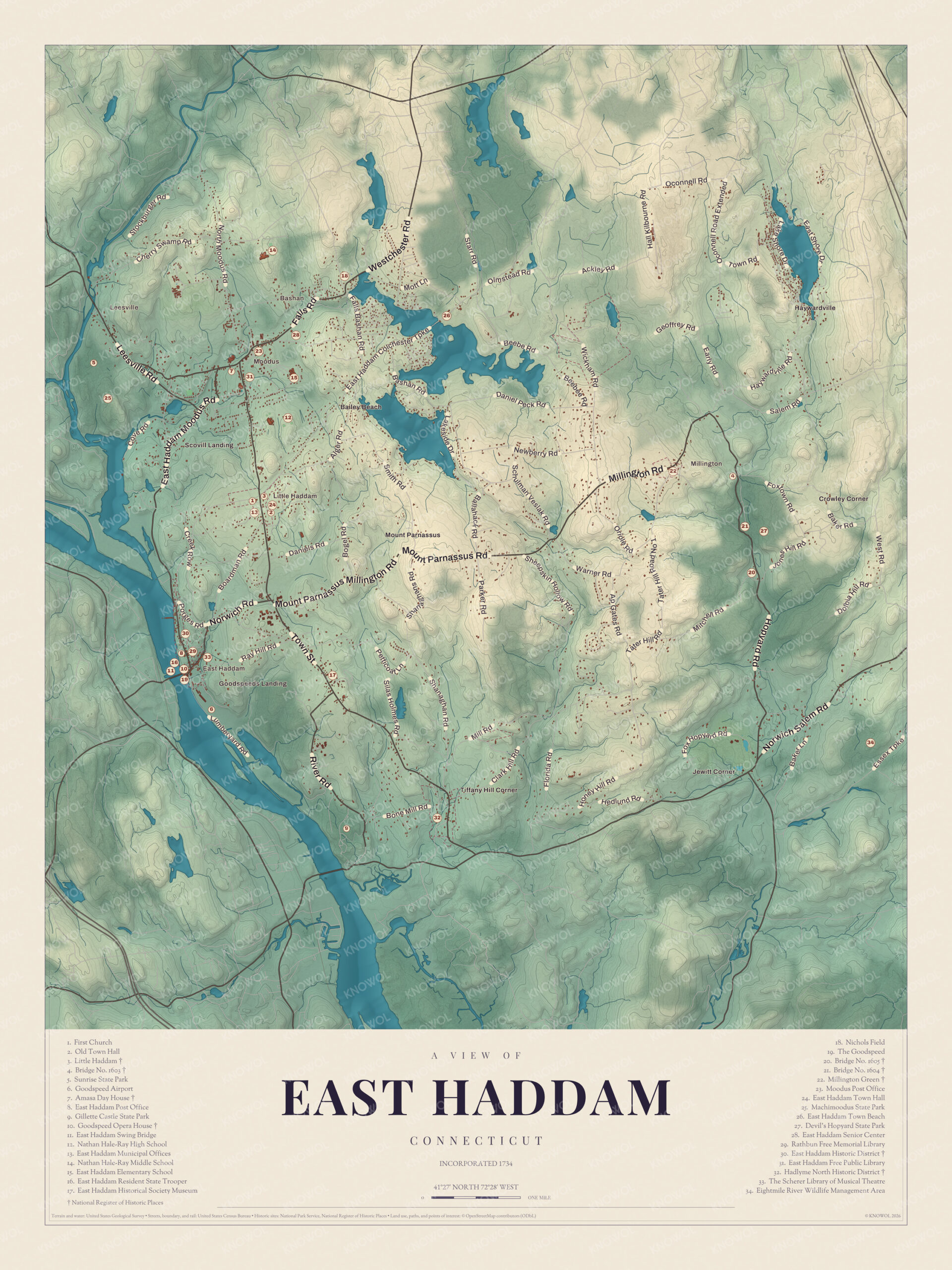
Shaded hills from Leesville in the north down to the Connecticut River, with Moodus, East Haddam, Little Haddam, Millington, Leesville, Bashan, Haywardville and Bashan Lake printed by name, and a guide of 34 numbered landmarks with the National Register sites marked.4
The story of East Haddam
The place of noises
The people who lived here first called the land Machimoodus, the place of noises. In 1729 the Rev. Stephen Hosmer wrote to Boston that the earthquakes seemed to have their center right in his own parish. On the night of May 18, 1791, a quake was felt in New York and Boston, while Moodus counted twenty to thirty shocks, and the next morning boulders weighing many tons had moved. In 1819 the county historian wrote that for forty years nearly every earthquake felt in Connecticut had been strongest in East Haddam. A traveler calling himself Doctor Steele claimed he'd dug up the cause, two stones he called carbuncles. And in 1925 a state history joked that the most important noise in Moodus was its weekly newspaper.56789
Twine for the fishing fleet
Moodus didn't even have its name until about 1850. Before that the mill village on the Moodus River was Mechanicsville, and in 1836 John Warner Barber wrote that one of its two cotton factories made cotton twine, said to be the first of its kind in the country. The Granite Twine Mill had gone up in 1815. About 1830 William E. Nichols built a twenty-spindle twisting machine, and his father, a peddler, carried the new cotton twine to fishermen along the Connecticut shore. The power came from Bashan Lake, which the mill owners bought together in 1857. In the 1800s Moodus, with twelve mills running, was the Twine Capital of America, and in 1906 a visitor heard the hum of ten thousand spindles.101121213114
Nathan Hale's schoolhouse
In the winter of 1773 a young teacher named Nathan Hale came to keep school in East Haddam. He wrote to a friend that for a long time he had thought the place couldn't be reached by friends or letters. One of his pupils, who lived to be an old woman, remembered that everybody loved him, he was so sprightly, kind and handsome. In 1799 Capt. Elijah Attwood bought the little schoolhouse, moved it and made it a home, and his family kept it for a hundred years. In 1899 Judge Julius Attwood gave it to the Sons of the Revolution. On June 6, 1900, Hale's birthday, thousands came to see it dedicated, and former Governor Morgan G. Bulkeley, born in East Haddam, gave the land around it for a park.1151617
Through the years
25 moments from 1662 to today.
- 1662Settlers buy the land that's now Haddam and East Haddam for thirty coats.1
- 1685The first permanent homes go up along Creek Row.1
- 1695Captain John Chapman starts a ferry across the Connecticut River.1
- 1704The first meetinghouse is built at Little Haddam.18
- 1704Jonathan Beebe of New London settles Millington.19
- 1729The Rev. Stephen Hosmer writes to Boston that the earthquakes seem to start in his own parish.5
- 1734East Haddam becomes its own town, separate from Haddam.1
- 1743The first house, a produce market and a storehouse go up at East Haddam Landing.20
- About 1765The first oil mill in Connecticut is built at Lord's Mills, now Leesville.21
- 1773Nathan Hale teaches the winter term in an East Haddam schoolhouse.1
- 1791On May 18 an earthquake shakes Moodus twenty to thirty times and is felt in New York and Boston.6
- 1794The First Church is built at Little Haddam, with a noon-mark cut in its front step.22
- 1799Capt. Elijah Attwood buys Hale's schoolhouse, moves it and makes it a home.17
- 1815The Granite Twine Mill, the oldest cotton mill in Moodus, is built.2
- 1816The Amasa Day House is built on the Moodus green for Colonel Julius Chapman.23
- About 1830William E. Nichols builds a twenty-spindle twisting machine at Moodus and starts making twine.12
- About 1850The mill village of Mechanicsville takes the name Moodus.10
- 1857The Moodus mill owners form a water company and buy Bashan Lake.13
- 1869The Connecticut Valley Advertiser begins weekly publication at Moodus.9
- 1877The Goodspeed Opera House opens its first play on October 24.24
- 1900On June 6, Hale's birthday, thousands gather to dedicate the restored schoolhouse.17
- 1913The 899-foot swing bridge opens and the ferry era ends.1
- 1914William Gillette begins building his stone castle, Seventh Sister, above the river.25
- 1937Three stone arch bridges are finished on Hopyard Road in Devil's Hopyard.26
- 1963The restored Goodspeed Opera House is rededicated on June 8.24
Places to see
The numbers match the landmark guide printed on the 2026 map.
- 1First ChurchOrchard and Town Roads. Meetinghouse of 1794.
- 3Little HaddamWest of town. The town's first center.
- 7Amasa Day HouseMoodus green. Federal house of 1816, now a museum.Visit their website
- 9Gillette Castle State Park67 River Road. William Gillette's stone castle on the Lyme line.Visit their website
- 10Goodspeed Opera HouseEast Haddam village. Theater of 1877 over the river.Visit their website
- 11East Haddam Swing BridgeEast Haddam village. 899 feet long, opened 1913.
- 17East Haddam Historical Society MuseumNorth of the village. Pictures of the bridge being built.Visit their website
- 22Millington GreenMillington. Houses from 1766 and 1792 around the green.
- 27Devil's Hopyard State ParkSoutheast. About 1,000 acres around Chapman Falls.Visit their website
- 30East Haddam Historic DistrictRoute 149. The Upper and Lower Landings.
On the National Register
All 16 places in East Haddam on the National Register of Historic Places that still stand today, oldest first, and why each one matters.3
-
Roaring Brook I Site
One of two Middle to Late Woodland Period archaeological sites near Roaring Brook. The Roaring Brook cultural phase is dated to about AD 1 to 750.27
-
Roaring Brook II Site
The second of the two Woodland Period sites, under an acre in size, found in surveys of the lower Connecticut Valley during the 1980s.27
-
Oriole Rockshelter
An archaeological site; its location is kept private to protect it.3
-
Wickham Road Historic District
A narrow gravel lane lined with stone walls, with three mid-1700s houses and the remains of David Wickham's sawmill, which ran until 1883. It shows what the countryside looked like before the factories came.28
-
Warner House
Built by John Warner, a regional maker of hinges and latches whose work is probably in the house, and restyled in 1790 with fine woodwork. Connecticut Landmarks opened it as a museum in 2019.29
-
Millington Green Historic District
Millington's meetinghouse went up on this triangular green in 1740, and militia trained here in the Revolution. Houses from 1766 and 1792 and a schoolhouse of 1854 stand around it.19
-
East Haddam Historic District
The Upper and Lower Landings on the river, which traded with the East and West Indies until the Civil War. The district takes in the town's civic buildings, the Goodspeed Opera House and monuments to Nathan Hale and General Joseph Spencer.30
-
Hadlyme North Historic District
The old core of Hadlyme, a village named for Haddam and Lyme that grew up around a church society of the 1740s. Its Congregational church of 1840 is still in use.31
-
Little Haddam Historic District
The town's first center, where its first church stood. The district holds the First Church of 1794, the town meeting hall of 1857, the Grange hall of 1905 and houses as old as about 1702.18
-
Amasa Day House
A Federal house at the head of the Moodus green, built for Colonel Julius Chapman and later home to families in banking and the twine business. Connecticut Landmarks runs it as a museum.23
-
Working Girls' Vacation Society Historic District
From 1892 to 1945 these farmhouses and barns were a summer retreat where working women from New York City could rest in the country.32
-
Goodspeed Opera House
William Henry Goodspeed built it in 1876 and 1877, and it opened its first play that October. Saved by citizens for one dollar and reopened in 1963, it's where Annie, Man of La Mancha and Shenandoah began.24
-
Seventh Sister (Gillette Castle)
The actor William Gillette, famous as Sherlock Holmes, designed this fieldstone castle on the southernmost of the Seven Sisters hills, with 47 puzzle doors and its own small railroad. The park straddles East Haddam and Lyme.25
-
Bridge No. 1603
One of three matching stone arch bridges on Hopyard Road, begun by the Civilian Conservation Corps and finished with Works Progress Administration money. A good example of rustic park building.26
-
Bridge No. 1604
The second of the three Depression-era stone arch bridges over the brooks that feed the Eightmile River.26
-
Bridge No. 1605
The third of the three stone arch bridges, each 38 feet long, all rehabilitated in 1988.26
In their words
“The pretty factory village of Moodus, vocal with the hum of ten thousand spindles.”
In olde Connecticut, 190614
“In spite of any reputation to the contrary, it is the most important noise.”
History of Connecticut in monographic form, 1925, on the Connecticut Valley Advertiser of Moodus9
“Everybody loved him, he was so sprightly, intelligent, and kind, and withal so handsome.”
A pupil of Nathan Hale's East Haddam school, in Once upon a time in Connecticut, 191616
Nearby towns
Sources
- East Haddam, Connecticut, Wikipedia
- The old chimney stacks of East Haddam (1887), on the Moodus mills, Internet Archive
- National Register of Historic Places listings in Middlesex County, Connecticut, Wikipedia
- Map of East Haddam, Connecticut in 2026, KNOWOL (USGS elevation, Census Bureau roads)
- Connecticut historical collections, John Warner Barber (1837), on the Moodus noises, Internet Archive
- Historic towns of the Connecticut River valley (1906), on the earthquake of 1791, Internet Archive
- A statistical account of the county of Middlesex, in Connecticut (1819), on the earthquakes, Internet Archive
- History of Middlesex County, Connecticut (1884), on Moodus and the noises, Internet Archive
- History of Connecticut in monographic form (1925), on the Connecticut Valley Advertiser, Internet Archive
- The Connecticut magazine (1900), on Machimoodus and Mechanicsville, Internet Archive
- Connecticut Historical Collections, John Warner Barber (1836), on Leesville and Mechanicsville, Internet Archive
- History of Connecticut in monographic form (1925), on the twine industry, Internet Archive
- History of Middlesex County, Connecticut (1884), on the Moodus Water Company, Internet Archive
- In olde Connecticut (1906), on Mount Tom and Moodus, Internet Archive
- Chapter sketches, Connecticut Daughters of the American Revolution; patron saints (1901), on Hale in East Haddam, Internet Archive
- Once upon a time in Connecticut (1916), on Nathan Hale, Internet Archive
- Chapter sketches, Connecticut Daughters of the American Revolution; patron saints (1901), on the Nathan Hale schoolhouse, Internet Archive
- Little Haddam Historic District, Wikipedia
- Millington, Connecticut, Wikipedia
- Historic towns of the Connecticut River valley (1906), on East Haddam Landing, Internet Archive
- Historic towns of the Connecticut River valley (1906), on Long Pond and Leesville, Internet Archive
- Some old time meeting houses of the Connecticut Valley (1911), Internet Archive
- Amasa Day House, Wikipedia
- Goodspeed Musicals, Wikipedia
- Gillette Castle State Park, Wikipedia
- Historic Bridges of Devil's Hopyard State Park, Wikipedia
- Roaring Brook sites, Wikipedia
- Wickham Road Historic District, Wikipedia
- Warner House (East Haddam, Connecticut), Wikipedia
- East Haddam Historic District, Wikipedia
- Hadlyme North Historic District, Wikipedia
- Working Girls' Vacation Society Historic District, Wikipedia