
A hill town on the Natchaug River, set off from Ashford in 1847, where Phoenixville's water power once spun cotton and twine and the village center turned out leather, wagon wheels and bobbins.
Eastford on the map
Click the map to look closer.
Eastford today
By KNOWOL
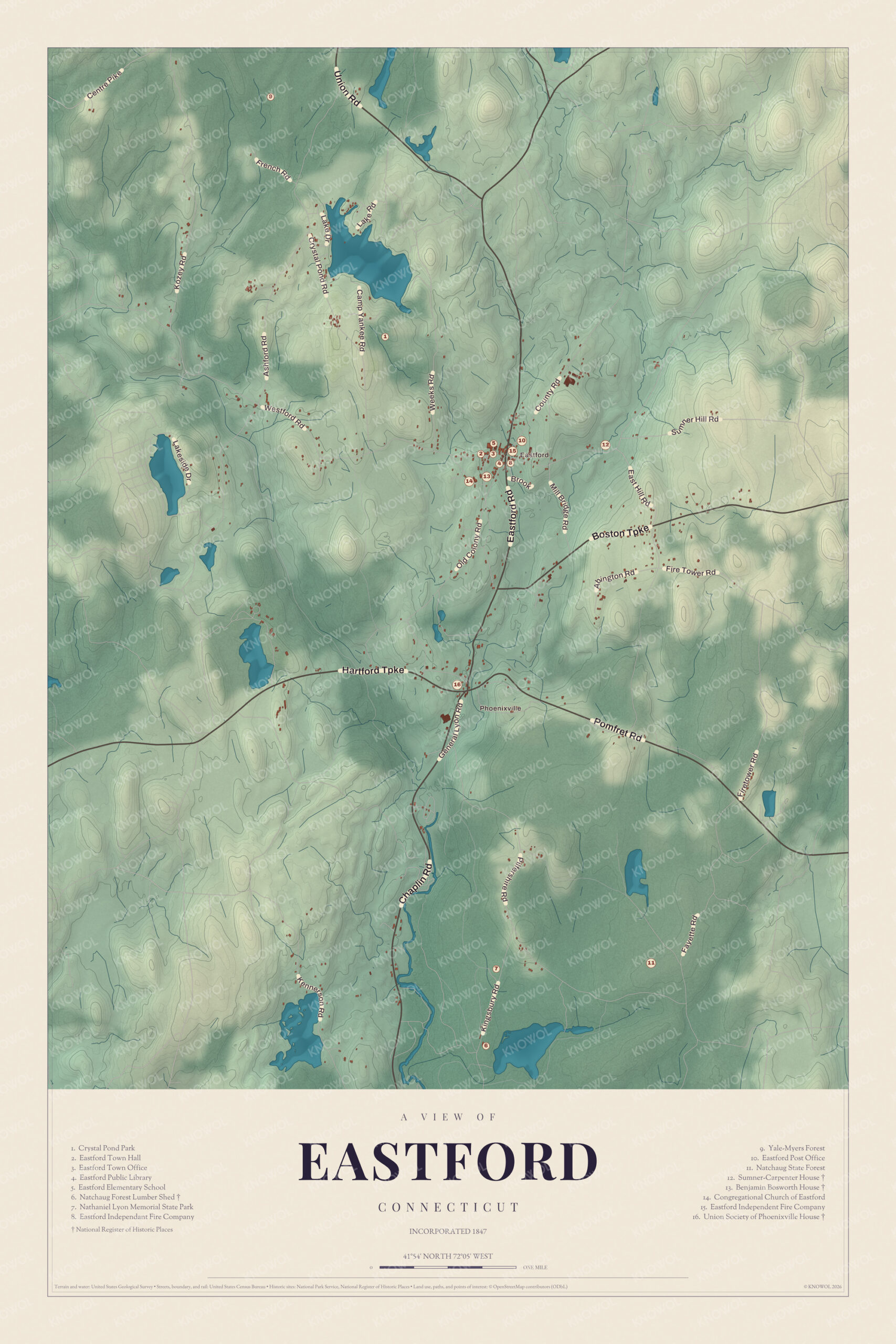
Shaded hills from North Ashford down through Natchaug State Forest, roads from the Boston Turnpike to Kozey Road, Eastford, Phoenixville and Crystal Pond by name, and a guide of 16 numbered landmarks with the National Register sites marked.5
The story of Eastford
The meetinghouse that froze in the road
When Eastford's Congregational church dedicated a new meetinghouse in 1829, Esquire Benjamin Bosworth bought the old one to make into a house. It had to come down a steep hillside. A great crowd brought three strings of oxen, thirty-three in a line, and had the building on its way when a chain broke. By custom the teamsters wanted a treat of liquor, and Bosworth, a new temperance man, said no. One account has him answering, "It will rot down where it is, first." The teams were unhitched and the building was left hanging. A crew of Abington men finished the move without a drop of liquor, but the old house was then caught by a storm at the foot of the hill and froze in place all winter, blocking the road.267
Smith Snow's wedding day
Phoenixville grew up where the Bigelow River joins the Natchaug. Smith Snow, who ran a mill there, was remembered as a man with little time for parties. The story handed down is that on his wedding day he came home, changed his clothes and went back to work in his mill to finish the day. The Union Society of Phoenixville House, at Routes 198 and 44, is said to be the house he built for his wife. In 1831 the Phoenix Manufacturing Company, with Snow among its owners, put up a stone cotton mill three floors high. Below the village, a Mr. Swinnington dammed a gulch to wash out the gold he was sure lay there, and found none. In 1880 the Latham brothers built a twine mill just north of the old cotton mills.891011
Ten thousand in a country town
Nathaniel Lyon was born in 1818 on a farm now inside Natchaug State Forest, and in August 1861 he became the first Union general killed in the Civil War, at Wilson's Creek in Missouri. The news reached Eastford over the town's first telegraph line, at a house that served as a testing station. His body came east by train and lay in state in St. Louis, Cincinnati, Philadelphia, New York and Hartford. A gang of pickpockets rode just ahead of it to work the crowds, until Hartford police caught seven of them. About ten thousand people came to the funeral at Eastford's Congregational church, and Galusha A. Grow, then Speaker of the U.S. House and born in the Eastford district of Ashford, gave the oration.12131431516
Through the years
21 moments from 1777 to today.
- 1777The General Assembly makes the east part of Ashford a separate parish called Eastford.17
- 1778The Congregational church is organized on September 23.7
- 1779The frame of the parish's first meetinghouse is raised.18
- 1791Benjamin Bosworth begins his Federal house, finished by 1801.19
- 1794A Baptist church is organized at North Ashford.7
- 1806Smith Snow builds the house now called the Union Society of Phoenixville House.9
- 1812About this year George and Rufus Sprague build a cotton mill at Phoenixville.10
- 1818Nathaniel Lyon is born on July 14 and grows up on his father's farm.12
- 1829A new meetinghouse is dedicated, and the old one is hauled down the hill by oxen.2
- 1831The Phoenix Manufacturing Company builds its stone cotton mill.10
- 1837The clothing works in Eastford village burn, and Captain Jonathan Skinner builds a cotton factory the same year.20
- 1847Eastford becomes a town, and holds its first town meeting on June 21.21
- 1850Skinner and Hewett's stone cotton mill burns and is never rebuilt.20
- 1861About ten thousand people come to General Lyon's funeral at the Congregational church.3
- 1866Grove Cemetery is established.22
- 1878The Congregational church marks its hundredth year.7
- 1880M. F. and J. E. Latham build a twine mill at Phoenixville.11
- 1919Natchaug State Forest is established.23
- 1933A Civilian Conservation Corps crew sets up camp in the forest and stays until 1941.23
- 2002The town buys the Union Society of Phoenixville House.9
- 2007The Union Society of Phoenixville House is listed on the National Register.9
Places to see
The numbers match the landmark guide printed on the 2026 map.
- 2Eastford Town HallVillage center. Town hall in the village cluster.
- 4Eastford Public LibraryVillage center. The town's library in the village.
- 6Natchaug Forest Lumber ShedKingsbury Road. Built by the CCC in the 1930s.
- 7Nathaniel Lyon Memorial State ParkNatchaug State Forest. Birthplace of General Nathaniel Lyon.
- 9Yale-Myers ForestShared with Union, Ashford and Woodstock. Yale's research forest of 7,840 acres.
- 11Natchaug State ForestSouth of Phoenixville. State forest established in 1919.Visit their website
- 12Sumner-Carpenter HouseOld Colony Road. Federal farmhouse of about 1806.
- 13Benjamin Bosworth HouseJohn Perry Road. Federal house with a Masonic lodge.
- 14Congregational Church of EastfordVillage center. Church gathered in 1778.
- 16Union Society of Phoenixville HouseRoutes 198 and 44. Smith Snow's house of 1806.
On the National Register
All 4 places in Eastford on the National Register of Historic Places that still stand today, oldest first, and why each one matters.4
-
Benjamin Bosworth House
An imposing Federal house built by the local craftsman Vinni Goodell for Benjamin Bosworth, a bachelor who owned several farms. Its monitor roof is rare for the period, and its third floor was a Masonic lodge room, with two fireplaces and built-in benches still in place.19
-
Sumner-Carpenter House
A well-preserved rural Federal house, probably by the same builder as the Bosworth House, built for John Newton Sumner. It was the center of one of the town's most successful farms, and a later owner, David Carpenter, served as selectman and in the legislature.24
-
Union Society of Phoenixville House
Built by the mill owner Smith Snow, it became the Sunday School and gathering place of Phoenixville, home to potluck and oyster suppers and holiday parties until 2000. The town bought it in 2002, and it's one of only two Union Society buildings still standing in Connecticut.9
-
Natchaug Forest Lumber Shed
A post-and-beam shed with five equipment bays, built by the Civilian Conservation Corps crew based in the forest from 1933 to 1941. It is the best preserved of the few buildings that crew left behind.23
In their words
“Eastford is the biggest place of its size on earth.”
An old Eastford saying, recalled by John Philo Trowbridge in A modern history of Windham County, 192025
“each was the busy center of a blithe and happy industry, like a hive of my father's bees in June.”
John Philo Trowbridge on Eastford's mills and shops in 1847, A modern history of Windham County, 192026
“It was a decidedly wide-awake place and many of its young people stayed there instead of going to the larger towns to engage in business.”
A modern history of Windham County, 1920, on the new town of 184727
Nearby towns
Sources
- Eastford, Connecticut, Wikipedia
- History of Windham County, Connecticut, vol. 2 (1874), on moving the old meetinghouse, Internet Archive
- The military and civil history of Connecticut during the war of 1861-65 (1868), Internet Archive
- National Register of Historic Places listings in Windham County, Connecticut, Wikipedia
- Map of Eastford, Connecticut in 2026, KNOWOL (USGS elevation, Census Bureau roads)
- History of Windham County, Connecticut, vol. 2 (1874), on Eastford Parish, Internet Archive
- History of Windham County, Connecticut (1889), on Eastford's churches, Internet Archive
- History of Windham County, Connecticut (1889), on Smith Snow, Internet Archive
- Union Society of Phoenixville House, Wikipedia
- History of Windham County, Connecticut (1889), on the Phoenixville mills, Internet Archive
- History of Windham County, Connecticut (1889), on the Latham twine mill, Internet Archive
- Nathaniel Lyon, Wikipedia
- Natchaug State Forest, Wikipedia
- A modern history of Windham County, Connecticut (1920), on the first telegraph line, Internet Archive
- Historical sketch of the police service of Hartford, from 1636 to 1901 (1901), Internet Archive
- Galusha A. Grow, Wikipedia
- The public records of the State of Connecticut, vol. 1 (1894), on the Eastford society, Internet Archive
- A modern history of Windham County, Connecticut (1920), on the Eastford parish, Internet Archive
- Benjamin Bosworth House, Wikipedia
- History of Windham County, Connecticut (1889), on the mills of Eastford village, Internet Archive
- History of Windham County, Connecticut, vol. 2 (1874), on the new town of Eastford, Internet Archive
- A modern history of Windham County, Connecticut (1920), on Grove Cemetery, Internet Archive
- Natchaug Forest Lumber Shed, Wikipedia
- Sumner-Carpenter House, Wikipedia
- A modern history of Windham County, Connecticut (1920), on Eastford village, Internet Archive
- A modern history of Windham County, Connecticut (1920), John Philo Trowbridge on Eastford's separation from Ashford, Internet Archive
- A modern history of Windham County, Connecticut (1920), on the new town of 1847, Internet Archive