
A Massachusetts town for its first seventy years, where Jonathan Edwards preached Sinners in the Hands of an Angry God, the Shakers sold their garden seeds, Thompsonville wove carpets for the nation and Hazardville made gunpowder in Powder Hollow.
Then and now
The same town 157 years apart. Click either map to look closer.
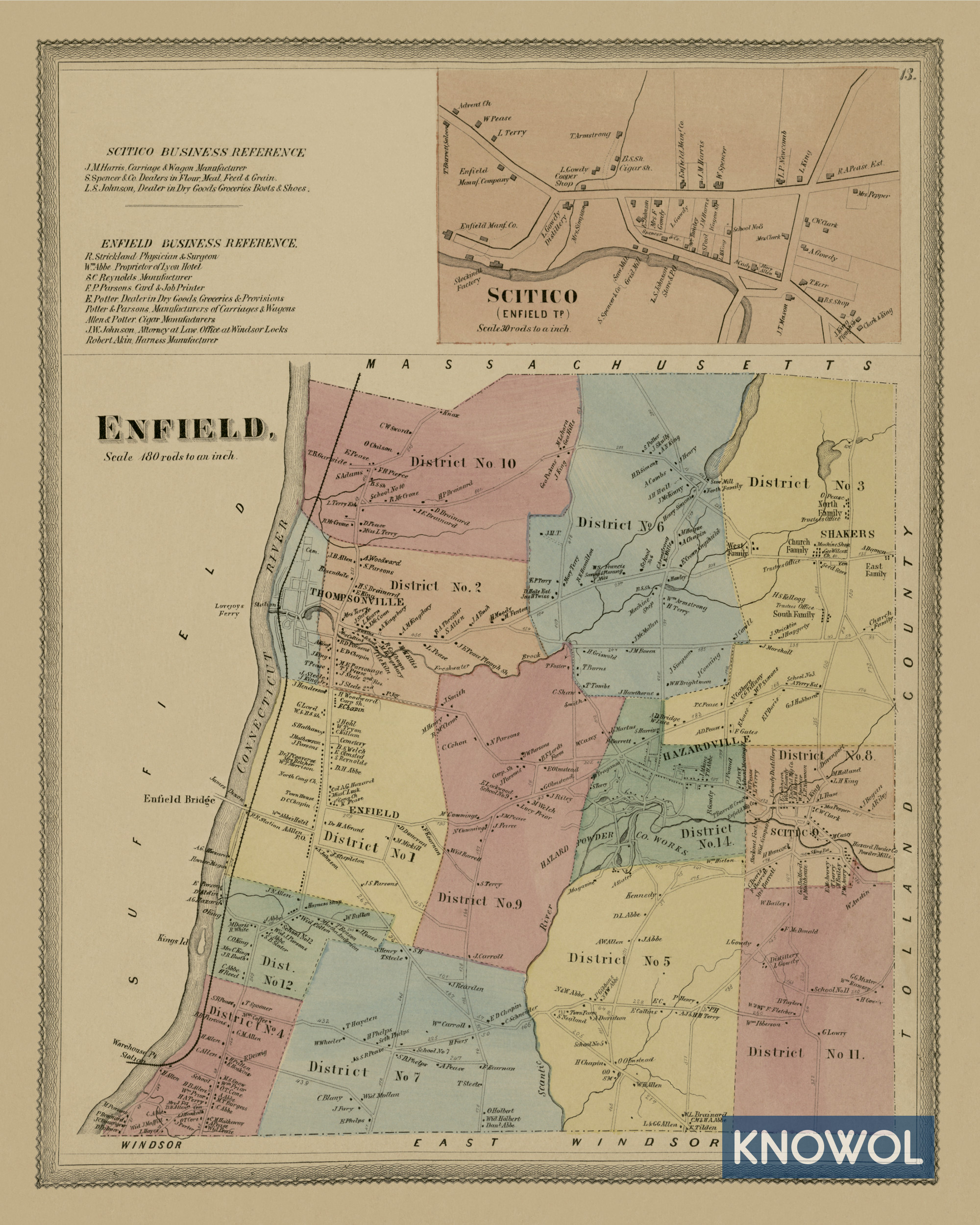
The landowners map
By Baker & Tilden
Every plot of land is labeled with its owner's name, across 14 districts including Hazardville, Scitico and Thompsonville, with landmarks like Enfield Bridge, the Hazard Powder Company and its powder mills, the Shakers' seed store, Gowdy Distillery and Lovejoy's Ferry.4
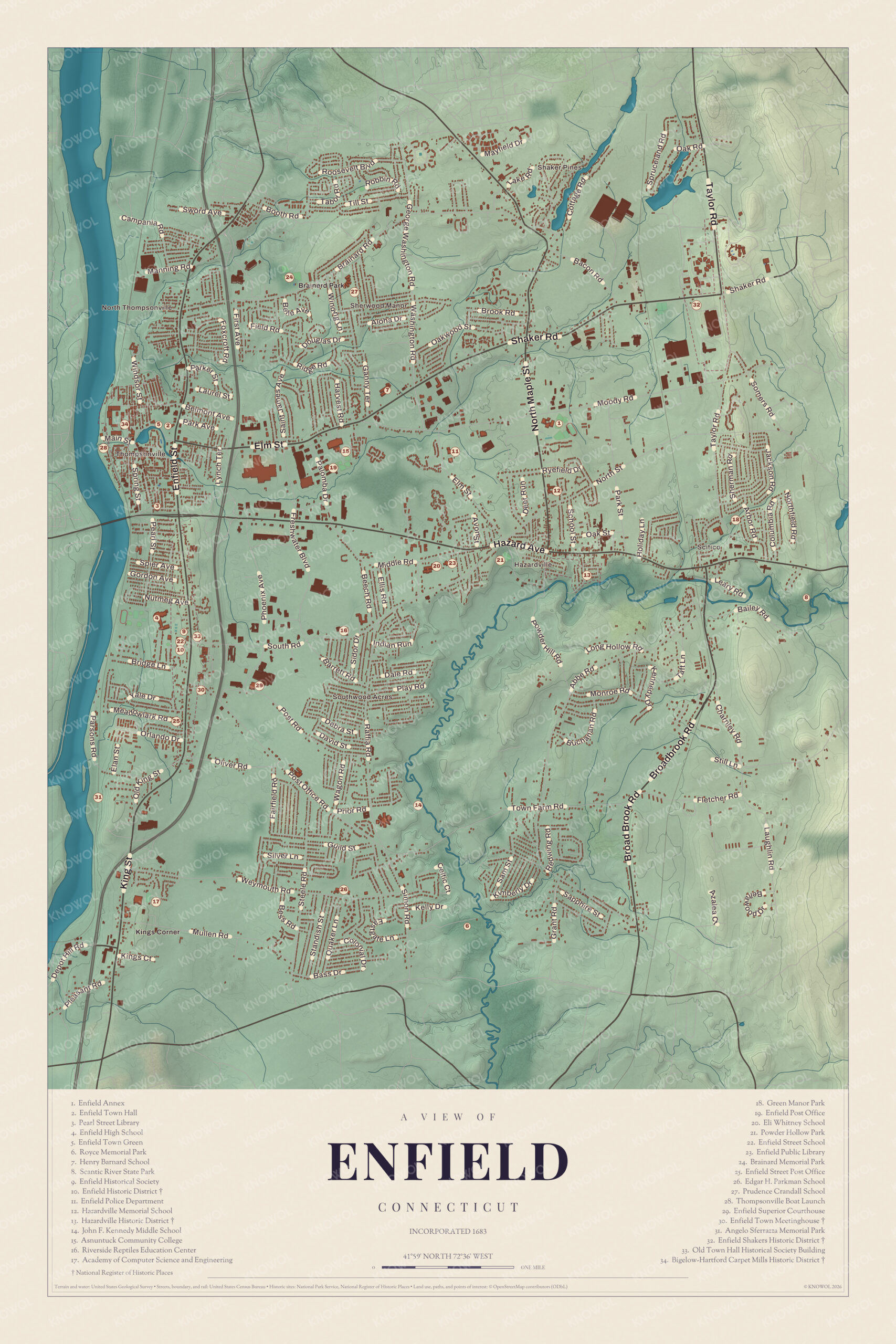
Enfield today
By KNOWOL
Shaded ground from the ridge above the Connecticut River out past Kings Corner to the Scantic River, every street from Enfield Street to Shaker Road, the villages printed by name, and a guide of 34 numbered landmarks with the National Register sites marked.5
The story of Enfield
The drum on the green
News of the fight at Lexington reached Enfield by a rider on the Sunday after, while the town sat in its meetinghouse. As the story was told, a drum was found and Thomas Abbe marched around the building beating the long roll, and the meeting broke up. Early the next day 74 men set out for Boston under Nathaniel Terry, from a town of about 1,400 people. Nobody wrote the drumming down at the time, and a speaker in 1916 admitted it rested on tradition, then told the doubters to say what they will. That November a marble statue of Captain Abbey was unveiled on the green across from the Congregational Church, and six hundred members of the Abbey family were invited.678
Carpets and gunpowder
For a long time Enfield farmed, and apart from a small ironworks on the Scantic River from 1802 there was little else. Then in 1828 Orrin Thompson dammed Freshwater Brook and started a carpet company, with skilled weavers brought from Scotland. By 1836 his new village had about 800 people and 120 looms turning out 800 yards of carpet a day, and by the 1920s more than 13,000 people worked there. East of the center, Allen Loomis started a small powder mill on the Scantic in 1835. It grew into the Hazard Powder Company, where John Mathewson set up the first steam machinery for making gunpowder brought to America. Over 60 people died in explosions in Powder Hollow before powder making ended in 1913.95102111
Sinners and Shakers
On July 8, 1741, Jonathan Edwards of Northampton came to preach in Enfield's little meetinghouse on the green, 40 by 45 feet. Neighbors had spent the night before in prayer, worried that Enfield's people were careless about their souls. The sermon was Sinners in the Hands of an Angry God, and an 1818 history says the room filled with such weeping that Edwards had to ask for quiet so he could be heard. Forty years later Joseph Meacham, an Enfield native and Baptist pastor in the northeast of town, became one of the first American Shakers and rose to lead them. A Shaker society formed in Enfield about 1788, and its members were said to be the first to sell garden seeds in little packets, as early as 1802.12131415
Through the years
25 moments from 1679 to today.
- 1679Robert and John Pease come from Salem to farm the land at Freshwater.1
- 1681The town committee makes the Pease family's lots wider than the rest, as the first settlers.16
- 1683Massachusetts incorporates the town on May 16, and Margaret Pease is the first child born here.17
- 1688The townspeople buy the land from Notatuck for 25 pounds.1
- 1713A twenty-year court fight with Windsor over Enfield's southern line ends in a compromise.18
- 1734The eastern part of town becomes the town of Somers.1
- 1741Jonathan Edwards preaches Sinners in the Hands of an Angry God in the little meetinghouse on the green.12
- 1749Enfield leaves Massachusetts and becomes part of Connecticut.1
- 1770The Separates, who broke from the first church in 1762, become the Second Ecclesiastical Society of Enfield.19
- 1775After news of Lexington, a drum is beaten around the meetinghouse and 74 men march for Boston.6
- 1775The meetinghouse that's now the Old Town Hall museum is finished.20
- 1788About this year a Shaker society forms in Enfield, after Enfield native Joseph Meacham and part of his Baptist church turn Shaker.14
- 1802The Enfield Shakers are said to start selling garden seeds in little packets.15
- 1826William Dixon builds the Enfield Bridge across the Connecticut to Suffield.21
- 1828Orrin Thompson dams Freshwater Brook and starts the carpet company that names Thompsonville.2
- 1835Allen Loomis starts a small powder mill on the Scantic River in Powder Hollow.5
- 1836Thompsonville has about 800 people and 120 looms making 800 yards of carpet a day.10
- 1845The Presbyterian church of the Scottish millworkers splits over instrumental music in worship.22
- 1848The meetinghouse is moved across Enfield Street and given its columned Greek Revival front.20
- 1900Half of the old covered bridge to Suffield is carried off in a freshet on February 15.21
- 1913Gunpowder making ends in Hazardville.23
- 1914The Carnegie library on Pearl Street opens on May 5.24
- 1916The Abbey Memorial is unveiled on the green on November 4.8
- 1917The Enfield Shaker community comes to an end.25
- 1972Asnuntuck Community College opens with 251 students.1
Places to see
The numbers match the landmark guide printed on the 2026 map.
- 3Pearl Street LibraryThompsonville. The Carnegie library of 1914.
- 8Scantic River State ParkPowder Hollow. Foundations of 21 powder mill buildings.Visit their website
- 10Enfield Historic DistrictEnfield Street. Two miles of houses on the ridge.
- 13Hazardville Historic DistrictHazardville. The old powder company village.
- 15Asnuntuck Community CollegeElm Street. Its name means fresh water.Visit their website
- 21Powder Hollow ParkHazardville. Ball fields where powder was made.
- 28Thompsonville Boat LaunchConnecticut River. Onto the river at Thompsonville.
- 30Enfield Town MeetinghouseEnfield Street. Isaac Kirby's meetinghouse, now a museum.Visit their website
- 32Enfield Shakers Historic DistrictTaylor Road. Connecticut's only Shaker settlement.
- 34Bigelow-Hartford Carpet Mills Historic DistrictThompsonville. Carpet mills and company housing.
On the National Register
All 7 places in Enfield on the National Register of Historic Places that still stand today, oldest first, and why each one matters.3
-
Enfield Historic District
Two miles of Enfield Street, the town's main road since early days, where house lots ran in strips down to the river. Its grandest house is Orrin Thompson's brick Greek Revival home of 1832, facing the 17th-century parade ground near the 1848 Congregational Church.26
-
Enfield Town Meetinghouse
Built by Isaac Kirby and modeled on a meetinghouse in East Windsor, it was moved across the street in 1848 and given its Ionic temple front. It was the town hall until the 1920s and is now the historical society's museum.20
-
Enfield Shakers Historic District
What survives of Connecticut's only Shaker settlement, known for its garden seed business, which lasted until 1917. Fifteen buildings remain, among them a meetinghouse, a large brick residence, barns and a sawmill, most from 1830 to 1860.25
-
Bigelow-Hartford Carpet Mills Historic District
The company village around the carpet mills, with more than 150 housing units the company built between about 1830 and 1920. It includes the Gothic cottages of Cottage Green from 1845, perhaps built to draw skilled craftsmen from England.2
-
Hazardville Historic District
The company village of the gunpowder works that ran from 1835 to 1913. Four brick buildings with brownstone trim anchor it: a school of 1864, the Hazardville Institute of 1869, an Episcopal church of 1863 and a Methodist church of 1872.23
-
Bigelow-Hartford Carpet Mills
Seven large brick mill buildings on nearly 23 acres, from the years when the company was the nation's biggest maker of carpet. The 1901 Tapestry Mill is nearly 900 feet long, and most of the complex is now apartments.27
-
Enfield Carnegie Library
Andrew Carnegie gave $20,000 for it in 1910, and the library designed by McLean and Wright of Boston opened on May 5, 1914. It still serves as a branch of the town library.24
In their words
“No history of Massachusetts is complete without including the history of Enfield for the first seventy years of its existence, nor would a history of Connecticut be complete that failed to include the entire history of Enfield.”
Historic towns of the Connecticut River Valley, 190628
“Let us believe this story to be true, let the cavillers say what they will.”
Memorial of Captain Thomas Abbey, 1916, on Thomas Abbe's drum7
“Seldom has the Town of Enfield been asked to accept any gift other than an increase in the town's debts.”
Allen B. Hathaway at the unveiling of the Abbey Memorial, 191629
Nearby towns
Sources
- Enfield, Connecticut, Wikipedia
- Bigelow-Hartford Carpet Mills Historic District, Wikipedia
- National Register of Historic Places listings in Hartford County, Connecticut, Wikipedia
- Landowners map of Enfield, Connecticut from 1869, restored by KNOWOL
- Map of Enfield, Connecticut in 2026, KNOWOL (USGS elevation, Census Bureau roads)
- The Connecticut quarterly (1895), on Enfield and Lexington, Internet Archive
- Memorial of Captain Thomas Abbey (1916), on the drum story, Internet Archive
- Encyclopedia of Connecticut biography (1917), on the Abbey Memorial, Internet Archive
- Historic towns of the Connecticut River Valley (1906), on Enfield's early manufacturing, Internet Archive
- Connecticut historical collections, John Warner Barber (1836), on Thompsonville, Internet Archive
- Encyclopedia of Connecticut biography (1917), on John Mathewson, Internet Archive
- Memorial of Captain Thomas Abbey (1916), on Jonathan Edwards' sermon, Internet Archive
- A complete history of Connecticut, civil and ecclesiastical (1818), on the revival at Enfield, Internet Archive
- The memorial history of Hartford County, Connecticut, 1633-1884 (1886), on Joseph Meacham and the Shakers, Internet Archive
- The Connecticut quarterly (1895), on the Enfield Shakers, Internet Archive
- The memorial history of Hartford County, Connecticut, 1633-1884 (1886), on the first settlers, Internet Archive
- Memorial of Captain Thomas Abbey (1917), on the first child born in Enfield, Internet Archive
- Historic towns of the Connecticut River Valley (1906), on the boundary war with Windsor, Internet Archive
- The memorial history of Hartford County, Connecticut, 1633-1884 (1886), on the Separates, Internet Archive
- Enfield Town Meetinghouse, Wikipedia
- Celebration of the two hundred and fiftieth anniversary of the settlement of Suffield, Connecticut (1921), on the Enfield Bridge, Internet Archive
- The memorial history of Hartford County, Connecticut, 1633-1884 (1886), on the Thompsonville churches, Internet Archive
- Hazardville Historic District, Wikipedia
- List of Carnegie libraries in Connecticut, Wikipedia
- Enfield Shakers Historic District (Connecticut), Wikipedia
- Enfield Historic District, Wikipedia
- Bigelow-Hartford Carpet Mills, Wikipedia
- Historic towns of the Connecticut River Valley (1906), on Enfield, Internet Archive
- Memorial of Captain Thomas Abbey (1916), on the unveiling, Internet Archive