
A shore town founded by Roger Ludlowe in 1639 on the land called Unquowa, the old county seat the British burned in 1779, with the harbor village of Southport, the dogwoods and church spire of Greenfield Hill, and five miles of Long Island Sound shore.
Fairfield on the map
Click the map to look closer.
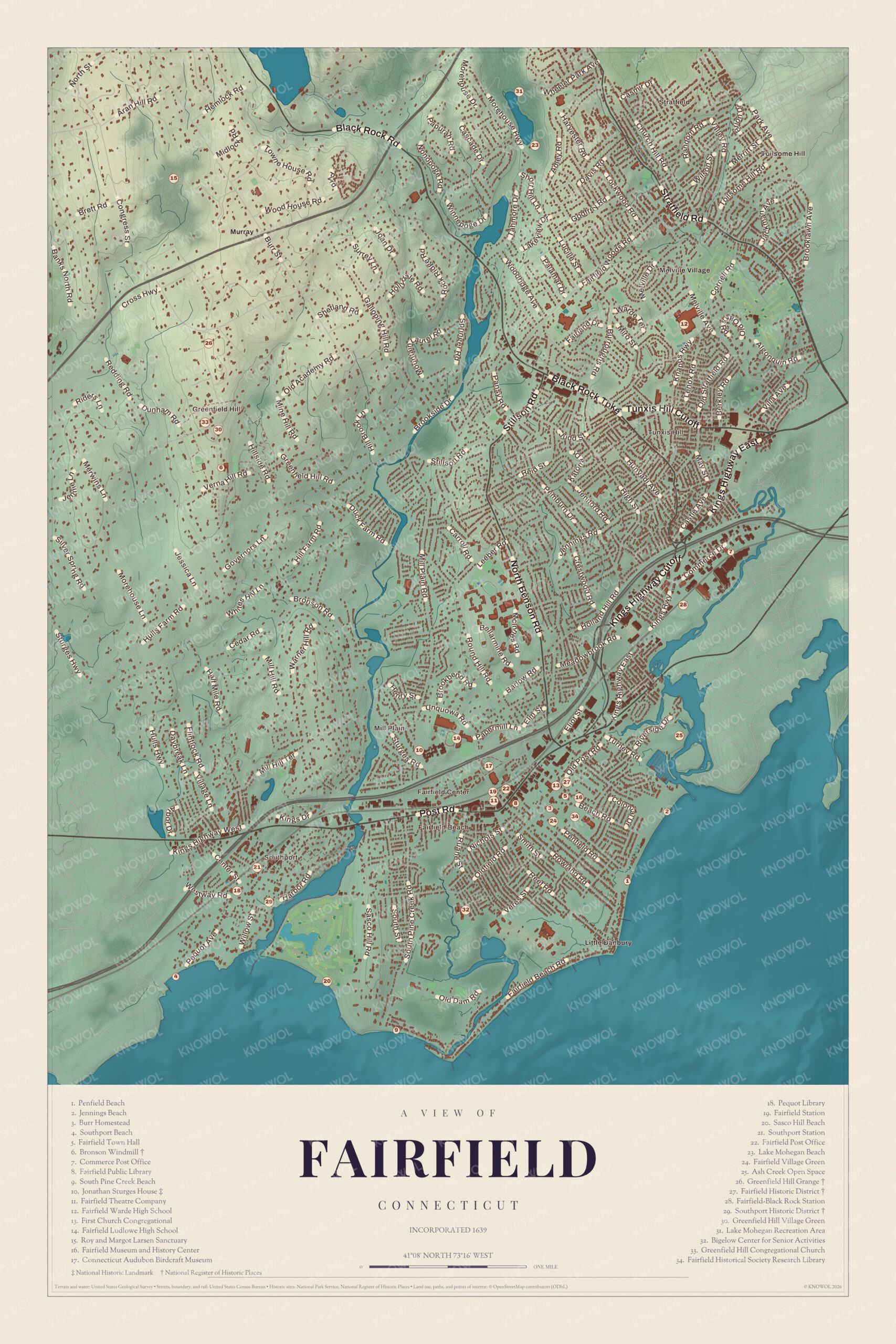
Fairfield today
By KNOWOL
Shaded hills from Greenfield Hill down past Little Danbury to the beaches, every street from the Post Road to Fairfield Beach Road, Southport, Fairfield Center and Lake Mohegan, and a guide of 34 numbered landmarks with the National Historic Landmark and National Register sites marked.2
The story of Fairfield
Mills on the tide
Long before Fairfield was a suburb, its creeks and tide mills fed armies. In 1750 the town gave Peter Penfield leave to build a grist mill on Ash Creek near the mouth of the Unquowa River. During the Revolution the Penfield mills were guarded night and day, because James Penfield was baking several barrels of flour a day for the army. By 1819 the town had nine grain mills, four of them on tide water, grinding wheat shipped in from other states. Mill River, today's Southport, ran the biggest trade in town, sending coasting vessels to New York and the southern ports, and it was called the wealthiest village in Fairfield. During the Civil War the farms around it grew the Southport Globe onion, which sold for ten dollars a barrel.56789
The night Fairfield burned
Fairfield backed independence from the start, and the British meant to punish it. On July 7, 1779, about 2,000 troops under General Tryon came ashore at Fairfield Beach. From the spire of Trinity Church, ten-year-old Samuel Rowland watched them march up Beach Lane until a neighbor told him to run. That evening and the next morning the soldiers burned the meetinghouse, the jail and more than two hundred buildings in all. A 1909 history said the buildings that escaped could be counted on two hands. Ten years later President Washington rode through and wrote that the chimneys of burnt houses were still standing. Samuel Rowland grew up to serve as town clerk for more than forty years.11011212
The view from Greenfield Hill
Greenfield Hill became its own parish in 1725, and in 1783 Timothy Dwight came as its minister. He opened an academy where young men and women studied the classics, and in 1794 he published a long poem named for the village. A gazetteer of 1819 said no other spot in Connecticut gave so wide a view. Ten other churches could be seen from the belfry, and at times nearly a hundred sails were moving on the Sound. The custom house for the Fairfield district was kept up here. A 1909 guide says that during the Revolution Major Benjamin Tallmadge, one of Washington's secret agents, often watched British ships from the meeting house spire. The Bronson Windmill, built in 1893 and 1894, still stands nearby.13141516171819
Through the years
21 moments from 1639 to today.
- 1639Roger Ludlowe buys the land called Unquowa and starts the settlement.1
- 1648The first mill begins grinding, with Henry Jackson as miller.13
- 1666Fairfield County is created, with Fairfield village as its county seat.3
- 1702Fairfield is made a port of entry.13
- 1725Trinity Church opens on Mill Plain, the second Episcopal church built in the colony.20
- 1750Peter Penfield is allowed to build a grist mill on Ash Creek near the mouth of the Unquowa River.5
- 1775John Hancock marries Dorothy Quincy at Thaddeus Burr's house.13
- 1779About 2,000 British troops land at Fairfield Beach on July 7 and burn the town.1
- 1783Timothy Dwight becomes minister at Greenfield Hill and opens his academy.14
- 1789President Washington passes through and notes the chimneys of burnt houses still standing.1
- 1794The new town hall is built on the Green.21
- 1815Peace with Britain is celebrated on the Green with an ox roast and a ball at the Knapp tavern.22
- 1819The town has nine grain mills, and Mill River is called its wealthiest village.7
- 1831Southport is chartered as a borough.23
- 1840Joseph Collins Wells designs the Gothic Revival house of Jonathan Sturges on Mill Plain.24
- 1853The county courts move to Bridgeport.3
- 1860sThe Southport Globe onion sells for ten dollars a barrel during the Civil War.9
- 1894The Pequot Library opens in Southport.25
- 1898The Audubon Society of the State of Connecticut is founded at Fairfield.26
- 1914Mabel Osgood Wright founds the Birdcraft Sanctuary.27
- 1945Two men on a barge stuck on Penfield Reef are saved in the first civilian helicopter hoist rescue.1
Places to see
The numbers match the landmark guide printed on the 2026 map.
- 1Penfield BeachThe shore. Town beach south of the center.
- 3Burr HomesteadOld Post Road. Rebuilt where Hancock married Dorothy Quincy.
- 5Fairfield Town HallFairfield Center. Built in 1794 after the burning.
- 6Bronson WindmillGreenfield Hill. The town's last windmill, about 80 feet.
- 10Jonathan Sturges HouseMill Plain Road. Gothic Revival landmark of 1840.
- 17Connecticut Audubon Birdcraft MuseumUnquowa Road. Oldest private songbird sanctuary in America.Visit their website
- 18Pequot LibrarySouthport. Pink granite library opened in 1894.Visit their website
- 24Fairfield Village GreenFairfield Center. The heart of the 1639 town.
- 29Southport Historic DistrictSouthport. Captains' and merchants' houses by the harbor.
- 33Greenfield Hill Congregational ChurchGreenfield Hill. Timothy Dwight's church on the green.Visit their website
On the National Register
All 13 places in Fairfield on the National Register of Historic Places that still stand today, oldest first, and why each one matters.4
-
John Osborne House
An early colonial house whose framing doesn't follow the usual patterns; tax records give 1734, though it may be as old as 1673. It stands near the Pequot Swamp, where the last battle of the Pequot War was fought in 1637.28
-
David Ogden House
A saltbox farmhouse built about the time David Ogden married Jane Sturges, home to the Ogden family for 125 years. It escaped the 1779 burning and is now a museum of the Fairfield Museum and History Center.29
-
Greenfield Hill Historic District
The village around the triangular green, an intellectual center after Timothy Dwight became minister in 1783 and opened an academy for young men and women. It holds 38 principal houses and buildings from the 1700s and 1800s.14
-
Fairfield Historic District
The old town center laid out in Four Squares by the founders, with about 75 historic buildings on 35 acres, including houses that survived the 1779 burning and the town hall of 1794.21
-
Southport Historic District
The center of Fairfield's trade and shipping after the Revolution, with more than 150 contributing buildings, mostly Greek Revival and Victorian homes of merchants, bankers and captains. The Meeker House is the only building known to have survived the 1779 burning of Southport.30
-
Jonathan Sturges House
National Historic Landmark
The first known commission of architect Joseph Collins Wells, and one of the oldest and best documented architect-designed Gothic Revival houses in the country. It has more than 30 rooms and 11 staircases and is still owned by the Sturges family.24
-
Pine Creek Park Bridge
A rare early iron Pratt pony truss bridge made by the Keystone Bridge Company of Pittsburgh. It was moved here in 1979 from its first spot on Mill Hill Road.31
-
Fairfield Railroad Stations
The brick eastbound station of 1882 replaced one lost to fire and is typical of the sturdier brick stations of the 1880s. The wooden westbound station is a good example of the New Haven Railroad's stations of the 1890s.32
-
Southport Railroad Stations
Two late 1800s station buildings at the stop that opened in 1884, a wooden saltbox westbound station and a brick eastbound one. The westbound station was gutted by fire in 2008 and restored and reopened in 2009.33
-
Bronson Windmill
An octagonal mill about 80 feet tall, built for Frederic Bronson to pump water into an underground cistern. It's the only survivor of the windmills that once dotted the town.19
-
Greenfield Hill Grange No. 133
A grange hall built when northern Fairfield was farm country known for flax, one of the few high quality halls built for a grange in the state. Its pressed tin ceilings are thought to be among the earliest of their kind.34
-
Restmore
An 11-room steel and stucco summer house built by Ira DeVer Warner of the Warner Brothers Corset Company, who ran a dairy farm on the rest of his 200 acres.35
-
Birdcraft Sanctuary
National Historic Landmark
Founded by Mabel Osgood Wright in 1914, the oldest private songbird sanctuary in the United States, where more than 120 kinds of birds have been seen. Its founding marked the revival of the bird conservation movement.27
In their words
“For more than two hundred years Fairfield was the queen of the county”
History of Fairfield County, Connecticut, 188136
“It is presumed that no other spot in Connecticut affords a prospect so extensive and delightful”
A gazetteer of the states of Connecticut and Rhode-Island, 1819, on the view from Greenfield Hill16
“Mill River, Southport, and Fairfield will always seem pleasant and homelike.”
George Dimon, writing from Ohio for the 1879 centennial of the burning37
Nearby towns
Sources
- Fairfield, Connecticut, Wikipedia
- Map of Fairfield, Connecticut in 2026, KNOWOL (USGS elevation, Census Bureau roads)
- Fairfield, ancient and modern, Frank Samuel Child (1909), on the county seat, Internet Archive
- National Register of Historic Places listings in Fairfield County, Connecticut, Wikipedia
- The history of Fairfield, Fairfield County, Connecticut, from 1700 to 1800, Elizabeth H. Schenck (1905), on Penfield's mill, Internet Archive
- The history of Fairfield, Fairfield County, Connecticut, from 1700 to 1800, Elizabeth H. Schenck (1905), on the Penfield mills in 1779, Internet Archive
- A gazetteer of the states of Connecticut and Rhode-Island (1819), on Fairfield's mills, Internet Archive
- A gazetteer of the states of Connecticut and Rhode-Island (1819), on Mill River, Internet Archive
- History of Connecticut in monographic form (1925), on the Southport Globe onion, Internet Archive
- Fairfield, ancient and modern, Frank Samuel Child (1909), on Samuel Rowland, Internet Archive
- Fairfield, ancient and modern, Frank Samuel Child (1909), on the meetinghouse and jail, Internet Archive
- Fairfield, ancient and modern, Frank Samuel Child (1909), on historic sites, Internet Archive
- Fairfield, ancient and modern, Frank Samuel Child (1909), summary of dates, Internet Archive
- Greenfield Hill Historic District, Wikipedia
- In olde Connecticut, Charles Burr Todd (1906), on Greenfield Hill, Internet Archive
- A gazetteer of the states of Connecticut and Rhode-Island (1819), on Greenfield Hill, Internet Archive
- A gazetteer of the states of Connecticut and Rhode-Island (1819), on the custom house, Internet Archive
- Fairfield, ancient and modern, Frank Samuel Child (1909), on Greenfield Hill, Internet Archive
- Bronson Windmill, Wikipedia
- Annals of an old parish: historical sketches of Trinity Church, Southport, Connecticut (1898), Internet Archive
- Fairfield Historic District (Fairfield, Connecticut), Wikipedia
- Fairfield, ancient and modern, Frank Samuel Child (1909), on the peace celebration of 1815, Internet Archive
- History of Fairfield County, Connecticut (1881), on the Borough of Southport, Internet Archive
- Jonathan Sturges House, Wikipedia
- Fairfield, ancient and modern, Frank Samuel Child (1909), on the Pequot Library, Internet Archive
- Fairfield, ancient and modern, Frank Samuel Child (1909), on the Audubon Society, Internet Archive
- Connecticut Audubon Society Birdcraft Museum and Sanctuary, Wikipedia
- John Osborne House, Wikipedia
- David Ogden House, Wikipedia
- Southport Historic District (Fairfield, Connecticut), Wikipedia
- Pine Creek Park Bridge, Wikipedia
- Fairfield station (Metro-North), Wikipedia
- Southport station (Metro-North), Wikipedia
- Greenfield Hill Grange No. 133, Wikipedia
- Restmore, Wikipedia
- History of Fairfield County, Connecticut (1881), on Fairfield, Internet Archive
- Centennial commemoration of the burning of Fairfield, Connecticut (1879), letter of George Dimon, Internet Archive