
A town of mill villages on the Quinebaug, the Five Mile River and Whetstone Brook, once the greatest cotton manufacturing town in Connecticut, with the borough of Danielson at the meeting of its rivers.
Killingly on the map
Click the map to look closer.
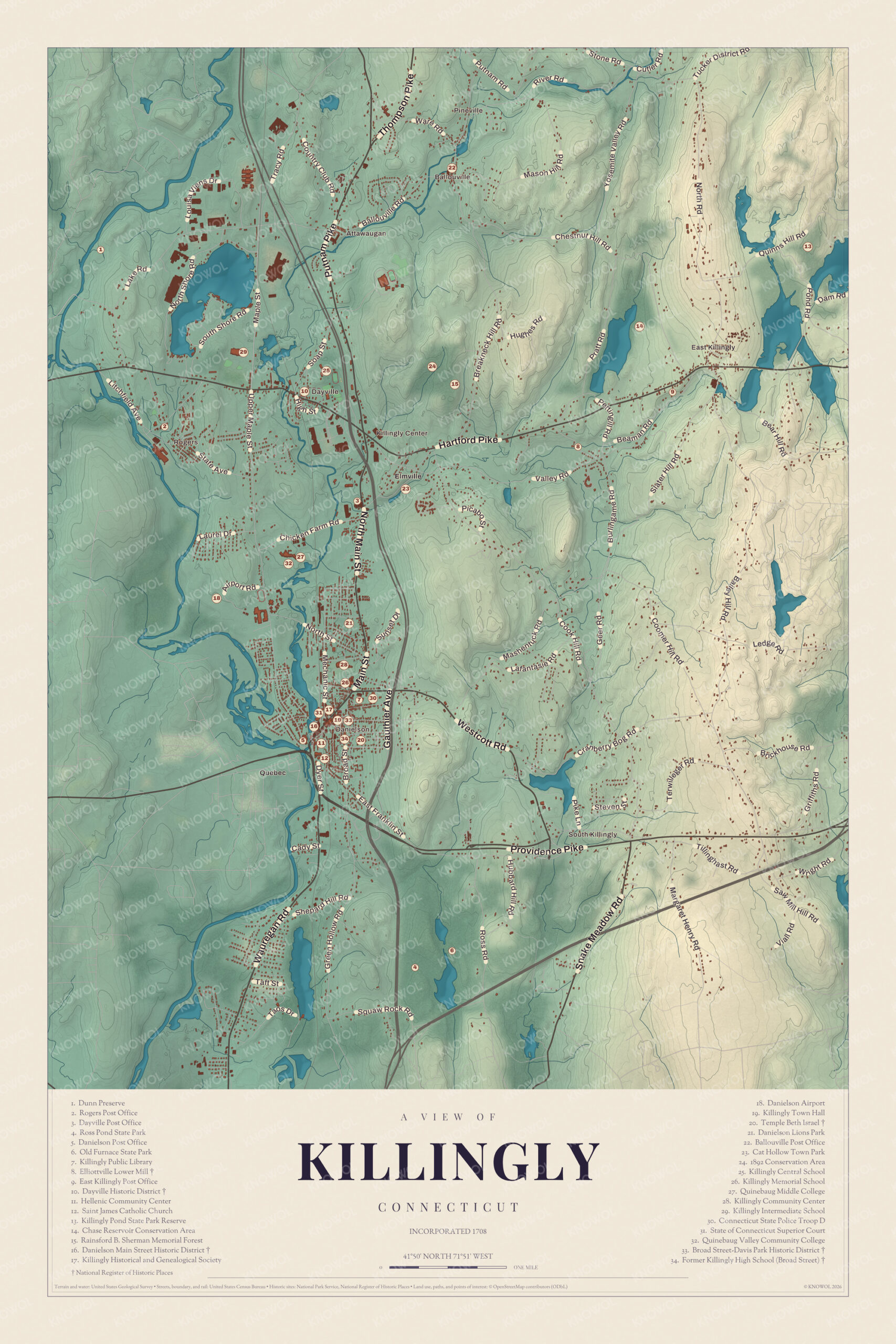
Killingly today
By KNOWOL
Shaded hills from Danielson and the Quinebaug valley east to Pineville and the high country along Rhode Island, every street, the mill villages by name, and a guide of 34 numbered landmarks with the National Register sites marked.5
The story of Killingly
Nell Alexander's ring
Alexander's Lake, near Dayville, was Lake Mashapaug to the Native people. In 1837 John Warner Barber told how it got its English name. Nell Alexander came over from Scotland and found a gold ring on the ship's deck that nobody claimed. He pawned it for small goods and peddled them around Boston and Roxbury, did well enough to buy the ring back, and in time bought 3,500 acres in Killingly. He settled by the lake in 1720, and the ring passed down from Nell to Nell. Barber also wrote down a Native legend that the lake swallowed a pine-covered hill during a four-day festival, leaving only Loon's Island, and said that on a still day you could see huge pine trunks deep in the water.67
The lively little Whetstone
Killingly's mills ran on falling water, and no stream worked harder than Whetstone Brook. It drops 175 feet in about a mile coming off Chestnut Hill, and in 1889 it turned five mills along that stretch, the first at the head of what one history called one of the wildest gorges in the state. In the 1830s the six cotton mills of Pleasant Valley were all in sight of one another from the top of the hill. Barber counted 24,428 spindles across town and called Killingly the greatest cotton manufacturing town in Connecticut, and by 1840 it had the most people in Windham County. The Elliottville Lower Mill of about 1850 still stands on Peep Toad Road, and in 1918 the International Mill in East Killingly was making bandages and gauze.328910
When Main Street was a river
Danielsonville became a borough in May 1854 and held its first meeting that July at Rothwell's Hall. The next spring it bought a fire engine in Troy, New York, for $990 and named it the Quinebaug, then renamed it Minnetexit for the new fire company. In 1876 a stock company built Music Hall for $38,000. It seated 800, and 1,000 people squeezed in to hear the lecturer John B. Gough. It's the town hall today. Ten years later, in February 1886, warm rain on deep snow sent Main Street running like a river. Crowds watched the Five Mile River pound the iron bridges all day, and Selectman Burlingame had long timbers chained to the upper bridge just as one side began to settle. The bridge held.111213
Through the years
25 moments from 1653 to today.
- 1653John Winthrop the younger receives a grant of the Quinebaug Country.1
- 1700English colonists first settle the part now called Killingly, then known as Aspinock.1
- 1707James Danielson buys the neck of land between the Quinebaug and Five Mile rivers.14
- 1708Killingly is incorporated, and Governor Saltonstall suggests the name.1
- 1720Nell Alexander settles by Lake Mashapaug, soon called Alexander's Lake.6
- 1728James Danielson is the first person buried in the cemetery he laid out between the rivers.15
- 1775William Danielson takes 146 Killingly men to Cambridge.16
- 1809James and Hezekiah Danielson build a cotton spinning mill, and Danielson begins to grow.17
- 1809Mary Kies of South Killingly patents a way of weaving straw with silk or thread.18
- 1814Local landowners and Rhode Island investors start a cotton mill at Daniel's Village.19
- 1832Captain John Day and the Alexanders build a cotton factory at Dayville.8
- 1837John Warner Barber counts 24,428 cotton spindles and calls Killingly the state's greatest cotton town.2
- 1840Killingly has the largest population in Windham County.8
- 1850About this year the Elliottville Lower Mill goes up on Peep Toad Road.9
- 1854The borough of Danielsonville is created by the legislature.11
- 1855The borough buys its first fire engine in Troy, New York, for $990.11
- 1858The Sayles woolen mill burns, and a new Dayville mill is ready to run sixty days later.20
- 1861The mills at Daniel's Village burn and are never rebuilt.19
- 1876Music Hall, today's town hall, is built for $38,000.12
- 1886The great February freshet turns Danielsonville's Main Street into a river.13
- 1908Killingly High School is built on Broad Street.21
- 1909The town buys the Old Furnace land from William Pike, and passes it to the state in 1918.22
- 1961Temple Beth Israel is dedicated after ten years of building.23
- 1971Quinebaug Valley Community College opens.5
- 1979The first Laotian family comes to Danielson, sponsored by Daniel and Carolyn O'Leary.24
Places to see
The numbers match the landmark guide printed on the 2026 map.
- 6Old Furnace State ParkSouth of Route 6. Site of a Revolutionary iron furnace.
- 8Elliottville Lower MillPeep Toad Road, East Killingly. Rare wood-frame textile mill.
- 10Dayville Historic DistrictDayville. Greek Revival houses of mill owners.
- 13Killingly Pond State Park ReserveNortheast corner. Pond on the Rhode Island line.
- 16Danielson Main Street Historic DistrictDanielson. Brick business blocks around Railroad Square.
- 17Killingly Historical and Genealogical SocietyDanielson. Right beside the town hall.Visit their website
- 19Killingly Town HallMain Street, Danielson. The 1876 Music Hall.
- 20Temple Beth IsraelEast of downtown Danielson. Early Modernist synagogue, dedicated 1961.Visit their website
- 33Broad Street-Davis Park Historic DistrictNorth of downtown Danielson. Victorian houses around an 1890 green.
- 34Former Killingly High School (Broad Street)Broad Street. The high school from 1908 to 1965.
On the National Register
All 8 places in Killingly on the National Register of Historic Places that still stand today, oldest first, and why each one matters.4
-
Old Westfield Cemetery
Established in 1720, not long after the town began, it holds about 450 graves in even rows beside the Five Mile River. James Daniels, counted as the founder of Danielson, is buried here, and the oldest stones carry cherubs and winged soul effigies.25
-
Daniel's Village Archeological Site
The site of one of the earliest textile mills in Connecticut, started in 1814 and owned by the Daniels family from 1845. The mills burned in 1861 and were never rebuilt, but the early stone dam, a stone house and the mill foundations remain.19
-
Dayville Historic District
Dayville grew into a freight hub for the river's mill villages after the railroad came. The district keeps its 1849 Greek Revival church, temple-front houses of the 1840s and later Italianate and Queen Anne homes of mill owners.26
-
Elliottville Lower Mill
Also called the Peep Toad Mill, it's a rare surviving wood-frame textile mill, with its dam, pond, raceway and a stone arch bridge over Whetstone Brook. It spun and prepared warps for the Elliottville company's upper mill.9
-
Danielson Main Street Historic District
The commercial heart of Danielson, more than 40 buildings on 20 acres, mostly masonry business blocks of about 1850 to 1920 that grew up around Railroad Square. Killingly's town hall is here in an 1876 Gothic Revival music hall.27
-
Broad Street-Davis Park Historic District
Middle and upper class families built large Victorian houses here above the river terrace. It takes in Davis Park, a triangular green made in 1890, and Hezekiah Danielson's house of about 1825, the oldest building in the district.17
-
Old Killingly High School
Designed by the Boston firm Hartwell, Richardson and Driver and thought state of the art, with fireproof construction and wide bands of windows. It was the high school until 1965 and the junior high until 1990, and the town still uses it.21
-
Temple Beth Israel
One of the first Modernist synagogues in Connecticut, built partly by its own members, many of them Holocaust survivors, and dedicated in 1961. It's now a cultural and historical center.23
In their words
“Killingly is the greatest cotton manufacturing town in the state.”
Connecticut historical collections, 18372
“Killingly's strength lies in her rocks and rivers.”
History of Windham County, Connecticut, 187428
“is altogether a live, wide awake, thrifty Yankee village.”
The historical, statistical and industrial review of the state of Connecticut, 1884, on Dayville29
Nearby towns
Sources
- Killingly, Connecticut, Wikipedia
- Connecticut historical collections (1837), on Killingly's cotton factories, Internet Archive
- History of Windham County, Connecticut (1889), on the Whetstone Brook mills, Internet Archive
- National Register of Historic Places listings in Windham County, Connecticut, Wikipedia
- Map of Killingly, Connecticut in 2026, KNOWOL (USGS elevation, Census Bureau roads)
- Connecticut historical collections (1837), on Alexander's Lake, Internet Archive
- Connecticut historical collections (1837), on Nell Alexander's ring, Internet Archive
- History of Windham County, Connecticut (1889), on Killingly's mills in the 1830s, Internet Archive
- Elliottville Lower Mill, Wikipedia
- A modern history of Windham County, Connecticut (1920), on the International Mill, Internet Archive
- History of Windham County, Connecticut (1889), on the borough of Danielsonville, Internet Archive
- History of Windham County, Connecticut (1889), on Music Hall, Internet Archive
- History of Windham County, Connecticut (1889), on the freshet of 1886, Internet Archive
- History of Windham County, Connecticut (1889), on James Danielson, Internet Archive
- Chapter sketches, Connecticut Daughters of the American Revolution (1901), on James Danielson, Internet Archive
- Commemorative biographical record of Tolland and Windham counties, Connecticut (1903), on the Danielson family, Internet Archive
- Broad Street – Davis Park Historic District, Wikipedia
- History of Windham County, Connecticut (1874), on Mary Kies, Internet Archive
- Daniel's Village Archeological Site, Wikipedia
- The historical, statistical and industrial review of the state of Connecticut (1884), on the Sabin L. Sayles Company, Internet Archive
- Old Killingly High School, Wikipedia
- Old Furnace State Park, Wikipedia
- Temple Beth Israel (Danielson, Connecticut), Wikipedia
- Danielson, Connecticut, Wikipedia
- Old Westfield Cemetery, Wikipedia
- Dayville Historic District, Wikipedia
- Danielson Main Street Historic District, Wikipedia
- History of Windham County, Connecticut (1874), on Killingly's villages, Internet Archive
- The historical, statistical and industrial review of the state of Connecticut (1884), on Dayville, Internet Archive