
A farm town in the crotch of the Quinebaug and Shetucket Rivers, once Norwich's Newent parish, where the Taft Tunnel was cut in 1837 and a small country synagogue still stands on Newent Road.
Lisbon on the map
Click the map to look closer.
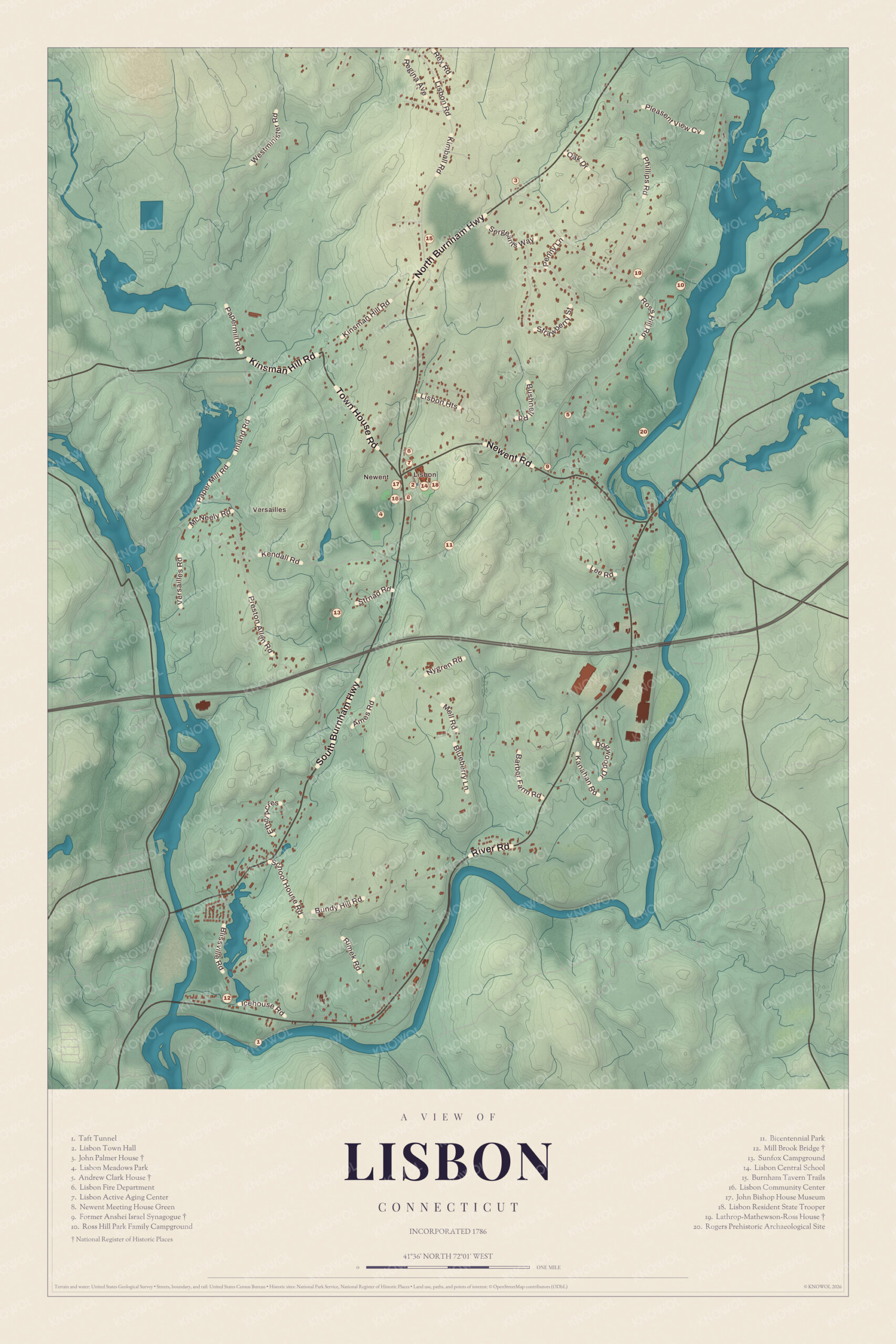
Lisbon today
By KNOWOL
Shaded hills from Newent and Ross Hill down to Sachem Point and the Shetucket, the town's roads printed by name, and a guide of 20 numbered landmarks with the National Register sites marked.5
The story of Lisbon
The crotch of the rivers
Lisbon began as Newent, the farm parish in the crotch of the Quinebaug and Shetucket Rivers. Joseph Perkins and his brother Jabez bought a big tract there, long called Perkins' Crotch, and tradition says the parish was named for Newent in Gloucestershire, England, where their family came from. Before there was a bridge, Newent families crossed the Shetucket by scow or ferry boat to get to church in Norwich, and in 1717 a cart bridge at the falls was asked for. The freshet of February 1727 swept it away. That was a hard year all around. In 1726 sickness had reached every family but one, and in the summer of 1727 it reached every family, and one in six of the men heading households died. Neighbors from other parishes came to help bring in the crops.6783
Sons of a small parish
For a parish of farms, Newent sent a lot of people out into the world. Samuel Kirkland, son of the first minister, was born here in 1741; he became a missionary to the Oneida people in New York and founded Hamilton College. Ebenezer Fitch, born in Newent Society in 1756, went to Yale and became the first president of Williams College. Dr. Jonathan Knight, born in Lisbon in 1758, was an army surgeon at Valley Forge during what an 1859 book called the most disheartening period of the war. Lieut. Nathaniel Kirtland of Newent was killed in battle on October 12, 1777. And Ebenezer Tracy, born in 1744, made Windsor chairs so well that a book of 1901 said many of them were still around.910111213145
A farm town on old roads
Lisbon has always been a farm town. In 1836 John Warner Barber found its hills gravelly but productive and its farmers mostly in good circumstances, and as late as 1907 it had no post office of its own. Mail came by rural delivery from Norwich, and from South Canterbury, Jewett City and Versailles. The roads tell the rest. The way from Norwich to Plainfield was open by 1717, and a dry-laid stone arch, probably from the 1790s, carried it over Mill Brook. It's likely the oldest stone arch bridge left in the state. In 1837 workers cut the Taft Tunnel through the hills by the Quinebaug for the Norwich and Worcester Railroad, one of the first railroad tunnels in the country, and trains still run through it.1516172
Through the years
25 moments from 1717 to today.
- 1717Norwich asks for help building a cart bridge over the Shetucket at the falls, the crossing to Newent.8
- 1718The land in the crotch of the rivers becomes the northeast parish of Norwich.18
- 1722The parish is named Newent, by tradition after the Perkins family's old home in England.18
- 1723The Newent church is gathered, with Daniel Kirkland as its first minister.10
- 1727The February freshet sweeps away the bridge over the Shetucket.8
- 1727A second summer of sickness reaches every family in Newent, and one in six household heads die.3
- 1741Samuel Kirkland, later founder of Hamilton College, is born in Newent.9
- 1744Ebenezer Tracy, the chairmaker, is born.14
- 1750Seven members leave to form a Separate church with Jeremiah Tracy as preacher.19
- 1756Peter Powers is ordained Newent's second minister.20
- 1756Ebenezer Fitch, later first president of Williams College, is born in Newent.11
- 1761The Lathrop house on Ross Hill first shows up in the Norwich land records.21
- 1761Hanover parish is formed from parts of Newent, Canterbury and Scotland parish.22
- 1777Lieut. Nathaniel Kirtland of Newent is killed in battle on October 12.13
- 1786Newent and Hanover become the town of Lisbon, set off from Norwich.1
- 1790John Palmer builds his Cape farmhouse on what's now North Burnham Highway.23
- 1798Capt. Andrew Clark builds his house on Ross Hill Road.24
- 1808A June tornado lays whole forests flat in Lisbon, some of 100 acres.25
- 1837The Taft Tunnel is cut through the hills by the Quinebaug for the Norwich and Worcester Railroad.2
- 1858The Newent church builds a new church; the old one had stood 87 years.10
- 1861Sprague is formed from parts of Lisbon and Franklin.26
- 1907Lisbon still has no post office; rural delivery from Norwich serves much of the town.16
- 1936Fifteen Jewish families build the Anshei Israel Synagogue on Newent Road.27
- 1995The synagogue is listed on the National Register with 14 other Connecticut synagogues.27
- 2020The census counts 4,195 people in Lisbon.1
Places to see
The numbers match the landmark guide printed on the 2026 map.
- 1Taft TunnelSouth of town, by the Quinebaug. Railroad tunnel cut in 1837.
- 2Lisbon Town HallTown center. Beside the Newent green.
- 3John Palmer HouseNorth Burnham Highway. Cape farmhouse built in 1790.
- 5Andrew Clark HouseRoss Hill Road. Palladian window and gilded eagle, 1798.
- 8Newent Meeting House GreenTown center. The old heart of Newent parish.
- 9Former Anshei Israel Synagogue142 Newent Road. Country synagogue built in 1936.
- 12Mill Brook BridgeLower Blissville Road. Dry-laid stone arch, probably 1790s.
- 15Burnham Tavern TrailsNorth Burnham Highway. Walking trails in the north of town.
- 17John Bishop House MuseumBeside the green. Local history museum.
- 19Lathrop-Mathewson-Ross House198 Ross Hill Road. Georgian house on record by 1761.
On the National Register
All 6 places in Lisbon on the National Register of Historic Places that still stand today, oldest first, and why each one matters.4
-
Lathrop-Mathewson-Ross House
A well-kept Georgian house first recorded in Ezra Lathrop's estate in 1761. The Mathewson and Ross families owned it from 1800 to 1958, and their diaries and accounts give a rare look at country life.21
-
John Palmer House
A well-preserved Cape farmhouse built by John Palmer, who helped found a Separatist church in nearby Scotland during the Great Awakening. It was carefully restored after a fire in 1968.23
-
Mill Brook Bridge
A small dry-laid stone arch on the old road from Norwich to Plainfield, probably the oldest surviving stone arch bridge in Connecticut. It was moved a short way in 1915, and part of the arch has since fallen.17
-
Andrew Clark House
Capt. Andrew Clark, a wealthy farmer and state representative, built this house in the change from Georgian to Federal style, with a Palladian window and a carved gilded eagle. Its north ell is the older Elisha Morgan farmhouse from before 1728.24
-
Anshei Israel Synagogue
Fifteen Jewish families from Poland and Russia built this one-room clapboard synagogue on land given by Harry Rothenberg. Its bimah and ark are original, and the Lisbon Historical Society cares for it now.27
-
Burnham Tavern
The old tavern on North Burnham Highway is Lisbon's newest National Register listing, added in 2022.4
In their words
“The division of the town of Norwich, or, as it has been termed, the 'nine mile-square,' took place in 1786. It was accomplished most amicably.”
A genealogical memoir of the Backus family, 1889, on the year Lisbon became a town26
“An able divine, an impressive preacher, a good man, faithful to his trust.”
The monument of Rev. Levi Nelson, Newent's minister for half a century, as quoted in 186110
“The inhabitants are generally farmers, who are mostly in good circumstances.”
John Warner Barber, Connecticut Historical Collections, 183615
Nearby towns
Sources
- Lisbon, Connecticut, Wikipedia
- Taft Tunnel, Wikipedia
- History of New London County, Connecticut (1882), on the Newent sickness, Internet Archive
- National Register of Historic Places listings in New London County, Connecticut, Wikipedia
- Map of Lisbon, Connecticut in 2026, KNOWOL (USGS elevation, Census Bureau roads)
- Commemorative biographical record of Hartford County, Connecticut (1901), on Perkins' Crotch, Internet Archive
- History of Norwich, Connecticut (1866), on the name Newent, Internet Archive
- History of Norwich, Connecticut (1874), on the Shetucket bridge, Internet Archive
- The Norwich jubilee (1859), on Daniel and Samuel Kirkland, Internet Archive
- Contributions to the ecclesiastical history of Connecticut (1861), on the First Church in Lisbon, Internet Archive
- Extracts from the itineraries and other miscellanies of Ezra Stiles (1916), on Ebenezer Fitch, Internet Archive
- The Norwich jubilee (1859), on Dr. Jonathan Knight, Internet Archive
- History of Norwich, Connecticut (1866), on Newent in the Revolution, Internet Archive
- Commemorative biographical record of Hartford County, Connecticut (1901), on Ebenezer Tracy, Internet Archive
- Barber, Connecticut Historical Collections (1836), on Lisbon, Internet Archive
- Register and manual of the State of Connecticut (1907), on Lisbon, Internet Archive
- Mill Brook Bridge, Wikipedia
- The historical, statistical and industrial review of the state of Connecticut (1883), on Lisbon, Internet Archive
- History of Norwich, Connecticut (1866), on the Separate church at Newent, Internet Archive
- History of Norwich, Connecticut (1874), on Peter Powers, Internet Archive
- Lathrop-Mathewson-Ross House, Wikipedia
- History of Windham County, Connecticut (1874), on Hanover parish, Internet Archive
- John Palmer House (Lisbon, Connecticut), Wikipedia
- Andrew Clark House, Wikipedia
- Old houses of the antient town of Norwich (1895), on the tornado of 1808, Internet Archive
- A genealogical memoir of the Backus family (1889), on the division of Norwich, Internet Archive
- Anshei Israel Synagogue, Wikipedia