
A small mill town on the Assabet River, once Assabet Village on the line between Stow and Sudbury, that grew up around Amory Maynard's woolen mill of 1847 and whose old mill later housed Digital Equipment Corporation.
Maynard, Massachusetts on the map
Click the map to look closer.
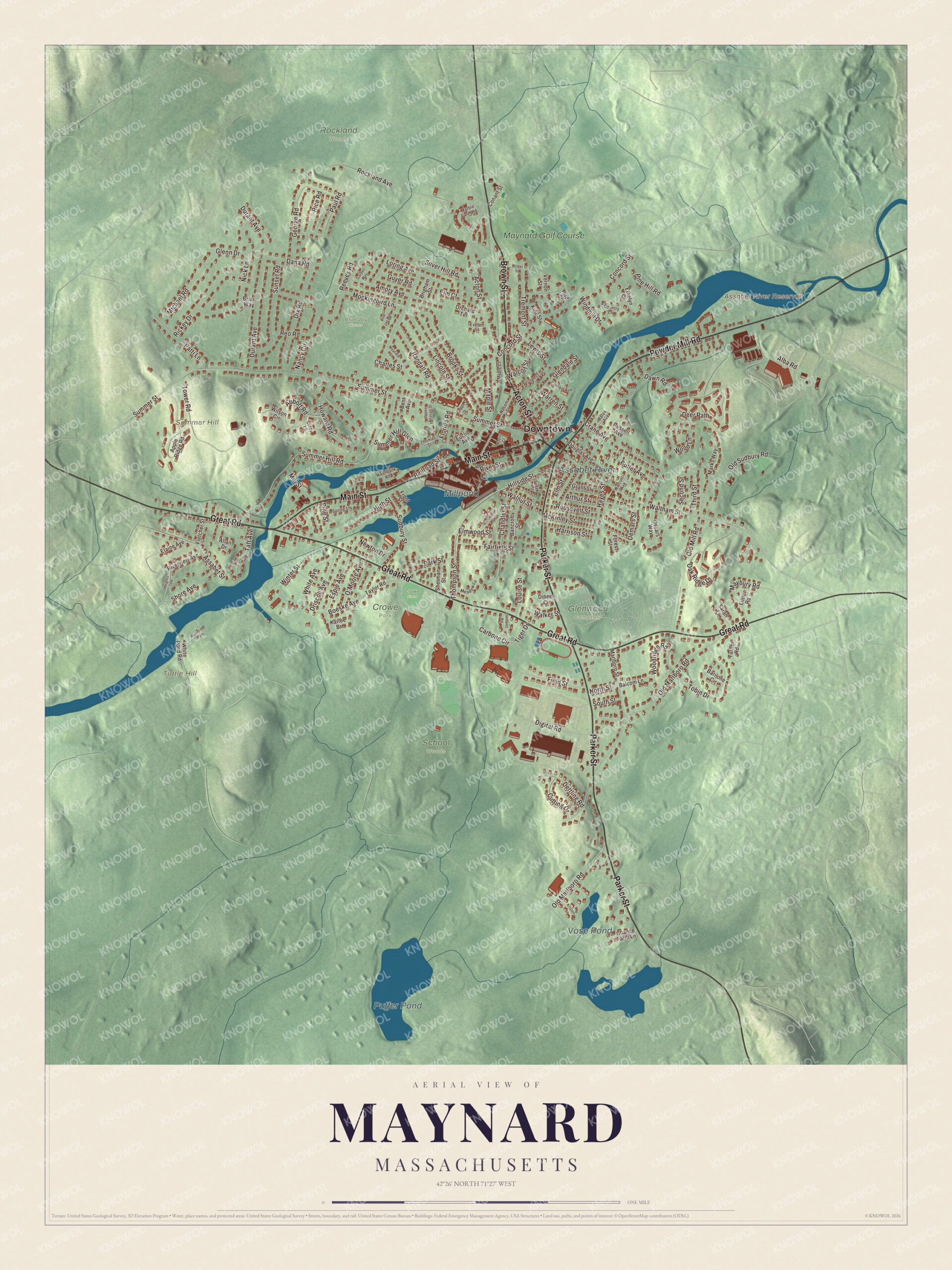
Maynard today
By KNOWOL
Maynard as it looks today in the look of an old atlas, with shaded relief, Main Street, Acton Street, Powder Mill Road, Parker Street, Brown Street and Great Road, the Assabet River, Puffer Pond, Vose Pond, the Millpond, Summer Hill and Tuttle Hill.3
The history of Maynard, Massachusetts
Thirty-four deeds and a trout brook
When Amory Maynard came to the Assabet in 1846, Boston had just taken his water power at Fort Meadow Pond in Marlborough, and he needed a new river. The village of Assabet then had about fourteen houses and no good roads. He bought fast: thirty-four deeds for his land were recorded in July 1846 alone. Not every seller trusted him. Haman Smith didn't like his looks and doubted he could pay. Maynard dug a canal and led the river into a low, swampy hollow with a trout brook running through it, and that hollow became the millpond. The first mill was a wooden building 50 by 100 feet. In the spring of 1847 it began making yarn, then carpets on hand looms, and Mary Wood, who boarded with Mr. Maynard, wound its first bobbin.241
The day Assabet became Maynard
By 1869 Assabet Village was bigger than either of its parent towns. It sat partly in Stow and partly in Sudbury, a long way from either town house, and it needed street lights, sidewalks, police and better schools. Sudbury fought the split, since the big woolen mill stood on its side of the river. On April 19, 1871, while the village was celebrating the anniversary of the Concord fight, word came by telegraph that the charter had been signed at twenty minutes past five. On April 27 the new town held its first meeting in Riverside Hall. Then more than a thousand people marched, a flag went up on Pompasitticut Hill at the signal of a Revolutionary cannon borrowed from Concord, and the fireworks waited out the rain.24
What the Assabet turned
The Assabet drops about thirty feet on its way across Maynard, and the old village put that fall to work. Long before the woolen mill, a grist mill stood near the Brooks place, and by the Daniel Puffer house a sawmill on a brook ran so slowly that people would start the saw, go off to other work and let it stop by itself. About 1820 William May built a paper mill and made paper by hand, and in later years it furnished paper for one of New England's leading daily newspapers. Ice cut on the mill pond filled Nathaniel Wyeth's brick ice house, 40,000 tons of it, for Boston. Just past the town line the river ran the powder mills. An 1890 county history doubted many streams its size had done so many different kinds of work.521
Maynard, Massachusetts through the years
25 moments from 1708 to today.
- 1708John Brigham's map of Sudbury shows only fifteen houses in the part that's now mostly Maynard.5
- 1715The Dr. Woods bridge, the first across the Assabet in today's Maynard, is built to carry the New Lancaster Road west.2
- 1775On April 19 men from the Stow and Sudbury sides march to Concord; the 1921 town history says Daniel Conant was the first man wounded there.2
- 1815The Rice Tavern on the old road to Lancaster closes after about a hundred years as an inn.2
- 1816The Ben Smith Bridge is built to carry the Great Road over the Assabet, for five hundred dollars.2
- 1820About this year William May builds a paper mill on the Sudbury side of the river and makes paper by hand.5
- 1846Amory Maynard and William H. Knight buy the water rights; thirty-four deeds for Maynard's land are recorded in July alone.2
- 1847The first mill, a wooden building 50 by 100 feet, starts making yarn and then carpets on hand looms.2
- 1849Work begins on the Marlboro Branch railroad, and Amory Maynard is given a life pass and the station agent's job.2
- 1857Twenty citizens build Union Hall at Main and Summer Streets, with the village's first billiard table in the basement.2
- 1862The mills become the Assabet Manufacturing Company and turn from carpets to blankets, flannels and cloth, filling big government orders in the Civil War.2
- 1867Peter Haley opens the first hotel, the Glendale House on Summer Street, named for the mill's Glendale blankets.2
- 1871Maynard is incorporated on April 19 from about 1,900 acres of Sudbury and 1,300 acres of Stow.2
- 1871Glenwood Cemetery is laid out, and its first burial is Thomas H. Brooks.5
- 1886The mill's red brick chimney goes up, 207 feet high.2
- 1889Water from White Pond reaches town, stored in a reservoir on Pompasitticut Hill that holds a million and a half gallons.2
- 1890Amory Maynard dies on March 5, and the mills close for the afternoon of his funeral.5
- 1892Lorenzo Maynard gives the town clock in the mill tower.2
- 1899The American Woolen Company buys the bankrupt mills for about $400,000.2
- 1901On August 19 the first electric car runs through town, on a new line from Hudson to Concord.2
- 1909A gale blows the tall spire off the Union Congregational Church on April 8.2
- 1920Laura E. Woodart casts the first ballot by a woman in Maynard.2
- 1942The Army takes about a fifth of the town, on the south side, for a munitions depot.1
- 1957Digital Equipment Corporation rents its first space in the old mill.1
- 2005The old depot land becomes part of the Assabet River National Wildlife Refuge.1
Places to see in Maynard, Massachusetts
Places worth a visit in Maynard today.
- Mill & Main PlaceMain Street. The old Assabet woolen mill and clock.
- Main StreetDowntown. Where Babe Ruth came to play pool.
- The MillpondBehind the mill. Once a swampy hollow with a trout brook.
- Glenwood CemeteryParker Street and Great Road. Laid out in 1871; Maynard family crypt.
- Summer HillWest of downtown. Old Pompasitticut Hill, highest point in town.
- Assabet RiverAcross town, west to east. Seven road bridges and a footbridge.
- Vose PondNear Puffer Road. Beside the old Rice Tavern farm.
- Assabet River National Wildlife RefugeSouth side of town. Once Army land, open since 2005.Visit their website
- Assabet River Rail TrailActon line to Stow line. Through downtown along the river.
Maynard on the National Register of Historic Places
All 1 places in Maynard on the National Register of Historic Places that still stand today, oldest first, and why each one matters.7
-
Glenwood Cemetery
One of the new town's first acts in 1871, laid out in the rural cemetery style with a circular lane at the entrance. Amory Maynard lies in the family crypt, an earth-covered mound with a granite front, in sight of Route 27.6
Maynard in their words
“The scenery of Maynard is beautiful, and perhaps unsurpassed in this part of the State.”
History of Middlesex County, 18905
“Assabet has got divorced from Stow, and repudiated even her maiden name.”
The Hudson Pioneer on the new town, April 1871, as reprinted in W. H. Gutteridge's history of Maynard, 19212
“The mills rank the third in size and capacity in the state, and are said to equal any in New England in the quality of their productions.”
History of Middlesex County, 1880, on the Assabet Mills8
Towns near Maynard, Massachusetts
Sources for the history of Maynard
- Maynard, Massachusetts, Wikipedia
- A brief history of the town of Maynard, Massachusetts, William H. Gutteridge (1921)
- Map of Maynard, Massachusetts in 2026, KNOWOL
- Encyclopedia of Massachusetts, biographical, genealogical (1916)
- History of Middlesex County, Massachusetts (1890)
- Glenwood Cemetery, Wikipedia
- National Register of Historic Places list, Wikipedia
- History of Middlesex County, Massachusetts (1880)