
A city of thirteen villages along the Charles, born as Cambridge Village, where Waban's people once lived on Nonantum hill, snuff mills ground at the Upper Falls, and the railroad named half the villages before there were villages to name.
Newton on the map
Click the map to look closer.
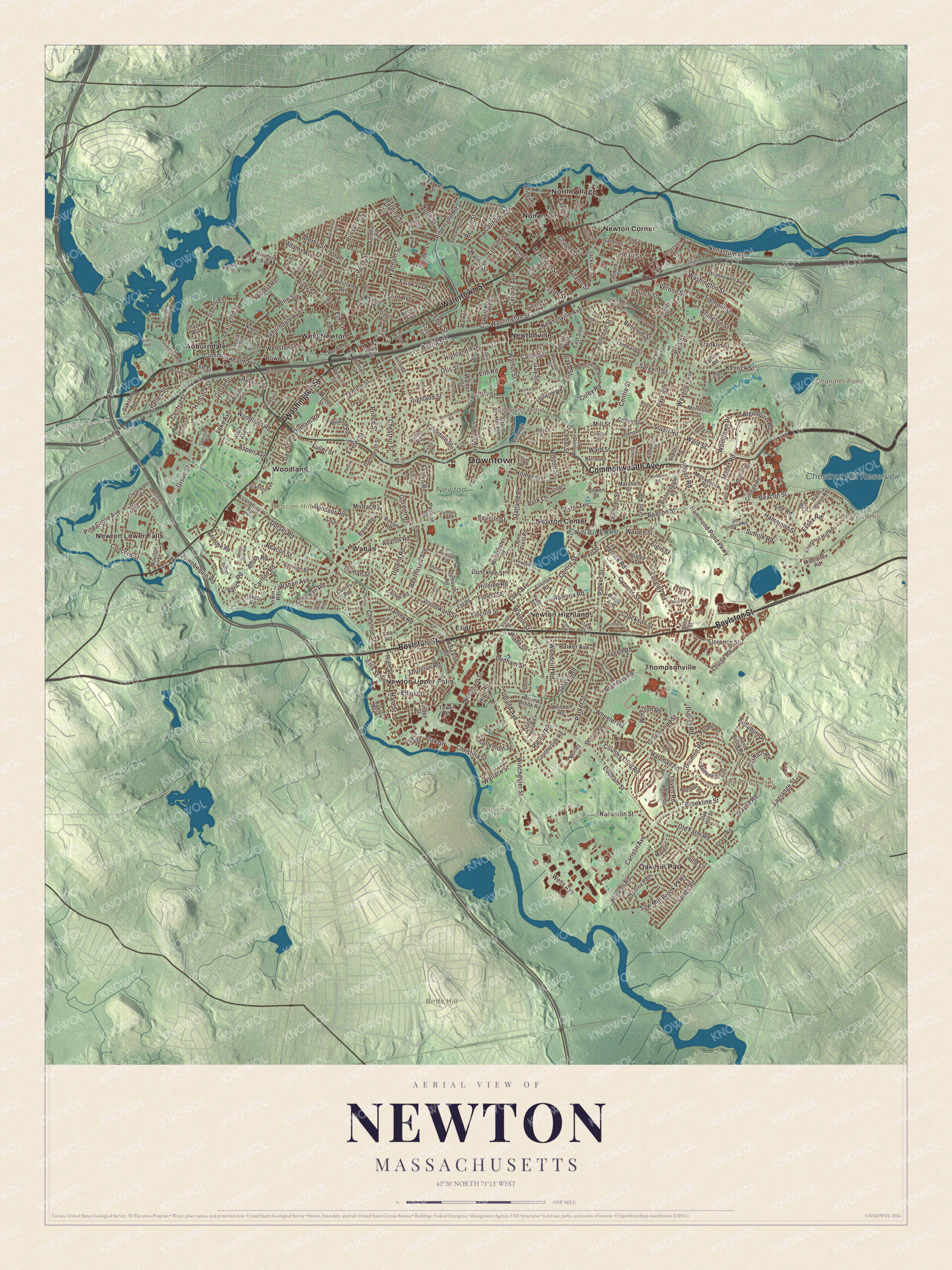
Newton today
By KNOWOL
The thirteen villages stitched together by Washington Street, Commonwealth Avenue, Centre Street, Boylston Street, Watertown Street and Waban Avenue, with Crystal Lake, Bulloughs Pond, the Chestnut Hill Reservoir and Bald Pate, Beacon and Birds Hills, and the Charles River along the north and west.4
The story of Newton
The bridge that talks back
Newton Upper Falls started with one mill. In 1688 John Clark built it at the head of the rapids, where the Charles dropped twenty feet. Later the Boston tobacconist Simon Elliot bought the mills and ran snuff mills here with twenty mortars, and King's 1889 handbook says he had the largest snuff business in New England. Cotton mills followed on the same site. Then in 1876 and 1877 Echo Bridge went up to carry Boston's Sudbury River water over the gorge, a granite arch 130 feet across. The handbook says one voice on a still day came back 18 times from under the arch, and a pistol shot 25. The favorite word to shout, it said, was July.52
One pond, four names
Crystal Lake was Wiswall's Pond first, after Thomas Wiswall built his house on its shore in 1654. In 1795 the Baptists, Newton's first Baptist church, dedicated a meetinghouse between Centre Street and the water on land Noah Wiswall gave them. The seats were rough boards, the pulpit was unplaned planks, and it went fifteen years without a stove. A 1911 history of the lake says the pond was called Silver Lake for a short time, then Baptist Pond, a name kept down to very recent times. An ice harvester gave it the name Crystal Lake. On a good winter day, the same book says, hundreds of skaters came out, with hockey games and the odd ice boat skimming by.641
Villages named by the railroad
The Boston and Worcester Railroad reached West Newton in 1834, and the stations gave the city many of its names. A 1927 county history says Newtonville, West Newton, Auburndale, Riverside, Chestnut Hill, Newton Centre, Highlands, Waban, Eliot and Woodland were all station names first, often before there was any village there. Newton Highlands was first called Oak Hill, though it sat on a plain, then Newton Dale. Auburndale had only seven houses in 1800, and its name is said to come from a line of poetry, Sweet Auburn, loveliest village of the plain. In West Newton, Horace Mann found the old Fuller Academy for the state's Normal School, which the 1889 handbook calls the first such building owned by an American state.1572
Through the years
24 moments from 1639 to today.
- 1639English settlement begins on land that is then part of Cambridge.1
- 1646On October 28, John Eliot preaches at Waban's large wigwam on the hill called Nonantum.8
- 1651Eliot persuades the Nonantum people to move to Natick.1
- 1654Thomas Wiswall builds his house on the pond that will become Crystal Lake.4
- 1664Captain John Spring dams Laundry Brook, making the mill pond now called Bulloughs Pond.4
- 1681The settlement breaks away from Cambridge as Cambridge Village.1
- 1688John Clark builds a mill at the head of the rapids where the Charles drops twenty feet, the start of Newton Upper Falls.5
- 1691Cambridge Village is renamed Newtown.1
- 1724Whittemore's tavern near the Weston bridge is already known as a house of entertainment.7
- 1766The town takes the name Newton.1
- 1795The Baptists dedicate a plain meetinghouse between Centre Street and the pond, with board seats and no stove.6
- 1798The West Parish Social Library is formed, the first of Newton's village libraries.9
- 1809Timothy Jackson builds the Jackson Homestead, later a stop on the Underground Railroad.4
- 1830About this year Deacon Luther Paul plants the avenue of elms on Centre Street in Newton Centre.2
- 1834The Boston and Worcester Railroad reaches West Newton.1
- 1844The state's Normal School moves from Lexington to West Newton.10
- 1866The Silver Lake Company is organized in Nonantum to make solid braided cord.5
- 1870The Newton Free Library at Newton Corner is dedicated on June 17.11
- 1874Newton becomes a city on January 5.1
- 1876Work begins on Echo Bridge, carrying the Sudbury River water over the Charles at Upper Falls.2
- 1883A plan to make a 174-acre central park around Bullough's Pond is voted down.2
- 1886The Gamewell fire alarm company buys the Newton Highlands alarm works and later moves it to Upper Falls.5
- 1902The Stanley Motor Carriage Company, maker of the Stanley Steamer, makes Newton its home.1
- 1919Brae Burn Country Club hosts the United States Open.1
Places to see
Places worth a visit in Newton today.
- Jackson Homestead527 Washington Street, Newton Corner. Underground Railroad stop, now a museum.Visit their website
- Crystal LakeNewton Centre. Once Wiswall's Pond, then Baptist Pond.
- Bulloughs PondWalnut Street. A mill pond dammed in 1664.
- Heartbreak HillCommonwealth Avenue. The marathon's fourth Newton hill.
- Bald Pate HillNewton. One of Newton's seven hills.
- AuburndaleAlong the Charles. Once home to Norumbega Park.
- Waban AvenueWaban. A protected scenic road.
- Newton Upper FallsOn the Charles. Mill village beside Echo Bridge.
- Newton Lower FallsOn the Charles. Paper mills and the old post office.
- Chestnut Hill ReservoirJust over the line in Boston. Olmsted's reservoir of 1870.
On the National Register
21 of the 186 places in Newton on the National Register of Historic Places that still stand today, oldest first, and why each one matters. See the full list of National Register places in Newton.3
-
John Woodward House
Built sometime before 1686, it is one of the city's oldest surviving buildings. It is a 2+1⁄2-story timber-frame structure, with a large central chimney, and is four bays wide and one deep.12
-
Staples-Crafts-Wiswall Farm
Deacon John Staples, a weaver and Newton's first schoolmaster, built the first house here in 1688. Moses Craft, who inherited it, rebuilt the house on the old foundation around 1750 as a two and a half story farmhouse.13
-
Whittemore's Tavern
Built about 1724, probably by William Robinson II, son of one of Auburndale's early settlers, it was a tavern for a time in the 1700s. It is now a private home.14
-
Ware Paper Mill
Built in 1790, it is a remnant of the first paper mill to be built on the banks of the Charles River. The 1+1⁄2-story stone building was built by John Ware, a veteran of the American Revolutionary War, and was used for paper production until 1938.15
-
Jackson Homestead
Timothy Jackson built this Federal farmhouse on his family's farm in 1809. His son William Jackson, an abolitionist who served in Congress, lived here from 1820, and the house was a station on the Underground Railroad. It is now the Newton History Museum.16
-
Railroad Hotel
The Railroad Hotel (Seth Davis Tavern) is a building that served as a historic hotel at the triangular lot where Washington Street joins Watertown Street (Route 16) in the West Newton section of Newton, Massachusetts. Built in 1831, it is the only early building still standing in West Newton's village center.17
-
Celia Thaxter House
The Italianate house was built c. 1856 as the home of Levi Lincoln Thaxter and American poet and author Celia Thaxter. The Thaxters lived here until 1880 when she moved to Kittery Point, Maine.18
-
First Baptist Church in Newton
The First Baptist Church in Newton was founded in 1788. Its historic building (built 1888) is located at 848 Beacon Street in the village of Newton Centre, in Newton, Massachusetts.19
-
Capt. Edward Durant House
Edward Durant II bought 91 acres here in 1732 and finished his country house in 1734. The Kenrick family later owned it and ran one of New England's largest plant nurseries from the land. It is now a house museum, the Durant-Kenrick House and Grounds.20
-
Reginald A. Fessenden House
National Historic Landmark
The home from 1919 until his death in 1932 of the inventor Reginald A. Fessenden, called the father of radio broadcasting because he was the first to broadcast the human voice and music by radio. It was made a National Historic Landmark in 1976.21
-
Woodland, Newton Highlands, and Newton Centre Railroad Stations, and Baggage and Express Building
The only surviving stations of thirteen designed by H. H. Richardson and his successors for the Boston and Albany's Newton Circuit between 1881 and 1894, now on the Green Line D branch.22
-
Nathaniel Topliff Allen Homestead
The Greek Revival house is notable as the home of Nathaniel Topliff Allen (1823 to 1903), an innovative educator in the mid-19th century. Allen's pioneering work influenced the development of new teaching methods taught at the state normal school (established in Newton, now Framingham State University).23
-
Echo Bridge
The granite bridge carries the Sudbury Aqueduct over the Charles in Hemlock Gorge. When it was built in 1876 and 1877 it was the second longest masonry arch in the country, and it is named for the echo under its great arch.24
-
East Parish Burying Ground
Newton's first burying ground, used since the 1660s beside the First Church, which was organized in 1664. The first settlers lie here, and it has been called the most important and most fragile historic site in the city.25
-
Bemis Mill
A brick mill on the Charles in Nonantum, it survives from Newton's early industrial days, with remnants of its old power and water control works. It is now an office building.26
-
Crystal Lake and Pleasant Street Historic District
The Crystal Lake and Pleasant Street Historic District encompasses a streetcar suburban residential subdivision developed between 1860 and 1895 in Newton, Massachusetts. The district roughly bounded by the Sudbury Aqueduct, Pleasant Street, Lake Avenue, Webster Court, and Crystal Street.27
-
Newton Lower Falls Historic District
The Newton Lower Falls Historic District encompasses the historic colonial village center of Newton Lower Falls, on the west side of Newton, Massachusetts. This area lies north of Washington Street, along Concord and Grove Streets, between Washington and Hagar Streets.28
-
Newton Upper Falls Historic District
The old mill village at the falls of the Charles, home to Hemlock Gorge and Echo Bridge, is listed as a whole on the National Register.29
-
Boston College Main Campus Historic District
Boston College Main Campus Historic District encompasses the historic heart of the campus of Boston College in the Chestnut Hill area of Newton, Massachusetts. It consists of a collection of six Gothic Revival stone buildings, centered on Gasson Hall, designed by Charles Donagh Maginnis and begun in 1909.30
-
Hammond House
Built some time between 1645 and 1730, it is believed to be the oldest house in Newton. It began as a single room with a chimney and was enlarged to five bays while still in the First Period, which was rare.31
-
Myrtle Baptist Church Neighborhood Historic District
The Myrtle Baptist Church Neighborhood Historic District encompasses a historic center of the African-American community in West Newton, Massachusetts. The district includes all of Curve Street, where the Myrtle Baptist Church is located, as well as a few properties on adjacent Auburn and Prospect Streets.32
In their words
“Few towns in the Commonwealth present so many eligible sites for building, or more delightful prospects.”
A gazetteer of the state of Massachusetts, 187433
“the climate is healthful; and happy is the man who owns a homestead in this progressive town.”
A gazetteer of the state of Massachusetts, 187433
“Nearly the whole town is as delightful as a park”
A gazetteer of the state of Massachusetts, 189034
Nearby towns
Sources
- Newton, Massachusetts, Wikipedia
- King's handbook of Newton, Massachusetts (1889), Internet Archive
- National Register of Historic Places listings in Newton, Massachusetts, Wikipedia
- Map of Newton, Massachusetts in 2026, KNOWOL (USGS elevation, Census Bureau roads)
- Middlesex County and its people; a history (1927), Internet Archive
- A comprehensive historical sketch of Crystal Lake in Newton Centre, Massachusetts (1911), Internet Archive
- History of Middlesex County, Massachusetts (1890), on Auburndale, Internet Archive
- A history of the early settlement of Newton, county of Middlesex, Massachusetts: from 1639 to 1800 (1854), Internet Archive
- Celebration of the two hundredth anniversary of the incorporation of the town of Newton, Massachusetts, December 27, 1888 (1888), Internet Archive
- Peirce School, Wikipedia
- A historical statement of the origin and growth of the Newton Free Library (1876), Internet Archive
- John Woodward House, Wikipedia
- Staples-Crafts-Wiswall Farm, Wikipedia
- Whittemore's Tavern, Wikipedia
- Ware Paper Mill, Wikipedia
- Jackson Homestead, Wikipedia
- Railroad Hotel, Wikipedia
- Celia Thaxter House, Wikipedia
- First Baptist Church in Newton, Wikipedia
- Capt. Edward Durant House, Wikipedia
- Reginald A. Fessenden House, Wikipedia
- Woodland, Newton Highlands, and Newton Centre Railroad Stations, and Baggage and Express Building, Wikipedia
- Nathaniel Topliff Allen Homestead, Wikipedia
- Echo Bridge, Wikipedia
- East Parish Burying Ground, Wikipedia
- Bemis Mill, Wikipedia
- Crystal Lake and Pleasant Street Historic District, Wikipedia
- Newton Lower Falls Historic District, Wikipedia
- Newton Upper Falls Historic District, Wikipedia
- Boston College Main Campus Historic District, Wikipedia
- Hammond House, Wikipedia
- Myrtle Baptist Church Neighborhood Historic District, Wikipedia
- A gazetteer of the state of Massachusetts (1874), Internet Archive
- A gazetteer of the state of Massachusetts (1890), Internet Archive