
The Rose of New England, a harbor city where the Yantic and Shetucket meet to form the Thames, with a colonial green at Norwichtown, a ring of mill villages, and the old landing that became its downtown.
Then and now
The same town 150 years apart. Click either map to look closer.
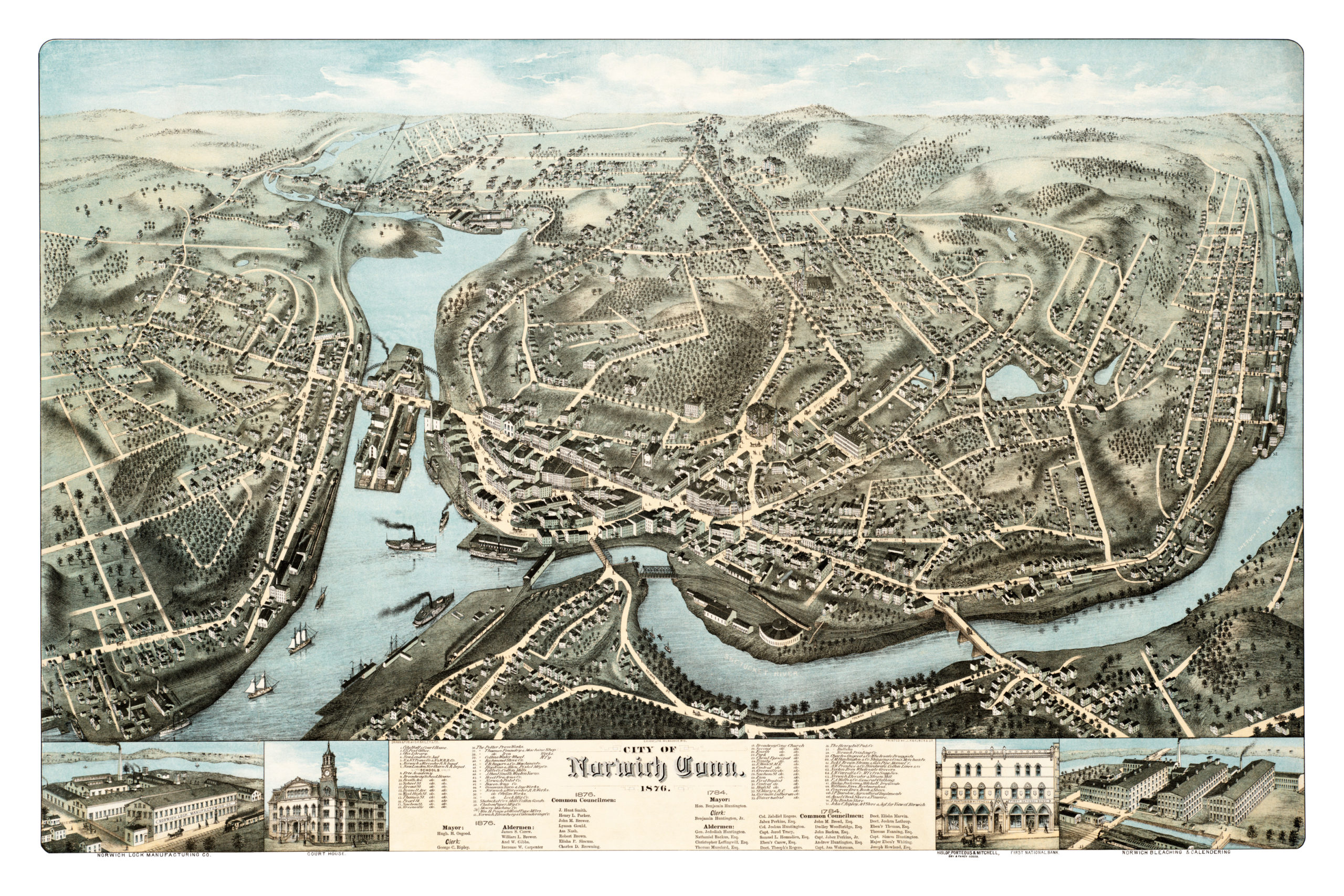
The bird's-eye view
By O.H. Bailey
Norwich drawn as if from the sky, with its street names and landmarks, from the Norwich Free Academy and Otis Library to Norwich Lock Manufacturing, Collins Water Wheels, the Hood Fire Arms Company, the Bacon Arms Company and the Boston Store.5
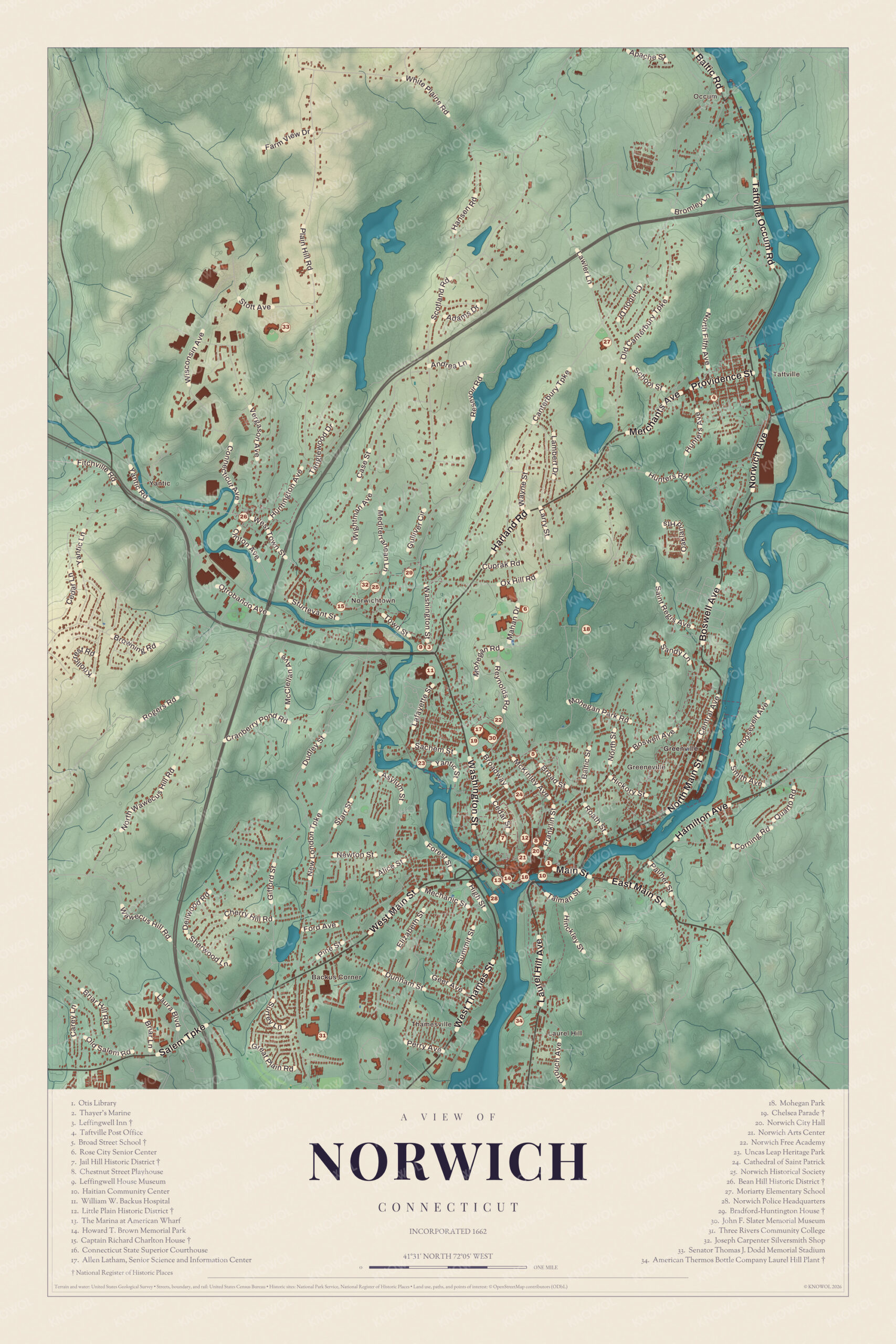
Norwich today
By KNOWOL
Shaded hills from Occum on the Shetucket down to the harbor, every street, the villages from Norwichtown and Taftville to Laurel Hill and Yantic, and a guide of 34 numbered landmarks with the National Register sites marked.6
The story of Norwich
A canoe of beef, corn and peas
Before there was a Norwich, the Narragansetts had Uncas and his Mohegans besieged in their fort by the Thames, close to starving. Thomas Leffingwell, an ensign at Saybrook, loaded a canoe with beef, corn and peas, paddled up the river in the dark, and got it all into the fort. The siege broke. In 1659 Uncas and his sons deeded the whole township, about nine miles square, to Leffingwell, John Mason, the Rev. James Fitch and their partners, and the settlers came up from Saybrook. The royal burying ground of his family lies near Yantic Falls, and in 1833 President Andrew Jackson helped lay the cornerstone of a monument to Uncas there.781
Rattlesnakes, a powder house and Lafayette's bare legs
Colonial Norwich was a wilder place than its greens let on. The town paid a bounty on rattlesnakes, and in 1730, at two shillings apiece, people killed 300 in fifteen days. During the Revolution a powder house holding tons of gunpowder stood on the rocks behind the Norwichtown church. Someone set it on fire, and a man who'd been offered a reward was halfway up the hill with water when it blew up. He walked away unhurt. Lafayette knew the town well. He once galloped up to Jedediah Huntington's door in a blue coat with no vest and no stockings, his legs bare below the knee in the heat. In 1824 he came back, and old people who remembered him hugged him and wept.4910
The petals of the Rose
Norwich grew as a ring of villages around the harbor, each at a fall of water. Cotton weaving began at Norwich Falls on the Yantic in 1813, and in 1832 the Thames Company built the first cotton mill on the Shetucket at Greeneville. In 1836 John Warner Barber counted nine or ten works at the falls and paper mills making paper for New York. Taftville's Ponemah Mills was said to be one of the three largest cotton plants in the country, and in 1902 a plant near Taftville began piping compressed air to the city for power, the first of its kind in America. At the 200th birthday in 1859, an arch on Broadway named the whole cluster "Norwich, the Rose of New England."1112131415
Through the years
25 moments from 1643 to today.
- 1643Uncas and the Mohegans rout the Narragansetts on the plain in the east of town, and their sachem Miantonomoh is taken prisoner.16
- 1659Settlers from Saybrook, led by Major John Mason and the Rev. James Fitch, found Norwich on land bought from Uncas.1
- 1675Stephen Backus builds the oldest corner of what becomes the Leffingwell Inn.17
- 1676In a summer drought, Uncas asks the Rev. James Fitch to pray for rain. It rains so hard the river rises more than two feet.18
- 1720A Norwich court hears a case over about 30 stolen watermelons, and acquits the two accused.19
- 1730With a bounty of two shillings a snake, townspeople kill 300 rattlesnakes in fifteen days.4
- 1743Royal commissioners meet at Norwich on the Mohegan land case, and the whole Mohegan tribe is lodged with the townspeople.20
- 1766The Rev. Nathaniel Whitaker of the church at Chelsea and the Mohegan preacher Samson Occom sail to Britain to raise money for Eleazar Wheelock's Indian school.21
- 1778Soon after the Rev. Joseph Strong comes to the First Church, Lafayette camps 2,000 men on the plain and asks him to pray with them.10
- 1784The harbor part of town is incorporated as the City of Norwich, with its first meeting at the Town House in July.2
- 1793A big fire downtown leads the town to build more in brick.22
- 1795Neighbors tired of passing the hat after fires incorporate the Mutual Assurance Company of the City of Norwich.23
- 1813William Williams, Jr., and Company begin making cotton cloth at Norwich Falls on the Yantic.11
- 1826The Norwich Courier prints the first recorded use of the word "hello."1
- 1832The Thames Company builds the first cotton mill on the Shetucket, at what becomes Greeneville.12
- 1833President Andrew Jackson helps lay the cornerstone of the Uncas monument at the royal burying ground of the Mohegans.8
- 1837The Norwich and Worcester Railroad is finished, after five years of building.1
- 1851Joseph Otis, back home at seventy after a career in New York, founds the Otis Library.24
- 1859At the town's 200th birthday, an arch on Broadway reads "Norwich, the Rose of New England."15
- 1861On Sunday, April 21, the women of Norwich begin sewing for the first companies to leave for the Civil War, and make 1,900 shirts.25
- 1866Taftville is founded for the Ponemah Mills on the Shetucket.26
- 1873The Second Empire City Hall on Union Square is finished.27
- 1902The Norwich Compressed Air Power Company opens a plant near Taftville to pipe power to the city, the first of its kind in the country.14
- 1913The Thermos plant at Laurel Hill opens, and Thermos bottles are made there until 1984.28
- 1952The town and the city of Norwich are joined into one.1
Places to see
The numbers match the landmark guide printed on the 2026 map.
- 1Otis LibraryDowntown. Founded by Joseph Otis in 1851.Visit their website
- 3Leffingwell InnNorwichtown. Its oldest corner dates to 1675.Visit their website
- 18Mohegan ParkNorth of downtown. Woods, Spaulding Pond and roses.
- 19Chelsea ParadeChelsea Parade. A public common since 1797.
- 20Norwich City HallDowntown. Second Empire, overlooking Union Square.
- 22Norwich Free AcademyChelsea Parade. Classes began here in 1856.Visit their website
- 29Bradford-Huntington HouseNorwichtown. A house of 1691 or earlier.
- 30John F. Slater Memorial MuseumFree Academy campus. Famous for its plaster casts.Visit their website
- 32Joseph Carpenter Silversmith ShopNorwichtown green. A rare little silversmith's shop.
- 34American Thermos Bottle Company Laurel Hill PlantLaurel Hill. Made Thermos bottles until 1984.
On the National Register
All 35 places in Norwich on the National Register of Historic Places that still stand today, oldest first, and why each one matters.3
-
Norwichtown Historic District
The place Norwich began in 1659, around a triangular green of about 1.75 acres. Four houses from the 1600s still stand here, along with the Federal style First Congregational Church of 1801 and the Colonial Cemetery, where four Connecticut governors are buried.29
-
Leffingwell Inn
One of Connecticut's oldest buildings. Stephen Backus built its oldest corner, Thomas Leffingwell's son made it an inn, and it was an important meeting place during the Revolution. It's the Leffingwell House Museum now.17
-
Dr. Philip Turner House
One of the oldest houses in Norwich, a colonial half house. Dr. Philip Turner, probably its owner during the Revolution, served as Surgeon General of the army's Eastern Department from 1777 to the end of the war.30
-
Bradford-Huntington House
John Bradford's new dwelling house in 1691, enlarged by the Huntingtons. Jabez Huntington, a major general of the state militia in the Revolution, owned it and is believed to have hosted George Washington and Lafayette here.31
-
Bean Hill Historic District
A square green laid out in 1729, faced by four houses of the 1700s and the 1833 Bean Hill Methodist Church, the first Methodist church in Norwich. It recalls the years when Bean Hill was a busy center of making and trading.32
-
Downtown Norwich Historic District
The old business heart beside the harbor, with 115 contributing buildings. Its oldest commercial building dates to 1742, and after a big fire in 1793 the town built more in brick.22
-
Nathaniel Backus House
Nathaniel Backus, a descendant of two of the town's founders, built it about 1750, and it was remade in the Greek Revival style about 1825. It was moved to this spot in 1952 and is a museum of the Faith Trumbull Chapter of the Daughters of the American Revolution.33
-
Dr. Joshua Lathrop House
Joshua Lathrop and his brother Daniel ran a drugstore here, believed to be the first in the Connecticut Colony.34
-
Gen. Jedidiah Huntington House
Home of Jedediah Huntington, a Continental Army general who fought at Bunker Hill and wintered at Valley Forge. Lafayette once galloped up to his door.3510
-
Col. Joshua Huntington House
A well-kept Georgian house built for Joshua Huntington, who served at the Siege of Boston and later rose to colonel in the Connecticut militia.36
-
Joseph Carpenter Silversmith Shop
A little gambrel-roofed shop on the green, shared by the silversmith, clockmaker and pewterer Joseph Carpenter and his brother Gardner, a merchant. Its chimney served the forge.37
-
Little Plain Historic District
A fashionable neighborhood from the late 1700s on, around a long, narrow park given by Deacon Jabez Huntington and Hezekiah Perkins, whose Georgian houses still stand at 181 and 185 Broadway.38
-
Dr. Daniel Lathrop School
Built with a bequest of 500 pounds from Dr. Daniel Lathrop, it's one of the oldest surviving brick school buildings in Connecticut. It has also been a branch library and a polling place.39
-
Gov. Samuel Huntington House
Home of Samuel Huntington, a signer of the Declaration of Independence, president of the Continental Congress for a year, and later Governor of Connecticut.40
-
Carpenter House
The Red House, a Georgian brick house that the merchant Gardner Carpenter built in 1793. The gambrel roof and third story were added about 1816.41
-
Chelsea Parade Historic District
The common pasture that became a public park in 1797, where the city's wealthy built their houses. It takes in 205 acres and 565 contributing buildings, the Free Academy and St. Patrick Cathedral among them.42
-
East District School
A rare 18th-century brick schoolhouse. Here the self-taught Consider Sterry ran an evening school for adults, teaching sailors to find latitude and longitude at sea.43
-
Capt. Richard Charlton House
A small cottage that probably replaced the house of Richard Charlton, a ship's captain killed in the French and Indian War, perhaps built with timbers from the old one.44
-
Yantic Falls Historic District
Mills and brick worker housing below the Yantic Falls, used for power since a nail factory of 1813. Tradition places a battle between the Mohegans and Narragansetts here, and Lydia Sigourney wrote a poem about the falls.45
-
Perkins-Rockwell House
A Federal house of cut granite, home of John A. Rockwell, a lawyer and congressman. His family kept it until 1934, when they gave it to the local DAR chapter.46
-
Jail Hill Historic District
First settled in the 1830s by free people of color from the Williams and Harris families, who were active abolitionists, and later home to Irish families who came to work in the mills.47
-
Greeneville Historic District
The planned mill village that William P. Greene laid out in 1833 on the Shetucket. With 683 contributing buildings, it held the largest industrial presence in Norwich.48
-
William A. Buckingham House
Home of William A. Buckingham, mayor of Norwich and Governor of Connecticut during the Civil War, who had both Abraham Lincoln and Ulysses S. Grant as guests. Civil War veterans bought it in 1898.49
-
Laurel Hill Historic District
A hillside suburb that Henry Bill and his partners laid out in 1850, with 124 houses, a third of them Italianate.50
-
Commonwealth Works Site
An industrial archaeological site where Charles Augustus Converse built a big water-powered complex that held Ethan Allen's gun factory, mills, a nail factory and a cork-cutting works.51
-
Occum Hydroelectric Plant and Dam
About 280 feet of the granite mill dam of 1865 survive, with a brick powerhouse of 1934, one of the few hydroelectric plants in the state built before 1940.52
-
Yantic Woolen Company Mill
E. Winslow Williams built this stone mill in 1865 after fire destroyed his father's. It made flannel and was the heart of the village of Yantic until textile work ended in 1989.5354
-
Taftville
The mill village built for the Ponemah Mills, whose main building was said to be the largest weave shed under one roof. In 1875 its 1,200 workers went on strike, and the mill is being turned into apartments now.26
-
Converse House and Barn
A striking High Victorian Gothic house built for Col. Charles A. Converse, who gave the Converse Art Gallery to the Norwich Free Academy.55
-
Norwich Town Hall
Built to hold the town offices, the city offices and the county court, it's a prominent example statewide of civic architecture in the Second Empire style, and it's still City Hall.27
-
Carroll Building
Norwich's Flat Iron Building, on a triangular lot where Main and Water Streets meet. Southern New England Telephone leased space here from 1894 to 1902.56
-
Broad Street School
The largest school of the city's building program, designed by the New York architect Wilson Potter, with high ceilings and well-lit classrooms. It's homes now.57
-
US Post Office, Norwich Main
A Classical Revival post office designed by James Knox Taylor, one of only six buildings he designed in 1903, which helps explain its unusual detail.58
-
Telephone Exchange Building
The city's first purpose-built telephone exchange, with the switchboard upstairs and batteries in the basement. It holds city offices now.59
-
American Thermos Bottle Company Laurel Hill Plant
Citizens called the Norwich Boomers raised money with the city to bring Thermos here, and Thermos bottles marked "Made in Norwich" came off its lines from 1913 to 1984. Two buildings were taken down for a school, but the big factory is loft apartments now.28
In their words
“Who that has been a denizen of the place, especially in early youth, can ever forget its winding valleys and rugged hills.”
A Modern History of New London County, 1922, quoting a native son writing from China60
“The city, as it is approached from the south, presents one of the most beautiful, interesting and romantic prospects in the state.”
Connecticut Historical Collections, 183613
Nearby towns
Sources
- Norwich, Connecticut, Wikipedia
- Acts and Laws of the State of Connecticut, May 1784 (An Act for incorporating a Part of the Town of Norwich), Internet Archive
- National Register of Historic Places listings in New London County, Connecticut, Wikipedia
- A History of Connecticut: Its People and Institutions, 1914, Internet Archive
- Bird's-eye view of Norwich, 1876, restored by KNOWOL
- Map of Norwich, Connecticut in 2026, KNOWOL (USGS elevation, Census Bureau roads)
- A Complete History of Connecticut, Benjamin Trumbull, 1818, Internet Archive
- Connecticut Historical Collections, John Warner Barber, 1836 (Yantic Falls and the royal burying ground), Internet Archive
- Connecticut Historical Collections, John Warner Barber, 1836 (Norwich Town and the powder house), Internet Archive
- A Modern History of New London County, Connecticut, 1922 (Lafayette in Norwich), Internet Archive
- Connecticut as a Colony and as a State, 1904, Internet Archive
- Biographical Review of New London County, Connecticut, 1898 (William P. Greene), Internet Archive
- Connecticut Historical Collections, John Warner Barber, 1836 (Norwich City), Internet Archive
- The Celebration of the Two Hundred and Fiftieth Anniversary of the Settlement of the Town of Norwich, 1912 (industries), Internet Archive
- The Celebration of the Two Hundred and Fiftieth Anniversary of the Settlement of the Town of Norwich, 1912 (the Rose of New England), Internet Archive
- The Historical, Statistical and Industrial Review of the State of Connecticut, 1884, Internet Archive
- Leffingwell Inn, Wikipedia
- History of Connecticut, 1925 (on Uncas and the drought of 1676), Internet Archive
- Connecticut Historical Collections, John Warner Barber, 1836 (Norwich town records), Internet Archive
- History of the Indians of Connecticut, John W. De Forest, 1851, Internet Archive
- The 150th Anniversary of the Organization of the Congregational Church in Columbia, Conn., 1867, Internet Archive
- Downtown Norwich Historic District, Wikipedia
- A History of Connecticut: Its People and Institutions, 1914 (on the Mutual Assurance Company), Internet Archive
- The Celebration of the Two Hundred and Fiftieth Anniversary of the Settlement of the Town of Norwich, 1912 (Otis Library), Internet Archive
- The Annals of Norwich, New London County, Connecticut, in the Great Rebellion of 1861-65, 1873, Internet Archive
- Taftville, Connecticut, Wikipedia
- Norwich City Hall (Connecticut), Wikipedia
- American Thermos Bottle Company Laurel Hill Plant, Wikipedia
- Norwichtown, Wikipedia
- Dr. Philip Turner House, Wikipedia
- Bradford-Huntington House, Wikipedia
- Bean Hill Historic District, Wikipedia
- Nathaniel Backus House, Wikipedia
- Dr. Joshua Lathrop House, Wikipedia
- Gen. Jedidiah Huntington House, Wikipedia
- Col. Joshua Huntington House, Wikipedia
- Joseph Carpenter Silversmith Shop, Wikipedia
- Little Plain Historic District, Wikipedia
- Dr. Daniel Lathrop School, Wikipedia
- Gov. Samuel Huntington House, Wikipedia
- Carpenter House (Norwich, Connecticut), Wikipedia
- Chelsea Parade Historic District, Wikipedia
- East District School, Wikipedia
- Capt. Richard Charlton House, Wikipedia
- Yantic Falls Historic District, Wikipedia
- Perkins-Rockwell House, Wikipedia
- Jail Hill Historic District, Wikipedia
- Greeneville (Norwich, Connecticut), Wikipedia
- William A. Buckingham House, Wikipedia
- Laurel Hill Historic District, Wikipedia
- Commonwealth Works Site, Wikipedia
- Occum Hydroelectric Plant and Dam, Wikipedia
- Yantic Woolen Company Mill, Wikipedia
- Yantic Woolen Company Mill, mill record, Connecticut Mills (Preservation Connecticut)
- Converse House and Barn, Wikipedia
- Carroll Building (Norwich, Connecticut), Wikipedia
- Broad Street School, Wikipedia
- United States Post Office, Norwich Main, Wikipedia
- Telephone Exchange Building (Norwich, Connecticut), Wikipedia
- A Modern History of New London County, Connecticut, 1922 ("Old Norwich!"), Internet Archive