
A hilltop farm town between Waterbury and Cheshire, once the parish of Columbia, named Prospect in 1827 for its height and its view, where farmers on the side made britannia spoons, goose-neck hoes and the country's first parlor matches.
Prospect on the map
Click the map to look closer.
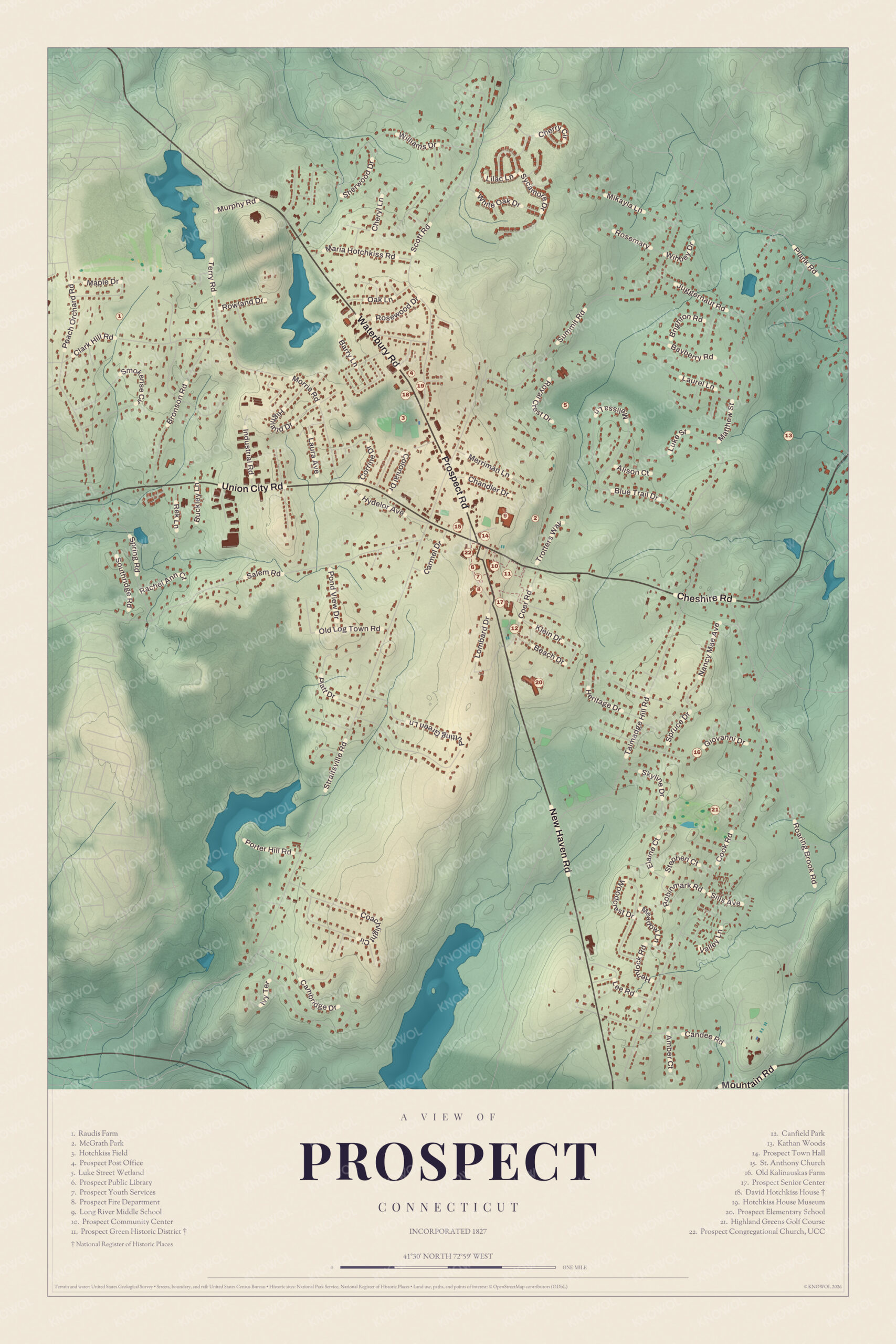
Prospect today
By KNOWOL
Shaded hills from the green on its hilltop out to Bluff Head in the east, every street from Salem Road to Old Log Town Road, and a guide of 22 numbered landmarks with the National Register sites marked.5
The story of Prospect
How Prospect got its name
When Columbia parish became a town in 1827, it couldn't keep its old name, because Tolland County already had a Columbia. David Miles Hotchkiss sat on the committee, and a 1902 county history says he secured the name Prospect. The same book gives the reason: the town stood about nine hundred feet above the sea, the highest point for miles around. Hotchkiss married in November 1819. The well on his farm was dug that autumn and, the book says, never went dry, and his house went up the next spring from timbers cut over the winter. That fits the house of 1820 on Waterbury Road, built for David by his father Frederick, and today the historical society's museum.2617
Spoons, hoes and matches
Prospect's farmers ran small shops on the side, and spoons were a specialty. William Mix, who lived in Prospect and Wallingford, is called the first maker of britannia spoons in America, and Bennet Jeralds learned the trade in his shop before making spoons of his own here until 1848. The firm of Hotchkiss & Wallace patented a way to stiffen britannia spoons with a wire down the center. Robert Wallace, a Prospect farmer's son born in 1815, went on to build the big silverware works at Wallingford. Eben Clark Tuttle came home and invented the goose-neck hoe, making twenty-five a day at first. And the first parlor matches in the country were made here, by Ives & Judd.891011121
Bishop Asbury comes to Columbia
Before there was a town, there was a breakaway church. Settlers in the hill parish called Columbia built a Separate meeting-house, and Benjamin Beach preached there until 1797. On September 23, 1796, Bishop Francis Asbury, the leader of American Methodism, preached in that meeting-house. Amos Hotchkiss, a Methodist who had given the most toward building it, put up the bishop and perhaps a hundred visitors for the night, using the house, the barn and the cider mill. Asbury asked his hostess for a spare teapot, since he carried his own tea, and for the top crust of the rye loaf. The Congregational church gathered in May 1798 with sixteen members, and its fourth meeting-house still faces the green.1314315
Through the years
23 moments from 1694 to today.
- 1694John Moss Jr. records land on the Ten Mile River, the first land record in what is now Prospect.1
- 1712The first European settlers build homes in the West Rocks, near the line between Waterbury and Cheshire.1
- 1757Ira Smith is born here. He served in the Revolution and lived his whole life within forty rods of the spot.16
- 1778The hilltop is chosen for a church, and the green is laid out in front of it.15
- 1778A separatist church goes up, the Society of Columbia, and the area becomes Columbia parish.1
- 1796Bishop Francis Asbury preaches in the Separate meeting-house at Columbia.13
- 1797Benjamin Beach ends his years as pastor of the Separate church.14
- 1798The Congregational church is organized on May 14 with sixteen members.3
- 1820Enos Root builds a Federal house on Waterbury Road for David Hotchkiss.7
- 1827Columbia parish becomes the town of Prospect, a name David M. Hotchkiss pressed for on the committee.2
- 1830Prospect gets its first post office.1
- 1846Eben Clark Tuttle moves his goose-neck hoe business from Prospect to Union City.12
- 1849Eli Ives and Bennet Jeralds start making britannia spoons in Prospect, and keep at it until 1854.17
- 1858The Columbia Methodist society, which had met since Asbury's day, comes to an end.13
- 1883Waterbury finishes a masonry dam for the Prospect reservoir, 23 feet high and 250 feet long.18
- 1905The church sells the green to the town, and the Tuttle family gives a library building on it.15
- 1907The Civil War Soldiers Monument goes up on the green.15
- 1929Electricity arrives along Route 69. The Grange hall, the church and three street lights are the first customers.1
- 1941The present Congregational church is built, the fourth on the site.15
- 1955Prospect becomes the main evacuation center for flooded Naugatuck and Waterbury.1
- 1961The town hall is built, the first building the town government has of its own.1
- 1977Robert Chatfield is elected mayor, and he's re-elected for decades after.1
- 1978The Hotchkiss family sells the 1820 house to the town after 160 years.7
Places to see
The numbers match the landmark guide printed on the 2026 map.
- 1Raudis FarmNorthwest. Farmland in the old farm town.
- 2McGrath ParkNorth of the center. Park just north of the center.
- 6Prospect Public LibraryTown center. Modern library south of the church.
- 11Prospect Green Historic DistrictTown center. The green laid out in 1778.
- 13Kathan WoodsEast side. Woodland out to the east.
- 14Prospect Town HallTown center. The town's own building since 1961.
- 16Old Kalinauskas FarmSoutheast. Old farm beside Highland Greens.
- 18David Hotchkiss HouseWaterbury Road. Federal house built in 1820.Visit their website
- 19Hotchkiss House MuseumWaterbury Road. Home of the historical society.Visit their website
- 22Prospect Congregational Church, UCCFacing the green. Fourth church on the site, 1941.
On the National Register
All 2 places in Prospect on the National Register of Historic Places that still stand today, oldest first, and why each one matters.4
-
Prospect Green Historic District
The green on the highest settled point in New Haven County, laid out in 1778 with the first church and owned by the church until 1905. Around it stand the Civil War Soldiers Monument of 1907, the Tuttle family's library building of 1905, a schoolhouse of the 1860s, the Grange Hall of 1947 and the church of 1941, the fourth on the site.15
-
David Hotchkiss House
Enos Root built this Federal house for Frederick Hotchkiss as a present for his son David. The family kept records of its building and upkeep through 160 years of ownership, sold it to the town in 1978, and it is now the Prospect Historical Society's headquarters and museum.7
In their words
“It being nine hundred feet above the level of the sea, and the highest point for miles around, it well merits the name.”
Commemorative biographical record of New Haven County, 1902, on the name Prospect2
“The Prospect church has no reason to regret that she was ever born, for her life has been fruitful of good.”
The churches of Mattatuck, 1892, on the church in Prospect19
“I have ever lived within forty rods of this spot in the town of Prospect”
Ira Smith, Revolutionary soldier, in his pension declaration, History of Cheshire, 191216
Nearby towns
Sources
- Prospect, Connecticut, Wikipedia
- Commemorative biographical record of New Haven County, Connecticut (1902), on David M. Hotchkiss, Internet Archive
- The churches of Mattatuck (1892), on the church in Prospect, Internet Archive
- National Register of Historic Places listings in New Haven County, Connecticut, Wikipedia
- Map of Prospect, Connecticut in 2026, KNOWOL (USGS elevation, Census Bureau roads)
- History of New Haven County, Connecticut (1892), on the Hotchkiss family of Prospect, Internet Archive
- David Hotchkiss House, Wikipedia
- Commemorative biographical record of Hartford County, Connecticut (1901), on William Mix, Internet Archive
- Illustrated popular biography of Connecticut (1891), on Bennet Jeralds, Internet Archive
- Commemorative biographical record of New Haven County, Connecticut (1902), on Hervey D. Hotchkiss, Internet Archive
- Souvenir History of Wallingford, Connecticut (1895), on Robert Wallace, Internet Archive
- Encyclopedia of Connecticut biography (1917), on Eben Clark Tuttle, Internet Archive
- The town and city of Waterbury, Connecticut (1896), on the Columbia Methodists, Internet Archive
- Contributions to the ecclesiastical history of Connecticut (1861), Internet Archive
- Prospect Green Historic District, Wikipedia
- History of Cheshire, Connecticut, from 1694 to 1840, including Prospect (1912), on Ira Smith's pension declaration, Internet Archive
- Commemorative biographical record of New Haven County, Connecticut (1902), on Eli Ives, Internet Archive
- The town and city of Waterbury, Connecticut (1896), on the Prospect reservoir, Internet Archive
- The churches of Mattatuck (1892), on the church in Prospect today, Internet Archive