
The northwest corner of Connecticut, a town of lakes and mountains whose Ore Hill iron went into Revolutionary cannon, musket barrels and railroad car wheels, and whose villages of Salisbury, Lakeville, Lime Rock and Taconic still keep the old names.
Salisbury on the map
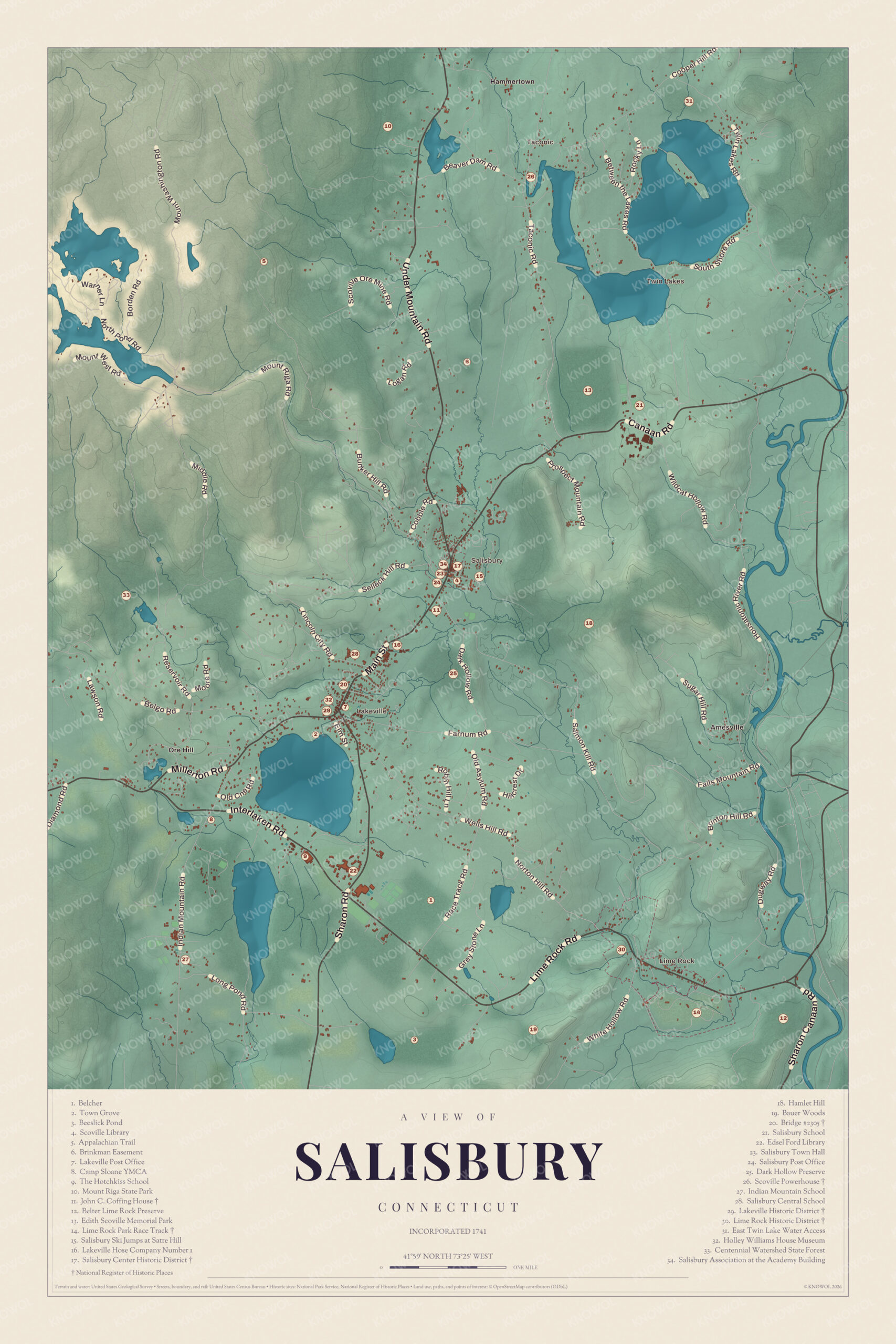
Click the map to look closer.
Salisbury today
By KNOWOL
Shaded hills from the south slope of Mount Frissell across to Weatogue and the Housatonic, every road, the villages of Salisbury, Lakeville, Lime Rock, Taconic, Twin Lakes, Amesville and Hammertown, and a guide of 34 numbered landmarks with the National Register sites marked.4
The story of Salisbury
Cannon from the lake outlet
Lakeville grew up around a furnace. In 1762 partners including a young Ethan Allen built one at the outlet of Lake Wononscopomuc, and it could make about two and a half tons of iron a day, where an old forge turned out about 150 pounds at a time. The slag cooled into a bluish green cinder that people wanted for their roads. In the Revolution the state ran the furnace and cast cannon there, at first 18-pounders of about a ton, and by 1778 32-pounders for the navy. Joshua Porter, later its superintendent, had asked for a tavern license years before because strangers on furnace business kept filling his house. The last blast came in 1832, and in 1843 Alexander H. Holley tore the furnace down to build a pocket knife factory.5678
The village on Mount Riga
Up on Mount Riga, about 2,000 feet high, a forge went up in 1781, and in 1810 the firm of Holley and Coffing finished a blast furnace there. Nobody is sure of the name. One old book says Swiss charcoal makers named it for the Rigi, another story says Russians who came to work the furnace named it for Riga. Iron from the mountain went to the armories at Springfield and Harper's Ferry, and in the 1820s the works made the big anchors for two frigates built in New York for Greece. A whole village grew up, with a school of seventy or eighty children, and a Salisbury woman who wanted a silk dress went up the mountain to a store with four clerks. Railroads and the cut-over woods ended it all, and the furnace was abandoned in 1847.910111213
Salisbury men and Vermont
A good part of early Vermont came out of Salisbury. The charters of Middlebury, Salisbury and New Haven, Vermont went to a party of men mostly from Salisbury, Connecticut, and the first meeting of the Middlebury proprietors was held here, in John Everts's house. Young men followed, John Chipman and fifteen others in 1766, then Ethan and Ira Allen. Their brother Heman kept his home in Lakeville. Wounded at Bennington, he came home and died in May 1778, and a week after his burial Ethan rode in from Valley Forge, hoping to see him. That November Ira Allen paid John Knickerbocker to copy Vermont's new constitution for the press, so the draft was readied, as one writer put it, within a stone's throw of Lake Wononscopomuc.141516
Through the years
25 moments from 1719 to today.
- 1719Dutch settlers from Livingston Manor begin buying land from the Indians at Weatogue, on the Housatonic.17
- 1730About this year Cornelius Knickerbocker settles at what will become Lakeville.18
- 1731The big iron ore deposit at Old Hill, later Ore Hill, is found by John Pell and Ezekiel Ashley.1
- 1734Thomas Lamb is making wrought iron at his forge in what's now Lime Rock.4
- 1738Town M is sold at auction in Hartford and named Salisbury.19
- 1741Salisbury is incorporated, and the first town meeting is held on November 9.20
- 1749The first meetinghouse is raised, with rum and wheat cake for the workers.21
- 1762Partners including Ethan Allen build a blast furnace at the outlet of Lake Wononscopomuc.4
- 1765Joshua Porter is licensed to keep a tavern by the furnace, where strangers crowd his house.7
- 1771Richard Smith buys 200 books in London for a town library.4
- 1774A town meeting votes to share Salisbury's harvest with the people of Boston.22
- 1777Vermont's new constitution is copied for the press in Salisbury.15
- 1778The furnace casts 32-pounder cannon for the United States Navy and New York.6
- 1783With wolves back in the mountains, the town offers 40 shillings a wolf.23
- 1810A town meeting votes one hundred dollars of town money for library books.4
- 1810Holley and Coffing finish the blast furnace on Mount Riga.9
- 1832The Lakeville furnace makes its last blast.8
- 1844Alexander H. Holley's pocket cutlery factory opens on the old furnace site.8
- 1846Furnace Village takes the name Lakeville.4
- 1847The furnace on Mount Riga is abandoned.13
- 1871The railroad reaches Lakeville.24
- 1891Maria Hotchkiss founds the Hotchkiss School in Lakeville.4
- 1894The Scoville Memorial Library opens in its stone building on Main Street.25
- 1952The United States Eastern Ski Jumping Championships begin their February run at Satre Hill.1
- 1957The first race is run at Lime Rock Park, on April 28.26
Places to see
The numbers match the landmark guide printed on the 2026 map.
- 4Scoville LibraryMain Street, Salisbury. Begun with 200 books in 1771.Visit their website
- 9The Hotchkiss SchoolSouth of Lakeville. Founded by Maria Hotchkiss in 1891.Visit their website
- 10Mount Riga State ParkNorth of town. Undeveloped hiking land in the mountains.
- 14Lime Rock Park Race TrackLime Rock. Racing on the hillsides since 1957.
- 15Salisbury Ski Jumps at Satre HillEast of the center. February ski jumping since 1952.Visit their website
- 17Salisbury Center Historic DistrictMain Street. The town center since the 1740s.
- 26Scoville PowerhouseTaconic. Built in 1906 to light an estate.
- 29Lakeville Historic DistrictLakeville. Old Furnace Village, mill pond and station.
- 30Lime Rock Historic DistrictLime Rock. Iron village on the Salmon Kill.
- 32Holley Williams House MuseumLakeville. Federal-style house built in 1768.
On the National Register
All 10 places in Salisbury on the National Register of Historic Places that still stand today, oldest first, and why each one matters.3
-
Lime Rock Historic District
The village once called the Hollow, where Thomas Lamb's forge started about 1734 and the Barnum and Richardson Company later made it the capital of the upper Housatonic iron industry. After the works closed, the Lime Rock Artists Association held exhibits here from 1927 through 1935.27
-
Salisbury Center Historic District
The town center since the 1740s, running from the triangular green and the White Hart Tavern down Main Street to the town hall and library. Part of the Bushnell Tavern of 1746 survives, much altered, at 6 Factory Street.28
-
Lakeville Historic District
About 10 acres of the old Furnace Village, with a street grid little changed since the late 1800s. It takes in Furnace Park, the Holley Manufacturing Company's buildings and mill pond, the Lakeville Station of about 1871, and the Holley-Williams House of 1768.24
-
John C. Coffing House
Built for John C. Coffing, whose firm of Holley and Coffing became one of the region's big operators of iron furnaces. The Holley and Coffing families ran much of the area's iron business for generations.29
-
Mount Riga Ironworks Site
One of the most successful ironworks of its day, making cannon and munitions in the Revolution and anchors and musket iron later, with a mountain community of about 100 houses. Its furnace of 1810 is believed to be the only surviving cold blast furnace in the state. The site is private land.30
-
Bridge No. 2305
A marble arch built by the local stonemason Lorenzo Tupper, a rare survivor in the state of a typical road bridge of the late 1800s. It has lasted on a busy highway partly because it was built to carry heavy loads of iron ore.31
-
Lakeville Manor
A Second Empire house built for St. Joseph's Convent, with St. Mary's Parish School beside it. From 1923 to 1968 it was a summer retreat of the Connecticut Council for Catholic Women, and both buildings are now homes.32
-
Scoville Memorial Library
Home of a town library that began with 200 books bought in 1771 and got town money in 1810. The stone building was paid for by Jonathan Scoville and his family, its tower clock chimes the quarter hours, and a 15th century carving from Salisbury Cathedral hangs over the reading room fireplace.25
-
Scoville Powerhouse
Built on Schenob Brook to make electricity for the Scoville family's country estate, by the same Providence architects who designed the Scoville Library. It has been a private home since the 1950s.33
-
Lime Rock Park Race Track
The nation's third oldest continuously operating road racing course, dreamed up by Jim Vaill and first raced on April 28, 1957. There are no grandstands; fans watch from the grassy hillsides.26
In their words
“our poor brothers of Boston, now suffering for us, shall share with us our plentiful harvest.”
Salisbury town meeting, August 22, 1774, quoted in An Historical Sketch of Salisbury, 189922
“Mount Riga furnace has done its work. Peace to its memory.”
The Connecticut Magazine, 1899, on the old furnace on Mount Riga13
“Chimes ring out the hours from the tower, and the books go forth every day to bless all who live or even sojourn in the town.”
The Connecticut Quarterly, 1898, on the Scoville Memorial Library34
Nearby towns
Sources
- Salisbury, Connecticut, Wikipedia
- An Historical Sketch of Salisbury, Connecticut (1899), on the town's public men, Internet Archive
- National Register of Historic Places listings in Litchfield County, Connecticut, Wikipedia
- Map of Salisbury, Connecticut in 2026, KNOWOL (USGS elevation, Census Bureau roads)
- Lakeville, in the American Switzerland, The Connecticut magazine (1903), on the blast furnace, Internet Archive
- Lakeville, in the American Switzerland, The Connecticut magazine (1903), on the Revolutionary cannon, Internet Archive
- The public records of the colony of Connecticut (1850), on Joshua Porter's tavern, Internet Archive
- Lakeville, in the American Switzerland, The Connecticut magazine (1903), on the end of the furnace, Internet Archive
- Iron mining in Connecticut, The Connecticut magazine (1899), on the Mount Riga furnace, Internet Archive
- Old paths and legends of the New England border (1907), on the name of Mount Riga, Internet Archive
- An Historical Sketch of Salisbury, Connecticut (1899), quoting Alexander H. Holley on Mount Riga, Internet Archive
- The Connecticut quarterly (1895), on the village on Mount Riga, Internet Archive
- Iron mining in Connecticut, The Connecticut magazine (1899), on the end of the Mount Riga furnace, Internet Archive
- An Historical Sketch of Salisbury, Connecticut (1899), on the Vermont charters, Internet Archive
- Lakeville, in the American Switzerland, The Connecticut magazine (1903), on Vermont's constitution, Internet Archive
- Lakeville, in the American Switzerland, The Connecticut magazine (1903), on Heman Allen, Internet Archive
- An Historical Sketch of Salisbury, Connecticut (1899), on Weatogue, Internet Archive
- Lakeville, in the American Switzerland, The Connecticut magazine (1903), on the first settlement, Internet Archive
- Lakeville, in the American Switzerland, The Connecticut magazine (1903), on the sale of Town M, Internet Archive
- An Historical Sketch of Salisbury, Connecticut (1899), on the first town meeting, Internet Archive
- The Connecticut quarterly (1898), on Salisbury's first meetinghouse, Internet Archive
- An Historical Sketch of Salisbury, Connecticut (1899), on the town meeting of 1774, Internet Archive
- An Historical Sketch of Salisbury, Connecticut (1899), on the wolf bounty, Internet Archive
- Lakeville Historic District, Wikipedia
- Scoville Library, Wikipedia
- Lime Rock Park, Wikipedia
- Lime Rock, Connecticut, Wikipedia
- Salisbury Center Historic District, Wikipedia
- John C. Coffing House, Wikipedia
- Mount Riga Ironworks, Wikipedia
- Bridge No. 2305, Wikipedia
- Lakeville Manor, Wikipedia
- Scoville Powerhouse, Wikipedia
- The Connecticut quarterly (1898), on the Scoville Memorial Library, Internet Archive