
A long, hilly town on the Rhode Island line, set off from Voluntown in 1794, where the French army camped on Sterling Hill and the granite ledge at Oneco built mills and paved city streets.
Sterling on the map
Click the map to look closer.
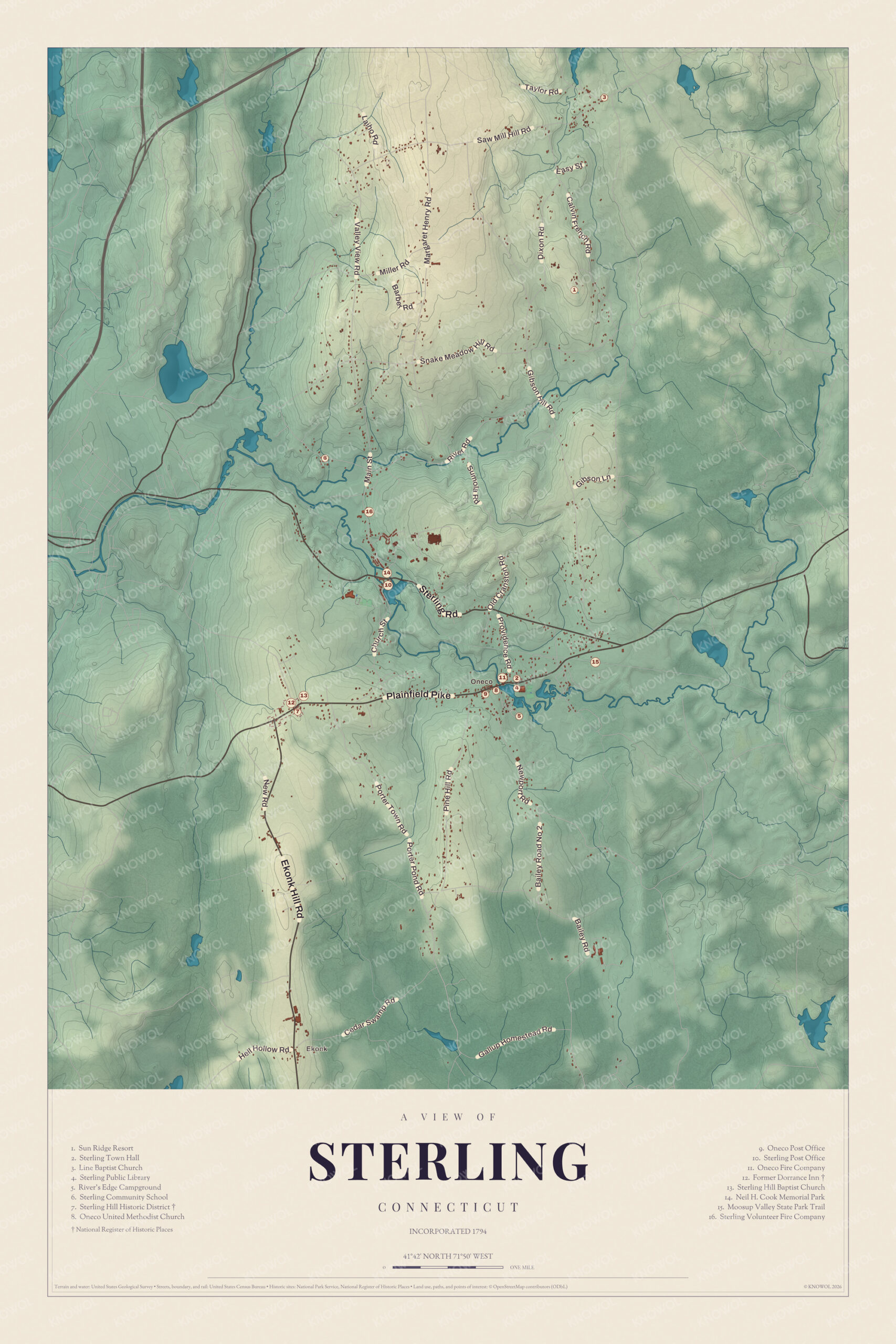
Sterling today
By KNOWOL
Shaded hills from Ekonk Hill across to Oneco and the Rhode Island line, the Plainfield Pike and every street, Sterling, Oneco and Ekonk printed by name, and a guide of 16 numbered landmarks with the National Register sites marked.5
The story of Sterling
The doctor's promised library
When the north end of Voluntown became a town in 1794, a temporary resident, Dr. John Sterling, gave it his name and promised a public library in return. He never sent it, and the people got a library together with their own gifts. The new town had about nine hundred people, poor soil and no public building, so its first town meeting was held in Robert Dixon's house on Sterling Hill. Leading citizens then built a meeting house on the Green at their own expense, and town meeting moved in during the autumn of 1797. With an academy, Dixon's well-known tavern and the big Dorrance houses around it, Sterling Hill made a fine show. A traveler coming in from Rhode Island wrote of a beautiful prospect from the hill.678
The Devil's Den Chimney
In 1808 the Sterling Manufacturing Company bought land at a ledge called the Devil's Den Chimney. An old gazetteer described a round hollow in the rock with two deep clefts, a little room with a fireplace and a chimney cut through the stone overhead, and a natural staircase winding to the top. Ice formed in that room in winter and lasted nearly all summer. The company built its workers' houses from the ledge's stone, and by 1818 its mill ran sixteen hundred spindles. It was one of the first in the country to bleach cloth with chlorine, William Pike's invention, and the Pikes' sap works turned wood into acids and charcoal and even dissolved battered tin pans. The Devil's Den itself was blown up to make way for the railroad.346
Granite from the Sterling hills
Sterling has always had good stone. Before the Civil War the Sprague family of Providence opened the ledge at Oneco, and the great granite blocks of their Baltic mill came from it. By 1889 Garvey Brothers had about 120 men at the quarry, with a railroad running right to the ledge, and Oneco granite went into paving, buildings and monuments in Providence, New York and Chicago, and even across the ocean to England. Henry M. Sayles, a stonemason, built the Great Wall west of Oneco village for the Spragues to hold the quarry's waste stone, fifteen feet wide in places. A writer in 1920 said millions of tons of granite had been cut from the rugged Sterling hills.9410
Through the years
24 moments from 1706 to today.
- 1706The volunteers' land that becomes Voluntown and Sterling is divided among its proprietors by a drawing of lots.11
- 1714Francis Smith and Miles Jordan bridge the river north of Egunk Hill, and Smith keeps a mill and takes in travelers.11
- 1719The vacant land east of Plainfield, today's Sterling, is annexed to Voluntown.11
- 1781Rochambeau's French army camps overnight at Sterling Hill on its march to Yorktown.12
- 1782The French camp at Sterling Hill again on the march back, and Rochambeau dines at Samuel Dorrance's inn.13
- 1794Sterling becomes a town, named by Dr. John Sterling, who promises a public library in return.6
- 1794The first town meeting is held on June 9 in Robert Dixon's house on Sterling Hill.7
- 1797Town meeting moves into the new meeting house on the Green at Sterling Hill.7
- 1808The Sterling Manufacturing Company buys land at a ledge called the Devil's Den Chimney.3
- 1810William Pike comes from Sturbridge and soon takes charge of the dye house at the Sterling mill.5
- 1812The Baptists take over the Sterling Hill meeting house for regular worship.7
- 1818The Sterling mill is called one of the largest in the state, running sixteen hundred spindles.3
- 1830About this year Henry Sabin builds a small cotton factory, the start of Oneco village.4
- 1851Charles Dow, who will found Dow, Jones and Company, is born on a Sterling farm.5
- 1859The Sterling Hill Baptist Church is given its Greek Revival look.12
- 1860About this year Smith and Williams start quarrying granite at Oneco.4
- 1879David Gallup, born and raised in Sterling, becomes lieutenant governor of Connecticut.14
- 1883Sterling builds its town hall at Oneco after a lively battle over where it should go.9
- 1884Garvey Brothers take over the Oneco quarry and soon employ about 120 men.4
- 1888Ekonk Grange No. 89 is organized at the Line Meeting House.10
- 1918Harry T. Sayles, the first Sterling man called to the war and the only one lost, is killed in France on June 6.10
- 1986The Sterling Hill Historic District is listed on the National Register.12
- 2003The Plainfield Pike through Sterling is listed on the National Register as part of Rochambeau's march route.2
- 2026The Dorrance Inn, built around 1716, is torn down on July 27 because of beetle damage.13
Places to see
The numbers match the landmark guide printed on the 2026 map.
- 2Sterling Town HallOneco. Town offices in Oneco village.
- 3Line Baptist ChurchNorth of town. Church up in the north.
- 4Sterling Public LibraryOneco. Shares a spot with the town hall.
- 6Sterling Community SchoolNorth of the Pike. The town's one public school.
- 7Sterling Hill Historic DistrictSterling Hill. Village center where the French camped.
- 8Oneco United Methodist ChurchOneco. Just west of the town hall.
- 12Former Dorrance InnPlainfield Pike. Site of Samuel Dorrance's tavern.
- 13Sterling Hill Baptist ChurchSterling Hill. The town's meeting house of 1797.
- 14Neil H. Cook Memorial ParkWest of the school. Between the school and Sterling Hill.
- 15Moosup Valley State Park TrailEast of Oneco. Rail trail to the Rhode Island line.
On the National Register
All 2 places in Sterling on the National Register of Historic Places that still stand today, oldest first, and why each one matters.15
-
March Route of Rochambeau's Army: Plainfield Pike
A 3.6-mile stretch of road through Plainfield and Sterling that the French army marched in June 1781 on its way to Yorktown and again in November 1782. Lined by stone walls about 50 feet apart, it's called in its nomination the longest continuous part of the route to survive with these features intact.2
-
Sterling Hill Historic District
A well-preserved village center of the early 1800s around the Sterling Hill Baptist Church, which began as the town's meeting house of 1797. The French army camped here in 1781 and 1782. One house at its western edge is in Plainfield.12
In their words
“It had fine water privileges, an excellent stone quarry, a great post road running through its center, and sterling men of good Scotch stock to administer public affairs.”
History of Windham County, 1889, on the new town of 17947
“Most of the well-to-do citizens in and about Oneco and in fact all parts of Sterling have their business foundations based on rock, the solid rock of Sterling hills.”
A modern history of Windham County, 19209
“A beautiful prospect from Sterling Hill.”
Doctor Dwight, a traveler, quoted in History of Windham County, 18898
Nearby towns
Sources
- Sterling, Connecticut, Wikipedia
- March Route of Rochambeau's Army: Plainfield Pike, Wikipedia
- History of Windham County, Connecticut (1889), on the Sterling mills and the Devil's Den Chimney, Internet Archive
- History of Windham County, Connecticut (1889), on Oneco and its quarries, Internet Archive
- Map of Sterling, Connecticut in 2026, KNOWOL (USGS elevation, Census Bureau roads)
- A modern history of Windham County, Connecticut (1920), on Sterling, Internet Archive
- History of Windham County, Connecticut (1889), on the founding of Sterling, Internet Archive
- History of Windham County, Connecticut (1889), on Sterling Hill, Internet Archive
- A modern history of Windham County, Connecticut (1920), on Oneco village, Internet Archive
- A modern history of Windham County, Connecticut (1920), on Ekonk Grange and Henry M. Sayles, Internet Archive
- History of Windham County, Connecticut (1889), on the volunteers' land and early settlers, Internet Archive
- Sterling Hill Historic District (Plainfield and Sterling, Connecticut), Wikipedia
- Dorrance Inn, Wikipedia
- History of Windham County, Connecticut, volume 2 (1880), on Sterling men in public life, Internet Archive
- National Register of Historic Places listings in Windham County, Connecticut, Wikipedia