
The river-meadow town where Sudbury's first settlers built in 1638, renamed for Francis Wayland, whose $500 gift began its free public library, with the old shoe village of Cochituate beside its long lake.
Wayland, Massachusetts on the map
Click the map to look closer.
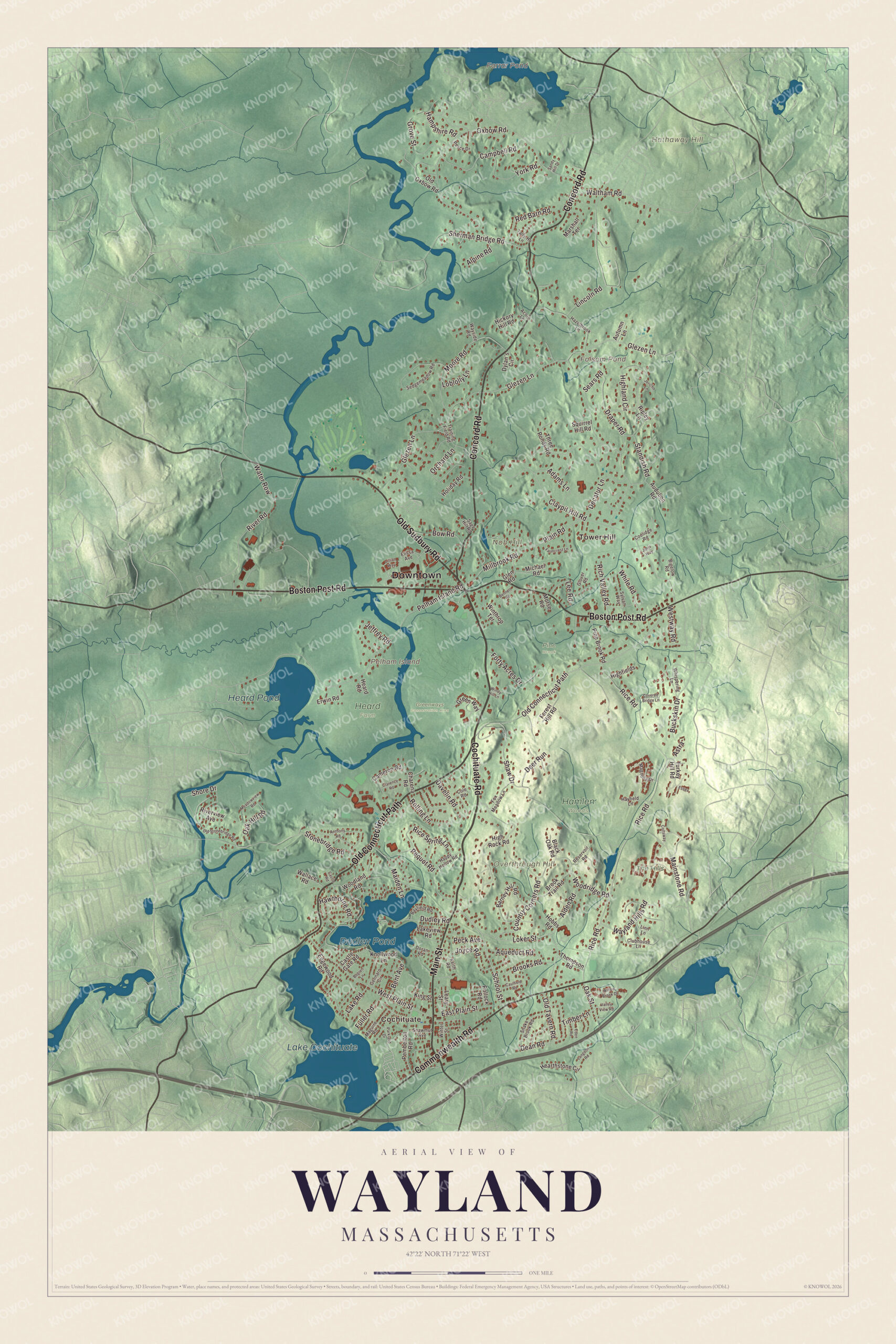
Wayland today
By KNOWOL
Wayland's streets, buildings, ponds and terrain from Downtown to Cochituate, with Old Connecticut Path and Boston Post Road, and Lake Cochituate, Dudley Pond, Farrar Pond, Tower Hill and Pelham Island labeled.6
The history of Wayland, Massachusetts
Where Sudbury began
Sudbury's first settlers reached the east bank of the river by the fall of 1638, and nearly two-thirds of their first grant lies in today's Wayland. They built along three roads close to the river meadows. In the spring of 1639 Thomas Cakebread put up a grist mill, and in 1890 some of its timber was thought to survive in the mill on the same spot. In 1642 John Rutter agreed to fell, saw, hew and frame a meetinghouse thirty feet long and twenty wide, paid partly in corn. It stood on the hillside in what's now the Old Burying Ground. John Parmenter's tavern, the first in town, was on the same street, and about 1643 the settlers bridged the river where the Old Town Bridge stands, said to be the first frame bridge in Middlesex County.78910111213
A library for the whole town
On Commencement day at Brown University in 1847, President Francis Wayland, the town's namesake, told Judge Edward Mellen he'd give $500 toward a town library if the people raised as much. Mellen kept the giver's name a secret, and 208 people subscribed the match by February 10, 1848. When the donor was named, the town meeting voted its thanks by rising with heads uncovered. On August 7, 1850, the first books went out from a room in the old town house, one volume at a time to anyone in town over fourteen. In 1851 the town's representative, Rev. John B. Wight, carried a law letting every Massachusetts town keep a free public library. At the library celebration that August, Dr. Wayland said it gave him a higher idea of New England character than anything he'd seen.141516317218
Pegs by the mouthful
Cochituate was a quiet farming corner until early in the 1800s, when William and James Madison Bent began making shoes. Stock was cut at the Bent shop and given out in cases of fifty or sixty pairs, and men carried a case or two home to a room or a little shop beside the house. Two worked together, a boss who cut and trimmed and a striker who pegged, and a good pegger held the pegs in his mouth almost by the dozen and kept up a steady rap-tap. Women sewed the uppers by hand. In 1837 the business made 29,660 pairs. The sewing machine and then the pegging machine moved the work into big shops, and by 1875 nine factories in Cochituate employed 431 men and 60 women.19204
Wayland, Massachusetts through the years
25 moments from 1638 to today.
- 1638Sudbury's settlers reach the east side of the river by fall and build along three roads, in what is now Wayland.78
- 1639Thomas Cakebread builds the settlement's grist mill in the spring.9
- 1639Herbert Pelham is granted the tract called The Island.21
- 1640A church is gathered, with Rev. Edmund Brown as its first minister.22
- 1642John Rutter agrees to frame the first meetinghouse, thirty feet by twenty, for the hillside at today's Old Burying Ground.1011
- 1643About this year the first cart bridge crosses the river at the Old Town Bridge site.13
- 1648A way is laid out from Watertown to the Dunster Farm, the Old Connecticut Path.23
- 1653About this year John Parmenter is licensed to keep the town's first tavern.12
- 1729Twelve men wade into the river to raise a new town bridge, and the town pays for their drink.24
- 1758The town decides to repair the Long Causeway with a lottery, and loses money on the tickets.25
- 1765About this year Nathaniel Reeves opens the Corner Tavern, the first change of horses on the Boston to Worcester stage.26
- 1775Two British officers scouting the country pass over the bridge now called Stone's Bridge.27
- 1780East Sudbury becomes a town on April 10.2
- 1835On March 11 the town takes the name Wayland, for Dr. Francis Wayland.2
- 1837The shoe business centered at Cochituate makes 29,660 pairs.4
- 1843The town refuses liquor licenses for the first time.28
- 1846Boston buys the water rights of Cochituate Pond, the old Long Pond, for its new water supply.29
- 1848Josiah Russell builds the stone-arch Old Town Bridge.30
- 1850On August 7 the free public library lends its first books.3
- 1851Rev. John B. Wight carries a state law letting towns keep free public libraries.172
- 1853Lydia Maria Child and her husband, David Lee Child, move to Wayland.31
- 1875Nine shoe factories in Cochituate employ 431 men and 60 women.4
- 1878The new Town Hall opens in December, and the library moves into it.16
- 1881The railroad finally reaches Wayland.32
- 1900The present library building is built.1
Places to see in Wayland, Massachusetts
Places worth a visit in Wayland today.
- DowntownRoutes 20 and 27. Village center around the 1815 meetinghouse.
- CochituateSouth, by Lake Cochituate. The Bent brothers' shoe village.
- Old Connecticut PathSoutheast toward Framingham. Colonial road past the Reeves and Bent taverns.
- Boston Post RoadEast to west through Downtown. Old stage road from Boston to Worcester.
- Old Sudbury RoadNorthwest of Downtown. Old highway toward Sudbury Centre.
- Cochituate RoadDowntown south to Cochituate. Early road from the center south.
- Tower HillEast Wayland. Named for Richard Fuller's wooden lookout tower.
- Lake CochituateCochituate, on the Natick line. Long Pond, later Boston's water supply.
- Dudley PondCochituate. Once a little lake in the woods.
- Pelham IslandWest, by the Sudbury River. Herbert Pelham's 1639 grant, called The Island.
Wayland on the National Register of Historic Places
All 8 places in Wayland on the National Register of Historic Places that still stand today, oldest first, and why each one matters.5
-
Noyes-Parris House
A First Period house whose oldest part, three bays wide around the central chimney, was built about 1669 by the early settler Peter Noyes and widened to five bays about 1790. His daughter Dorothy became the second wife of Rev. Samuel Parris, a major figure in the Salem witch trials.33
-
Hopestill Bent Tavern
Hopestill Bent built the oldest part, two rooms around a central chimney, about 1710 and kept a tavern here. About 1800 a second First Period house was moved onto the site and joined to it, giving the building most of its present shape.34
-
Reeves Tavern
Jacob Reeves added the main block in 1762 and 1763 to a house probably built before 1720, and was running a tavern here by 1764. He hosted John Adams in 1774 and signed the 1780 petition to set the east side off from Sudbury.35
-
1767 Milestones
Stone mileposts on the old Upper Boston Post Road, named for a 1767 order of the Province of Massachusetts Bay that such stones be set along major roads. The 40 surviving stones on the route were listed together in 1971.36
-
Wayland Center Historic District
The 19th-century village center at the junction of Route 20 and Cochituate Road, with fifteen well-preserved buildings. Its centerpiece is the meetinghouse of 1815, whose bell came from the firm of Paul Revere, and material from the old 1726 meetinghouse went into a new town hall, now a residence.37
-
Old Town Bridge
A four-arch stone bridge built in 1848 by Josiah Russell where the first bridge in Middlesex County is supposed to have stood in the 1640s. It carried the main road west from Boston for many years, was rebuilt with mortar after a flood in 1900, and was open to traffic until 1955.30
-
Stone's Bridge
A four-arch bridge of dry-laid split granite, built in 1858 where a horse bridge near Daniel Stone's house is mentioned in 1674. It's named for the Stone family, not its material, and it was cut short in 1955 when the river channel shifted.38
-
Weston Aqueduct Linear District
The 13.5-mile aqueduct, built from 1901 to 1903, carried water from the Sudbury Reservoir through Framingham and Wayland to the Weston Reservoir. Its route, buildings and bridges were listed together in 1990.39
Wayland in their words
“This gives me a higher idea of New England character than any thing I have before witnessed. Your inhabitants have assembled without distinction of age or sex, to celebrate, with joyful festivities, not any great victory, not any great political event, but the founding of a library.”
Francis Wayland at the library celebration of August 26, 1851, in Origin of the free public library system of Massachusetts, 186018
“The town is pleasantly situated, and its rural quiet, beautiful drives and varied scenery render it peculiarly attractive as a summer residence.”
History of Middlesex County, Massachusetts, 189040
“This short causeway is a revelation of beauty on a quiet day and a most desirable resting place.”
Massachusetts beautiful, 1923, on the causeway over Cochituate Lake just past Cochituate village41
Towns near Wayland, Massachusetts
Sources for the history of Wayland
- Wayland, Massachusetts, Wikipedia
- A gazetteer of the state of Massachusetts (1890), on Wayland, Internet Archive
- Origin of the free public library system of Massachusetts (1860), on the library's opening, Internet Archive
- The annals of Sudbury, Wayland and Maynard (1891), on the growth of the shoe business, Internet Archive
- National Register of Historic Places list, Wikipedia
- Map of Wayland, Massachusetts in 2026, KNOWOL
- History of Middlesex County, Massachusetts (1890), Wayland chapter, on the first settlement, Internet Archive
- History of Middlesex County, Massachusetts (1890), Wayland chapter, on the first three roads, Internet Archive
- History of Middlesex County, Massachusetts (1890), Wayland chapter, on the Cakebread mill, Internet Archive
- History of Middlesex County, Massachusetts (1890), Wayland chapter, on the first meetinghouse, Internet Archive
- The annals of Sudbury, Wayland and Maynard (1891), on the Old Burying Ground, Internet Archive
- History of Middlesex County, Massachusetts (1890), Wayland chapter, on the Parmenter tavern, Internet Archive
- The annals of Sudbury, Wayland and Maynard (1891), on the Old Town Bridge, Internet Archive
- Origin of the free public library system of Massachusetts (1860), on the town meeting's thanks, Internet Archive
- Beginnings of the Wayland Library (1878), Internet Archive
- The annals of Sudbury, Wayland and Maynard (1891), on the public library, Internet Archive
- History of Middlesex County, Massachusetts (1880), Wayland chapter, on the town library, Internet Archive
- Origin of the free public library system of Massachusetts (1860), on the library celebration of 1851, Internet Archive
- History of Middlesex County, Massachusetts (1890), Wayland chapter, on the Bent shoe shop, Internet Archive
- The annals of Sudbury, Wayland and Maynard (1891), on shoemaking at Cochituate, Internet Archive
- History of Middlesex County, Massachusetts (1890), Wayland chapter, on the Pelham grant, Internet Archive
- History of Middlesex County, Massachusetts (1890), Wayland chapter, on the first church, Internet Archive
- History of Middlesex County, Massachusetts (1890), Wayland chapter, on the Old Connecticut Path, Internet Archive
- The annals of Sudbury, Wayland and Maynard (1891), on raising the town bridge in 1729, Internet Archive
- The annals of Sudbury, Wayland and Maynard (1891), on the Long Causeway lottery, Internet Archive
- The annals of Sudbury, Wayland and Maynard (1891), on the Corner Tavern, Internet Archive
- The annals of Sudbury, Wayland and Maynard (1891), on the New Bridge, or Stone's Bridge, Internet Archive
- The annals of Sudbury, Wayland and Maynard (1891), on temperance, Internet Archive
- A history of Framingham, Massachusetts (1847), on Cochituate Pond and the Boston water works, Internet Archive
- Old Town Bridge, Wikipedia
- History of Middlesex County, Massachusetts (1890), Wayland chapter, on Lydia Maria Child, Internet Archive
- Middlesex County and its people; a history (1927), on Wayland, Internet Archive
- Noyes-Parris House, Wikipedia
- Hopestill Bent Tavern, Wikipedia
- Reeves Tavern, Wikipedia
- 1767 Milestones, Wikipedia
- Wayland Center Historic District, Wikipedia
- Stone's Bridge, Wikipedia
- Weston Aqueduct Linear District, Wikipedia
- History of Middlesex County, Massachusetts (1890), Wayland chapter, Internet Archive
- Massachusetts beautiful (1923), on the drive through Cochituate, Internet Archive