
The old county town of Windham Green and the mill city of Willimantic, where the falls of the Willimantic River made thread known around the world and a night of bullfrogs made the town famous for good.
Then and now
The same town 144 years apart. Click either map to look closer.
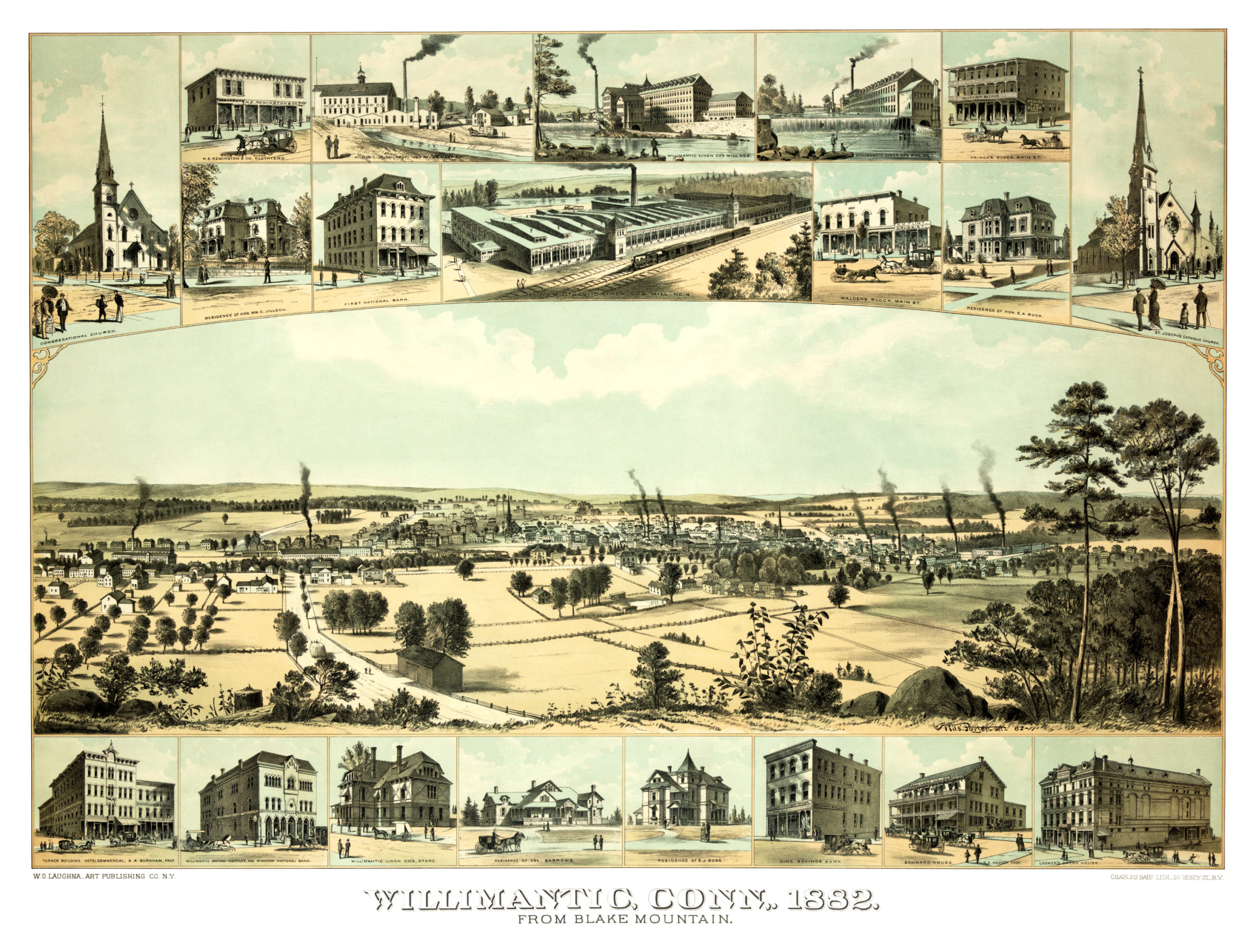
The bird's-eye view of Willimantic
By Nils Porter and the Charles Hart Lithography Company
Willimantic drawn from the sky in 1882, when it was still a borough of Windham, with the Willimantic Linen Company, Loomer's Opera House, the Windham National Bank, the Willimantic Savings Institute, the Turner Hotel and the Brainard House.4
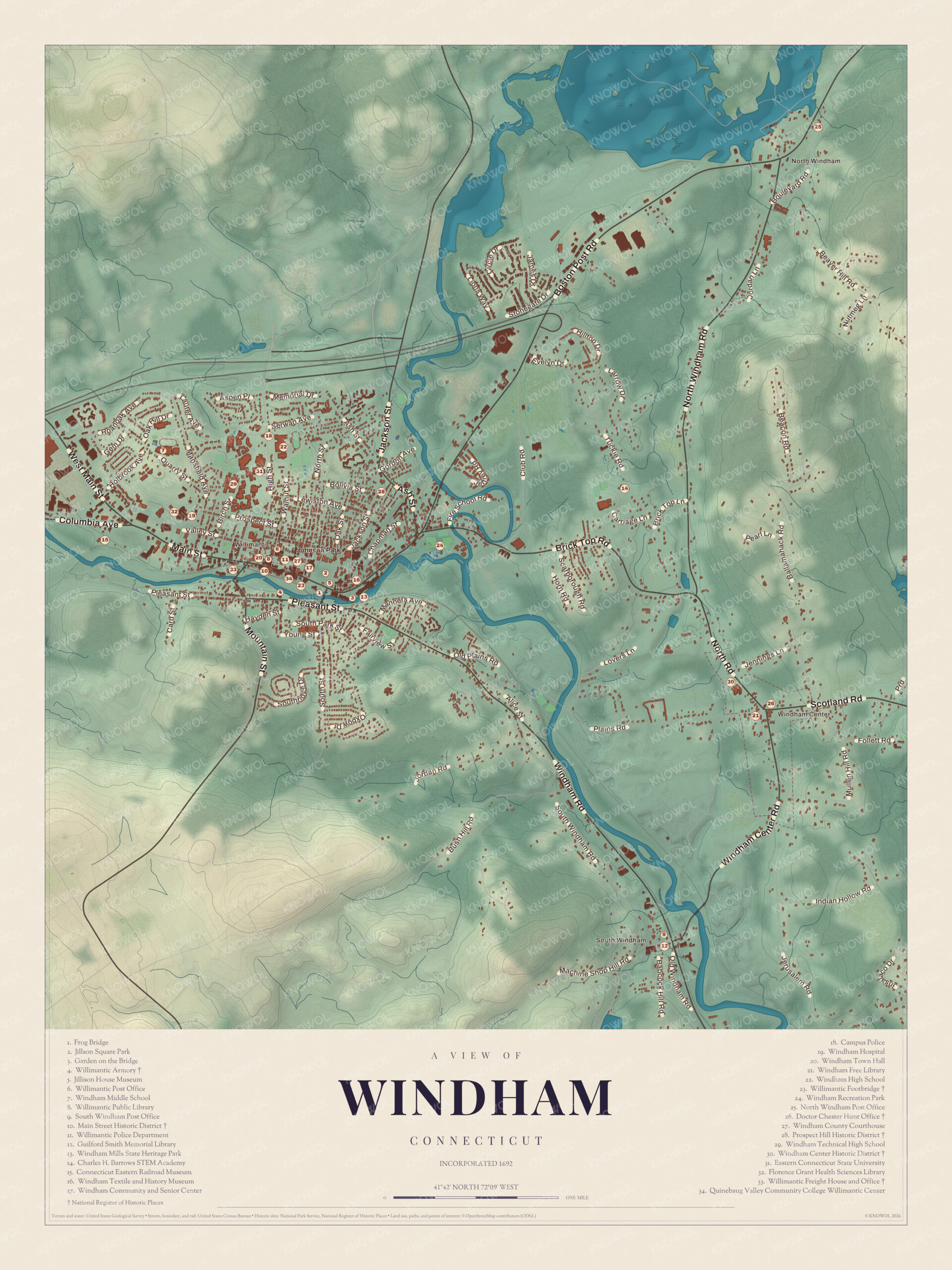
Windham today
By KNOWOL
Shaded hills from downtown Willimantic out to North Windham, every street, Willimantic, North Windham, South Windham and Windham Center by name, and a guide of 34 numbered landmarks with the National Register sites marked.5
The story of Windham
The night of the frogs
One summer night in the 1750s, the people of Windham Green woke to a roar in the dark. Some thought it was an earthquake, some thought the Day of Judgment had come, and others were sure an army of French and Indians was marching on them. Armed men went out and fired into the night, and some swore the noise was calling for the town's two lawyers, Colonel Dyer and Elderkin. By morning the sound was traced to a drying pond crowded with bullfrogs. The story flew all over the country and was sung in ballads. In 1857 James Walden of Willimantic printed a little book of the accounts, which admitted that a Windham native could hardly travel anywhere without hearing about bullfrogs. Today four frogs sit on the bridge into town.678910
John Gates and the old county town
Windham's first English house went up in the spring of 1689. John Gates had held a commission under Cromwell, and when Charles II took the throne he fled to Virginia, then to Norwich, then out to the new plantation with Jo, an enslaved man he'd bought in Virginia. They dug a cellar in a rocky hillside north of the village. When Gates died in 1697 he left 200 acres for the town's poor and 200 more for a school. In 1726 Windham Green became the county town, with a log jail 31 feet long. It grew busy enough to print its own newspaper, The Phenix, in 1791, and to build four-wheeled carriages in 1808. Then the courts moved to Brooklyn in 1819, and by 1836 people said the Green had held more buildings before the Revolution than ever since.1112131415161718
The mills at the falls
Willimantic grew where the river drops about 90 feet. The first dam across it went in in 1727. In 1824 the Jillson brothers bought a water privilege on the south side of Main Street and built what was then the largest cotton mill in Willimantic. By 1836 the village, built up in just twelve years, had nearly 2,000 people and six cotton factories. The Willimantic Linen Company came in 1854, and by 1889 it had 2,000 workers in four mills known by number, with No. 2 a stone mill about 400 feet long and five stories high. The Linen Company even helped light up a celebration in Hartford, with electric lights on top of the Capitol seen eighteen miles away. The mills ran until 1985, and their story is told today in the old company store.19202122232245
Through the years
25 moments from 1675 to today.
- 1675Joshua Uncas, son of Uncas, leaves the land that becomes Windham to settlers in his will.1
- 1689In the spring, John Gates, an Englishman who had held a commission under Cromwell, raises the first English house in Windham.11
- 1691The settlers hold their first town meeting on May 18.1
- 1692In May the tract is named the town of Windham.1
- 1697John Gates dies, leaving 200 acres for the town's poor and 200 acres for a schoolhouse.14
- 1726Windham Green becomes the seat of the new Windham County, and the justices order a log jail 31 feet long.2515
- 1727The first dam is built across the Willimantic River, near where the Linen Company's stone dam later stood.20
- 1739The Reverend Thomas Clap leaves the Windham pulpit to lead Yale College, and the colony pays the town about 53 pounds for losing him.2627
- 1754One June night the town is terrified by a roar in the dark that turns out to be bullfrogs, the Battle of the Frogs.9
- 1777On December 13 the gunpowder mill that Jedediah Elderkin and Nathaniel Wales built at Willimantic blows up.28
- 1781Rochambeau's French army camps on the Shetucket River on its way to Yorktown, and camps again on Scotland Road on the way back in 1782.2930
- 1791John Byrne prints Windham's first newspaper, The Phenix, or Windham Herald.16
- 1806The first mill at the falls, for carding wool, opens in Willimantic.5
- 1819The county courts are moved from Windham to Brooklyn.16
- 1821The Windham Green fire district buys a hand fire engine for $180 and forms a company of twenty-four men.31
- 1825William Jillson begins his granite house by the falls, finished in 1827.32
- 1828George Spafford and James Phelps start building paper machines in South Windham, the beginning of the Smith and Winchester company.33
- 1833Willimantic becomes a borough.1
- 1836Willimantic, built up in just twelve years, has nearly 2,000 people and six cotton factories.22
- 1854Investors from Hartford buy the Jillson mills and form the Willimantic Linen Company.23
- 1882Nils Porter draws the bird's-eye view of Willimantic.4
- 1893Willimantic is incorporated as a city.1
- 1906The Willimantic Footbridge is built across the river and the railroad tracks.34
- 1983The city of Willimantic is consolidated with the town of Windham again.1
- 2000The Thread City Crossing, the Frog Bridge, opens, with four big green frogs on its concrete thread spools.10
Places to see
The numbers match the landmark guide printed on the 2026 map.
- 1Frog BridgeWillimantic. Four frogs on concrete thread spools.
- 3Garden on the BridgeWillimantic. The 1857 stone arch, now planted.
- 5Jillson House MuseumMain Street. William Jillson's granite house of 1827.
- 10Main Street Historic DistrictDowntown Willimantic. Stores and offices from about 1870.
- 16Windham Textile and History MuseumWillimantic. In the old company store.Visit their website
- 20Windham Town HallWillimantic. Town hall and courthouse of 1896.
- 21Windham Free LibraryWindham Center. The Windham Bank of 1832.
- 23Willimantic FootbridgeMain Street. A steel truss footbridge of 1906.
- 28Prospect Hill Historic DistrictNorth of Main Street. Nearly 1,000 buildings, mostly Victorian.
- 30Windham Center Historic DistrictWindham Center. The old county town around the green.
On the National Register
All 14 places in Windham on the National Register of Historic Places that still stand today, oldest first, and why each one matters.3
-
Windham Center Historic District
205 acres around the green of the village that was the town's most thickly settled place for its first 125 years and the seat of Windham County from 1726. The Congregational Church, a former inn, old houses and the Windham Bank of 1832, now the Windham Free Library, still face the green.25
-
Fourth Camp of Rochambeau's Army
The French army camped here on the banks of the Shetucket River in the summer of 1781, marching from Providence to join Washington. One of Rochambeau's aides called Windham a charming market town and said they camped on the river very comfortably, though hardly militarily.29
-
March Route of Rochambeau's Army: Scotland Road
About 1,700 feet of Scotland Road, lined with stone walls and open fields, that the French army marched in 1781 on the way to Yorktown and again in 1782 on the way back. The walls and views are much as they were then.35
-
Forty-Seventh Camp of Rochambeau's Army
About 15 acres east of Windham Center where the French army camped in November 1782 on its march home from Yorktown. A French military engineer's map shows the camp on both sides of the road, and the site may tell archaeologists how a moving army camped.30
-
Dr. Chester Hunt Office
A small gambrel-roofed building, one of the village's few Federal-era commercial buildings, still with its handcut nails and stenciled walls. Dr. Hunt used it as an office and dispensary in the mid-1800s, and it was moved to the library grounds when it was given to the library association.36
-
William Jillson Stone House
A rare stone house, its granite walls about 17 inches thick, built by William Jillson, one of the first to buy water rights at the Willimantic Falls. The mills he and his brothers started grew into the American Thread Company, and the Windham Historical Society keeps the house as a museum.32
-
American Thread Company
The great granite mill complex of the Willimantic Linen Company, which became part of the American Thread Company in 1898 and made thread here until 1985. Mill No. 4 burned in 1995 and the old chimney is gone, but the other mills stand, some now apartments.23
-
Prospect Hill Historic District
About 40 square blocks north of Main Street, one of the largest historic districts in the state and one of its largest groups of Victorian houses, built up for the mill city's families.37
-
Main Street Historic District
Willimantic's downtown. Main Street was laid out in 1707 and carried the Windham Turnpike, and from about 1870 it filled with stores and offices as the mill village became a railroad hub. The district grew in 1992 to take in the Hall and Bill printing building of 1889.19
-
Willimantic Freight House and Office
The long freight house is gone, but the mansard-roofed freight office still stands, the last of the city's 19th century railroad buildings and a reminder of the days when Willimantic was a major rail junction.38
-
Willimantic Footbridge
A steel truss footbridge about 600 feet long that carries walkers from Main Street over Riverside Drive, the railroad tracks and the river. It's one of the few early 1900s footbridges left in the state, and it was closed in July 2025 for serious structural damage.34
-
Willimantic Armory
A red-brick armory paid for by the state after Willimantic asked for one in 1909. The National Guard used it from 1913 until 1980, and it's apartments now.39
-
Willimantic Elks Club
One of the finest Tudor Revival buildings in the region, built for a lodge founded in 1914, and a center of the city's social life ever since.40
-
Mansfield Hollow Dam
An Army Corps of Engineers earth dam more than two miles long that holds back the Natchaug River to protect the valley below from floods. It runs along Windham Airport and into Mansfield.41
In their words
“Windham, in its general appearance, very much resembles an English village.”
John Warner Barber, Connecticut Historical Collections, 183618
“A citizen of the town can hardly go so far from home, but he will hear something about bull-frogs if his place of nativity is known.”
William L. Weaver, The Battle of the Frogs, published in Willimantic, 18578
“Willimantic thread is sold throughout the civilized world.”
The historical, statistical and industrial review of the state of Connecticut, 188442
Nearby towns
Sources
- Windham, Connecticut, Wikipedia
- History of Windham County, Connecticut (1889), on the Willimantic Linen Company, Internet Archive
- National Register of Historic Places listings in Windham County, Connecticut, Wikipedia
- Bird's eye view of Willimantic, CT from 1882, restored by KNOWOL
- Map of Windham, Connecticut in 2026, KNOWOL (USGS elevation, Census Bureau roads)
- The historical, statistical and industrial review of the state of Connecticut (1884), on the Frog Panic, Internet Archive
- Once upon a time in Connecticut (1916), The Frogs of Windham, Internet Archive
- The Battle of the Frogs, at Windham, William L. Weaver (Willimantic, 1857), Internet Archive
- Battle of the Frogs, Wikipedia
- Frog Bridge, Wikipedia
- Connecticut Historical Collections, John Warner Barber (1837), Internet Archive
- A catalogue of the names of the early Puritan settlers of the colony of Connecticut, Royal R. Hinman (1852), Internet Archive
- A digest of the early Connecticut probate records, vol. 1 (1904), on Windham's first settler, Internet Archive
- A digest of the early Connecticut probate records, vol. 1 (1904), will of John Kates, Internet Archive
- A history of Connecticut: its people and institutions (1914), on the Windham jail, Internet Archive
- The historical, statistical and industrial review of the state of Connecticut (1884), on Windham after the Revolution, Internet Archive
- Connecticut Historical Society Annual Report (1948), on Windham's early industries, Internet Archive
- Connecticut Historical Collections, John Warner Barber (1836), on Windham village, Internet Archive
- Main Street Historic District (Willimantic, Connecticut), Wikipedia
- History of Windham County, Connecticut, Richard M. Bayles (1889), on the county courts and the first dam, Internet Archive
- History of Windham County, Connecticut (1889), on the Jillson mill, Internet Archive
- Connecticut Historical Collections, John Warner Barber (1836), on the borough of Willimantic, Internet Archive
- Jillson Mills (American Thread Company), Wikipedia
- History of Hartford County, Connecticut, 1633-1928 (1928), Internet Archive
- Windham Center Historic District, Wikipedia
- Chapter sketches, Connecticut Daughters of the American Revolution: patron saints (1901), on Thomas Clap, Internet Archive
- A complete history of Connecticut, Benjamin Trumbull (1898 edition), Internet Archive
- Chapter sketches, Connecticut Daughters of the American Revolution: patron saints (1901), on Jedediah Elderkin, Internet Archive
- Fourth Camp of Rochambeau's Army, Wikipedia
- Forty-Seventh Camp of Rochambeau's Army, Wikipedia
- History of Windham County, Connecticut (1889), on the first fire company, Internet Archive
- William Jillson Stone House, Wikipedia
- Connecticut Historical Society Annual Report (1948), on the Smith and Winchester company, Internet Archive
- Willimantic Footbridge, Wikipedia
- March Route of Rochambeau's Army: Scotland Road, Wikipedia
- Dr. Chester Hunt Office, Wikipedia
- Prospect Hill Historic District (Willimantic, Connecticut), Wikipedia
- Willimantic Freight House and Office, Wikipedia
- Willimantic Armory, Wikipedia
- Willimantic Elks Club, Wikipedia
- Mansfield Hollow Lake and Dam, Wikipedia
- The historical, statistical and industrial review of the state of Connecticut (1884), on Willimantic, Internet Archive