
A quiet town on the Natchaug River that grew from one settler's clearing, took the name of the deacon whose will paid for its church, and still keeps the village street it built in the early 1800s.
Chaplin on the map
Click the map to look closer.
Chaplin today
By KNOWOL
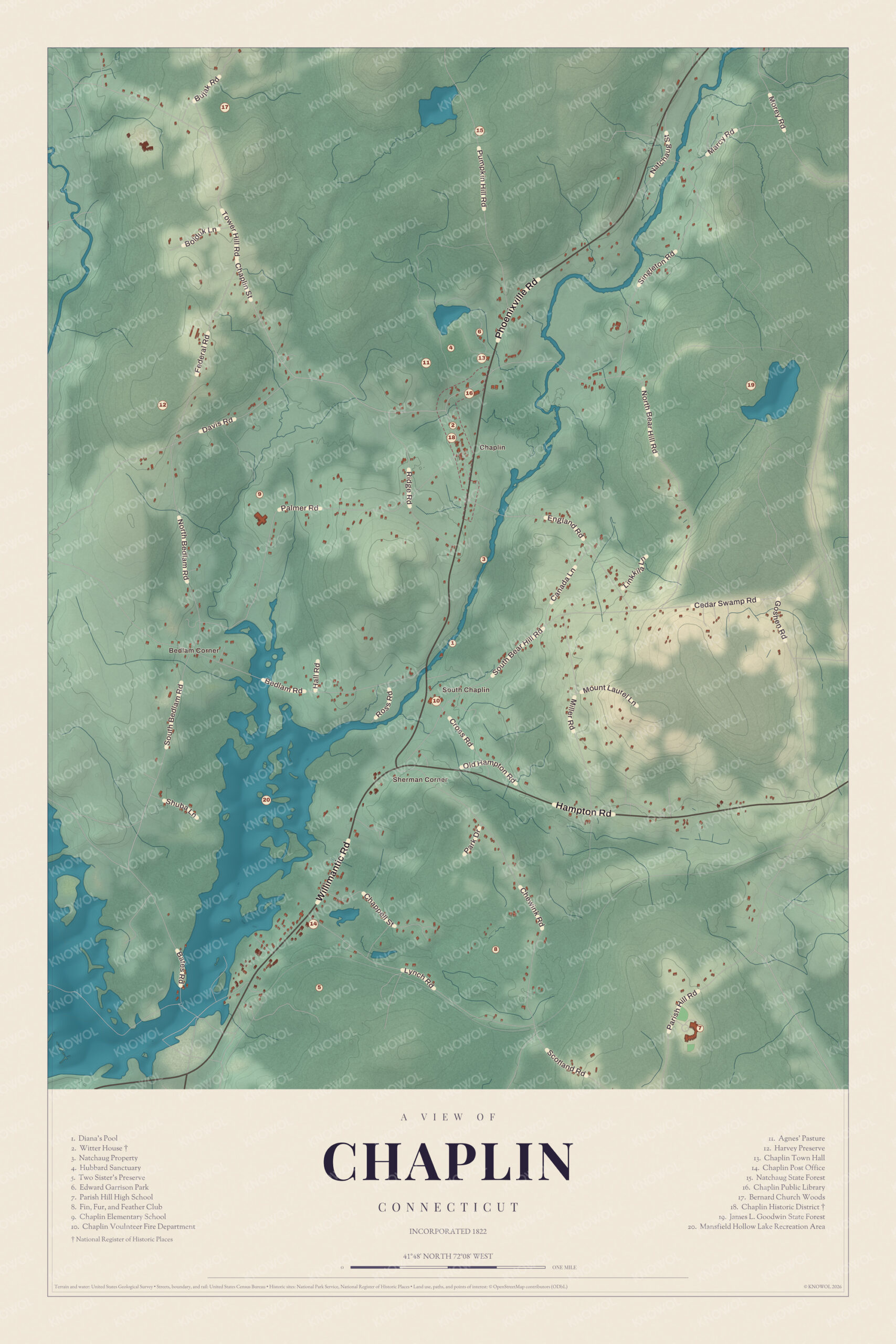
Shaded hills from the Natchaug River valley out to Bedlam Corner, with Chaplin, South Chaplin, Bedlam Corner, Sherman Corner and Mansfield Hollow Lake printed by name, and a guide of 20 numbered landmarks with the National Register sites marked.6
The story of Chaplin
Deacon Chaplin's church
Chaplin began with one young man in the woods. Benjamin Chaplin cleared a homestead on the Natchaug, lived alone for a while making baskets and wooden trays, and in 1747 married the widow Mary Ross. He was a skilled surveyor, and in 1756 he bought 1,765 acres that crossed the river in nine places. At one time he owned 3,000 acres. When he died in 1795, his will left money for a church near his home. The society that grew from it was named Chaplin in 1809, its church was formed in 1810, and on August 25, 1814, the meetinghouse frame went up on Chaplin's Hill amid great public rejoicings. The town followed in 1822.73892
Silk, boots and paper on the Natchaug
In the 1830s Chaplin village was one street more than a mile long, with about 30 houses, three stores, a jeweller, a tavern, a hat factory and several shoemakers' shops. About 40 hands made calfskin boots and brogans worth $30,000 a year. The women of the town raised the silkworms and reeled and spun about 1,200 pounds of raw silk a year. In 1835 the Lyons of Boston built a big paper mill on the Natchaug half a mile south of the village, making paper mostly for New York. It burned to the ground in 1870, was rebuilt, burned again and was rebuilt once more. The river had the power, but no railroad came, and for half a century the mills hardly grew.4101112
Saints Rest
By the 1880s Chaplin Center had a nickname, Saints Rest, because several retired ministers had chosen to spend their last years there. It was a temperance town, with no saloon, tavern or dance hall. On Sundays David Griggs's old horse Major came to church as regularly as his master, bringing neighbors who couldn't otherwise get there. A mile from the Center, Deacon Origen Bennett's calls to his oxen, Haw, Bright, Gee, Brown, carried clear across the meadow. On May 31, 1910, more than three hundred guests came for the church's hundredth birthday, the biggest day the town had seen in years. Four years later Jared and Johanna Lincoln marked seventy years of marriage at their Chaplin home.131415161718
Through the years
24 moments from 1747 to today.
- 1747Benjamin Chaplin, who has been living alone on the Natchaug making baskets and wooden trays, marries the widow Mary Ross.7
- 1756Chaplin buys 1,765 acres from the Brattles of Cambridge, land that crosses the Natchaug in nine places.7
- 1795Deacon Benjamin Chaplin dies on March 25, leaving money in his will for a church near his home.19
- 1809The legislature incorporates a new church society and names it Chaplin, after its benefactor.8
- 1810The church is formed on May 31.8
- 1814On August 25 the meetinghouse frame is raised on Chaplin's Hill amid great public rejoicings.9
- 1815The society accepts the finished meetinghouse in September and dedicates it.9
- 1820Work begins on Dr. Oren Witter's brick house on Chaplin Street, finished in 1821.20
- 1822Chaplin becomes a town, made from parts of Mansfield, Windham and Hampton.2
- 1835The Lyons of Boston build a large paper mill on the Natchaug, half a mile south of the village.4
- 1836About 1,000 people live in Chaplin, and its one long street has a hat factory, a tavern and shoemakers' shops.4
- 1840The building now listed as the former town hall goes up on Chaplin Street.2
- 1850Eaton's Store is built on Chaplin Street.2
- 1863Peter Lyon, the paper maker who called his Chaplin home a paradise in the woods, dies here at 87.10
- 1870The paper mill, run by Greene and Borthwick, is destroyed by fire. It's rebuilt, burns again and is rebuilt again.11
- 1889A county history calls Chaplin a temperance town, with no saloon, tavern or dancing hall.14
- 1901On October 7 the town votes to start a free library, helped by a $100 gift from Seth Moseley.21
- 1910The church celebrates its hundredth year on May 31 and unveils a bronze tablet to Benjamin Chaplin.17
- 1911The Ross Memorial Library building goes up on Chaplin Street.2
- 1914Jared and Johanna Lincoln celebrate seventy years of marriage at their Chaplin home.18
- 1952The Army Corps of Engineers finishes the Mansfield Hollow Dam, with part of its flood storage land in Chaplin.6
- 1964James L. Goodwin's forest becomes public land.6
- 1970The Witter House is listed on the National Register.20
- 1978The Chaplin Historic District is listed on the National Register.2
Places to see
The numbers match the landmark guide printed on the 2026 map.
- 1Diana's PoolNatchaug River, toward South Chaplin. Rocky pool on the Natchaug.
- 2Witter HouseChaplin Street. Brick Federal house of 1820 and 1821.
- 4Hubbard SanctuaryNorth of the village. Woods just north of the center.Visit their website
- 11Agnes' PastureNorth of the village. Open land near the old center.Visit their website
- 13Chaplin Town HallNorth of the old center. Today's seat of town government.
- 15Natchaug State ForestReaches into six towns. Trails for hiking, riding and skiing.
- 16Chaplin Public LibraryNorth of the old center. The town's free library.
- 18Chaplin Historic DistrictChaplin Street. The early 1800s village, listed 1978.
- 19James L. Goodwin State ForestEast. Pine Acres Lake and 14 miles of trails.Visit their website
- 20Mansfield Hollow Lake Recreation AreaSouth. Flood control land along the Natchaug.
On the National Register
All 2 places in Chaplin on the National Register of Historic Places that still stand today, oldest first, and why each one matters.5
-
Chaplin Historic District
The village center runs about eight tenths of a mile along Chaplin Street and was mostly built in the early 1800s around the Congregational Church of 1812 to 1815. Because it had no water power and the railroads passed it by, it survives as a good example of early 19th century town planning.2
-
Witter House
A fine and little changed brick house of the Federal period, with seven fireplaces with carved mantels and a free standing carved column in each front parlor. Three generations of doctors named Oren Witter owned it, and the first was Chaplin's first town clerk.20
In their words
“In the summer season the wild scenery of nature, which meets the eye of the traveler in passing up and down on this route, winding his way along the banks of the Natchaug, is delightfully romantic.”
Connecticut historical collections, 18374
“If you prefer to follow the state road to Eastford, the quiet beauty of Chaplin Centre itself, with the white church on the hill, will have impressed you”
A modern history of Windham County, 1920, on the drive through Chaplin22
“The citizens of Chaplin were unwearied in their efforts to promote the objects of the session and the happiness of the members of the Institute.”
The Connecticut Common School Journal, 1862, on the teachers' institute held in Chaplin23
Nearby towns
Sources
- Chaplin, Connecticut, Wikipedia
- Chaplin Historic District, Wikipedia
- Connecticut historical collections (1837), on Deacon Chaplin, Internet Archive
- Connecticut historical collections (1837), on the town of Chaplin, Internet Archive
- National Register of Historic Places listings in Windham County, Connecticut, Wikipedia
- Map of Chaplin, Connecticut in 2026, KNOWOL (USGS elevation, Census Bureau roads)
- History of Windham County, Connecticut (1889), on Benjamin Chaplin, Internet Archive
- Connecticut historical collections (1837), on the Chaplin society and church, Internet Archive
- History of Windham County, Connecticut (1874), on building the Chaplin meetinghouse, Internet Archive
- History of Windham County, Connecticut (1889), on the Chaplin paper mill, Internet Archive
- Genealogical and biographical record of New London County, Connecticut (1905), on Alexander C. Borthwick, Internet Archive
- History of Windham County, Connecticut (1889), on Chaplin's early trades, Internet Archive
- A modern history of Windham County, Connecticut (1920), on Chaplin Center, Internet Archive
- History of Windham County, Connecticut (1889), on the Chaplin church, Internet Archive
- A modern history of Windham County, Connecticut (1920), on the Chaplin choir and Major the horse, Internet Archive
- A modern history of Windham County, Connecticut (1920), on Deacon Origen Bennett, Internet Archive
- A modern history of Windham County, Connecticut (1920), on the church centennial, Internet Archive
- A modern history of Windham County, Connecticut (1920), on Jared W. Lincoln, Internet Archive
- Connecticut historical collections (1837), on Deacon Chaplin's monument, Internet Archive
- Witter House, Wikipedia
- A modern history of Windham County, Connecticut (1920), on the William Ross Public Library, Internet Archive
- A modern history of Windham County, Connecticut (1920), on the drive through Chaplin, Internet Archive
- The Connecticut Common School Journal (November 1862), Internet Archive