
Once the North Society of Preston, a town of mill villages on the Pachaug and Quinebaug rivers, where Eleazer Jewett's mill seat of 1771 grew into the borough of Jewett City.
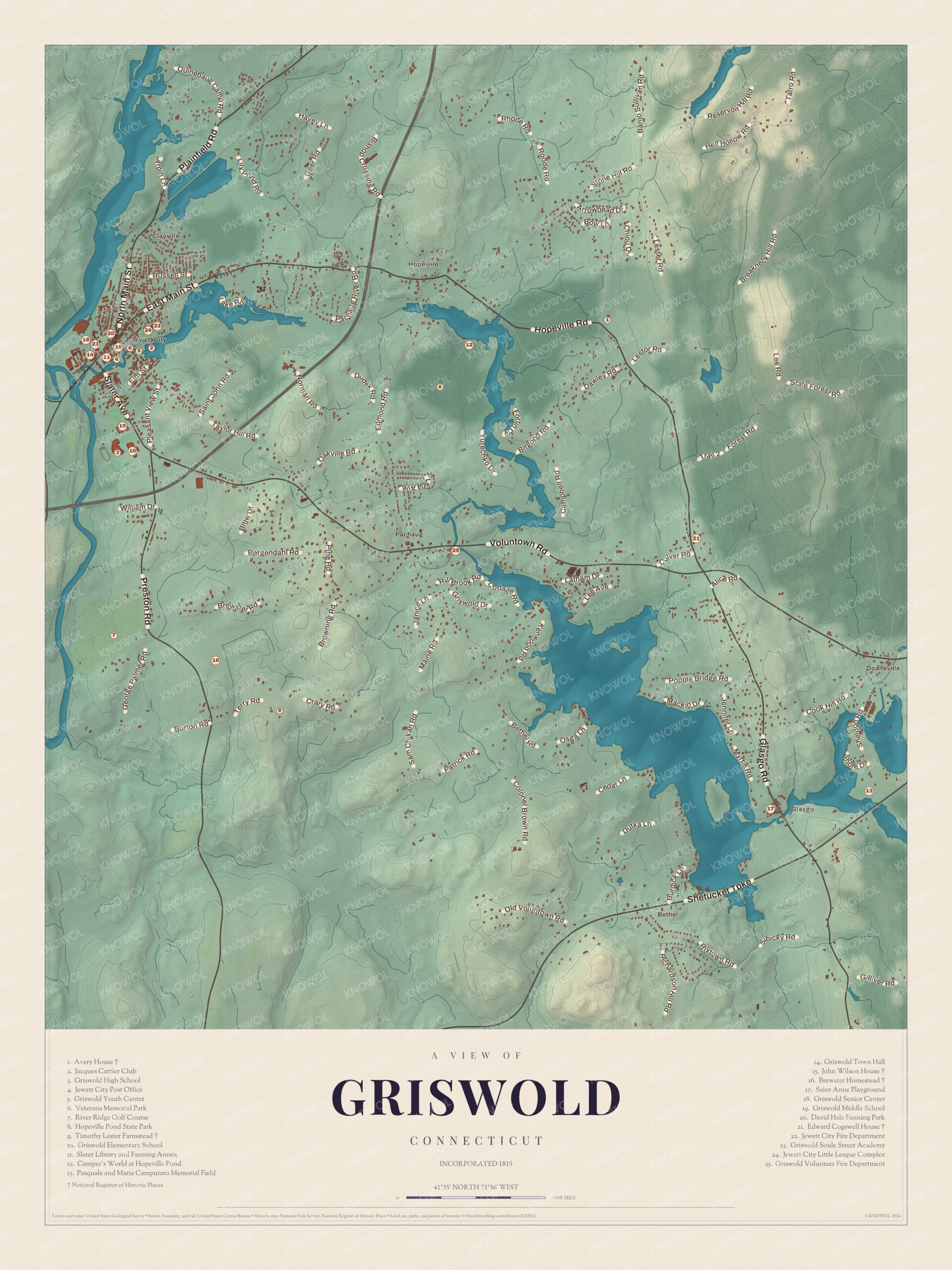
Griswold on the map
Click the map to look closer.
Griswold today
By KNOWOL
Shaded hills from Clayville and Jewett City out to Hopeville Pond and the Pachaug River, the town's roads printed by name, and a guide of 25 numbered landmarks with the National Register sites marked.5
The story of Griswold
The man who made Jewett City
Jewett City began with one man and a mill seat. In April 1771 Eleazer Jewett settled by the rapids of the Pachaug River with a small farm. He built a gristmill, then a sawmill, and sold off pieces of his land so others would settle near him. About 1790 his son-in-law John Wilson, a clothier from Massachusetts, joined him, and by December 1793 Wilson's fulling mill was open for business. Jewett later added a hotel to his mills. As the town lines shifted, Wilson served as a selectman of Norwich, of Preston and of Griswold without ever moving house. Jewett lived into his eighty-seventh year, and his gravestone says the village owed its importance to his industry and kindness, and that its name will keep his memory.2678
Cotton on the Pachaug
The mills came one after another along the Pachaug. In 1804 Elisha Rose ran an oil mill and John Scholfield Jr. started a carding machine, carding wool for twelve cents a pound. In 1814 the Fanning Manufacturing Company began making cotton yarn and cloth. Wilson's old woolen mill burned in 1827, and the Slater cotton mill later went up on the site. When John F. Slater took charge it had ninety looms, and by his death in 1884 it had more than five times as many. Upriver, John Slater's Hope Mill gave Hopeville its name before it burned in 1881. Even then, an 1882 history said there was water enough near the depot to run another 120,000 spindles.7910113
Cheese for the raising
Griswold started out as the North Society of Preston, formed in 1716 by families who were tired of the long trip to church in Preston. In 1717 they split into two camps over where the meeting-house should stand, until the legislature sent a committee to settle it. When the frame finally went up, the society voted forty-one shillings and eight pence for a hundredweight of cheese for the raising. The church was organized on November 30, 1720, with Hezekiah Lord as its pastor. An 1882 history called it, in its best days, one of the strongest churches in eastern Connecticut. In 1815 North Preston became its own town and took the name of Governor Roger Griswold.1121314
Through the years
25 moments from 1704 to today.
- 1704Joseph Kinne comes to the area from Salem, Massachusetts.15
- 1711Stephen Gates is granted land at what becomes Hopeville and builds a gristmill and a sawmill.11
- 1713Daniel Kinne dies; his is the oldest marked stone in the Kinne Cemetery.15
- 1716The North Society of Preston is formed so families can worship closer to home.1
- 1717North Preston quarrels over where to put its meeting-house until a legislative committee settles it.12
- 1720The First Church is organized on November 30, with Hezekiah Lord as pastor.13
- 1740Simon Brewster begins farming 250 acres on what's now Preston Road.16
- 1741Timothy Lester marries Mehitable Belcher and their farm in southern Griswold begins.17
- 1771In April, Eleazer Jewett begins the settlement of Jewett City.2
- 1781About this year John Wilson builds his Georgian house in Jewett City.18
- 1793John Wilson's fulling mill opens for customers in December.7
- 1804John Scholfield Jr. starts a carding machine, carding wool for twelve cents a pound.7
- 1814The Fanning Manufacturing Company begins making cotton yarn and cloth.9
- 1815Griswold is incorporated as a town, named for Governor Roger Griswold.1
- 1825Jewett City gets its own Congregational society and church.14
- 1827The old Wilson woolen mill burns; the Slater cotton mill later rises on the site.9
- 1840Hopeville is a thriving village, known for its woolens.11
- 1866The Catholics of Jewett City buy the old stone church for $1,700.19
- 1873The Jewett City Savings Bank opens, and Miss Mary L. Brown makes its first deposit, $100.20
- 1881The Hopeville mill burns and is never rebuilt.11
- 1884The Slater Library goes up on Main Street with money from John Fox Slater.21
- 1886Heavy rains break the Ashland dam and the flood washes out the mill bridges.22
- 1895Jewett City is incorporated as a borough within the town.1
- 1935The Civilian Conservation Corps fixes up the Avery House for park use.23
- 1938Hopeville Pond becomes a state park.5
Places to see
The numbers match the landmark guide printed on the 2026 map.
- 1Avery HouseHopeville Pond State Park. The park manager's house, about 1770.
- 6Veterans Memorial ParkJewett City. A park in the borough.
- 8Hopeville Pond State ParkHopeville. 554 acres on the dammed Pachaug.Visit their website
- 9Timothy Lester FarmsteadCrary and Browning Roads. Garrison house in the Revolution.
- 11Slater Library and Fanning AnnexMain Street, Jewett City. Granite and brownstone library of 1884.Visit their website
- 14Griswold Town HallJewett City. Town offices in the borough.
- 15John Wilson HouseAshland Street, Jewett City. Mill founder's Georgian house, about 1781.
- 16Brewster HomesteadPreston Road. Six generations of Brewsters lived here.
- 20David Hale Fanning ParkJewett City. Named for the library's benefactor.
- 21Edward Cogswell HouseHopeville Road. An early settler's house, about 1740.
On the National Register
All 7 places in Griswold on the National Register of Historic Places that still stand today, oldest first, and why each one matters.4
-
Kinne Cemetery
The Kinne family burying ground, whose oldest marked stone is for Daniel Kinne, who died in 1713. Its carved stones are good examples of New England funeral art of the 1700s and 1800s, and Isaac C. Glasko, the Black blacksmith and landowner the village of Glasgo is named for, is buried here. It's on the Connecticut Freedom Trail.15
-
Brewster Homestead
One of the oldest buildings in Griswold, on land the Mohegan sachem Uncas gave to Jonathan Brewster, son of Plymouth's William Brewster. Simon Brewster began farming 250 acres here in 1740, and six generations of the family owned the house until 1996.16
-
Edward Cogswell House
Its ell was built about 1740 by Edward Cogswell, who came here in 1714 as one of the first settlers and helped lead the separation of Griswold from Preston. It's one of the town's few 18th-century buildings, and his descendants kept it until 1862.24
-
Timothy Lester Farmstead
Also called the Garrison House, it served as a garrison and training ground in the Revolution. The farmhouse has a huge kitchen hearth with two beehive ovens, and stone walls still line its 43 acres.17
-
Avery House
A central-chimney Colonial with fine paneled fireplaces and its original door frames and latch hardware. The Civilian Conservation Corps fixed it up for park use in 1935, and it's now the park manager's house.23
-
John Wilson House
Built by John Wilson, Eleazer Jewett's son-in-law, who started a fulling mill in 1790 and incorporated the Jewett City Cotton Manufacturing Company in 1815. Alfred Young, agent of the Slater Mills, moved it a short way in the 1860s, and it's the only house left tied to either man.18
-
Slater Library and Fanning Annex
A Romanesque Revival library of granite and brownstone, paid for by the industrialist John Fox Slater and designed by Stephen C. Earle. The Fanning Annex of 1930, a bequest of David Hale Fanning, nearly doubled its size.21
In their words
“In April, 1771, he began the settlement of this village, and from his persevering industry and active benevolence it has derived its present importance. Its name will perpetuate his memory.”
Eleazer Jewett's gravestone in the Jewett City cemetery, as given in the Genealogical and biographical record of New London County, 19052
“Many of the building sites contiguous to the village are as charming as those on the Hudson”
History of New London County, 1882, on Jewett City25
“The church in its better days, from forty to a hundred years ago, was one of the strongest and the community one of the most intelligent in Eastern Connecticut.”
History of New London County, 1882, on the First Church in Griswold14
Nearby towns
Sources
- Griswold, Connecticut, Wikipedia
- Genealogical and biographical record of New London County, Connecticut (1905), on Eleazer Jewett, Internet Archive
- History of New London County, Connecticut (1882), on the water power at Jewett City, Internet Archive
- National Register of Historic Places listings in New London County, Connecticut, Wikipedia
- Map of Griswold, Connecticut in 2026, KNOWOL (USGS elevation, Census Bureau roads)
- History of New London County, Connecticut (1882), on Eleazer Jewett, Internet Archive
- History of New London County, Connecticut (1882), on the first mills of Jewett City, Internet Archive
- History of New London County, Connecticut (1882), quoting H. L. Reade on early Jewett City, Internet Archive
- History of New London County, Connecticut (1882), on the cotton mills of Jewett City, Internet Archive
- Representative men of Connecticut, 1861-1894 (1894), on John F. Slater's Jewett City mill, Internet Archive
- Hopeville Pond State Park, Wikipedia
- History of New London County, Connecticut (1882), on the North Preston meeting-house, Internet Archive
- History of New London County, Connecticut (1882), on the First Church in Griswold, Internet Archive
- History of New London County, Connecticut (1882), on the Griswold churches, Internet Archive
- Kinne Cemetery, Wikipedia
- Brewster Homestead, Wikipedia
- Timothy Lester Farmstead, Wikipedia
- John Wilson House (Jewett City, Connecticut), Wikipedia
- History of New London County, Connecticut (1882), on the Catholic church in Jewett City, Internet Archive
- History of New London County, Connecticut (1882), on the Jewett City Savings Bank, Internet Archive
- Slater Library, Wikipedia
- Ashland Mill Bridge, Wikipedia
- Avery House (Griswold, Connecticut), Wikipedia
- Edward Cogswell House, Wikipedia
- History of New London County, Connecticut (1882), on Jewett City, Hopeville and Clayville, Internet Archive