
The town at the mouth of the Connecticut River where the Saybrook Colony built its fort in 1635, Yale began as the Collegiate School, and two lighthouses off Fenwick still mark the channel.
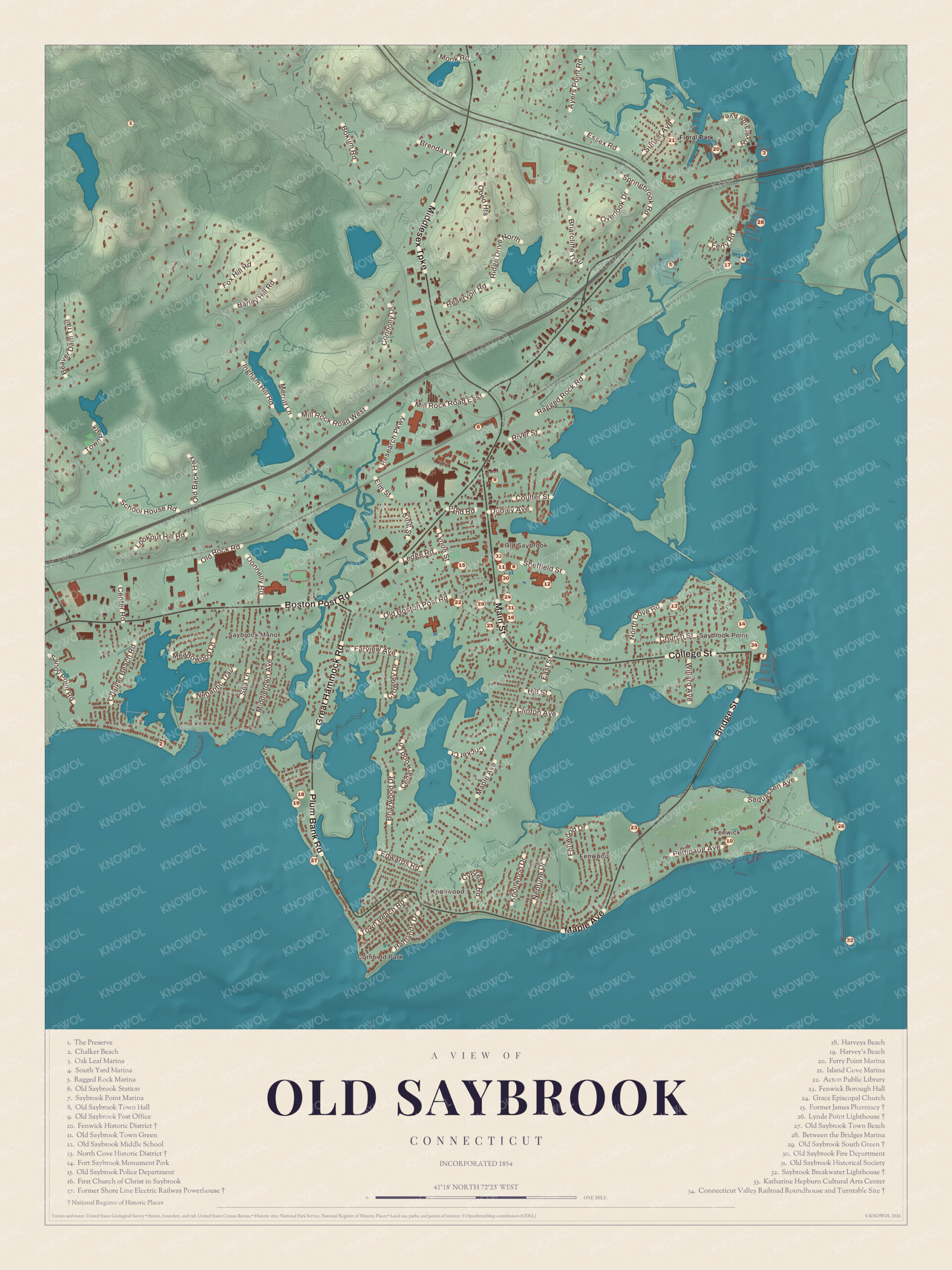
Old Saybrook on the map
Click the map to look closer.
Old Saybrook today
By KNOWOL
Shaded land from Otter Cove Estates down to the coves and points along the Sound, every street, Saybrook Point, Fenwick and Saybrook Manor, and a guide of 34 numbered landmarks with the National Register sites marked.2
The story of Old Saybrook
Lady Fenwick's tomb
In July 1639 George Fenwick came back to Saybrook and brought his wife with him. A letter of the time found the couple and their chaplain living in a fair house at the fort, well fortified. A 1916 book says she loved flowers and fruit, kept gardens and pet rabbits, and brought red Devon cattle across the ocean. When she died she was buried within the fort, and Matthew Griswold, who worked for her husband, furnished her tomb of hewn sandstone, with no name on it. It stood near the old fort for two centuries. When the Valley Railroad came through, the tomb was moved with care to the old burying ground on the Point, and the story goes that a heavy braid of her auburn hair was shared out among the villagers.5678910
Four thousand shad in a day
Old Saybrook's shad fisheries once gave work to 250 or 300 men. Gangs of eight or nine hauled their seines straight onto a stony beach near the lighthouse, a spot called the Pavement. In 1835 or 1836 the Pavement took four thousand shad in one day, 1,700 in a single haul. With a pile of unsalted fish already on shore, one owner wanted to let the last catch go, but the others stopped fishing and dressed every one, with help from the town. On election day the fishing gangs marched to Judge William Lynde's house behind "Governor" L'Hommedieu, who rode the horse that turned the capstan, with perhaps a drum and fife and boys carrying sticks for muskets. In 1884 the town was still called the headquarters of the shad fishery.3119
Yale's first commencement
On October 9, 1701, the Collegiate School of Connecticut was chartered, and that November its trustees voted to fix the school at Saybrook. The first commencement was held on September 16, 1702, in the Reverend Thomas Buckingham's house at Saybrook Point. Nathaniel Lynde offered a small house and land near the old burying ground for the school, for as long as it stayed. In 1708 a synod in the church on the Green adopted the Saybrook Platform, a strict code for Connecticut's churches. Years later, the story goes, a farmer asked a fisherman what the Saybrook Platform was, and the fisherman guessed it was the old platform down yonder where they used to clean fish. The school moved to New Haven in 1716 and became Yale University.112131415
Through the years
25 moments from 1624 to today.
- 1624Dutch traders set up a short-lived trading post here called Kievits Hoek, or Plover's Corner.1
- 1635The Saybrook Colony is founded, and Lion Gardiner builds its fort on Saybrook Point.2
- 1639In July George Fenwick comes back to Saybrook and brings his wife, Lady Fenwick.5
- 1643The fort's palisades, whole trees set in the ground, are so rotten they could almost be pushed over.16
- 1644Fenwick sells the fort to Connecticut, and the duties paid to him become the colony's first tariff.17
- 1647The wooden fort burns in winter, and Captain John Mason, his wife and child narrowly escape.18
- 1659Mason leads most of the settlers away to found Norwich.1
- 1662The Saybrook ferry to Lyme is authorized, the first ferry in the county with privileges guaranteed by law.19
- 1675Major Andros appears in the Sound with an armed force, making for the fort, and Captain Thomas Bull's soldiers arrive to hold it.20
- 1679A receipt is given for the tombstone of the Lady Alice Boteler, as Lady Fenwick was still called.21
- 1701The Collegiate School of Connecticut is chartered on October 9 and settles at Saybrook.1
- 1702The school's first commencement is held on September 16 at the Reverend Thomas Buckingham's house on Saybrook Point.13
- 1708A synod meeting in the church on the Green adopts the Saybrook Platform.14
- 1712John Burrows builds the Black Horse Tavern on North Cove Road.22
- 1767William Hart Jr., merchant and later general, builds his house on Main Street.23
- 1785Humphrey Pratt builds his tavern, a stagecoach stop where he kept the town's first post office.24
- 1835In 1835 or 1836 the Pavement fishery near the lighthouse takes 4,000 shad in one day.3
- 1839The 65-foot brownstone Lynde Point Lighthouse is lit.25
- 1852The General Assembly makes Old Saybrook a town separate from Saybrook.1
- 1854The northern part of Old Saybrook becomes the town of Essex.1
- 1860Jeannette Hart gives a handsome iron fence for the front of the old cemetery on Saybrook Point.26
- 1870Lady Fenwick's tomb is moved from the old fort to the cemetery on the Point.6
- 1871The Connecticut Valley Railroad builds a roundhouse and turntable at Saybrook Point, partly on the remains of the fort.27
- 1886The Saybrook Breakwater Lighthouse, the Outer Light, is built off Lynde Point.28
- 1911Anna Louise James earns her pharmacist's license, the first African American woman pharmacist in Connecticut.29
Places to see
The numbers match the landmark guide printed on the 2026 map.
- 10Fenwick Historic DistrictFenwick. Shingle-style cottages and a golf course.
- 13North Cove Historic DistrictNorth Cove Road. Old port and shipbuilding street.
- 14Fort Saybrook Monument ParkSaybrook Point. Where the colony's first fort stood.
- 17Former Shore Line Electric Railway PowerhouseAlong the river. Trolley powerhouse of 1908 to 1910.
- 25Former James PharmacyMain Street and Pennywise Lane. Anna Louise James's drugstore and home.
- 26Lynde Point LighthouseFenwick. The Inner Light, brownstone, lit 1839.
- 29Old Saybrook South GreenMain Street. The green laid out about 1760.
- 32Saybrook Breakwater LighthouseOff Lynde Point. The Outer Light on the license plates.
- 33Katharine Hepburn Cultural Arts CenterMain Street. The Kate, in the old town hall.Visit their website
- 34Connecticut Valley Railroad Roundhouse and Turntable SiteSaybrook Point. Foundations of 1871, excavated 1981 and 1982.
On the National Register
All 21 places in Old Saybrook on the National Register of Historic Places that still stand today, oldest first, and why each one matters.4
-
Connecticut Valley Railroad Roundhouse and Turntable Site
The railroad built its roundhouse and turntable partly on the remains of Fort Saybrook, the Saybrook Colony's main fort. Their brick and stone foundations, excavated in 1981 and 1982, are on view in the park.27
-
Elisha Bushnell House
Dated to 1678 by the architectural historian J. Frederick Kelly, it began as two rooms around a central chimney and grew into a classic saltbox. It's one of Connecticut's oldest surviving buildings.30
-
Cypress Cemetery
The town's oldest cemetery, on Saybrook Point and still in use, with documented burials back to 1679 and gravestones by carvers from Boston, Newport, Middletown and beyond. Lady Alice Fenwick and Anna Louise James are buried here.31
-
Parker House
A gambrel-roofed house built about 1679 by William Parker, one of the first settlers of Hartford, probably for his son Joseph. It stayed in the Parker family until the 1960s.32
-
John Whittlesey Jr. House
Its rear ell is estimated to date to 1693, with the main block added about 1750. The Whittleseys kept the nearby ferry landing on the Connecticut River and ran the ferry.33
-
North Cove Historic District
North Cove Road was laid out from the fort to the mainland in the 1600s, and its houses were mostly built between 1700 and 1855, when it was a port and shipbuilding community. The oldest is the Robert Bull House of about 1700.34
-
Black Horse Tavern
Built about 1712 by John Burrows near the old fort site, it served shipbuilders on the North Cove and travelers on the river road. It was a tavern under various owners until 1924.22
-
Samuel Eliot House
A well preserved Georgian house traditionally dated to 1737, when Samuel Eliot, son of Yale founding trustee Jared Eliot, married. The Stowe and Newell families owned it for many years from 1753.35
-
Jedidiah Dudley House
One of the Dudley and Whittlesey family houses clustered at the old ferry landing. In 1662 John Whittlesey and William Dudley were granted the ferry across the river to Lyme, and Jedidiah Dudley probably built this house.36
-
William Tully House
Known as Heartsease, it began as a one-room house and grew. In 1779 the family defended it against Tories trying to take goods to the British, and it was later the home of Dr. William Tully, a leading Connecticut physician.37
-
Old Saybrook South Green
The town green, laid out about 1760, was soon lined with fine houses of merchants and politicians, most built between 1760 and 1900 while Old Saybrook was a busy port. Grace Episcopal Church of 1872 and the Masonic Hall are here too.38
-
Ambrose Whittlesey House
A one-story section of 1765 with a two-story main block added about 1800, mixing Georgian and Federal style. Ambrose Whittlesey was a sea captain in the West Indies trade, and the house stayed in the family until 1967.39
-
Gen. William Hart House
Built by the merchant William Hart Jr., who served in the Revolution and later ran for governor. It's now owned by the Old Saybrook Historical Society, with archives and gardens on the grounds.23
-
Humphrey Pratt Tavern
Humphrey Pratt, the town's first postmaster, kept the post office here, and it was a stagecoach stop on the Boston and New York road. The Marquis de Lafayette is said to have danced in its upstairs ballroom.24
-
Bushnell-Dickinson House
A gambrel-roofed Federal house built by Phineas Bushnell on what was, until about 1800, the main east and west road through town. His descendants kept it until 1934.40
-
James Pharmacy
Home and workplace of Anna Louise James, the first African American woman pharmacist in Connecticut, who ran the store until 1955. It's also the birthplace and childhood home of her niece, the author Ann Petry.29
-
Lynde Point Lighthouse
The Inner Light, a 65-foot octagonal brownstone tower lit in 1839, replacing a wooden tower of 1803. It was listed for its superior stonework and is still an active aid to navigation.25
-
Fenwick Historic District
About 195 acres of the borough of Fenwick, with 60 buildings, many in the Shingle style, and the Fenwick Golf Course. St. Mary's-By-the-Sea, designed by Francis Goodwin, was built in 1883.41
-
Saybrook Breakwater Lighthouse
The Outer Light, a sparkplug lighthouse at the end of the breakwater. With the Inner Light it marks the channel into the river, and it appears on Connecticut's Preserve the Sound license plates.28
-
Shore Line Electric Railway Power House
A coal-fired powerhouse on the river that made electricity for the Shore Line Electric Railway, the trolley line from New Haven, with coal brought in by boat. It also powered the Connecticut River railroad bridge.42
-
Old Saybrook Town Hall and Theater
A Colonial Revival town hall and theater by the New London architect James Sweeney, opened in 1911. Since 2009 it's been the Katharine Hepburn Cultural Arts Center, with a 285-seat theater and a Hepburn museum.43
In their words
“Its streets are broad and beautiful, and well lined with the venerated trees which the first settlers planted.”
History of New London County, 1882, on Saybrook, its Hart mansion and Fenwick Hall44
“Its principal street is broad, and the houses indicate respectable and wealthy owners, which give the place a very retired, but very aristocratic air.”
The historical, statistical and industrial review of the state of Connecticut, 18849
“About a mile north of the village of Old Saybrook, on the road to Essex, is a spot known as "Obed's Heights," from which no finer view in the valley of the Connecticut is to be found.”
The Connecticut Magazine, 190545
Nearby towns
Sources
- Old Saybrook, Connecticut, Wikipedia
- Map of Old Saybrook, Connecticut in 2026, KNOWOL (USGS elevation, Census Bureau roads)
- History of Middlesex County, Connecticut (1884), on the shad fisheries, Internet Archive
- National Register of Historic Places listings in Middlesex County, Connecticut, Wikipedia
- Historic towns of the Connecticut River Valley (1906), on Fenwick's return, Internet Archive
- Once upon a time in Connecticut (1916), on Lady Fenwick, Internet Archive
- History of Middlesex County, Connecticut (1884), on Matthew Griswold and Lady Fenwick's tomb, Internet Archive
- A history of Connecticut (1887), on Lady Fenwick's tomb, Internet Archive
- The historical, statistical and industrial review of the state of Connecticut (1884), on Old Saybrook, Internet Archive
- The Connecticut River and the valley of the Connecticut (1907), on Lady Fenwick's tomb, Internet Archive
- History of Middlesex County, Connecticut (1884), on the Sound fisheries, Internet Archive
- Historical landmarks of Connecticut (1897), on the Collegiate School at Saybrook, Internet Archive
- History of New Haven County, Connecticut (1892), on the first commencement, Internet Archive
- Old paths and legends of the New England border (1907), on the church on the Green, Internet Archive
- The Connecticut River and the valley of the Connecticut (1907), on the Saybrook Platform, Internet Archive
- Wadsworth, or the Charter Oak (1904), on the fort in 1643, Internet Archive
- The History of Connecticut (1855), on the Fenwick agreement, Internet Archive
- History of Norwich, Connecticut (1874), on the fire at Saybrook Fort, Internet Archive
- History of Middlesex County, Connecticut (1884), on the ferries, Internet Archive
- The Connecticut River and the valley of the Connecticut (1906), on Andros at Saybrook Fort, Internet Archive
- The History of Connecticut (1855), on Lady Fenwick's tombstone, Internet Archive
- Black Horse Tavern (Old Saybrook, Connecticut), Wikipedia
- Gen. William Hart House, Wikipedia
- Humphrey Pratt Tavern, Wikipedia
- Lynde Point Light, Wikipedia
- History of Middlesex County, Connecticut (1884), on the Hart family, Internet Archive
- Connecticut Valley Railroad Roundhouse and Turntable Site, Wikipedia
- Saybrook Breakwater Light, Wikipedia
- James Pharmacy, Wikipedia
- Elisha Bushnell House, Wikipedia
- Cypress Cemetery, Wikipedia
- Parker House (Old Saybrook, Connecticut), Wikipedia
- John Whittlesey Jr. House, Wikipedia
- North Cove Historic District, Wikipedia
- Samuel Eliot House, Wikipedia
- Jedidiah Dudley House, Wikipedia
- William Tully House, Wikipedia
- Old Saybrook South Green, Wikipedia
- Ambrose Whittlesey House, Wikipedia
- Bushnell-Dickinson House, Wikipedia
- Fenwick, Connecticut (Fenwick Historic District), Wikipedia
- Shore Line Electric Railway (Power House), Wikipedia
- Katharine Hepburn Cultural Arts Center, Wikipedia
- History of New London County, Connecticut (1882), on Saybrook, Internet Archive
- The Connecticut Magazine (1905), on Obed's Heights, Internet Archive