
A wooded town on the Rhode Island line, granted to the volunteers of the Narragansett war, where the Pachaug River ran the Briggs cotton mills and the mill land became the start of Connecticut's largest state forest.
Voluntown on the map
Click the map to look closer.
Voluntown today
By KNOWOL
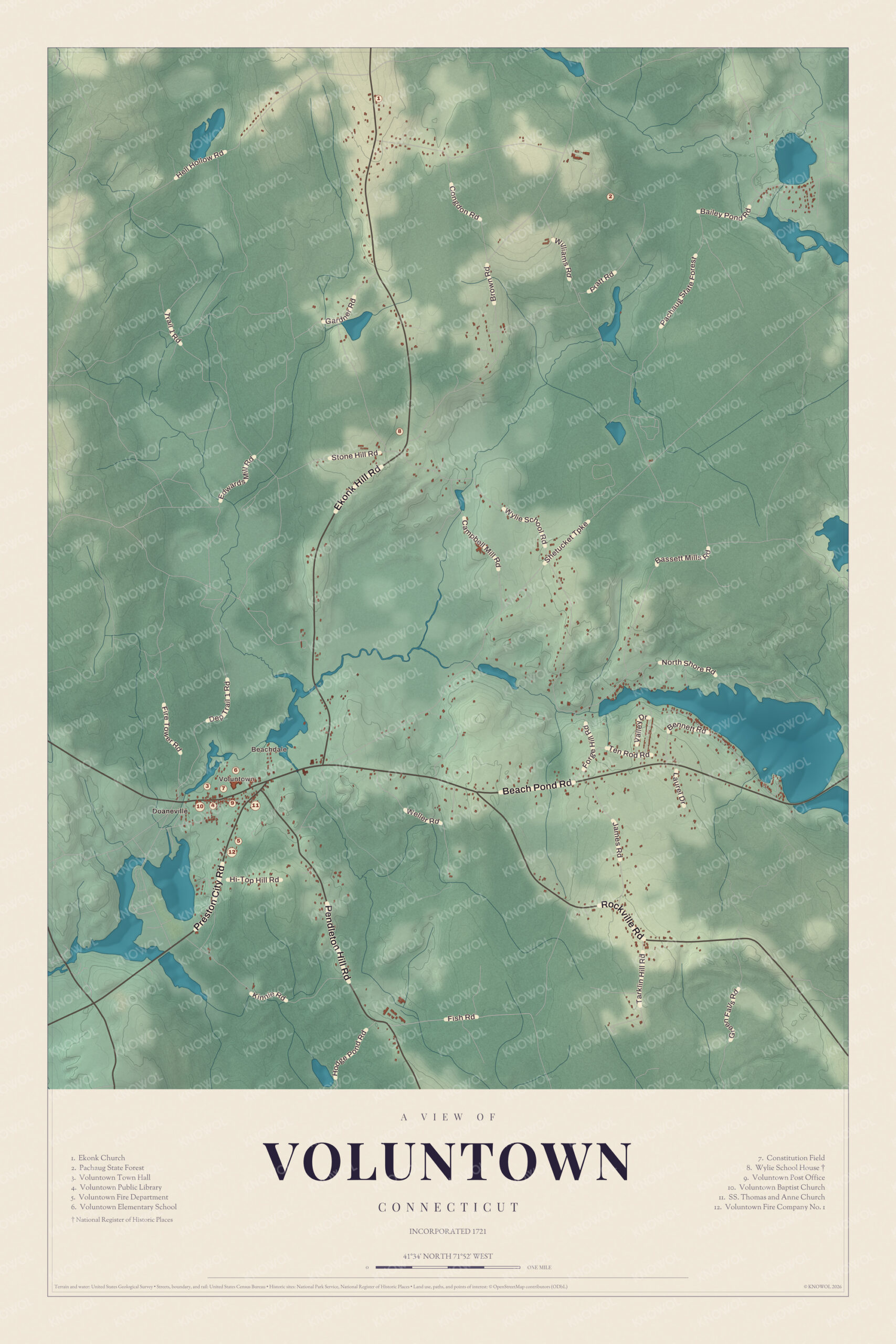
Shaded hills and the woods of Pachaug State Forest, every road from Beach Pond Road to Hell Hollow Road, Voluntown, Beachdale and Doaneville printed by name, and a guide of 12 numbered landmarks with the National Register site marked.2
The story of Voluntown
A town for the volunteers
Voluntown is named for the men who fought. In 1696 Lieut. Thomas Leffingwell of Norwich and Sergt. John Frink of Stonington asked the colony for a plantation for the English volunteers of the Narragansett war, and a tract six miles square was granted out of the conquered land. It wasn't much of a prize. The 1882 county history says the soil was poor and the place remote, and a pair of four-year-old steers once bought eighty-six acres. Samuel Fish is named as the first settler, and Fish descendants still owned their family's volunteer lots in 1905. Many of the newcomers were Scotch-Irish, and in 1723 they gathered under Rev. Samuel Dorrance, a Glasgow graduate, the first and for a long time the only Presbyterian church in Connecticut.56789
Beach Pond and the Briggs mills
The Pachaug River made Voluntown a mill town. In 1814 James Treat of Preston and others formed the Industry Manufacturing Company, one of the earliest cotton yarn mills in New England, and once Treat and his son-in-law Doane had it, Voluntown village grew up around it in a few years. In 1856 Ira G. Briggs bought the mills out of Treat's insolvent estate. To keep the wheels turning, Briggs built a new dam at Beach Pond and raised the road for half a mile, making the pond about 1,200 acres and ten feet deeper, so the mills could run all year instead of nine months. By 1922 the company made cloth, thread and even tire fabric. It closed in 1926, and in 1928 its land became the start of Pachaug State Forest.1011123131415
From a moving school to the Wylie School
Voluntown cared about its schools from the start. In 1732 the town voted to hire a schoolmaster for a "surkelating" school, one that moved around town, and in 1735 it was kept in four places, with the master, John Dunlap, paid thirty pounds plus meat, drink, washing and lodging. In 1792 a library association bought a hundred books. In the 1850s a one-room schoolhouse went up on Ekonk Hill on land from Henry Wylie, a local farmer. It served the north end of town until 1939, and Margaret Tanner, who taught in the town's schools for forty years, was its teacher from 1909. It's the only district school left in Voluntown, and the historical society keeps it with an old stove and desks inside.1617182
Through the years
24 moments from 1675 to today.
- 1675Colonial volunteers fight in King Philip's War, the war the town is named for.1
- 1696Thomas Leffingwell and John Frink ask for a plantation for the volunteers, and a tract six miles square is granted.5
- 1700The grant is confirmed and the land becomes a Volunteer Town.2
- 1705With the Mohegan claim settled, the town is surveyed and its bounds set.19
- 1721Voluntown is incorporated as a town.2
- 1723Rev. Samuel Dorrance gathers the first Presbyterian church in Connecticut.9
- 1732The town votes to hire a schoolmaster for a school that moves from place to place.16
- 1782Rochambeau's French army camps at Voluntown on its march north from Yorktown.20
- 1792A library association is formed and buys a hundred books.17
- 1794Sterling is set off from the north, taking 26 square miles and leaving 38.21
- 1814James Treat and others form the Industry Manufacturing Company on the Pachaug.10
- 1829The Shetucket Turnpike is chartered through Voluntown to the Rhode Island line.22
- 1834A forge in town is making iron from local bog ore.23
- 1856Ira G. Briggs and partners buy the old Treat mills and start the Beachdale Manufacturing Company.12
- 1858A new Line Meeting House goes up on the Sterling town line.24
- 1871The Briggs firm buys the Doane mill downstream.3
- 1881Voluntown moves from Windham County to New London County.1
- 1882Rev. Thomas J. Joynt builds a Catholic church in the village.25
- 1888Briggs runs about 15,000 spindles in three mills with 200 workers.14
- 1909Margaret Tanner begins teaching at the Wylie School.18
- 1926The Briggs directors vote to close the company and sell its property.14
- 1928The state buys 1,100 acres of Briggs land, the start of Pachaug State Forest.15
- 1939The Wylie School, the town's last district school, closes.18
- 1973The Pachaug-Great Meadow Swamp is named a National Natural Landmark.15
Places to see
The numbers match the landmark guide printed on the 2026 map.
- 1Ekonk ChurchFar north. The last stop in the guide.
- 2Pachaug State ForestMost of the town. Connecticut's largest state forest.Visit their website
- 3Voluntown Town HallVoluntown village. Town offices in the village.
- 4Voluntown Public LibraryVoluntown village. Close by the town hall.
- 6Voluntown Elementary SchoolVoluntown village. The district's one school, pre-K to 8.
- 7Constitution FieldVoluntown village. Playing field near the school.
- 8Wylie School HouseEkonk Hill Road. The town's last one-room school.
- 10Voluntown Baptist ChurchVoluntown village. Village church of the Baptists.
- 11SS. Thomas and Anne ChurchVoluntown village. The village's Catholic church.
- 12Voluntown Fire Company No. 1Voluntown village. The village fire company.
On the National Register
All 1 places in Voluntown on the National Register of Historic Places that still stand today, oldest first, and why each one matters.4
-
Wylie School
Built on land given by Henry Wylie, a local farmer, it served the northern part of Voluntown until 1939 and is the town's only surviving district school. Margaret Tanner taught there from 1909, and the local historical society now uses it as a meeting space and museum.18
In their words
“His young comrades called on him to lead them; and he closed his business and accepted the call”
The military and civil history of Connecticut during the war of 1861-65, 1869, on Capt. Isaac D. Kenyon, a Voluntown storekeeper26
“Despite its lean soil and local disadvantages it is gaining in many ways and has hopes of farther advancement.”
History of Windham County, Connecticut, 187427
“One foot may be in Sterling and the other foot in Voluntown.”
History of Windham County, Connecticut, 1889, on the Line Meeting House24
Nearby towns
Sources
- Voluntown, Connecticut, Wikipedia
- Map of Voluntown, Connecticut in 2026, KNOWOL (USGS elevation, Census Bureau roads)
- History of New London County, Connecticut (1882), on the Briggs mills and Beach Pond, Internet Archive
- National Register of Historic Places listings in New London County, Connecticut, Wikipedia
- History of New London County, Connecticut (1882), on the volunteers' grant, Internet Archive
- History of New London County, Connecticut (1882), on the first settlers, Internet Archive
- Genealogical and biographical record of New London County, Connecticut (1905), on the Fish family, Internet Archive
- A modern history of Windham County, Connecticut (1920), Internet Archive
- History of New London County, Connecticut (1882), on the Presbyterian church, Internet Archive
- History of New London County, Connecticut (1882), on the Industry Manufacturing Company, Internet Archive
- History of Windham County, Connecticut (1874), on Voluntown village, Internet Archive
- History of New London County, Connecticut (1882), on Ira G. Briggs, Internet Archive
- A modern history of New London County, Connecticut (1922), on the Briggs Manufacturing Company, Internet Archive
- Briggs Manufacturing Drives Voluntown's 19th-Century Cotton Economy, ConnecticutHistory.org
- The Story of Connecticut's Largest State Forest, ConnecticutHistory.org
- History of New London County, Connecticut (1882), on the first schools, Internet Archive
- History of New London County, Connecticut (1882), on the library of 1792, Internet Archive
- Wylie School, Wikipedia
- History of New London County, Connecticut (1882), on the survey of 1705, Internet Archive
- Map: Rochambeau's Camp at Voluntown, ConnecticutHistory.org
- Historic gleanings in Windham County, Connecticut (1899), Internet Archive
- History of Norwich, Connecticut (1866), on the Shetucket Turnpike, Internet Archive
- Sketch of the Geology and Mineralogy of New-London and Windham Counties, in Connecticut (1834), Internet Archive
- History of Windham County, Connecticut (1889), on the Line Meeting House, Internet Archive
- History of New London County, Connecticut (1882), on Voluntown's churches, Internet Archive
- The military and civil history of Connecticut during the war of 1861-65 (1869), on Capt. Isaac D. Kenyon, Internet Archive
- History of Windham County, Connecticut (1874), on Voluntown in the 1870s, Internet Archive