
Connecticut's first English settlement, where Plymouth men raised a trading house at the mouth of the Farmington in 1633 and the town later grew brick, tobacco and paper along its two rivers.
Windsor on the map
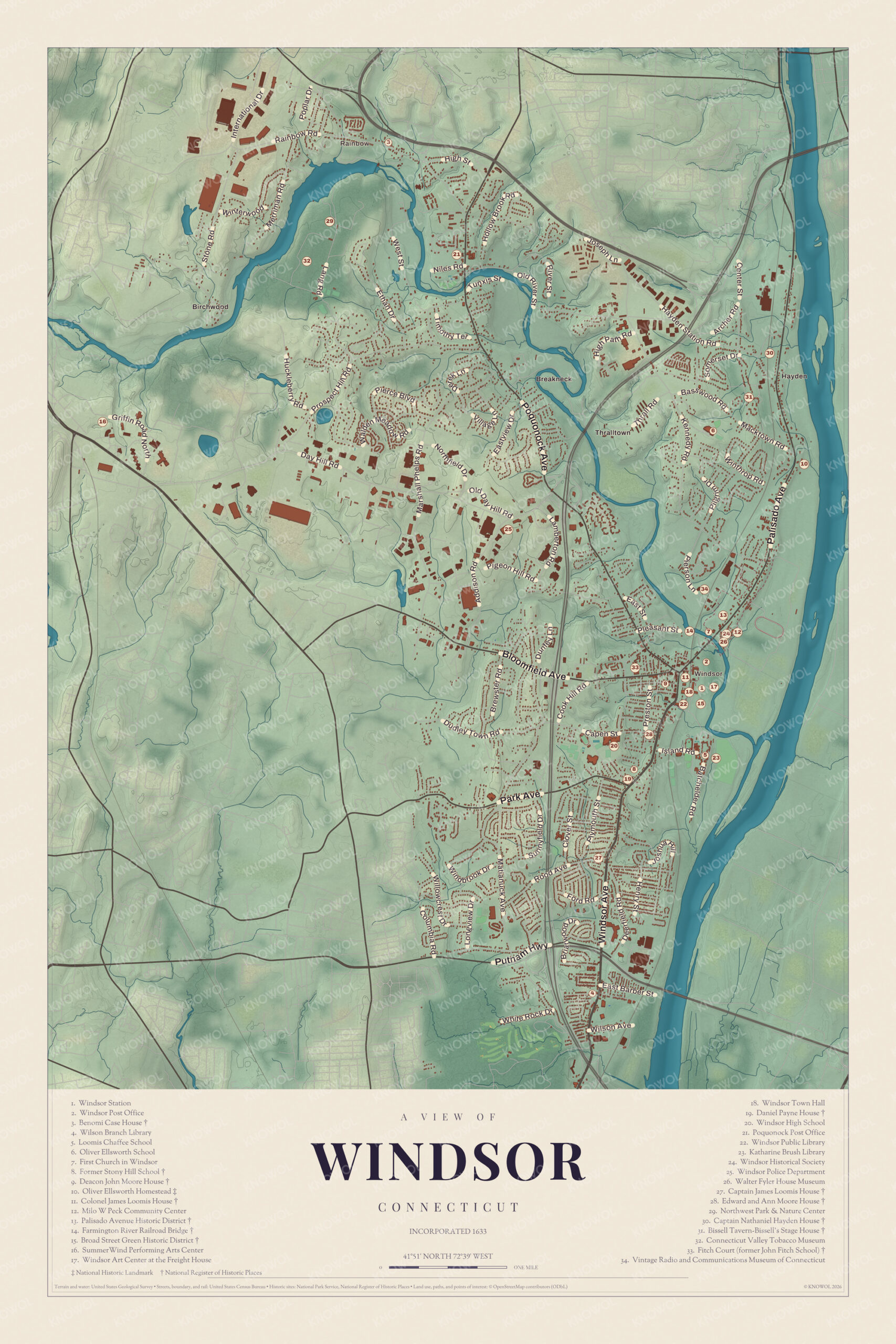
Click the map to look closer.
Windsor today
By KNOWOL
Shaded land from downtown Windsor out to Rainbow, every street from Palisado Avenue to Matianuck Avenue, Poquonock and Wilson by name, and a guide of 34 numbered landmarks with the National Historic Landmark and the National Register sites marked.4
The story of Windsor
The trading house that came in pieces
In 1631 a river sachem named Wahginnacut went to the governors of Massachusetts and Plymouth and asked the English to settle in the Connecticut valley, promising corn and eighty beaver skins a year. Plymouth took him up on it. In the fall of 1633 William Holmes sailed upriver with the frame of a trading house already cut and fitted on board. At the Dutch fort in Hartford two cannon were turned on his boat and he was told to strike his colors. Holmes answered that he had the governor of Plymouth's commission to go up the river, and he should go. The Dutch let him pass. He raised the house near the mouth of the Farmington, and the meadow there was still called Plymouth Meadow in 1886.561
Elms, stocks and the great canoe
Broad Street Green holds some hard old memories. An 1886 county history says tradition put the town whipping post where the signpost then stood, that it was used as late as 1714, and that the remains of the stocks were still on the green in 1806. The elms there were set out in 1755 by a man who later fell on hard times and was twice publicly whipped at two of his own trees, which he then cut down. For more than a century the Farmington was crossed by ferry. On Sundays no more than thirty-five people could ride in the great canoe and six in the little one. The first free bridge came in 1749, and when it had to be rebuilt in 1762 the colony let the town raise 250 pounds by lottery.789
Mills and salmon at Poquonock
Poquonock is an old Indian name that an 1886 history says means cleared land, and in 1882 the postmaster counted forty different spellings of it on a year's mail. Around 1803 Roger Griswold, brother of Bishop Griswold, built the Rainbow Mills at the big bend of the Farmington. A freshet soon tore away the embankment and carried off a load of kiln-dried grain. The water power did better later on, with paper mills at Rainbow and Poquonock and, from 1880, the Tunxis Worsted Company and its 260 hands. Henry J. Fenton's hatchery raised 600,000 salmon for the state in 1881, and he even hatched lamprey eels for a Yale professor. In 1900 Poquonock was where Windsor first grew tobacco under cloth.104
Through the years
25 moments from 1631 to today.
- 1631Wahginnacut, a river sachem, asks the governors of Massachusetts and Plymouth to send settlers to the valley.5
- 1633William Holmes sails past the Dutch guns at Hartford and raises Plymouth's trading house near the mouth of the Farmington.6
- 1635The Dorchester company arrives, and those who stay the winter live on acorns, malt and grain.11
- 1637On February 21 the General Court renames the Dorchester settlement Windsor.1
- 1637Windsor sends thirty men to the Pequot War, and the families wait inside the palisado.12
- 1638The first highway in Connecticut is laid out between Hartford and Windsor.1
- 1649John Bissell agrees to keep the ferry over the Great River for seven years.8
- 1664Deacon John Moore's house is built facing the green at Broad and Elm Streets.13
- 1675Going off to King Philip's War, John Fitch wills his estate to start a school in Windsor.14
- 1737Samuel Hayden builds his house at Hayden's under a great forest oak.15
- 1749The first free bridge is built across the Farmington, ending the old Rivulet ferry.8
- 1755The elms on Broad Street Green are set out.7
- 1762The colony lets Windsor raise 250 pounds by lottery to rebuild the bridge.9
- 1769Horace H. Hayden, later called the father of American dentistry, is born in Windsor.16
- 1775Captain Nathaniel Hayden marches twenty-three Windsor men toward Boston.2
- 1776With the men at war, women and children bring in the harvest, and clock weights are melted into bullets.2
- 1781Oliver Ellsworth contracts for his new house, Elmwood, which Washington visits in 1789.17
- 1783Sergeant Daniel Bissell receives the Badge of Military Merit for spying behind British lines.18
- 1803About this year Roger Griswold builds the Rainbow Mills, and a freshet soon wrecks them.10
- 1867The seven-arch stone railroad bridge over the Farmington is built.19
- 1874The Loomis family charters the Loomis Institute.4
- 1881Fenton's hatchery at Poquonock hatches 600,000 salmon for the state.10
- 1900Windsor first grows tobacco under cloth, on half an acre on River Street in Poquonock.4
- 1914The Loomis Institute opens on the old Loomis homestead.4
- 1921The Windsor Historical Society is founded.4
Places to see
The numbers match the landmark guide printed on the 2026 map.
- 1Windsor StationWindsor Center. Railroad depot of 1870, restored 1988.
- 5Loomis Chaffee SchoolSouth of the center. Fields cover the 1633 trading house site.Visit their website
- 7First Church in WindsorPalisado Green. Oldest Congregational church in Connecticut.
- 9Deacon John Moore HouseElm Street. Built about 1664, moved twice.
- 10Oliver Ellsworth HomesteadPalisado Avenue. Elmwood, home of a Chief Justice.
- 13Palisado Avenue Historic DistrictPalisado Avenue. Houses of the 1700s on the ridge.
- 14Farmington River Railroad BridgePleasant Street. Seven sandstone arches, 464 feet long.
- 15Broad Street Green Historic DistrictWindsor Center. The green and town hall.
- 26Walter Fyler House MuseumPalisado Green. Saved from a gas station in 1925.Visit their website
- 32Connecticut Valley Tobacco MuseumNorthwest Park. The story of shade tobacco.
On the National Register
21 of the 41 places in Windsor on the National Register of Historic Places that still stand today, oldest first, and why each one matters. See the full list of National Register places in Windsor.3
-
Deacon John Moore House
One of the oldest houses in the state, with its original frame. It first faced the green at Broad and Elm Streets and was moved, probably around 1805 and again in 1897. John Moore was a deacon and a woodworker known for carved vines and blossoms.13
-
Capt. Benjamin Allyn II House
A well-preserved Colonial brick house, first built as a saltbox. A partial carving on its beams gives a traditional date of 1670, though 1760 is also possible.20
-
Capt. Nathaniel Hayden House
A brick house with a gambrel roof built by Nathaniel Hayden. When news of Lexington and Concord came, Captain Hayden led 23 men to Massachusetts.21
-
Taylor Chapman House
One of a small number of Georgian brick houses left in Windsor, near the road that led to the old Bissell Ferry across the Connecticut.22
-
Hezekiah Chaffee House
One of Windsor's largest Georgian brick houses, built for Dr. Hezekiah Chaffee on the Palisado Green. The Loomis Institute bought it in 1926 for the girls' Chaffee School, and the Windsor Historical Society shows it today.23
-
Oliver Ellsworth Homestead
National Historic Landmark
Elmwood, home of Oliver Ellsworth, a framer of the Constitution and third Chief Justice of the United States, named for thirteen elms he planted for the states. Washington visited in 1789 and Adams in 1799. The Connecticut DAR has kept it since 1903.17
-
Palisado Avenue Historic District
The town's first settlement ground, from the Palisado Green north along the ridge, with the First Church of 1794 and houses of the 1700s and 1800s set well back from the road.24
-
Bissell Tavern-Bissell's Stage House
Built by Ebenezer Fitch Bissell, a Revolutionary War veteran, and made a tavern by his son. It was a stagecoach stop on the main road between Springfield and Hartford.25
-
Broad Street Green Historic District
The green was laid out as a common in the 1700s and took over as the center of town life in the 1800s. The district holds the town hall, library, post office and the Oliver Mather House of 1777.26
-
Edward and Ann Moore House
One of the few well-preserved, purely Federal houses in town, built of brick by Edward Moore at the corner of Capen Street.27
-
Col. James Loomis House
A brick Federal house built by James Loomis, who ran the town's only store next door. His children helped found the Loomis Chaffee School.28
-
Elijah Mills House
A Federal brick house built by Elijah Mills, whose family ran one of the Windsor brickyards. Even the cellar walls and floors are brick.29
-
Benomi Case House
One of the town's finest brick Greek Revival houses, built by the farmer Benomi Case. The Snow family lived there for nearly a hundred years.30
-
First Church Parsonage
The First Congregational Church's first parsonage paid for by the church, built for Reverend Leete when his ministry began.31
-
Stony Hill School
A district schoolhouse that first stood across the street. In 1899 Dr. Case traded the town this lot for the old one, and the school was moved and remade.32
-
Eli Phelps House
The largest and most elaborate of Windsor's Italianate houses, built by a tobacco farmer and a sign of how well the town's farmers did.33
-
Farmington River Railroad Bridge
A 464-foot bridge of seven sandstone arches built by the Hartford and New Haven Railroad, one of the state's finest stone arch railroad bridges. It still carries the main line to Springfield.19
-
Hartford & New Haven Railroad Depot
Windsor Station, built by the Hartford and New Haven Railroad and restored to its Victorian look in 1988. Amtrak and Hartford Line trains still stop here.34
-
Hartford & New Haven Railroad-Freight Depot
A Gothic Revival brick freight depot by the tracks, now the home of the Windsor Art Center.35
-
Former Fire Station
Windsor's first firehouse, on land given by H. Sidney Hayden. It was a fire station until 1939.36
-
John Fitch School
The town's first high school built for the purpose, a Beaux Arts design by William Henry McClean with a green-domed cupola. It is named for John Fitch, who left money for a school in 1675, and has been senior housing since 1988.37
In their words
“Walk up, Marshall; our mothers are at home praying for us, and the enemy can't hurt us.”
Captain Seth Hanchett to Elijah Marshall of Windsor, storming the barricade at Quebec in 1775, as told in The Memorial History of Hartford County, 18862
“Windsor adds to the record of names that adorn her history, another name fit to stand on the roll with the best of her sons born on the soil.”
The Memorial History of Hartford County, 188638
“there was an indefinable charm, for me, in all that pertained to Windsor history.”
Henry R. Stiles, Windsor's historian, in the supplement to his History of Ancient Windsor39
Nearby towns
Sources
- Windsor, Connecticut, Wikipedia
- The Memorial History of Hartford County, Connecticut, 1633-1884 (1886), on Windsor in the Revolution, Internet Archive
- National Register of Historic Places listings in Windsor, Connecticut, Wikipedia
- Map of Windsor, Connecticut in 2026, KNOWOL (USGS elevation, Census Bureau roads)
- The Memorial History of Hartford County, Connecticut, 1633-1884 (1886), on Wahginnacut's visit, Internet Archive
- The Memorial History of Hartford County, Connecticut, 1633-1884 (1886), on William Holmes and the trading house, Internet Archive
- The Memorial History of Hartford County, Connecticut, 1633-1884 (1886), on Broad Street Green, Internet Archive
- The Memorial History of Hartford County, Connecticut, 1633-1884 (1886), on Windsor's ferries and bridges, Internet Archive
- The public records of the colony of Connecticut (1850), on the 1762 bridge lottery, Internet Archive
- The Memorial History of Hartford County, Connecticut, 1633-1884 (1886), on Poquonock and Rainbow, Internet Archive
- The Memorial History of Hartford County, Connecticut, 1633-1884 (1886), on the first winter, Internet Archive
- The Memorial History of Hartford County, Connecticut, 1633-1884 (1886), on the palisado, Internet Archive
- Deacon John Moore House, Wikipedia
- History of ancient Windsor, Connecticut (1859), on John Fitch's will, Internet Archive
- The Memorial History of Hartford County, Connecticut, 1633-1884 (1886), on the Hayden house and oak, Internet Archive
- The Connecticut magazine (1907), on Dr. Horace H. Hayden, Internet Archive
- Oliver Ellsworth Homestead, Wikipedia
- The Memorial History of Hartford County, Connecticut, 1633-1884 (1886), on Sergeant Daniel Bissell, Internet Archive
- Farmington River Railroad Bridge, Wikipedia
- Capt. Benjamin Allyn II House, Wikipedia
- Capt. Nathaniel Hayden House, Wikipedia
- Taylor Chapman House, Wikipedia
- Hezekiah Chaffee House, Wikipedia
- Palisado Avenue Historic District, Wikipedia
- Bissell Tavern-Bissell's Stage House, Wikipedia
- Broad Street Green Historic District, Wikipedia
- Edward and Ann Moore House, Wikipedia
- Col. James Loomis House, Wikipedia
- Elijah Mills House, Wikipedia
- Benomi Case House, Wikipedia
- First Church Parsonage (Windsor, Connecticut), Wikipedia
- Stony Hill School (Windsor, Connecticut), Wikipedia
- Eli Phelps House, Wikipedia
- Windsor station (Connecticut), Wikipedia
- Hartford and New Haven Railroad Freight Depot (Windsor, Connecticut), Wikipedia
- Former Fire Station (Windsor, Connecticut), Wikipedia
- John Fitch School, Wikipedia
- The Memorial History of Hartford County, Connecticut, 1633-1884 (1886), on General Pierson, Internet Archive
- The history of ancient Windsor, Connecticut, supplement, Henry R. Stiles, Internet Archive