
Old Winnisimmet, the ferry landing across the Mystic from Boston that grew in the 1830s into a busy little city of stove works, art tiles and newcomers, and rebuilt itself around Bellingham Square after the great fire of 1908.
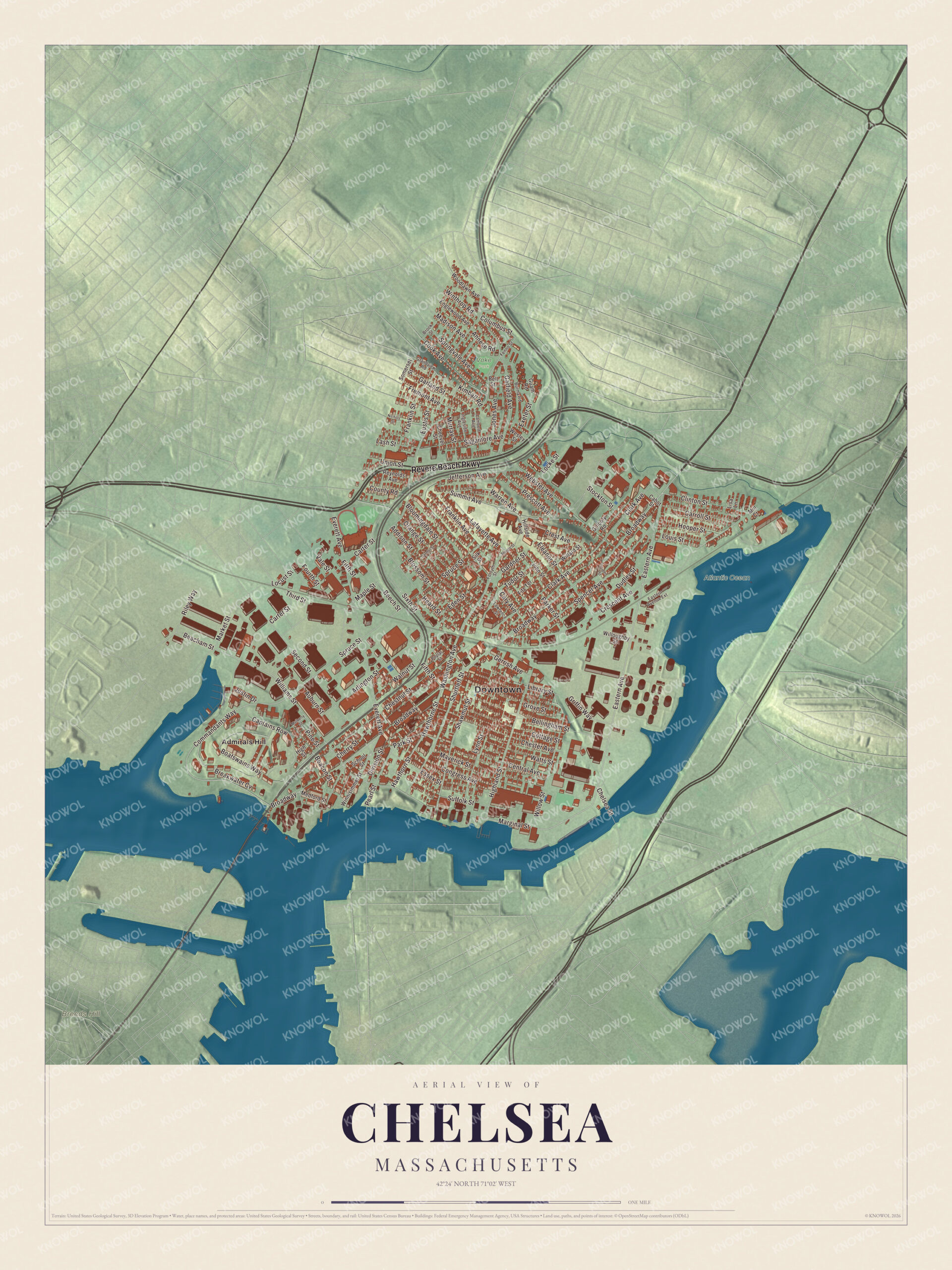
Chelsea on the map
Click the map to look closer.
Chelsea today
By KNOWOL
Chelsea's hilly peninsula in shaded relief from United States Geological Survey elevation data, with Broadway, Washington Avenue, Eastern Avenue, Marginal Street, Commandants Way, the Revere Beach Parkway and Admirals Hill.4
The story of Chelsea
The ferry village
For two hundred years Winnisimmet was four big farms and a ferry landing. In 1830 only 30 of the town's 771 people lived inside today's city, since the town center was at Rumney Marsh, now Revere. Then about 1831 a land company bought the Williams Farm along with the ferry and laid out house lots. The next summer the steam ferryboats Boston and Chelsea went on the line, and the city's 1884 history says they were the first of their kind in Boston Harbor. In 1832 John Low opened the first store, at Broadway and Everett Avenue, and an omnibus called the North Ender ran from the ferry landing to Boylston Market for twelve and a half cents. The old families called the newcomers roosters. By 1840 the town had 2,390 people.256
The Sunday the city burned
About eleven on Sunday morning, April 12, 1908, an alarm came in for a fire at the Boston Blacking Company works on West Third Street, near the Everett line. The firemen put it out with little damage, but a forty-mile gale carried sparks to the wooden houses nearby, and the fire ran east across the city until it reached the water at the East Boston line. The heat was so great that granite buildings crumbled. City Hall, the public library, St. Rose Church, the Shurtleff School and nearly all of the Broadway business district were lost. Help came fast: within two weeks the relief fund held almost $300,000, and hundreds of automobiles were offered to carry goods to the homeless. The rebuilt Bellingham Square is now a National Register district.718
Stoves and art tiles
The land company hoped Boston businessmen would build homes in Chelsea, but factories followed them. The Magee Furnace Company, at work here from 1864, had five hundred people on its payroll by 1884 and made thirty thousand stoves and furnaces a year, shipped by the carload across the country and sold as far away as Sweden, Turkey, Australia and China. In 1878 the painter John G. Low and his father John Low, the village's first storekeeper, started the Low Art Tile works, whose tiles an 1892 book called a revelation. Thomas Martin's elastic web business grew from twelve hands to five Chelsea mills. The city engineer's 1884 list of other products ran from anchors and pilot bread to type, vaccine matter and window shades.910112
Through the years
25 moments from 1624 to today.
- 1624Samuel Maverick settles at Winnisimmet, the first European to stay for good.1
- 1635Maverick sells nearly all of Winnisimmet to Richard Bellingham, later governor of the colony.1
- 1639The Winnisimmet Ferry to Boston is chartered, which the city's 1884 history calls the oldest chartered ferry company in the country.6
- 1739Chelsea is incorporated as a town, named for Chelsea in London.1
- 1775The Battle of Chelsea Creek is fought on May 27 and 28, and colonial forces capture the armed schooner Diana.4
- 1775In October a guard keeps watch at the Winnisimmet Ferry, reporting to Colonel Loammi Baldwin, commander in Chelsea.12
- 1778The town votes to set up a smoke-house at the ferry to keep smallpox from coming over from Boston.5
- 1787The town's long fight for Governor Bellingham's Winnisimmet estate ends in defeat.5
- 1802The Chelsea Bridge is built as part of the turnpike that's now Broadway.2
- 1823The Navy buys the site of its hospital from Dr. Aaron Dexter for $18,000.13
- 1830Only 30 of the town's 771 people live inside what is now the city.2
- 1831Trustees buy the Williams Farm and the ferry, and the land is soon laid out in house lots.5
- 1832John Low builds the first store, at the corner of Broadway and Everett Avenue.2
- 1836The granite Naval Hospital above the Mystic River is completed.14
- 1846North Chelsea, today's Revere and Winthrop, becomes its own town, leaving Chelsea its present bounds.1
- 1857Chelsea becomes a city, with Francis B. Fay as its first mayor.2
- 1863The Chelsea Library Association gives the city about a thousand books to start a public library.15
- 1864The Magee Furnace Company's stove works are established in Chelsea.9
- 1878John G. Low and his father start the Low Art Tile works.10
- 1881The Highland Park Hotel on Powderhorn Hill is dedicated as a Soldiers' Home on June 8.16
- 1908On April 12 a fire that starts near the Everett line burns across the city in a forty-mile gale.7
- 1909Congregation Agudath Shalom builds its Walnut Street synagogue after the fire.17
- 1973The Second Great Chelsea Fire destroys 18 city blocks.1
- 1974The Naval Hospital closes, the oldest naval hospital then in service in the country.14
- 1991The state places Chelsea under receivership; local control returns in 1995.1
Places to see
Places worth a visit in Chelsea today.
- Bellingham SquareDowntown. Civic heart rebuilt after the 1908 fire.
- BroadwayThrough the middle of the city. The old turnpike over the Chelsea Bridge.
- Admirals HillBetween the Mystic and Island End rivers. Old Naval Hospital buildings, now homes.
- Chelsea Naval HospitalSouth slope of Admirals Hill. Granite Navy hospital completed in 1836.
- Mary O'Malley ParkAdmirals Hill shore. The city's largest park.Visit their website
- Powderhorn HillSoldiers Home neighborhood. About 200 feet, with harbor views.
- Soldiers HomeTop of Powderhorn Hill. A home for veterans since 1881.
- Revere Beach ParkwayNorth side of the city. Charles Eliot's parkway to Revere Beach.
- Chelsea CreekEast Boston line. Designated port area with Logan's fuel.
- Mill HillEastern Avenue, on the Revere line. The smallest of the city's drumlins.
On the National Register
All 9 places in Chelsea on the National Register of Historic Places that still stand today, oldest first, and why each one matters.3
-
Bellingham-Cary House
Built in 1724, the house may hold within it the 1659 hunting lodge of colonial governor Richard Bellingham, and it is the only 18th-century building left in the city. Samuel Cary enlarged it to its present look about 1791.18
-
Naval Hospital Boston Historic District
The Chelsea Naval Hospital, built of Vermont granite and completed on January 7, 1836, was one of the first three hospitals Congress authorized for Navy personnel. When it closed in 1974 it was the oldest naval hospital in service in the country, and its buildings are now homes.14
-
Chelsea Garden Cemetery
Laid out in 1841 as a rural cemetery with paths winding over hilly ground, it was the first burying ground inside the city limits. The Soldiers Circle at its main entrance holds a number of the city's Civil War dead.19
-
Revere Beach Parkway-Metropolitan Park System of Greater Boston
One of the first parkways the landscape architect Charles Eliot proposed, in an 1893 report, it was built from 1896 to 1904 to carry people from inland towns to Revere Beach. It runs from Wellington Circle in Medford through Everett and the north of Chelsea to Eliot Circle in Revere.20
-
C. Henry Kimball House
A two-and-a-half-story Queen Anne house built about 1896, one of the city's finest. Charles Henry Kimball developed heated vehicles for shipping potatoes and was a major figure in Chelsea's wholesale fruit and produce exchange.21
-
Bellingham Square Historic District
The civic and commercial heart of Chelsea, around the six-way junction of Broadway, Washington Avenue and three other streets, built almost entirely after the Great Chelsea Fire of 1908. Leading architects designed the new City Hall (Peabody and Stearns) and the library and post office (Guy Lowell).8
-
Congregation Agudath Shalom
Chelsea's oldest surviving synagogue, built in 1909 after the great fire destroyed the congregation's first building, when the city was one-third Jewish. Inside are wall and ceiling frescoes painted by Jewish immigrant artists.17
-
Downtown Chelsea Residential Historic District
This district incorporates the Shurtleff School (now the Early Learning Center) and period structures around the school. The area had been completely devastated in the 1908 fire and had previously contained City Hall and a number of other community buildings.22
-
Luna (tugboat)
National Historic Landmark
Designed in 1930 by John G. Alden, Luna was the world's first diesel-electric tugboat built for commercial service and is the last full-sized wooden ship-docking tug left on the Gulf and Atlantic coasts. The Luna Preservation Society has been restoring her since 1995.23
In their words
“Chelsea is spread out like a map at its base.”
William E. McClintock, Chelsea's city engineer, on the view from Powderhorn Hill, 188424
“The attractions of the place are so great that numbers of gentlemen doing business in Boston and elsewhere make their homes in Chelsea.”
Sights in Boston and suburbs, a guide to the stranger, 185625
“It is a grand monument that through your aid and assistance has been built in Chelsea. Look with pride upon it, for it is an honor to the State as well as to this Department”
Grand Army of the Republic, Department of Massachusetts, on the Soldiers' Home, encampment journals of 1900 to 190226
Nearby towns
Sources
- Chelsea, Massachusetts, Wikipedia
- The Bay State Monthly, vol. 1 no. 2 (1884), "Chelsea" by William E. McClintock, on the growth of the ferry village, Internet Archive
- National Register of Historic Places listings in Suffolk County, Massachusetts, Wikipedia
- Map of Chelsea, Massachusetts in 2026, KNOWOL
- The memorial history of Boston, vol. 3 (1881), Mellen Chamberlain on Chelsea, Revere and Winthrop, Internet Archive
- The Bay State Monthly, vol. 1 no. 2 (1884), "Chelsea" by William E. McClintock, city engineer, on the Winnisimmet Ferry, Internet Archive
- Souvenir book of the great Chelsea fire, April 12, 1908 (1908), Internet Archive
- Bellingham Square Historic District, Wikipedia
- The Bay State Monthly, vol. 1 no. 2 (1884), "Chelsea" by William E. McClintock, on the Magee Furnace Company and Chelsea's industries, Internet Archive
- Massachusetts of today (1892), on John G. Low and the Low Art Tile works, Internet Archive
- Massachusetts of today (1892), on Thomas Martin's elastic fabric mills, Internet Archive
- A documentary history of Chelsea (1908), on the guard at Winnisimmet Ferry in 1775, Internet Archive
- The memorial history of Boston, vol. 3 (1881), on the naval hospital site in Chelsea, Internet Archive
- Naval Hospital Boston Historic District, Wikipedia
- The Bay State Monthly, vol. 1 no. 2 (1884), "Chelsea" by William E. McClintock, on the public library, Internet Archive
- History of the Department of Massachusetts, Woman's Relief Corps (1895), on the Soldiers' Home, Internet Archive
- Congregation Agudath Shalom, Wikipedia
- Bellingham-Cary House, Wikipedia
- Chelsea Garden Cemetery, Wikipedia
- Revere Beach Parkway-Metropolitan Park System of Greater Boston, Wikipedia
- C. Henry Kimball House, Wikipedia
- Downtown Chelsea Residential Historic District, Wikipedia
- ''Luna'' (tugboat), Wikipedia
- The Bay State Monthly, vol. 1 no. 2 (1884), "Chelsea" by William E. McClintock, on Powderhorn Hill, Internet Archive
- Sights in Boston and suburbs, or, Guide to the stranger (1856), Internet Archive
- Journals of the encampment proceedings of the Department of Massachusetts, Grand Army of the Republic, 1900 to 1902 (1900), Internet Archive