
A town between the Neponset falls and the Blue Hills, where early mills made powder, paper and chocolate, Benjamin Crehore built bass-viols and pianos, a fourth of the town was vaccinated in one summer in 1809, and a weather station on Great Blue Hill has kept records since 1885.
Milton, Massachusetts on the map
Click the map to look closer.
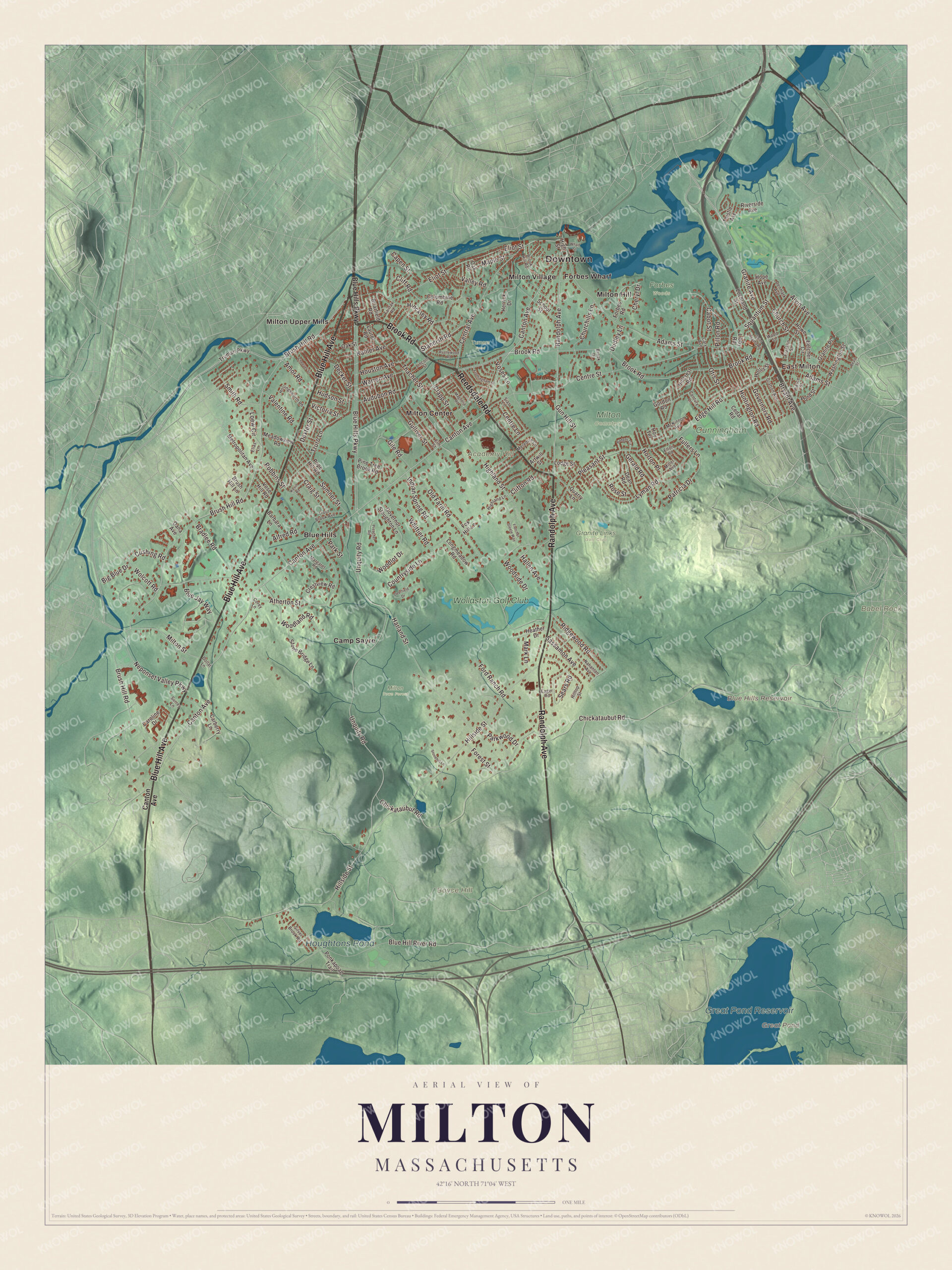
Milton today
By KNOWOL
Blue Hill Avenue, Canton Avenue, Brush Hill Road, Randolph Avenue, Reedsdale Road and Brook Road across town, with Houghtons Pond, Great Pond, Milton Hill, Brush Hill and the Blue Hills, drawn from USGS elevation data and Census Bureau roads.2
The history of Milton, Massachusetts
The summer Milton lined up for cowpox
In the summer of 1809 Milton set out to protect the whole town from smallpox. A committee went from house to house, and the town agreed with Dr. Amos Holbrook that he would inoculate anyone with cowpox for twenty-five cents. On July 20 people gathered at the school house on Milton Hill, then in the Scotch Woods and on Brush Hill. In a few days 337 people were done, from babies two months old to neighbors past seventy, more than a fourth of the town. That October twelve of the children were given real smallpox matter at Stephen Horton's house, set up as a hospital, and on October 25 they went home well. Milton printed its papers and sent a copy to the selectmen of every town in the Commonwealth. Dr. Holbrook's house still stands on Milton Hill.35678
Bass-viols, paper and powder at the falls
The falls of the Neponset made Milton a mill town. In the autumn of 1634 Israel Stoughton's mill turned the first wheel on the river, and the powder mill above the bridge ran until 1744, when it blew up. The paper mill below the bridge was restarted with a paper-maker on furlough from a British regiment, who later went to Quebec and was wounded on the Plains of Abraham. In 1798 Benjamin Crehore, building stage machinery for Boston's Federal Street Theatre, mended the orchestra's broken bass-viol and began making bass-viols of his own, the first in the country by the 1887 town history's account. Years later a Milton deacon in Thomaston, Maine, tried a church bass-viol said to be over two hundred years old. Pasted inside was a paper: Ben. Crehore, Maker, Milton.910111213
The governor's hill
Governor Thomas Hutchinson loved his country home on Milton Hill, but the quarrel with Britain kept coming up the road to it. On October 24, 1765, just before the Stamp Act took effect, Milton held a mass meeting on the Church Green. On December 16, 1773, the meeting in Boston sent Francis Rotch, owner of the tea ship Dartmouth, out to the governor's country house in Milton to ask for a pass. He came back about six o'clock with a refusal, and that same evening the tea party took place. On June 1, 1774, Hutchinson walked down Milton Hill to the Lower Mills, nodding to his neighbors, and left his home for good. That September the Suffolk Resolves were adopted in Milton, and Great Blue Hill was later lit up for independence and for the surrenders of Burgoyne and Cornwallis.14151617218
Milton, Massachusetts through the years
25 moments from 1634 to today.
- 1634In the autumn Israel Stoughton's mill at the falls turns the first water wheel on the Neponset.9
- 1636Dorchester is granted the Unquity land, which is also bought from its Native owners for twenty-eight fathoms of wampum.19
- 1662The part of Dorchester south of the Neponset is incorporated as the town of Milton.1
- 1674A powder mill opens on the river, possibly the earliest in the colonies.2
- 1729Daniel Henchman's paper mill on the Neponset, the first in New England, goes to work.2
- 1744The original powder mill blows up.10
- 1754About 340 acres of Braintree's Blue Hill lands, with Houghton's Pond, are annexed to Milton.20
- 1765On October 24 a mass meeting on the Church Green protests just before the Stamp Act takes effect.15
- 1765John Hannan makes chocolate at a new mill on the old powder mill site.21
- 1773On December 16 Rotch, owner of the tea ship Dartmouth, is refused a pass by Governor Hutchinson at Milton, and the tea party follows that evening.16
- 1774On June 1 Governor Hutchinson walks down Milton Hill for the last time and leaves for England.14
- 1774The Suffolk Resolves are passed in Milton in September.2
- 1775The Provincial Congress lets four soldiers work at the Milton paper mill, since so few in the colony can make paper.22
- 1788The fourth meeting-house, today's First Parish Church, is dedicated on January 1.23
- 1798Milton Academy is chartered after a state committee views eight Norfolk County towns.24
- 1800Benjamin Crehore makes a piano in his Milton shop, the first in the country by the 1887 town history's account.25
- 1801Josiah Bent starts baking water crackers with a single oven in his house on Highland Street.26
- 1803Isaac Sanderson makes New England's first folio-post and quarto letter paper, for the Boston Custom House.27
- 1809In a few summer days 337 people, more than a fourth of the town, are vaccinated against smallpox.3
- 1826On October 7 the first train runs over the Granite Railway to the Neponset.28
- 1833The Forbes brothers build the house on Milton Hill for their mother.29
- 1868About four hundred acres in the northwest go to form the new town of Hyde Park.30
- 1885The Blue Hill Observatory on Great Blue Hill is first occupied on February 1.31
- 1910Cunningham Park, with a skating rink and a toboggan coast, runs on a bequest of more than $600,000.32
- 1924George H. W. Bush is born at 173 Adams Street on Milton Hill on June 12.1
Places to see in Milton, Massachusetts
Places worth a visit in Milton today.
- Great Blue HillBlue Hills Reservation. Weather observatory on top since 1885.
- Blue Hills ReservationSouth part of town. Metropolitan park land bought in 1893.Visit their website
- Houghtons PondBlue Hills Reservation. Spring-fed kettle pond for swimming.
- Governor Hutchinson's FieldAdams Street, Milton Hill. Meadow looking out over Boston.Visit their website
- Captain Robert Bennet Forbes HouseAdams Street, Milton Hill. China Trade family home of 1833.Visit their website
- Suffolk Resolves House1370 Canton Avenue. Milton Historical Society headquarters.Visit their website
- Eustis EstateCanton Avenue. Stone mansion of 1878, now a museum.Visit their website
- East Milton SquareEast Milton. Granite Railway track in the gardens.
- Railway VillageEast Milton. Stone workers' village by the railway.
- Brush Hill RoadWest Milton. Probably a Native path before colonists.
Milton on the National Register of Historic Places
16 of the 30 places in Milton on the National Register of Historic Places that still stand today, oldest first, and why each one matters. See the full list of National Register places in Milton.4
-
Brush Hill Historic District
Brush Hill Road, probably a Native path before the colonists came, crosses the low rise of Brush Hill between the Blue Hills and the Neponset River. The area was among the last allotted by the early colonists, in 1660, and its houses run from the late 1600s to the mid-1900s.33
-
Milton Cemetery
Established in 1672, it is the town's only municipal burying ground: the original three-acre ground, used until 1854, a section laid out that year in the rural cemetery style, and a modern section of 1945. The abolitionists Wendell Phillips and Ann Terry Greene Phillips are buried here.34
-
Suffolk Resolves House
Long named as the house where the Suffolk Resolves were adopted in 1774, a claim still argued over in town; tree-ring dating puts its oldest part at about 1763, with more built in the 1780s. Threatened with demolition in 1950, it was moved from Adams Street to Canton Avenue and restored, and it is now the headquarters of the Milton Historical Society.35
-
Gov. Thomas Hutchinson's Ha-ha
Probably built about 1771, it is the only surviving structure of the once-extensive estate of Thomas Hutchinson, the last civilian colonial governor of the British Province of Massachusetts Bay, and one of the few examples of an early ha-ha in North America.36
-
Belcher-Rowe House
Built in 1776-1777 by the widow and daughter-in-law of former colonial governor Jonathan Belcher, it is Milton's first known example of Federal style residential architecture. The house was listed on the National Register of Historic Places in 1982.37
-
Dr. Amos Holbrook House
Built about 1800 by Dr. Amos Holbrook, a physician who served in the Revolution and urged the town to inoculate against smallpox, on land once part of Governor Hutchinson's estate at the top of Milton Hill. Its hall and dining room keep early 19th-century painted frescoes.8
-
Capt. Robert B. Forbes House
National Historic Landmark
Built in 1833 for Margaret Perkins Forbes by her sons, the China Trade merchants Captain Robert Bennet Forbes and John Murray Forbes, to an unusual Greek Revival design by Isaiah Rogers. An elliptical staircase like a lighthouse's rises three stories to a cupola for watching ships come into Boston Harbor. Four generations of Forbeses lived here until 1962, and it opened as a museum in 1964.29
-
Dorchester-Milton Lower Mills Industrial District
A factory complex on both sides of the Neponset, most of it built for Walter Baker & Company, the first major maker of chocolate products in the United States. Its industrial buildings date from about 1868 to 1947 and now hold shops, offices and homes.38
-
Eustis Estate Historic District
Its centerpiece is the stone mansion of William Ellery Channing Eustis, designed by William Ralph Emerson and built in 1878 at the foot of the Blue Hills. Most of the estate belongs to Historic New England, which opened it as a museum in 2017.39
-
Great Blue Hill Weather Observatory
Abbott Lawrence Rotch built this stone weather station at his own expense and began regular observations on February 1, 1885. It holds the oldest continuous weather record in North America and saw the continent's earliest kite soundings of the atmosphere. The first tower was replaced by the present concrete tower in 1908.40
-
Great Blue Hill Observation Tower
Known locally as Eliot Tower, this 35-foot stone tower was built in the 1930s by the Civilian Conservation Corps in the rustic style its projects were known for. It stands beside the Eliot Memorial Bridge, a short way from the summit, with views of about 270 degrees.41
-
Milton Centre Historic District
The traditional civic heart of Milton, on Academy Hill along Canton Avenue, with town buildings, churches and houses mostly of the 18th and 19th centuries. The fourth meetinghouse, built in 1788, is now the First Parish Church and the oldest surviving building in the center.42
-
Milton Hill Historic District
Extending mainly along Adams Street across the top of Milton Hill, it holds high-style homes of the 18th to early 20th centuries. Adams Street began as a Native footpath and became the main colonial road between Boston and Plymouth, and the hill first became prominent in the 1740s as the estate of Thomas Hutchinson.43
-
G.H. Bent Company Factory
Josiah Bent began baking water crackers in Milton in 1801, and his company later sold hardtack to Civil War troops. His grandson George H. Bent built this two-and-a-half-story wooden factory, which keeps its historic signs. The bakery closed soon after 2017, and the building now holds homes and shops.44
-
Railway Village Historic District
The 30-acre (12 ha) district lies roughly between East Milton Square and the town line with neighboring Quincy. The area's significant growth occurred after the 1826 construction of the Granite Railway, which transported stone from the nearby granite quarries to the Neponset River.45
-
Davenport Estate Historic District
Now called the Wakefield Estate, these 22 acres on Brush Hill Road were owned and developed by the Davenport family for over 300 years. The Wakefield Trust runs the estate for education, and its grounds open by appointment or on announced occasions.46
Milton in their words
“The scenic beauty of Milton Hill can hardly be surpassed.”
The history of Milton, Mass., 188747
“The people, in grateful remembrance of their childhood's home, have brought it with them to this new land, where thirty-two towns have appropriated the name, the first and oldest of which is believed to be our own municipality.”
The history of Milton, Mass., 1887, on the name Milton48
“In the autumn of 1634 the waters of the Neponset turned the first wheel ever set up on its shores, and ground the first corn ever ground by water power in New England.”
The Milton catechism, 1910, on Israel Stoughton's mill9
Towns near Milton, Massachusetts
Sources for the history of Milton
- Milton, Massachusetts, Wikipedia
- Map of Milton, Massachusetts in 2026, KNOWOL
- A collection of papers relative to the transactions of the town of Milton to promote a general inoculation of the cow pox, or kine pock (1809), on the July inoculation, Internet Archive
- National Register of Historic Places listings in Milton, Massachusetts, Wikipedia
- A collection of papers relative to the transactions of the town of Milton to promote a general inoculation of the cow pox, or kine pock (1809), on Dr. Holbrook's fee, Internet Archive
- Collections of the Massachusetts Historical Society (1833), on the Milton vaccination test of 1809, Internet Archive
- A memoir of Dr. James Jackson (1905), on Milton's vaccination pamphlet, Internet Archive
- Dr. Amos Holbrook House, Wikipedia
- The Milton catechism; an outline of the history of Milton, Massachusetts, illustrated (1910), on Israel Stoughton's mill, Internet Archive
- The Milton catechism (1910), on the powder mill, Internet Archive
- Historical collections relating to the history and antiquities of every town in Massachusetts (1844), on the first paper mill, Internet Archive
- The history of Milton, Mass., 1640 to 1887 (1887), on Benjamin Crehore and the Federal Street Theatre, Internet Archive
- The history of Milton, Mass., 1640 to 1887 (1887), on the Crehore bass-viol in Thomaston, Internet Archive
- The Loyalists of Massachusetts and the other side of the American Revolution (1910), on Hutchinson leaving Milton, Internet Archive
- The Milton catechism (1910), on the Stamp Act meeting of 1765, Internet Archive
- Publications of the Colonial Society of Massachusetts, volume 8, transactions 1902 to 1904 (1906), on Rotch's errand to Milton, Internet Archive
- The Milton catechism (1910), on Francis Rotch's visit to Governor Hutchinson, Internet Archive
- The history of Milton, Mass., 1640 to 1887 (1887), on Great Blue Hill in the Revolution, Internet Archive
- The Milton catechism (1910), on the purchase of Unquity, Internet Archive
- The history of Milton, Mass., 1640 to 1887 (1887), on the accession of 1754, Internet Archive
- The Milton catechism (1910), on the first chocolate, Internet Archive
- The history of Milton, Mass., 1640 to 1887 (1887), on the paper mill in 1775, Internet Archive
- The Milton catechism (1910), on the meeting-houses, Internet Archive
- The history of Milton, Mass., 1640 to 1887 (1887), on the founding of Milton Academy, Internet Archive
- The history of Milton, Mass., 1640 to 1887 (1887), on the first piano-forte, Internet Archive
- The Milton catechism (1910), on Bent's water crackers, Internet Archive
- The history of Milton, Mass., 1640 to 1887 (1887), on Isaac Sanderson's paper, Internet Archive
- The Milton catechism (1910), on the Granite Railway, Internet Archive
- Capt. Robert B. Forbes House, Wikipedia
- The history of Milton, Mass., 1640 to 1887 (1887), on the land given to Hyde Park, Internet Archive
- The history of Milton, Mass., 1640 to 1887 (1887), on the Blue Hill Observatory, Internet Archive
- The Milton catechism (1910), on the Cunningham bequest, Internet Archive
- Brush Hill Historic District, Wikipedia
- Milton Cemetery, Wikipedia
- Suffolk Resolves House, Wikipedia
- Gov. Thomas Hutchinson's Ha-ha, Wikipedia
- Belcher-Rowe House, Wikipedia
- Dorchester-Milton Lower Mills Industrial District, Wikipedia
- Eustis Estate Historic District, Wikipedia
- Great Blue Hill Weather Observatory, Wikipedia
- Great Blue Hill Observation Tower, Wikipedia
- Milton Centre Historic District, Wikipedia
- Milton Hill Historic District, Wikipedia
- G.H. Bent Company Factory, Wikipedia
- Railway Village Historic District, Wikipedia
- Davenport Estate Historic District, Wikipedia
- The history of Milton, Mass., 1640 to 1887 (1887), on Milton Hill, Internet Archive
- The history of Milton, Mass., 1640 to 1887 (1887), on the name Milton, Internet Archive