
The old South Parish of a much larger town, home of the state normal school since 1840 and of iron works that turned out skillets, cannon and wrought iron for the Monitor.
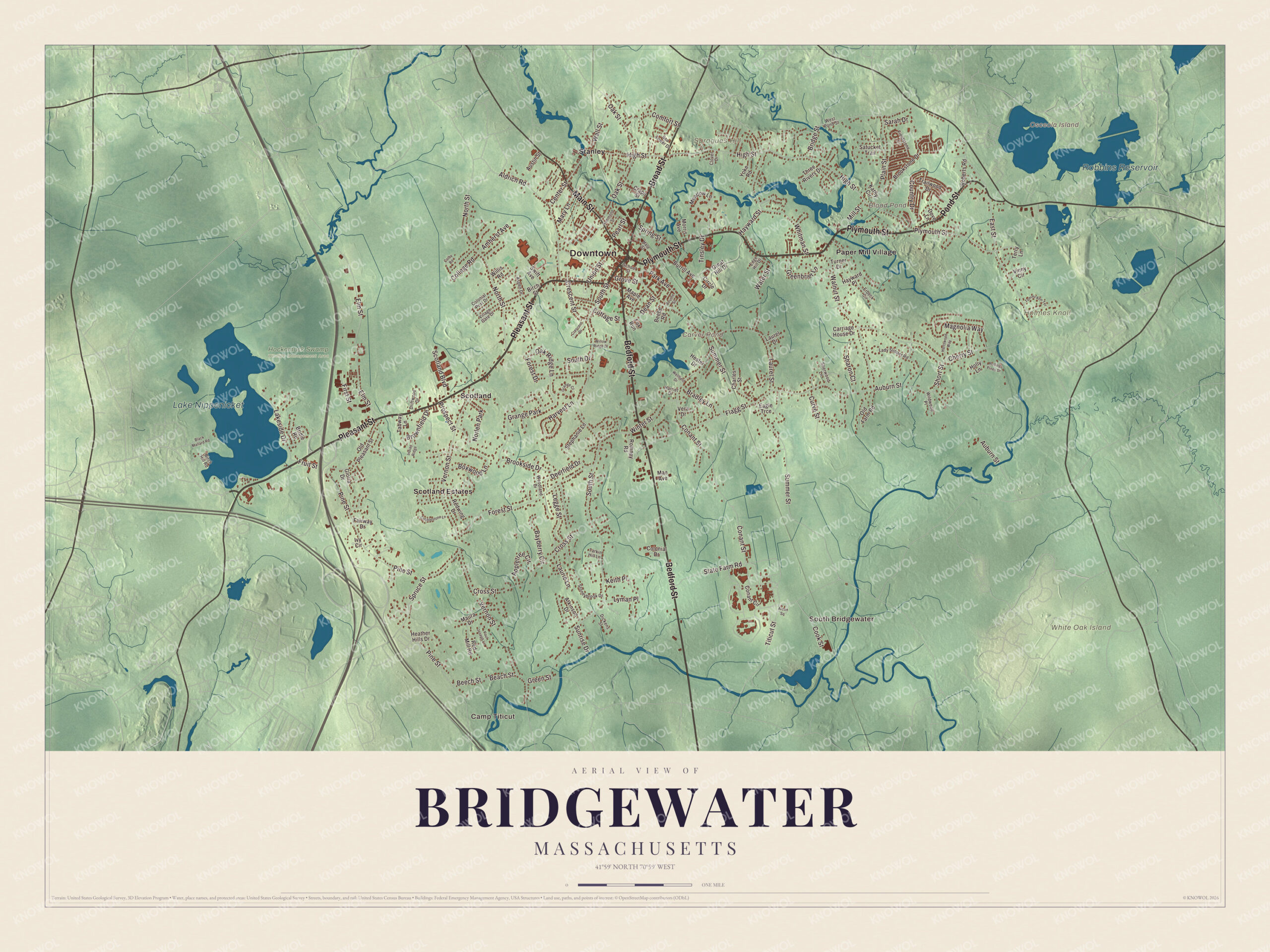
Bridgewater, Massachusetts on the map
Click the map to look closer.
Bridgewater today
By KNOWOL
Pleasant, Plymouth, Pond, Broad, Main and Bedford Streets across town, with Lake Nippenicket, Carver Pond, Blood Pond, Osceola Island and Spragues Hill, drawn from USGS elevation data and Census Bureau roads.2
The history of Bridgewater, Massachusetts
Skillets, cannon and steamship shafts
Iron came early to the South Parish. In 1737 Capt. Josiah Edson and his partners were casting hollow-ware at South Brook, near Carver's Pond, for a busy trade in skillets and cauldrons. On the Town River the Lazell brothers built a slitting mill in 1785, and by 1795 the works was cutting and rolling 445 tons of iron a year. Once the railroad came through in 1846, it grew into one of the largest iron works in the country. It made the shafts of the biggest ocean steamers and the wrought-iron work of Ericsson's Monitor, and in the Civil War it sent many cannon to the United States. One was so big it was shown at the county fair before it was mounted in front of Fort Sumter. The Stanley Works bought the plant in 1899.562
Cotton gins, paper and piano frames
The iron works wasn't the only shop in town. In 1817 E. Carver built a cotton-gin factory at the outlet of Carver's Pond, and in 1833 Bates, Hyde and Company started making gins too, the business later called the Eagle Cotton-Gin Company. Opposite its works on the Old Colony Railroad stood the foundry of Henry Perkins, a grandson of an iron works forgeman, known for the finest piano frames, some of them for the Chickerings' pianos. At Pratt Town, Joseph Hooper made paper in 1823 in what the 1884 county history calls the first paper mill in the county. Clay beds along the Town River made good bricks, and Mitchell Hooper, who started in 1829, once made four million of them in a single year.789101112
A town of schools
Bridgewater took its schooling seriously. Before 1800 the South Parish had already sent twenty-three young men to Harvard. In 1799 Maj. Isaac Lazell helped found the county academy here, writing in his day-book that he hoped science would flourish in the academy then going up, and he and his heirs gave the land for the academy and for the public square. The academy burned in 1821 and was rebuilt the next year. On September 9, 1840, the state's normal school opened in the town house, which the town fitted up for $250. Its first principal, Nicholas Tillinghast, was a West Point graduate. At the dedication of its own building in 1846, Horace Mann said its only removal had been a constant moving onward and upward.3131415
Bridgewater, Massachusetts through the years
25 moments from 1645 to today.
- 1645The land is granted as part of Duxbury to 54 proprietors, most of whom never move here.1
- 1656Bridgewater is set up as a township of Plymouth Colony on June 3.1
- 1694David Perkins is allowed to dam the Town River, the start of the iron works site.2
- 1716South Bridgewater, roughly today's town, becomes its own parish on June 1.16
- 1717The parish's first meeting-house is dedicated on June 14, on land given by John Washburn.16
- 1731Rev. John Shaw is ordained and begins a pastorate of sixty years.17
- 1737Capt. Josiah Edson and others are casting skillets and cauldrons at South Brook, near Carver's Pond.5
- 1748Lewis Edson is born here; he later writes the hymn tunes Bridgewater and Lenox.18
- 1785Isaac and Nathan Lazell build a slitting mill on the Town River.2
- 1795The whole parish turns out and gathers the stones for the old graveyard's wall in a single day.19
- 1799The county academy is founded in the center of town.3
- 1805The Lazell brothers help build the turnpike between Boston and New Bedford.13
- 1817E. Carver builds a cotton-gin factory at the outlet of Carver's Pond.7
- 1822A new church builds its meeting-house in the village of Scotland.20
- 1823Joseph Hooper makes paper at Pratt Town, in the first paper mill in the county.10
- 1824The Plymouth County Agricultural Society begins holding its yearly exhibitions in Bridgewater.21
- 1840The state's normal school opens on September 9 with 28 students.2
- 1842Mount Prospect Cemetery, west of the village, is consecrated on October 26.22
- 1846The railroad opens to Boston and Fall River, and the iron works grows into one of the largest in the country.5
- 1876Henry T. Pratt starts the weekly Every Saturday, renamed the Bridgewater Independent that December.23
- 1883The Memorial Building for the public library is dedicated on May 30.24
- 1899The Stanley Works buys the iron works, and the neighborhood becomes Stanley.2
- 1912The William H. McElwain School is built on Main Street.25
- 1994The iron works site is given to the town and becomes Iron Works Park.2
- 2010The normal school becomes Bridgewater State University.2
Places to see in Bridgewater, Massachusetts
Places worth a visit in Bridgewater today.
- Bridgewater State UniversityBridgewater center. The 1840 normal school, now a university.Visit their website
- Iron Works ParkHigh Street, Stanley. Remnants of the old iron works.
- Lake NippenicketWestern edge. The Nip, the town's largest pond.
- Hockomock Swamp Wildlife Management AreaWestern part of town. Part of a vast freshwater swamp.Visit their website
- Taunton RiverEastern side of town. Begins where the Town and Matfield meet.
- Carver PondNear the center. Once powered a cotton-gin factory.
- Spragues HillNorth of the center. Thought to honor Capt. Benjamin Sprague.
- Paper Mill VillageEastern part of town. One of the town's old villages.
- ScotlandVillage of Bridgewater. Its meeting-house went up in 1822.
- StanleyAround the iron works. Named for the Stanley Works, 1899.
Bridgewater on the National Register of Historic Places
All 2 places in Bridgewater on the National Register of Historic Places that still stand today, oldest first, and why each one matters.4
-
Bridgewater Iron Works
The Town River site where David Perkins was allowed to dam the river in 1694 and the Lazell brothers built a slitting mill in 1785. By 1860 the Bridgewater Iron Company was one of the largest in the country, forging parts for the Navy's ironclads, and the Stanley Works bought it in 1899. Since 1994 it has been Iron Works Park, with the remnants of several buildings.26
-
William H. McElwain School
A two-story brick Classical Revival school of 1912, designed by Loring & Phipps and named for William H. McElwain, whose shoe company was one of Bridgewater's major employers. His family gave the land, and it served as a public school until 1997.25
Bridgewater in their words
“Of the villages of New England which are renowned for their sylvan charms, Bridgewater may well be regarded as one of the most attractive.”
History of Plymouth County, 188427
“What the old town lacks in enterprise and push is made up in the character and stability of its people.”
History of Plymouth County, 1884, comparing Bridgewater with Brockton28
“Its only removal has been a constant moving onward and upward, to higher and higher degrees of prosperity and usefulness.”
Horace Mann on the Normal School at the dedication of its building, 1846, in the school's history of 187615
Towns near Bridgewater, Massachusetts
Sources for the history of Bridgewater
- Bridgewater, Massachusetts, Wikipedia
- Map of Bridgewater, Massachusetts in 2026, KNOWOL
- History of Plymouth County, Massachusetts (1884), on Bridgewater Academy, Internet Archive
- National Register of Historic Places list, Wikipedia
- History of Plymouth County, Massachusetts (1884), on the Bridgewater iron works, Internet Archive
- Proceedings of the 250th anniversary of old Bridgewater (1907), on the iron works' cannon, Internet Archive
- History of Plymouth County, Massachusetts (1884), on Carver's Pond, Internet Archive
- History of Plymouth County, Massachusetts (1884), on the Eagle Cotton-Gin Company, Internet Archive
- Encyclopedia of Massachusetts, biographical, genealogical (1916), on Henry Perkins, Internet Archive
- History of Plymouth County, Massachusetts (1884), on the Pratt Town paper mill, Internet Archive
- History of Plymouth County, Massachusetts (1884), on the town's setting and the turnpike, Internet Archive
- History of Plymouth County, Massachusetts (1884), on Mitchell Hooper's brickyard, Internet Archive
- History of Plymouth County, Massachusetts (1884), on Maj. Isaac Lazell, Internet Archive
- History of Plymouth County, Massachusetts (1884), on the State Normal School, Internet Archive
- History and alumni record of the State Normal School, Bridgewater, Mass., to July, 1876 (1876), Internet Archive
- History of Plymouth County, Massachusetts (1884), on the South Parish of 1716, Internet Archive
- History of Plymouth County, Massachusetts (1884), on Rev. John Shaw, Internet Archive
- History of Plymouth County, Massachusetts (1884), on Lewis Edson's hymn tunes, Internet Archive
- History of Plymouth County, Massachusetts (1884), on the old graveyard, Internet Archive
- History of Plymouth County, Massachusetts (1884), on the church at Scotland, Internet Archive
- History of Plymouth County, Massachusetts (1884), on the Plymouth County Agricultural Society, Internet Archive
- History of Plymouth County, Massachusetts (1884), on Mount Prospect Cemetery, Internet Archive
- History of Plymouth County, Massachusetts (1884), on Bridgewater's newspapers, Internet Archive
- History of Plymouth County, Massachusetts (1884), on the public library, Internet Archive
- William H. McElwain School, Wikipedia
- Bridgewater Iron Works, Wikipedia
- History of Plymouth County, Massachusetts (1884), on the village, Internet Archive
- History of Plymouth County, Massachusetts (1884), on the town's people, Internet Archive