
The Nipmuc town of Hassanamesit, the place of small stones, which became a hilltop common ringed by churches and an 1805 inn, with the Willards' clock farm to the north and mill villages strung along the Blackstone.
Grafton, Massachusetts on the map
Click the map to look closer.
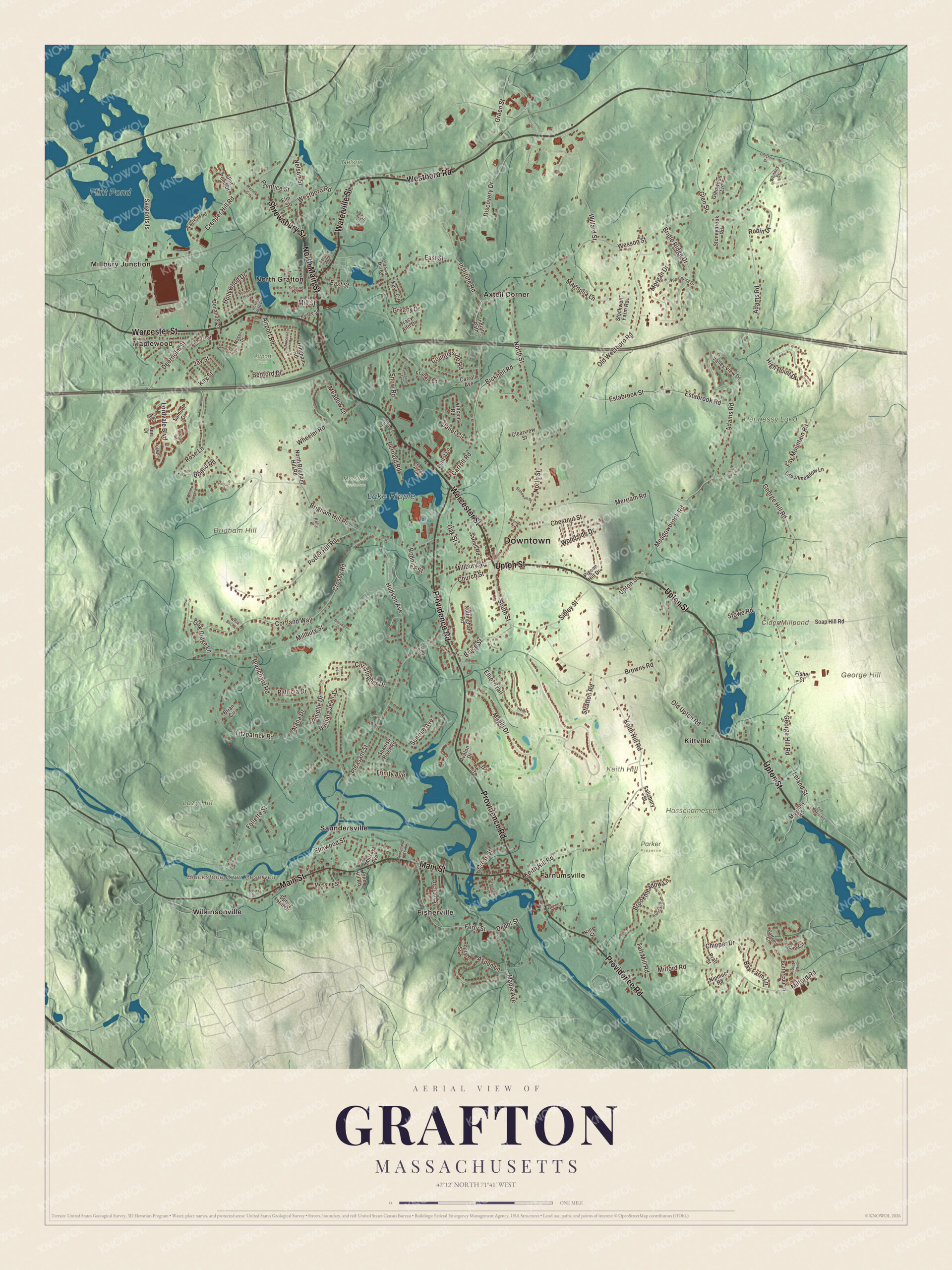
Grafton today
By KNOWOL
KNOWOL's 2026 map of Grafton prints Worcester Street, Upton Street, Providence Road and Waterville Street, with Lake Ripple, Flint Pond, the Blackstone River Reservoir and Brigham, George and Keith hills.6
The history of Grafton, Massachusetts
The place of small stones
Before it was Grafton, this was Hassanamesit, a Nipmuc town that John Eliot made one of his praying towns in 1647. Daniel Gookin wrote that the name meant a place of small stones, and an 1898 writer said the pebbles could still be picked up along the streams at Saundersville and Farnumsville. Gookin praised its rich meadows and orchards and said no Indian town its size was better stocked with cattle and swine. James Printer, a deacon's son from here, helped print Eliot's Indian Bible, and in 1698 he was teaching five families back home. In 1727 the Nipmuc owners sold 7,500 acres for 2,500 pounds, held in trust for them, and much of that money was later lost. That same year a Nipmuc woman, Sarah Robins, took possession of the land that is still the Hassanamisco Reservation.1789310
Before the sun went down
Grafton made up its mind early. In February 1773 the town meeting voted unanimously to defend its rights at all hazards, and in September 1774, more than six months before Lexington, it voted to buy a six-pounder cannon. About noon on April 19, 1775, word came that the British were marching on Concord. Men gathered on the Common, and before sunset two companies of nearly 100 men were on the road to Cambridge. The minister, Daniel Grosvenor, left his pulpit, took his musket and went with them. When war came again in April 1861, the Town Hall filled, and Benjamin Smith, a Revolutionary soldier of 98, sat on the platform. Grafton sent 399 men to the Civil War, out of about 4,000 people.1112131415
Linen, leather and valentines
Each Grafton village had its trade. In 1826 the New England Manufacturing Company built the stone Upper Mill in North Grafton, filled it with linen machinery for twine and bagging, and gave New England Village its name. Ethan Allen started there in 1832 making pocket cutlery, then pistols, and later said he began with $12 and often went hungry to save the price of a meal. In 1837 the town made 671,538 pairs of shoes, and in 1879 work on leather was still its leading trade. A building at the Depot had lately been used to make valentines. At Saundersville a former stage driver, Esek Saunders, ran the cotton mill, and 38,000 yards of sheeting from Pratt's mill, in red, white and blue, decorated the Coliseum at Boston's 1872 World's Peace Jubilee.1617418192021
Grafton, Massachusetts through the years
25 moments from 1647 to today.
- 1647John Eliot makes the Nipmuc town of Hassanamesit one of his praying towns.1
- 1661Cambridge schoolmaster Elijah Corlett is paid 320 acres in the Farms district for teaching a Hassanamisco boy.22
- 1675King Philip's War breaks up the praying town, and some of its people are held on Deer Island in Boston Harbor.7
- 1698Five Nipmuc families have come back, and James Printer, who helped print the Indian Bible, is their teacher.9
- 1727The Nipmuc owners sign a deed selling 7,500 acres for 2,500 pounds, kept in trust for them by the province.3
- 1728The common is laid out as the first English families settle around it.23
- 1735The town is incorporated, and Governor Belcher fills in the name Grafton.2
- 1774In September the town votes to buy a six-pounder cannon, more than six months before Lexington.11
- 1775On April 19 two companies of nearly 100 men leave the Common for Cambridge before sunset.12
- 1794Martha Willard, mother of the first English child born in town, dies in her 100th year.24
- 1802Simon Willard patents the banjo clock he developed on the family farm in Grafton.25
- 1805Samuel Wood builds the inn on the Common later known as the Hassanamisco House.26
- 1826The New England Manufacturing Company builds the Upper Mill and gives New England Village its name.16
- 1832Ethan Allen begins making pocket cutlery in New England Village, and soon pistols.17
- 1837Grafton turns out 671,538 pairs of shoes and 18,072 pairs of boots.4
- 1861At the Town Hall war meeting, Revolutionary soldier Benjamin Smith, age 98, sits on the platform.14
- 1862Fire destroys the Town Hall, the Unitarian Church and Warren Block, but the town safe survives intact.27
- 1866Joseph Leland gives $1,000 to start a free public library, and the town matches it.28
- 1870Burglars empty the safe of the First National Bank of Grafton on the night of October 25.29
- 1872Pratt's mill sheeting in red, white and blue decorates the Coliseum at Boston's World's Peace Jubilee.21
- 1874The narrow-gauge Grafton Centre Railroad opens on August 20, linking the Centre to the Boston and Albany station.30
- 1938The Tupperware company is founded in South Grafton.1
- 1955The Air Force installs a 50,000-ton forge in North Grafton, run by Wyman-Gordon.1
- 1976The state recognizes the Hassanamisco Nipmuc Band.10
- 2004190 acres of the Hassanamessit Woods, thought to hold the old praying village, are protected for good.6
Places to see in Grafton, Massachusetts
Places worth a visit in Grafton today.
- Grafton CommonGrafton Center. Laid out 1728, fenced in 1845.
- Grafton InnOn the Common. Built 1805, once the Hassanamisco House.
- Willard House and Clock MuseumWillard Street, North Grafton. The Willard brothers' clock-making farm.Visit their website
- Hassanamisco ReservationBrigham Hill Road. Nipmuc land since 1727.
- Washington MillsNorth Grafton. The 1826 Upper Mill, still making abrasives.
- FarnumsvilleSouth Grafton, on the Blackstone. Mill village with an 1844 mill.
- FishervilleWhere the Quinsigamond meets the Blackstone. Mill village begun in 1831.
- SaundersvilleOn the Blackstone, at the Sutton line. The Saunders brothers' mill village from 1835.
- George HillNear the Upton line. A famous Nipmuck seat overlooking Upton.
- Cummings School of Veterinary MedicineNorth Grafton. Tufts vet school on the old hospital grounds.Visit their website
Grafton on the National Register of Historic Places
All 9 places in Grafton on the National Register of Historic Places that still stand today, oldest first, and why each one matters.5
-
Willard House and Clock Museum
The Willard brothers, Benjamin, Simon, Ephraim and Aaron, made clocks on this family farm in the late 1700s before moving to Roxbury, and Simon developed his banjo clock, patented in 1802, while in Grafton. The museum holds more than 80 Willard clocks.25
-
Hassanamisco Reservation
The 3.5 acres at 80 Brigham Hill Road are owned and used by the Hassanamisco Nipmuc Band, recognized by the state in 1976. A Nipmuc woman, Sarah Robins, took possession of this land in 1727, and the reservation and the Cisco Homestead were listed together in 2011.10
-
Grafton Common Historic District
The oval common was laid out in 1728 and fenced with granite posts and wooden rails in 1845. Around it stand the 1863 Unitarian Church, the 1833 Congregational Church and the 1805 Grafton Inn. Most of its buildings date from the middle 1800s, since the railroads bypassed the center and later building slowed.23
-
Grafton Inn
Samuel Wood built the three-story inn of wood and brick in 1805, with a design influenced by Charles Bulfinch. It was doubled in size about 1865 to 1875, when the Italianate front porch was added, and it is still an inn and restaurant.31
-
Blackstone Canal Historic District
The 45-mile canal from Worcester to Providence opened in 1828, when the packet boat Lady Carrington reached Worcester, and closed in 1848 after the railroad took its trade. The 1995 listing covers its whole historic course in Massachusetts, including the stretch through Grafton.32
-
Fisherville Historic District
Industry began here in 1831 to 1832, when Peter Farnum and his partners built a brick mill, and a tight neighborhood of worker houses grew up around it. The mill complex reached its present form about 1909.33
-
Ethan Allen House and Gun Shop
Armsmaker Ethan Allen, inventor of the pepper-box revolver, built the gun shop in 1833 and his Greek Revival house in 1834 to 1836, damming the brook beside the shop for water power. It is one of the only early 19th-century gun shops left in the state.34
-
George Clapp House
Builder George Clapp put up this house about 1835. It is the town's only high-style Greek Revival house, with fluted Doric columns across the front and a colonnade down one side, and his family lived here until 1845.35
-
Farnumsville Historic District
This mill village on the east bank of the Blackstone grew up around the Farnum Mill, and its surviving main mill dates to 1844. Its houses were built between the 1820s and the 1920s, and the village had its own post office from 1831 to 1960.36
Grafton in their words
“Chestnut Hill near the Centre, George Hill on the Upton line, Keith Hill at the south, and Brigham Hill at the west, are all beautiful eminences”
A gazetteer of the state of Massachusetts, 187437
“Grafton, though not a large tract of land, has an exceedingly rich and good soil, and the inhabitants have become wealthy by tilling it.”
History of Grafton, 187938
“In behalf of the hundreds of Grafton's sons, whose homes are no longer on your grand and beautiful hills, nor in your deep and fertile valleys, I say, in all honesty, and with the deepest fervor, we are proud of your record during the war.”
Rev. E. Frank Howe, Grafton's centennial oration, July 4, 187639
Towns near Grafton, Massachusetts
Sources for the history of Grafton
- Grafton, Massachusetts, Wikipedia
- History of Grafton (1879), on the naming of the town, Internet Archive
- History of Grafton (1879), on the 1727 deed and the money held in trust for the Hassanamisco owners, Internet Archive
- History of Grafton (1879), on the town's manufactures in 1837, Internet Archive
- National Register of Historic Places list, Wikipedia
- Map of Grafton, Massachusetts in 2026, KNOWOL
- History of Grafton, Worcester County, Massachusetts (1879) by Frederick C. Pierce, on Gookin's account of Hassanamesit and King Philip's War, Internet Archive
- The Nipmuck Indians (1898), on the meaning of Hassanamisco, Internet Archive
- History of Grafton (1879), on James Printer and the Indian Bible, Internet Archive
- Hassanamisco Reservation, Wikipedia
- Grafton: historical oration delivered by Rev. E. Frank Howe at the centennial celebration, July 4, 1876, on the town before the Revolution, Internet Archive
- History of Grafton (1879), on April 19, 1775, Internet Archive
- History of Grafton (1879), on Rev. Daniel Grosvenor, Internet Archive
- History of Grafton (1879), on the war meeting of April 1861, Internet Archive
- Grafton: historical oration by Rev. E. Frank Howe (1876), on Grafton in the Civil War, Internet Archive
- History of Grafton (1879), on business in New England Village, Internet Archive
- History of Grafton (1879), on Ethan Allen, Internet Archive
- History of Grafton (1879), on the currying business, Internet Archive
- History of Grafton (1879), on the shoe factory at the Depot, Internet Archive
- History of Grafton (1879), on Saundersville and Esek Saunders, Internet Archive
- History of Grafton (1879), on Pratt's mill at Centreville, Internet Archive
- Proceedings of the Worcester Society of Antiquity (1877), on Elijah Corlett's land in Grafton, Internet Archive
- Grafton Common Historic District, Wikipedia
- History of Grafton (1879), on Martha Willard, Internet Archive
- Willard House and Clock Museum, Wikipedia
- History of Grafton (1879), on the Hassanamisco House, Internet Archive
- History of Grafton (1879), on the fire of September 11, 1862, Internet Archive
- History of Grafton (1879), on the Free Public Library, Internet Archive
- History of Grafton (1879), on the Grafton bank robbery, Internet Archive
- History of Worcester County, Massachusetts (1879), Grafton chapter, on the Grafton Centre Railroad, Internet Archive
- Grafton Inn, Wikipedia
- Blackstone Canal Historic District, Wikipedia
- Fisherville Historic District, Wikipedia
- Ethan Allen House and Gun Shop, Wikipedia
- George Clapp House, Wikipedia
- Farnumsville Historic District, Wikipedia
- A gazetteer of the state of Massachusetts (1874), Grafton entry, Internet Archive
- History of Grafton (1879), on Grafton's soil, Internet Archive
- Grafton: historical oration by Rev. E. Frank Howe (1876), to Grafton's absent sons, Internet Archive