
A mill city where the two branches of the Hoosic meet between Mount Greylock and the Hoosac Range, grown from a frontier fort and a pine flat once called Slab City into the home of the Hoosac Tunnel and MASS MoCA.
North Adams then and now
The same town 145 years apart. Click either map to look closer.
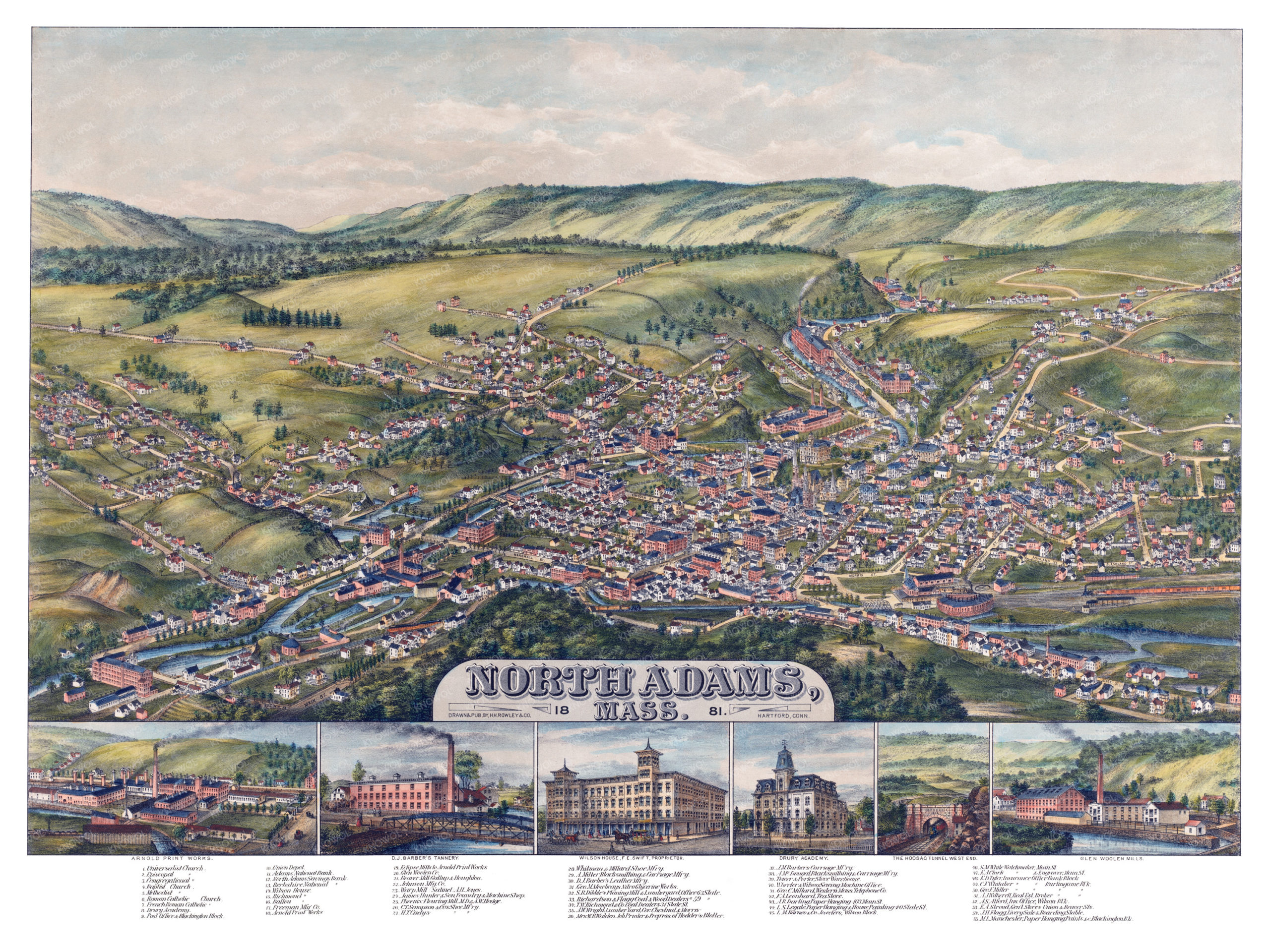
North Adams in 1881
By H.H. Rowley
North Adams drawn as if from the sky in 1881, with Barber's Carriage Manufactory, Wheeler & Wilson Sewing Machines, Stroud's General Store, Mowbray's Nitroglycerin Works, the Phoenix Flouring Mill, the Adams National Bank, Drury Academy and the village churches.4
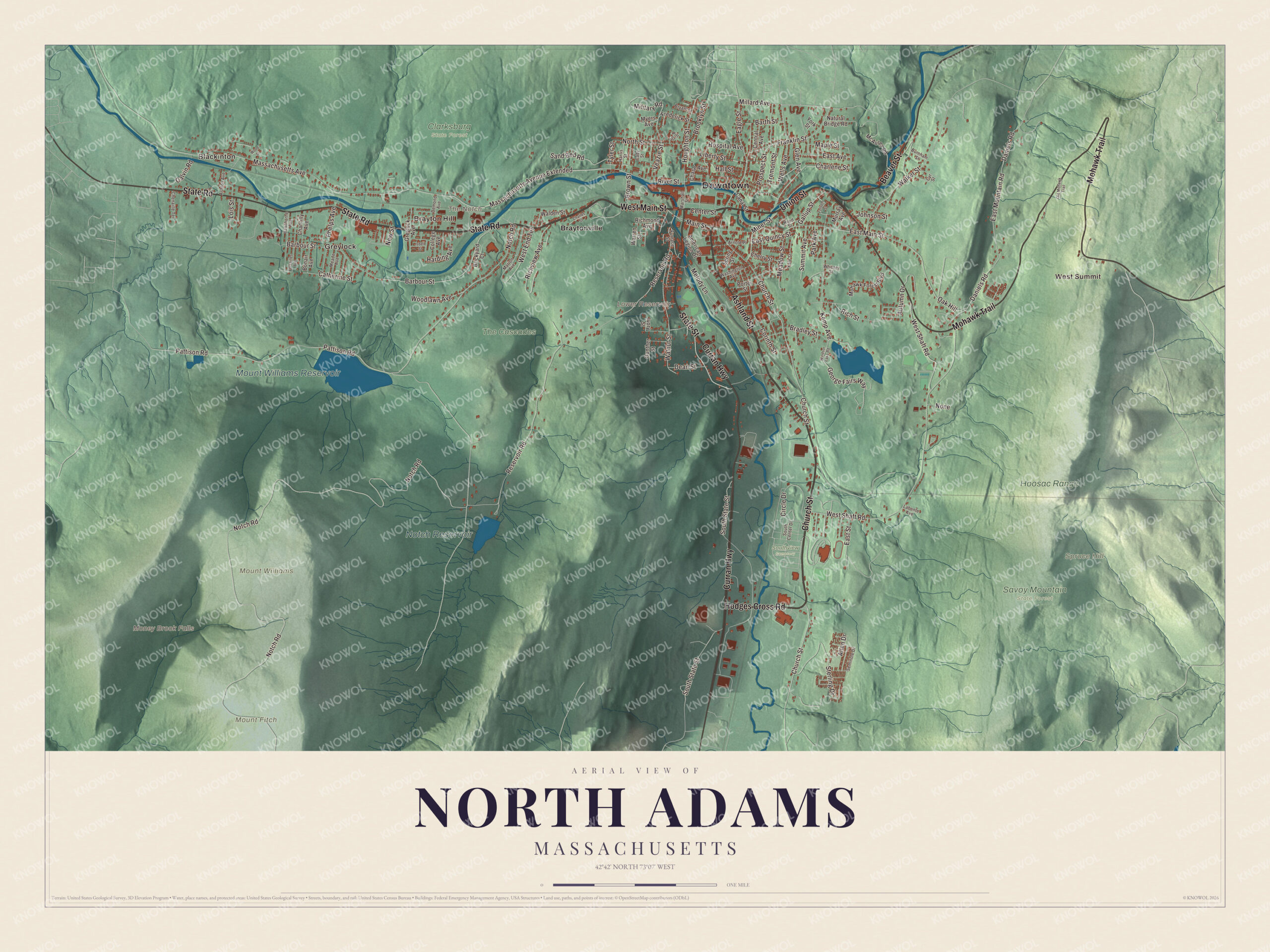
North Adams today
By KNOWOL
The Hoosic valley between the Hoosac Range and Mount Williams, with West Main, Church, Union and Ashland Streets, State Road, The Notch, Spruce Hill, Brayton Hill and the Mount Williams, Notch and Lower Reservoirs.5
The history of North Adams, Massachusetts
Slab City on the flat
Before it was a mill city, the village at the forks of the Hoosic was a pine flat the first farmers passed by. They settled on the mountain slopes and said the flat would hardly bear white beans. The pines were another matter, and the village's fences and early buildings were knocked together from slabs, which earned it the name Slab City. The town's 1885 history counts fewer than a dozen houses here in 1794, among them Giles Barnes's low house on Marshall Street, believed to be the first in North Adams. David Darling opened the first hotel in 1795. The river ran the mills and sometimes ran over them. The April freshet of 1785 carried off Oliver Parker's saw and grist mills, and Barnes said Noah's flood was the only one that ever equalled it.6
Through the mountain
North Adams was the headquarters for building the Hoosac Tunnel, a railroad bore of 4.75 miles through the Hoosac Range to the town of Florida. Work began in 1851 and dragged on for years. In 1867 George M. Mowbray came to North Adams at the commissioners' request and finished a factory near the west shaft to make nitroglycerine, and more than half a million pounds of it went into the rock. At seven minutes past three on the afternoon of November 27, 1873, the last blast between the headings was fired, and the first train went through on February 9, 1875. The town's 1885 history put the cost at $14,000,000 and 195 lives, while an 1878 history of the tunnel counted 136 lives lost.278
The shoemakers from San Francisco
In 1870 Calvin T. Sampson made women's shoes in a brick factory on Marshall Street and was locked in a fight with the shoemakers' union, the Knights of St. Crispin. When men he hired from North Brookfield were talked into quitting, he sent his superintendent to San Francisco. Seventy-five Chinese workers arrived in North Adams on June 13, 1870, to a large crowd, guarded by thirty policemen in plain clothes. Their number soon passed a hundred, and they worked in the bottoming room for about ten years, and most took home considerable savings. The case broke the Crispins, and on a national scale it became known as a trigger for the Chinese Exclusion Act of 1882. Sampson's factory is part of the MASS MoCA complex today.9101
North Adams, Massachusetts through the years
24 moments from 1745 to today.
- 1745Fort Massachusetts, the westernmost of a line of frontier forts, goes up on the bank of the Hoosic.1
- 1746French and Native forces besiege the fort, and John Hawks, with only 22 men fit to fight, holds out 28 hours before surrendering.11
- 1785The April freshet remembered as Parker's flood carries off Oliver Parker's saw and grist mills.6
- 1795David Darling opens the village's first hotel, later part of the Old Black Tavern at Main and State Streets.6
- 1811Twenty investors build the Old Brick Factory, a cotton mill on Marshall Street, with machinery from Giles Tinker's new shop.12
- 1821Sanford Blackinton and two partners build the little mill called The Boys' Factory, the start of Blackinton village.13
- 1827The first newspaper, the Berkshire American, arrives from Pittsfield, press, type and editor all in one large sleigh.14
- 1838Nathaniel Hawthorne spends time in North Adams and walks to the Natural Bridge.1
- 1843John R. Briggs starts the Adams Transcript, later the North Adams Transcript, on September 7.15
- 1846The last rail of the Pittsfield and North Adams Railroad is laid on October 16.8
- 1851Work begins on the Hoosac Tunnel.2
- 1860Oliver Arnold and Company starts printing cloth downtown, the beginning of the Arnold Print Works.1
- 1862The iron furnace that supplied iron for the ironclad Monitor burns to the ground and is never rebuilt.12
- 1867George M. Mowbray finishes a factory near the tunnel's west shaft to make nitroglycerine for blasting.7
- 1870Seventy-five Chinese workers hired in San Francisco arrive on June 13 to work in Calvin T. Sampson's shoe factory.9
- 1873The final blast between the headings of the Hoosac Tunnel is fired on November 27.7
- 1875The first train passes through the Hoosac Tunnel on February 9.7
- 1878On April 16 the old town of Adams is divided and the northern half becomes North Adams.16
- 1882An accident in the freight yard kills or badly hurts 35 tunnel workmen, and townspeople start a fund for a hospital that same day.8
- 1889The first electric streetcar runs on October 5.14
- 1895North Adams becomes a city.1
- 1942Sprague Electric buys the old Arnold Print Works on Marshall Street.1
- 1985Sprague closes its Marshall Street operations.1
- 1999The Massachusetts Museum of Contemporary Art opens in the old mill complex.17
Places to see in North Adams, Massachusetts
Places worth a visit in North Adams today.
- MASS MoCAMarshall Street. Contemporary art in the old print works.Visit their website
- Natural Bridge State ParkNorth of downtown. A white marble arch over Hudson Brook.Visit their website
- BlackintonWest end, on the Hoosic. The city's best preserved mill village.
- GreylockWest end. Mill village begun in 1846.
- BraytonvilleWest of downtown. Mill village begun in 1832.
- Fort MassachusettsWest end, toward Williamstown. Site of the 1745 frontier fort.
- Hoosac TunnelEast side of the city. West portal of the 1875 railroad tunnel.
- West SummitHoosac Range. A view into three states.
- Mount WilliamsSouthwest corner. The city's high point, 2,951 feet.
- Mount Greylock State ReservationSouthwest of the city. Trails toward the state's highest peak.Visit their website
North Adams on the National Register of Historic Places
All 24 places in North Adams on the National Register of Historic Places that still stand today, oldest first, and why each one matters.3
-
Hillside Cemetery
Located on the western fringe of the city, the earliest portions of the cemetery date to 1798; it is the community's oldest public burying ground. The cemetery is divided by Route 2, with the older section to the north and the younger section (laid out in 1858) to the south.18
-
Blackinton Historic District
North Adams' best preserved mill village, grown around the woolen mill Sanford Blackinton and his partners founded in 1821. It keeps the brick mill buildings, the 1839 company store, two churches and Sanford Blackinton's Greek Revival house of about 1850.19
-
William B. Sherman Farm
Built in the 1820s, it is one of the city's few surviving 19th-century houses, with relatively few alterations since its elaborate Italianate porch in the 1870s. It was listed on the National Register of Historic Places in 1985.20
-
Windsor Print Works
Caleb Turner founded it in 1829 as the first print works in western Massachusetts. Its twelve brick buildings date from 1872 to 1889 and now hold galleries, arts businesses and light industry.21
-
Crowley House
It is one of a small number of houses in North Adams built in a transitional Federalist-Greek Revival style, and one of its relatively small number of early 19th-century houses. The house was listed on the National Register of Historic Places in 1985.22
-
Beaver Mill
With a construction history dating to 1833, it is the oldest surviving mill building in the city, and was the first local acquisition of Sprague Electric, a major local employer in the 20th century. The mill was listed on the National Register of Historic Places in 1973.23
-
Wells House
Built about 1840, it is a locally rare surviving example of a Greek Revival farmhouse. It was added to the National Register of Historic Places in 1985.24
-
Eber Sherman Farm
Built about 1843, it is a well-preserved example of a local variant of transitional Greek Revival and Italianate architecture. It was listed on the National Register of Historic Places in 1983.25
-
Church Street-Cady Hill Historic District
The principal residential neighborhood near downtown. Church Street, laid out about 1780, is one of the city's oldest roads, lined with Italianate and Second Empire houses built from the 1850s on, with Stick and Queen Anne houses on the streets to the east.26
-
Hathaway Tenement
A row of six apartment units, it was built in about 1850, and is a rare surviving example of worker housing dating to the early period of North Adams' industrial development. It was added to the National Register of Historic Places in 1985.27
-
Hoosac Tunnel
The 4.75-mile railroad tunnel through the Hoosac Range runs in a straight line from its west portal in North Adams to its east portal in Florida. Begun in 1851 and finished in 1875, it was then the second-longest tunnel in the world, and trains still use it.2
-
Freight Yard Historic District
The rail yard that was the eastern end of the line from Troy, serving as North Adams' freight and passenger depot from 1859 until the Hoosac Tunnel opened in 1875. Its restored buildings later held Western Gateway Heritage State Park, which told the story of the tunnel.28
-
Norad Mill
Sanford Blackinton and Daniel Dewey built this woolen mill in Braytonville in 1863 to meet Civil War demand. It is the oldest mill complex in North Adams whose outside hasn't been much changed, so its Italianate style still shows.29
-
Charles Browne House
Built in 1869, it was the home of Charles A. Browne Sr., inventor of the electrical fuse and an innovator of devices and materials used in construction of the nearby Hoosac Tunnel. The house is a well-preserved example of a local variant of Italianate architecture, and was listed on the National Register of Historic Places in 1985.30
-
Arnold Print Works
The Arnold Print Works built this mill complex between 1870 and 1900 on the point of land between the two branches of the Hoosic, and printed cloth here until 1942. Sprague Electric used it next, and since 1999 it has been MASS MoCA, one of the largest centers for contemporary art in the country.17
-
Monument Square, Eagle Street Historic District
The civic heart of the city, around the Civil War monument where Main and Church Streets meet, with the public library in the old Blackinton mansion, the First Baptist and First Congregational churches and the post office. Most of the business district went up between about 1870 and 1920.31
-
Armstrong House
Built about 1875, it is a well-preserved example of a locally idiosyncratic Italianate style. It was listed on the National Register of Historic Places on October 25, 1985.32
-
H. W. Clark Biscuit Company
Herbert W. Clark's bakery, rebuilt here after his Liberty Street plant burned in 1913. Its 1922 Baking Building was the first reinforced concrete building in the city, and after years empty the complex became housing.33
-
Freeman's Grove Historic District
A well-preserved working neighborhood north of downtown, named for the Freeman Manufacturing Company, where workers' houses stand near larger Victorian homes. Most of it was built between 1887 and 1894.34
-
Sykes House
It was built in 1890, and is a prominent local example of Queen Anne architecture. It was listed on the National Register of Historic Places in 1985.35
-
Johnson School
A Romanesque Revival school designed by the prominent local architect Edwin Thayer Barlow, enlarged in 1924. It was one of the last of the city's neighborhood schools to close.36
-
Normal School Historic District
Ten buildings along Church Street, among them Murdock Hall of 1896, the first main building of the normal school that is now the Massachusetts College of Liberal Arts, and Victorian houses built as the school arrived.37
-
The Boardman
Nine rowhouses filling a whole block of Montana Street, built by Walter Penniman to designs by Edwin Thayer Barlow for the people drawn by the new normal school across the street. It was one of the most elaborate multiunit buildings in the city.38
-
St. Joseph's School
A brick Classical Revival school of three and a half stories, built in 1928 and 1929 to add room to the parish school. It reached a peak of more than 1,200 students in 1958 and is now housing for older residents.39
North Adams in their words
“Right at our feet and fifteen hundred feet below us lies the village of North Adams, packed in among its ravines and climbing the slopes on every side”
From the Hub to the Hudson, 1869, looking down from Prospect Rock40
“Like a heart that has been rent asunder by a torrent of passion which has raged and left ineffaceable traces, though now there is but a rill of feeling at the bottom.”
Nathaniel Hawthorne on the Natural Bridge, quoted in Literary shrines, 189541
“There is no road leading out of North Adams from which you may not gain, without traveling far, prospects which, to use the Frenchman's climax, are either magnificent, sublime, or pretty good.”
From the Hub to the Hudson, 186942
Towns near North Adams, Massachusetts
Sources for the history of North Adams
- North Adams, Massachusetts, Wikipedia
- Hoosac Tunnel, Wikipedia
- National Register of Historic Places listings in Berkshire County, Massachusetts, Wikipedia
- Bird's Eye View of North Adams, Massachusetts in 1881, restored by KNOWOL
- Map of North Adams, Massachusetts in 2026, KNOWOL
- History of North Adams, Mass., 1749-1885 (1885), on the north village, Internet Archive
- History of the Hoosac Tunnel (1878), by E. S. Martin, Internet Archive
- History of North Adams, Mass., 1749-1885 (1885), on the Hoosac Tunnel and the hospital, Internet Archive
- History of North Adams, Mass., 1749-1885 (1885), on the Sampson Manufacturing Company, Internet Archive
- History of Berkshire County, Massachusetts (1885), on Calvin T. Sampson's shoe factory, Internet Archive
- History of North Adams, Mass., 1749-1885 (1885), on Fort Massachusetts, Internet Archive
- History of North Adams, Mass., 1749-1885 (1885), on early mills and works, Internet Archive
- Historic homes and institutions and genealogical and personal memoirs of Berkshire County, Massachusetts (1906), on Sanford Blackinton, Internet Archive
- Western Massachusetts: a history, 1636-1925 (1926), on the city of North Adams, Internet Archive
- History of North Adams, Mass., 1749-1885 (1885), on newspapers, Internet Archive
- History of North Adams, Mass., 1749-1885 (1885), on the division of the town, Internet Archive
- Massachusetts Museum of Contemporary Art (Arnold Print Works), Wikipedia
- Hillside Cemetery, Wikipedia
- Blackinton Historic District, Wikipedia
- William B. Sherman Farm, Wikipedia
- Windsor Print Works, Wikipedia
- Crowley House, Wikipedia
- Beaver Mill, Wikipedia
- Wells House, Wikipedia
- Eber Sherman Farm, Wikipedia
- Church Street-Cady Hill Historic District, Wikipedia
- Hathaway Tenement, Wikipedia
- Freight Yard Historic District, Wikipedia
- Norad Mill, Wikipedia
- Charles Browne House, Wikipedia
- Monument Square, Eagle Street Historic District, Wikipedia
- Armstrong House, Wikipedia
- H. W. Clark Biscuit Company, Wikipedia
- Freeman's Grove Historic District, Wikipedia
- Sykes House, Wikipedia
- Johnson School, Wikipedia
- Normal School Historic District, Wikipedia
- The Boardman, Wikipedia
- St. Joseph's School, Wikipedia
- From the Hub to the Hudson: with sketches of nature, history and industry in north-western Massachusetts (1869), on the view from Prospect Rock, Internet Archive
- Literary shrines: the haunts of some famous American authors (1895), on Hawthorne in North Adams, Internet Archive
- From the Hub to the Hudson: with sketches of nature, history and industry in north-western Massachusetts (1869), on drives around North Adams, Internet Archive